
How kaitenzushi works, from the door to the register
Kaitenzushi (回転寿司) means rotating sushi: kaiten is rotation, and sushi becomes zushi in the compound. Small plates travel past every seat on a belt, and the bill is the number of plates you finish. The big chains have added a touch panel at each seat, so most people now order what they want and have it delivered straight to them.
That gives every visit the same stages: check in, order, stack your plates, ask for the bill. These are the words printed on signs and screens along the way.
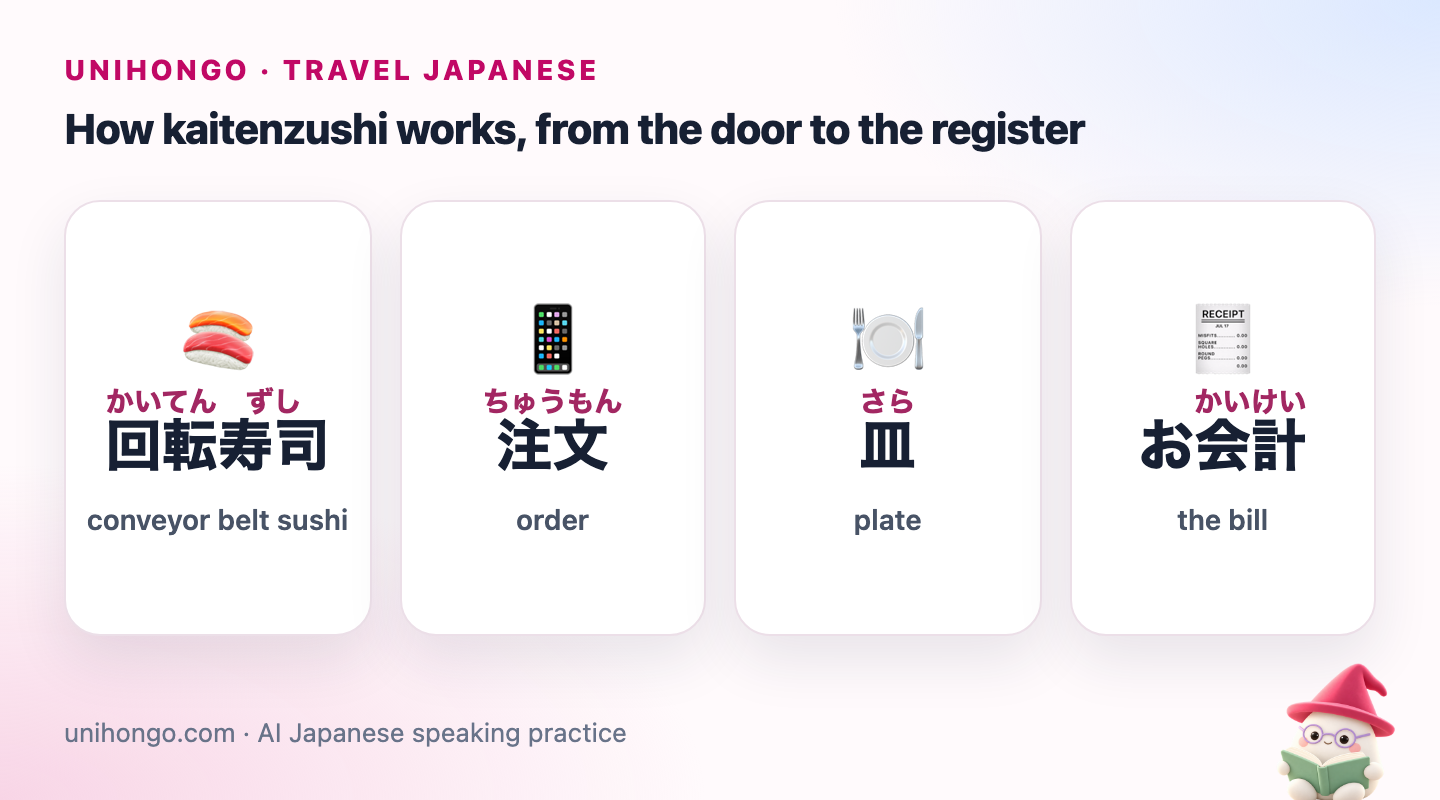
| Japanese | Romaji | Meaning |
|---|---|---|
| 回転寿司 | kaitenzushi | conveyor belt sushi |
| 注文 | chūmon | order |
| 皿 | sara | plate |
| お会計 | o-kaikei | the bill |
| 受付 | uketsuke | reception, check-in |
| レーン | rēn | the belt, the lane |
At the door: a number ticket and two questions
At a busy shop nobody greets you with a menu. Near the entrance stands a reception machine, the uketsuke. You enter the number of adults and children, choose a seat type, and it prints a number ticket, bangōfuda (番号札). The seat buttons are kauntā (カウンター), a row of single seats along the belt, tēburu (テーブル), a booth for a group, and dochira demo (どちらでも), either, which usually gets you seated fastest.
At smaller shops a staff member asks the same two things aloud. The exchange runs in this order.
| Japanese | Romaji | Meaning |
|---|---|---|
| 何名様ですか。 | Nanmei-sama desu ka. | How many people? |
| 二人です。 | Futari desu. | Two people. |
| カウンターとテーブル、どちらがよろしいですか。 | Kauntā to tēburu, dochira ga yoroshii desu ka. | Counter or table, which would you like? |
| テーブルでお願いします。 | Tēburu de onegai shimasu. | A table, please. |
| どちらでもいいです。 | Dochira demo ii desu. | Either is fine. |
| 十五番でお待ちのお客様。 | Jūgo-ban de o-machi no o-kyaku-sama. | The customer waiting with number 15. |
When your number appears on the screen or is called, show the ticket. Staff lead you to the seat or hand you a slip with the seat number.
The touch panel: the words on the screen
The panel is a tatchi paneru (タッチパネル), and the one button that matters is chūmon, order. Choose a picture, set the number of plates, and nothing happens until you press the confirm button, usually chūmon suru. Many panels have a language button, but not every message on the screen is translated.
| Japanese | Romaji | Meaning |
|---|---|---|
| タッチパネル | tatchi paneru | touch panel |
| 注文する | chūmon suru | place the order |
| 注文履歴 | chūmon rireki | order history |
| にぎり | nigiri | hand-pressed sushi |
| 軍艦 | gunkan | sushi wrapped in a band of seaweed |
| サイドメニュー | saido menyū | side dishes |
| 店員呼び出し | ten'in yobidashi | call a staff member |
| 会計 | kaikei | bill, checkout |
Ordered plates usually arrive on a separate fast lane and stop at your seat, and the panel chimes to tell you. Take only what stops for you. Some shops still let sushi circle on the main belt for anyone to take; others now make everything to order.
Reading the toppings
Sushi menus write most fish in hiragana or katakana, so you can read them from your first week of study. These are the plates on nearly every belt.
| Japanese | Romaji | Meaning |
|---|---|---|
| まぐろ | maguro | tuna |
| サーモン | sāmon | salmon |
| えび | ebi | shrimp |
| いか | ika | squid |
| たまご | tamago | sweet rolled omelette |
| いくら | ikura | salmon roe |
| ねぎとろ | negitoro | minced tuna with green onion |
Gunkan (軍艦), literally battleship, is rice wrapped in a strip of seaweed with a soft topping such as ikura or negitoro spooned on top. A standard plate carries two pieces, counted nikan (二貫); richer toppings often come as one piece, ikkan (一貫), on the same kind of plate.
Plates, colours and how the bill is built
A plate is a sara (皿), said o-sara to be polite, and plates are counted hitosara, futasara, misara. Pricing follows one of two systems. In the first, the colour or pattern of the plate sets the price, and a chart on the wall or the menu shows which colour costs what. In the second, nearly every plate has the same price and only a few special items differ.
Either way, keep your empty plates stacked at your seat, because the stack is your bill. Some chains have a slot at the table that counts finished plates instead.
Wasabi, ginger and the tea you make yourself
Three things on the table confuse first-time visitors. The first is wasabi. At many chains, sushi now comes without it, and you add your own from small packets or a pot. Sushi made without wasabi is sabi-nuki (さび抜き): sabi is short for wasabi and nuki means left out. Where the kitchen puts wasabi inside by default, the panel offers a sabi-nuki button, or you ask aloud.
The second is gari (ガリ), thin slices of pickled ginger in a box on the table. Eat a little between plates to clear your mouth. The third is tea. There is no teapot: put a spoonful of green powder, konacha (粉茶), into a cup, then press the cup against the button under the hot-water tap at your seat. The water is close to boiling, so push with the cup, never with your hand.
| Japanese | Romaji | Meaning |
|---|---|---|
| さび抜き | sabi-nuki | without wasabi |
| わさび抜きでお願いします。 | Wasabi-nuki de onegai shimasu. | Without wasabi, please. |
| わさびはありますか。 | Wasabi wa arimasu ka. | Do you have wasabi? |
| ガリ | gari | pickled ginger |
| 粉茶 | konacha | powdered green tea |
| 湯のみ | yunomi | tea cup |
You may hear tea called agari (あがり) in a sushi shop. It began as jargon used by staff, like oaiso for the bill, and it sounds odd from a customer. O-cha (お茶) is always right.
Calling staff and paying
When you are finished, press the kaikei button on the panel, or catch a staff member's eye and say the first line below. Someone counts the stacked plates and gives you a slip or a card. You take that to the register, the reji (レジ), near the door.
| Japanese | Romaji | Meaning |
|---|---|---|
| すみません、お会計お願いします。 | Sumimasen, o-kaikei onegai shimasu. | Excuse me, the bill, please. |
| お皿を確認いたします。 | O-sara o kakunin itashimasu. | I will check your plates. |
| こちらをレジまでお持ちください。 | Kochira o reji made o-mochi kudasai. | Please take this to the register. |
| カードは使えますか。 | Kādo wa tsukaemasu ka. | Can I use a card? |
| ごちそうさまでした。 | Gochisōsama deshita. | Thank you for the meal. |
Four small mistakes to avoid
- Putting a plate back on the belt after touching it. Once lifted, it is yours.
- Taking a plate from the fast lane that someone else ordered.
- Using the hot-water tap to rinse your fingers. It is for tea, and it is hot enough to burn.
- Saying agari or oaiso to sound like a regular. Polite customers say o-cha and o-kaikei.