
What makes a bento an ekiben
A convenience store bento is the same in every city. An ekiben is the opposite: it belongs to one station or one region and shows off what that place is known for, whether crab, beef, trout or mountain vegetables. Some have been sold for generations with a recipe and a wrapper design that barely change.
Ekiben are made to be eaten at room temperature, hours after cooking. The rice is seasoned or cooked firm, the dishes are simmered, grilled or pickled, and the container itself can be the attraction: thin wood, bamboo, even a ceramic pot.
Where to buy one
The simplest place is an ekiben shop, ekiben-ya (駅弁屋), inside a large station, usually near the shinkansen gates. Big terminals stock boxes from many regions. Smaller stations sell their own from a kiosk, baiten (売店), on the concourse or the platform, hōmu (ホーム). Popular boxes can sell out by the afternoon.
Do not count on buying on board. Shanai hanbai (車内販売), sales from a trolley on the train, now runs on some trains only and has been cut back on many lines, so buy before you board.
| Japanese | Romaji | Meaning |
|---|---|---|
| 駅弁屋 | ekiben-ya | ekiben shop |
| 売店 | baiten | kiosk |
| 車内販売 | shanai hanbai | on-board sales |
| 駅弁はどこで買えますか。 | Ekiben wa doko de kaemasu ka. | Where can I buy an ekiben? |
| 車内販売はありますか。 | Shanai hanbai wa arimasu ka. | Are there on-board sales? |
Reading the label
The printed paper wrapper carries a few words that help you choose. Meibutsu (名物) marks a famous local product. Gentei (限定) means limited: kikan gentei is for a limited period, and sūryō gentei means only a limited number are made. On the back or the side is a sticker with the practical information.
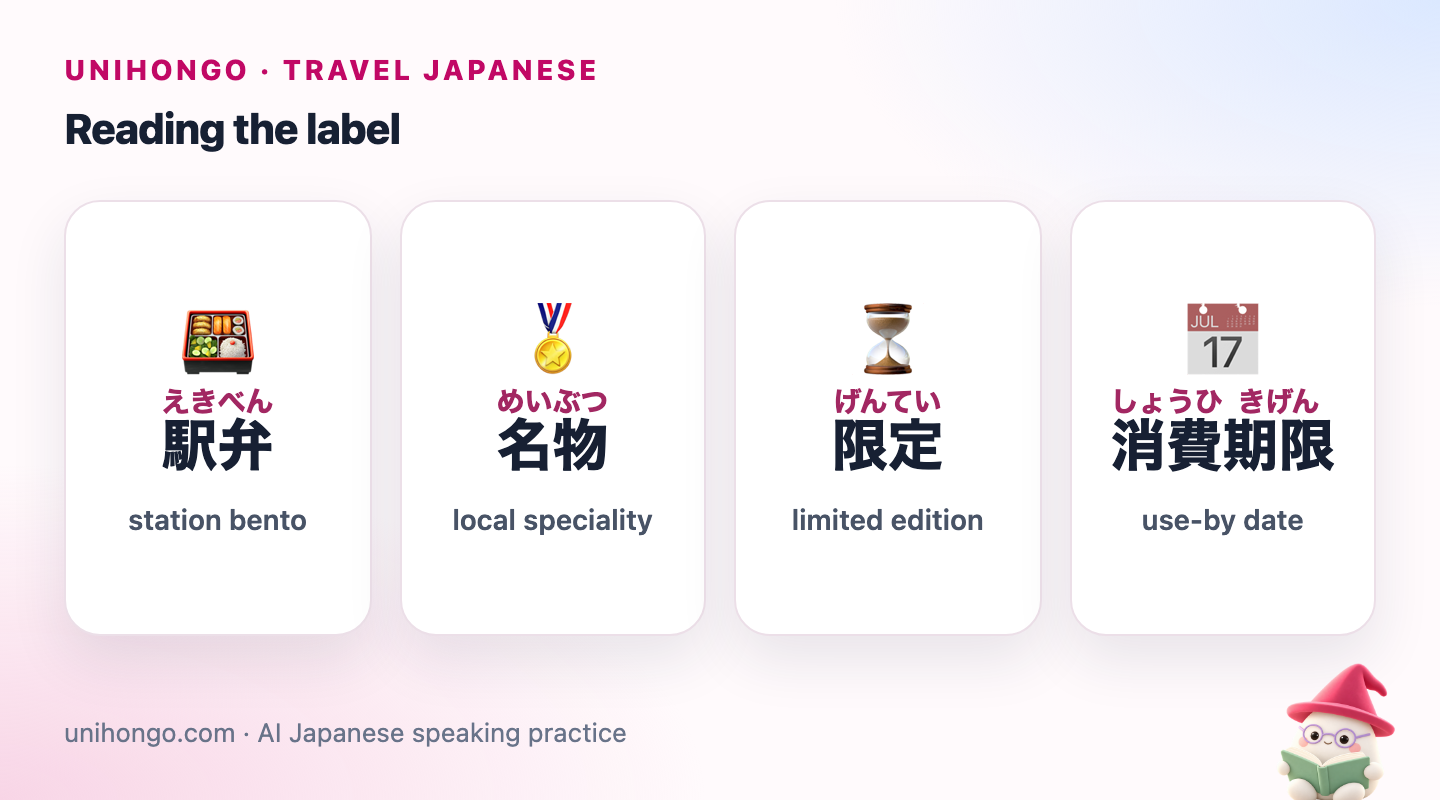
| Japanese | Romaji | Meaning |
|---|---|---|
| 駅弁 | ekiben | station bento |
| 名物 | meibutsu | local speciality |
| 限定 | gentei | limited edition |
| 消費期限 | shōhi kigen | use-by date |
| 原材料 | genzairyō | ingredients |
| 期間限定 | kikan gentei | for a limited time |
| えびは入っていますか。 | Ebi wa haitte imasu ka. | Does it contain shrimp? |
Shōhi kigen (消費期限) is the use-by date, and on an ekiben it includes a time of day, because the box is meant to be eaten within hours. Genzairyō (原材料) is the ingredient list, where allergens are named. If you cannot read it, ask the clerk directly, replacing ebi with the food you need to avoid.
Four ekiben that travellers know by name
Ask a Japanese traveller to name an ekiben and these come up quickly: Tōge no Kamameshi (峠の釜めし), Masu no Sushi (ますのすし), Ikameshi (いかめし) and gyūtan bentō (牛たん弁当).
| Romaji | Home | What is inside |
|---|---|---|
| Tōge no Kamameshi | Yokokawa, Gunma | Seasoned rice topped with chicken, mushrooms, chestnut and more, sold in a ceramic pot |
| Masu no Sushi | Toyama | Pressed trout sushi wrapped in bamboo leaves in a round box, cut into wedges like a cake |
| Ikameshi | Mori, Hokkaido | Small squid stuffed with rice and simmered in a sweet soy sauce |
| gyūtan bentō | Sendai | Grilled beef tongue over rice; some boxes have a pull-string heater |
The gyūtan box is the famous exception to the eaten-cold rule. Some versions sit on a heating unit: you pull a string on the side, steam rises for several minutes, and the rice and beef come out hot. Follow the diagram printed on the box and keep it flat on the tray while it works.
Buying: the exchange at the counter
Ekiben counters move fast before a departure, so have your line ready. Point at the box or the display sample and say the first line. Tea is the traditional partner and is sold in bottles beside the till.
| Japanese | Romaji | Meaning |
|---|---|---|
| これを一つください。 | Kore o hitotsu kudasai. | One of these, please. |
| お茶もお願いします。 | O-cha mo onegai shimasu. | And a tea, please. |
| お箸はお付けしますか。 | O-hashi wa o-tsuke shimasu ka. | Shall I include chopsticks? |
| はい、お願いします。 | Hai, onegai shimasu. | Yes, please. |
| 温めはできますか。 | Atatame wa dekimasu ka. | Can it be heated? |
| 申し訳ありません、温めはできません。 | Mōshiwake arimasen, atatame wa dekimasen. | I am sorry, we cannot heat it. |
The heating question usually gets a polite no. Unlike a convenience store, an ekiben shop generally does not microwave the box, because the food is designed to taste right as it is.
When your first choice is gone
Famous boxes sell out, and a small sign reading urikire (売り切れ) goes up over the sample. Three short questions keep the conversation going.
| Japanese | Romaji | Meaning |
|---|---|---|
| これはまだありますか。 | Kore wa mada arimasu ka. | Do you still have this one? |
| 申し訳ありません、売り切れです。 | Mōshiwake arimasen, urikire desu. | I am sorry, it is sold out. |
| おすすめはどれですか。 | Osusume wa dore desu ka. | Which do you recommend? |
| この駅の名物はどれですか。 | Kono eki no meibutsu wa dore desu ka. | Which is this station's speciality? |
Eating on the train: where it is fine and where it is not
On the shinkansen and on limited express trains, eating is part of the journey. The seats face forward, each has a fold-down tray, and nobody will look twice at a bento. On ordinary commuter trains, where passengers sit on long benches facing each other or stand, eating a meal is considered bad manners. The practical test is the seat: if it has a tray table, you may eat.
- Open the box once people around you have settled, not while they are still finding seats.
- Strong smells travel. In a crowded car, think about your neighbours before opening a pungent box.
- Keep the string, wrapper and lid together, and close the empty box again.
- Take your rubbish to the bins by the doors between cars or on the platform. Do not leave it in the seat pocket.