

Why Konpira-san is worth the 785 steps
Kotohira-gū is the head shrine of Konpira worship, and its deities, Ōmononushi and Emperor Sutoku, have long been prayed to for safety at sea, farming, medicine and prosperity. Sailors, fishermen and shipping companies still come to pray, and the shrine's ema hall is full of pictures and models of ships offered over the centuries. In the Edo period a pilgrimage to Konpira-san was one of the great journeys of a commoner's life, alongside the pilgrimage to Ise.
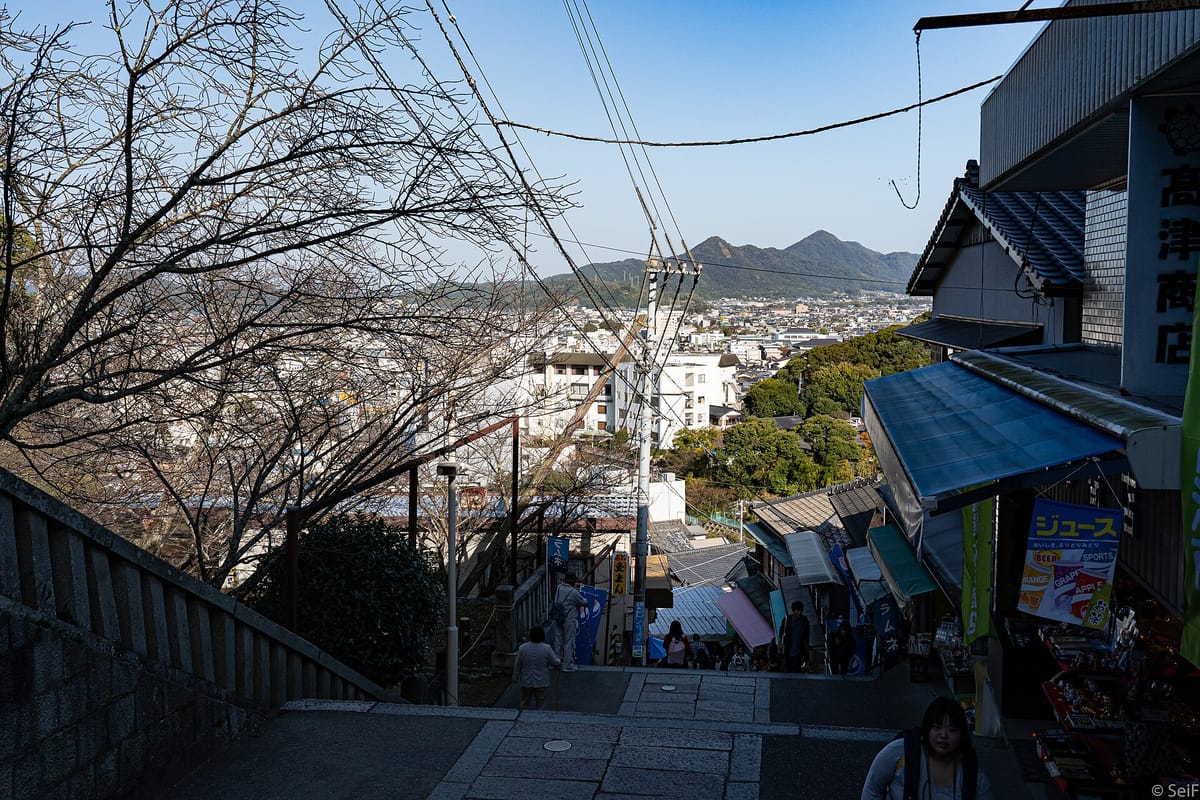
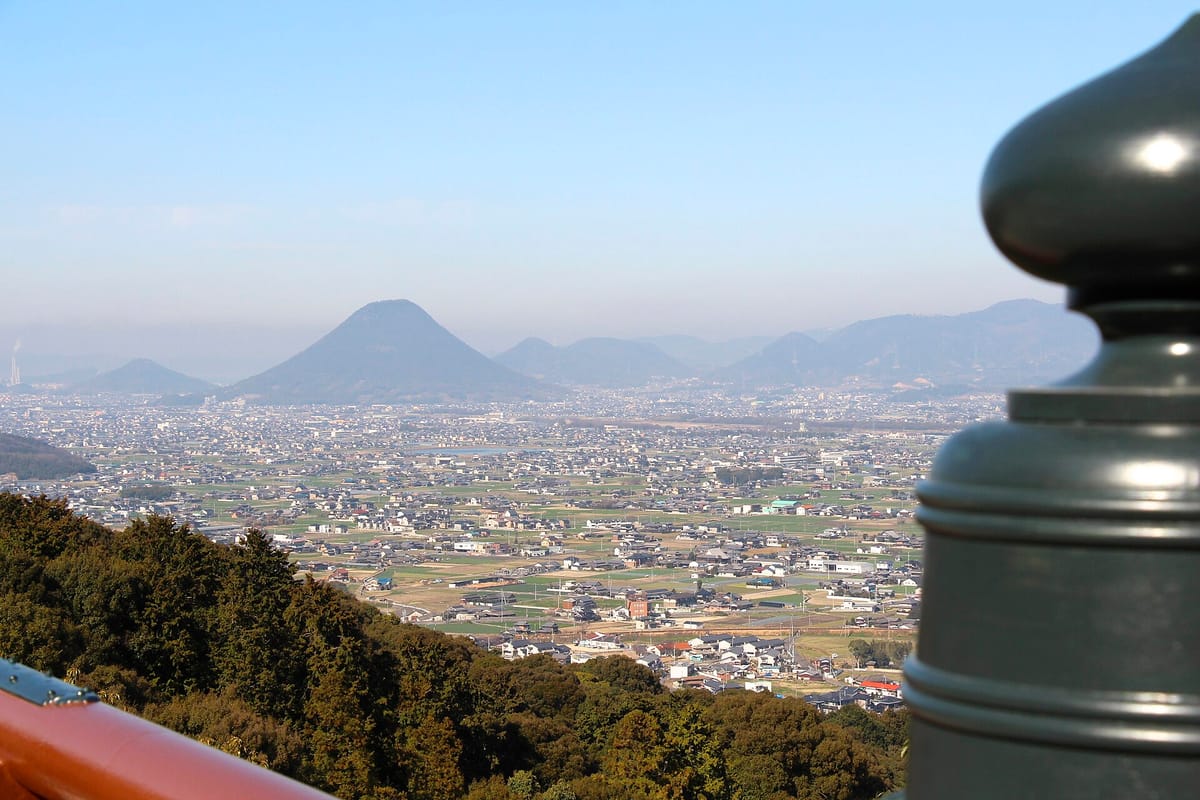
The climb is the experience. From the town, the approach, sandō, rises in flights of stone steps past souvenir shops, udon restaurants and old inns, then through the great gate into the shrine's forest, where the steps continue past halls, lanterns and smaller shrines. At the top, the Gohongū looks out across the Sanuki plain towards the Seto Ōhashi bridges and the neat cone of Sanuki Fuji.
For a Japanese learner, the climb is a gift of repetition. Every flight has a signboard, every hall a name board, and everyone on the steps is asking the same question: how far is it now? It is the natural moment for your first real conversation with a stranger in Japanese.
Getting there: JR and Kotoden to Kotohira
Kotohira is about an hour from Takamatsu by train, and there are two lines. The JR Dosan Line runs to JR Kotohira Station, and the private Kotoden railway's Kotohira Line runs from Takamatsu-Chikkō, next to the ferry port, and Kawaramachi to Kotoden Kotohira Station, the end of the line. Both stations are in the town centre, around ten minutes' walk from the first step.
From either station, head for the shopping street that leads to the approach. The steps begin between shops and restaurants, and the count on the small markers starts here. There is no car access to the shrine itself and no parking at the top, so everyone climbs, although the first stretch is gentle.
| Japanese | Romaji | Meaning |
|---|---|---|
| 琴平行きの電車は何番線ですか。 | Kotohira-yuki no densha wa nanbansen desu ka. | Which platform is the train to Kotohira? |
| 琴平まで乗り換えはありますか。 | Kotohira made norikae wa arimasu ka. | Do I need to change trains to get to Kotohira? |
| 金刀比羅宮の参道はどちらですか。 | Kotohira-gū no sandō wa dochira desu ka. | Which way is the approach to Kotohira-gū? |
| 荷物を預けられる所はありますか。 | Nimotsu o azukerareru tokoro wa arimasu ka. | Is there somewhere I can leave my luggage? |
| 杖を借りられますか。 | Tsue o kariraremasu ka. | Can I borrow a walking stick? |
From the Ōmon to the Gohongū: what you will see
From step 113 the approach becomes especially steep, a stretch called Ichi-no-saka, and brings you to the Ōmon, the great gate that marks the start of the sacred grounds. Just inside, under white parasols, sit the Gonin Byakushō, five families who have the privilege of selling a flat, amber candy, kamiyo-ame, inside the gate. Beyond them, the stone-paved Sakura-no-baba runs for about 150 metres under cherry trees.
Halfway up, a path to the right leads to the Omote-shoin, a reception hall with sliding doors painted by the Edo artist Maruyama Ōkyo, and to the shrine's museums. Then the steps pass Asahi-sha, the largest building on the grounds, finished in 1845 after forty years of work and covered in carvings. The final 133 steps, the Gozen Yondanzaka, climb in four flights to the Gohongū.
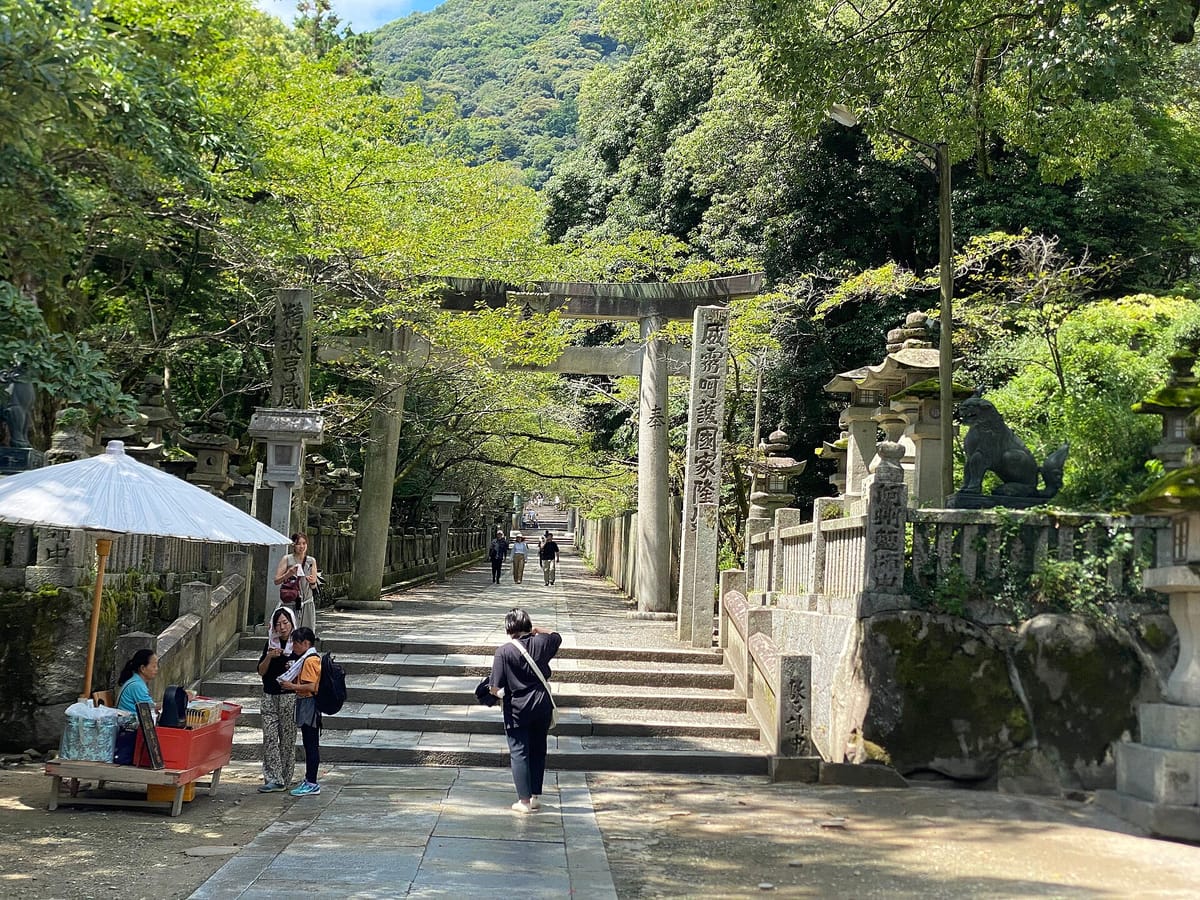
- Ōmon (大門): the great gate, donated by Matsudaira Yorishige, lord of Takamatsu, where the sacred grounds begin.
- Konpira-inu (こんぴら狗): a bronze statue of the dogs that once made the pilgrimage for their owners, carrying a purse and a name tag.
- Omote-shoin (表書院): the reception hall with Maruyama Ōkyo's paintings, including a famous drinking tiger.
- Asahi-sha (旭社): the huge, richly carved hall completed in 1845.
- Sakaki-mon (賢木門): a gate once written with characters meaning upside-down wood, because a pillar was fitted the wrong way up.
- Gohongū (御本宮): the main shrine at step 785, with a viewing platform over the Sanuki plain.
- Emadō (絵馬堂): the hall of votive pictures and models of ships near the main shrine.
- Okusha (奥社): the inner shrine, officially Izutama Jinja, at step 1,368, with carvings of tengu on the cliff above it.
Words on the signs: halls, gates and steps
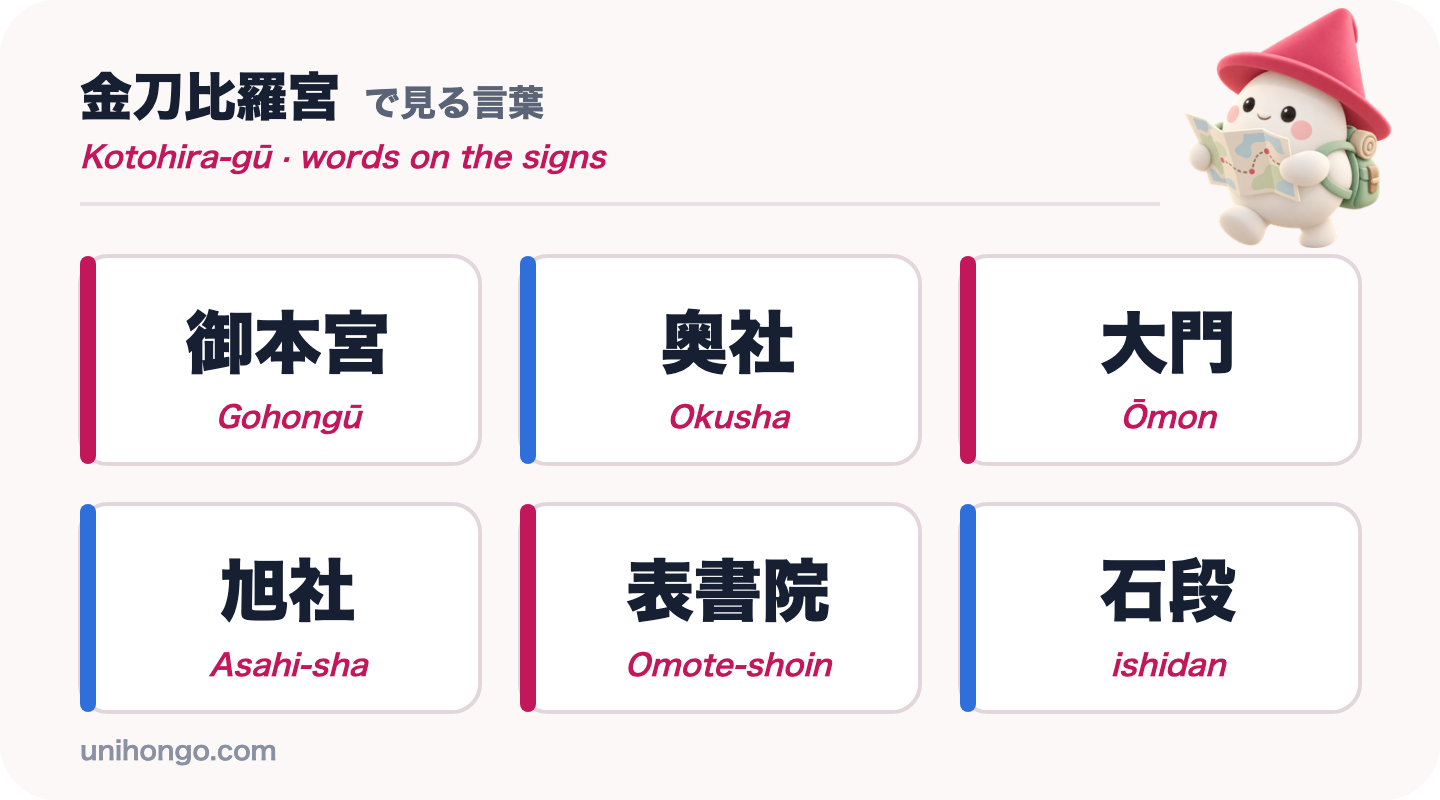
The name boards at Kotohira-gū use the formal vocabulary of shrines. The honorific prefix 御, go or o, appears in 御本宮, the main shrine, and in many other words you will hear at the counters: 御朱印, goshuin, and お守り, o-mamori. The table covers the signs you will pass most often, plus the name of the shrine itself.
| Word | Reading | Meaning |
|---|---|---|
| 金刀比羅宮 | Kotohira-gū | Kotohira Shrine, the official name |
| こんぴらさん | Konpira-san | The friendly everyday name |
| 御本宮 | Gohongū | Main shrine |
| 奥社 | Okusha | Inner shrine |
| 大門 | Ōmon | Great gate |
| 旭社 | Asahi-sha | The large carved hall halfway up |
| 表書院 | Omote-shoin | Reception hall with painted doors |
| 石段 | ishidan | Stone steps |
| 授与所 | juyosho | Counter for charms and fortunes |
Japanese at the charm counter and on the steps
At the main shrine, after you pray, you can receive charms, fortunes and a goshuin at the juyosho. As at other shrines, you are said to receive, itadaku, a charm rather than buy it. The yellow charm of happiness is the one most visitors ask for, and there are also charms for safe travel and for sea safety that suit the shrine's history.
On the steps, the talk is about distance and rest. People greet each other with a quick konnichiwa or otsukaresama desu, good work, a friendly acknowledgment that you are both making the effort.
| Japanese | Romaji | Meaning |
|---|---|---|
| 幸福の黄色いお守りをひとつください。 | Shiawase no kiiroi o-mamori o hitotsu kudasai. | One yellow charm of happiness, please. |
| 交通安全のお守りはありますか。 | Kōtsū anzen no o-mamori wa arimasu ka. | Do you have a charm for safe travel? |
| 御朱印をお願いできますか。 | Goshuin o onegai dekimasu ka. | Could I ask for a goshuin? |
| 奥社まで、どのくらいかかりますか。 | Okusha made, dono kurai kakarimasu ka. | How long does it take to the inner shrine? |
| この近くで休める所はありますか。 | Kono chikaku de yasumeru tokoro wa arimasu ka. | Is there somewhere near here to rest? |
| お疲れさまです。 | Otsukaresama desu. | Good work (said to fellow climbers). |
Etiquette, timing and practical tips
Kotohira-gū is a working shrine with daily rituals and a steady stream of worshippers, and the steps are steep in places. A little care makes the climb pleasant for everyone.
- Bow at the Ōmon as you enter the sacred grounds, and walk to the side of the path rather than the centre.
- Purify your hands at the temizuya before praying: bow twice, clap twice, pray and bow once.
- Film and photograph with consideration. The shrine has asked visitors not to get in the way of people praying, especially near the halls.
- Photography is now permitted inside the shrine's museum rooms, including the Omote-shoin, but check the signs in each room.
- Pets may walk the grounds but must not enter any shrine building.
- Start in the morning in summer; the climb is hot, and there are shady rests but few vending machines higher up.
- Keep time for the Okusha only if your legs are fresh; the path is quieter, steeper and takes about forty-five minutes more each way.
- Check the official calendar for festival days, when the steps are busiest, and for the days the museums and the Omote-shoin are open.
Practise the climb before you go
The conversation you are most likely to have at Konpira-san happens halfway up, when you stop to catch your breath and someone coming down smiles at you. You ask how many steps are left, and then, since you have a local's attention, where to get the famous yellow charm.
Read the four lines aloud until you can say your part without looking. Then open Unihongo, choose the Shrine Visit topic and ask your AI Sensei to be a local on the Kotohira-gū steps who answers with real numbers and place names. Practising the numbers with dan, hyakudan, nihyakudan, sanbyaku-dan, is especially useful, because the sound changes are easy to miss when you hear them for the first time.
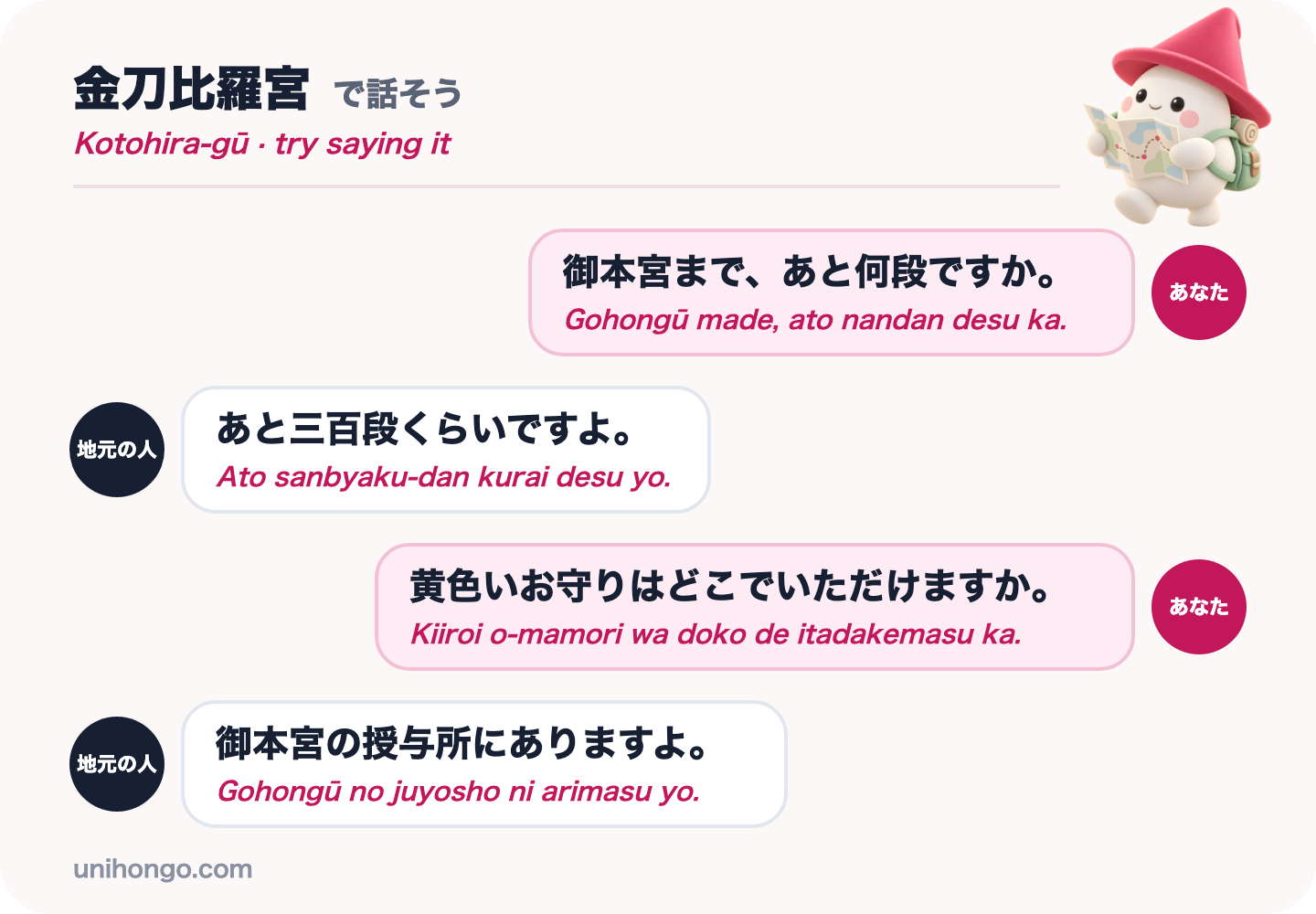
| Japanese | Romaji | Meaning |
|---|---|---|
| 御本宮まで、あと何段ですか。 | Gohongū made, ato nandan desu ka. | How many more steps to the main shrine? |
| あと三百段くらいですよ。 | Ato sanbyaku-dan kurai desu yo. | About three hundred more. |
| 黄色いお守りはどこでいただけますか。 | Kiiroi o-mamori wa doko de itadakemasu ka. | Where can I receive the yellow charm? |
| 御本宮の授与所にありますよ。 | Gohongū no juyosho ni arimasu yo. | It's at the charm counter at the main shrine. |
Official information
Opening days for the Omote-shoin and museums, festival dates and any notices about paths to the Okusha are published by the shrine. Its English guide is a good read before you climb.