

Why Tokyo Disney Resort is different
Tokyo Disney Resort is Disney designed, but Japanese made. The Walt Disney Company licenses the parks to the Oriental Land Company, a Japanese firm, which builds and runs them. The result feels familiar to anyone who knows Disney, yet different in the details: the covered World Bazaar instead of an open Main Street, flavoured popcorn carts with their own queues, seasonal events all year round and a level of cleanliness and courtesy that visitors from abroad often remark on.
Despite the name, the resort is not in Tokyo but in Urayasu, Chiba Prefecture, on reclaimed land on Tokyo Bay. It includes two parks, the Ikspiari shopping and dining complex next to Maihama Station, several Disney hotels and the Disney Resort Line monorail that loops round them all.
For a Japanese learner, the parks are a surprisingly rich language environment. Cast members speak polite Japanese, announcements and ride introductions are mostly in Japanese, and families around you chat in everyday Tokyo speech. You will hear keigo, polite service language, at its most cheerful.
Getting there: Maihama Station and the Disney Resort Line
Maihama Station, 舞浜駅, on the JR Keiyō Line, is the gateway to the resort, about fifteen minutes from Tokyo Station. The Keiyō Line platforms at Tokyo Station are deep underground and a long walk from the other JR platforms, so allow ten minutes or more for the transfer. From Maihama Station, Tokyo Disneyland's entrance is a short walk.
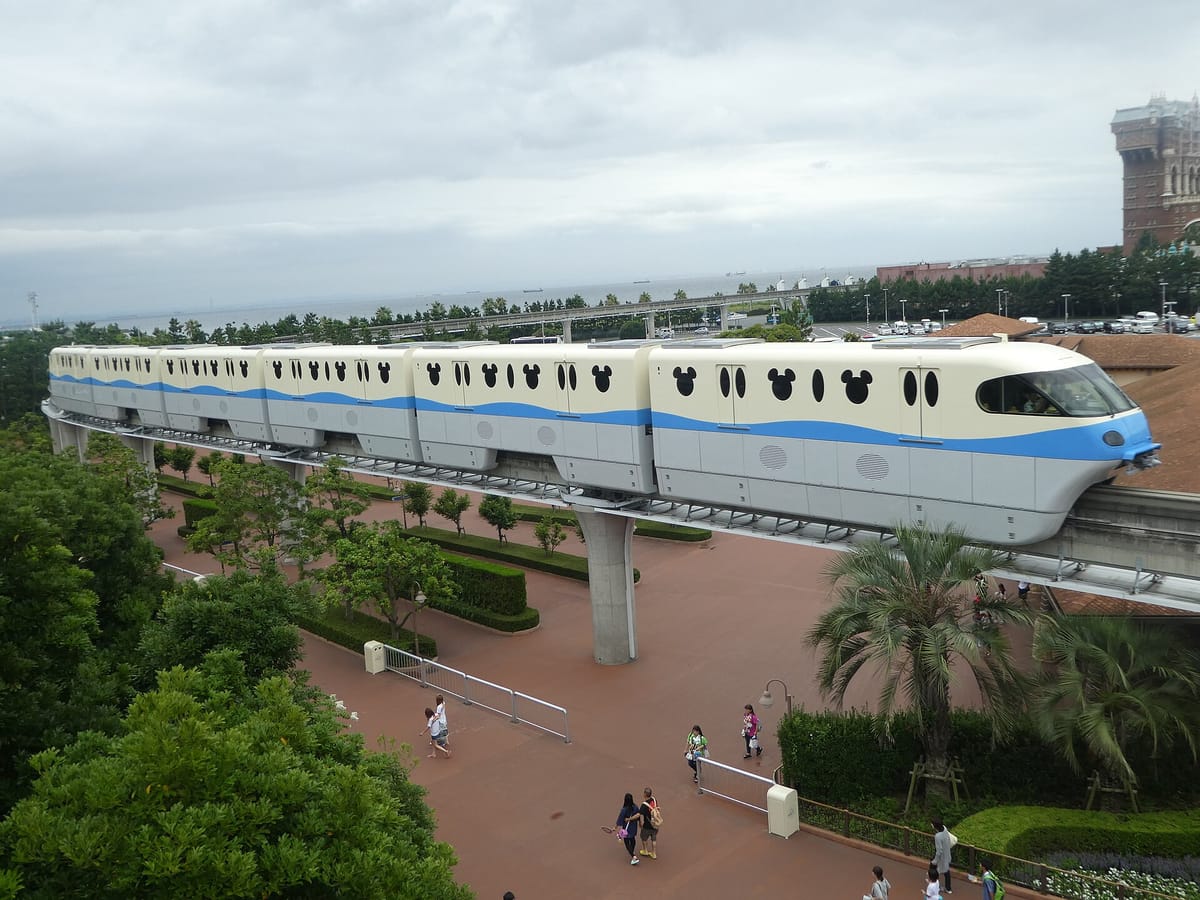
The Disney Resort Line, ディズニーリゾートライン, is a monorail loop with four stations: Resort Gateway next to Maihama Station, Tokyo Disneyland Station, Bayside for the partner hotels, and Tokyo DisneySea Station. It is a separate fare from JR, and it runs in one direction only, so check which way round your stop is. Tokyo DisneySea is also about twenty minutes on foot from Maihama. Direct limousine buses connect the resort with Haneda and Narita airports.
| Japanese | Romaji | Meaning |
|---|---|---|
| 舞浜駅に行くには、何番線ですか。 | Maihama-eki ni iku ni wa, nanbansen desu ka. | Which platform for Maihama Station? |
| 京葉線の乗り場はどこですか。 | Keiyō-sen no noriba wa doko desu ka. | Where do I board the Keiyō Line? |
| ディズニーシーへはモノレールで行けますか。 | Dizunī Shī e wa monorēru de ikemasu ka. | Can I get to DisneySea by monorail? |
| ディズニーシー・ステーションは次ですか。 | Dizunī Shī Sutēshon wa tsugi desu ka. | Is DisneySea Station next? |
| コインロッカーはどこにありますか。 | Koin rokkā wa doko ni arimasu ka. | Where are the coin lockers? |
What you will see: Tokyo Disneyland and Tokyo DisneySea
Each park takes a full day. Attractions open, close and change, so check the official app for what is running on your date, but the overall shape of each park stays the same.
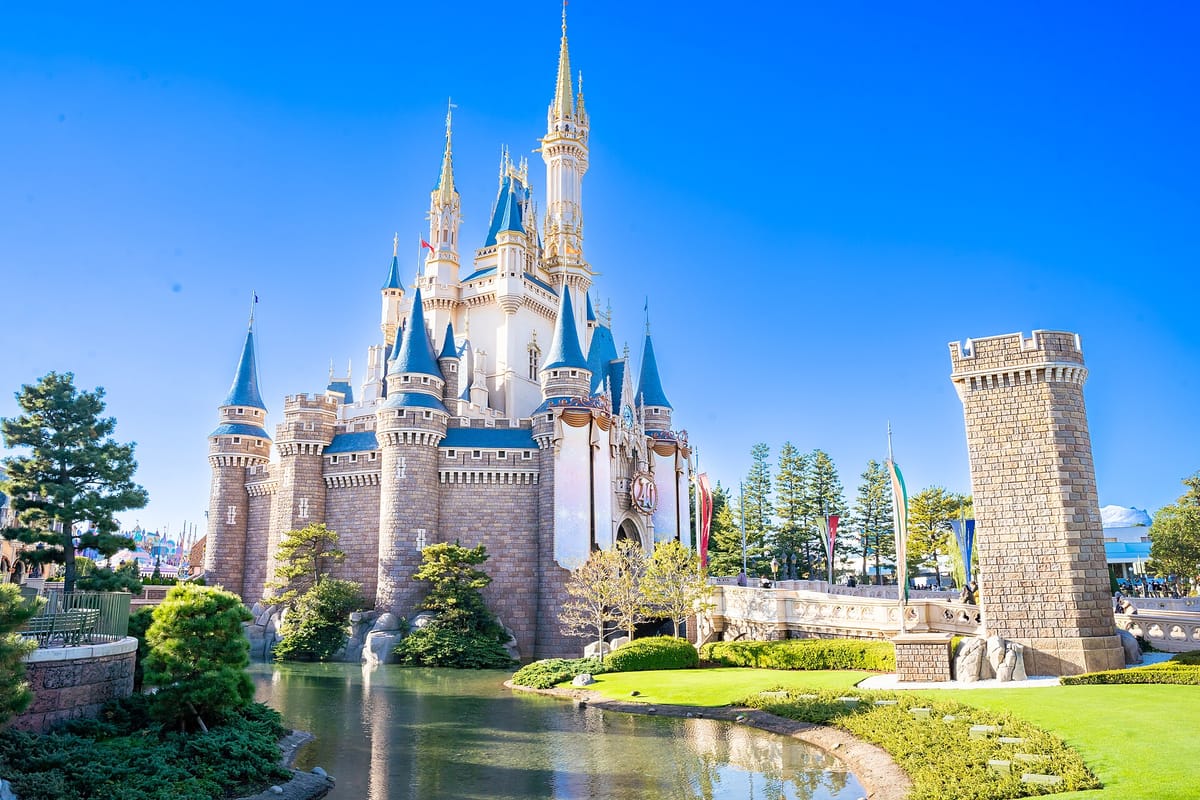
- Tokyo Disneyland: seven themed lands, from the covered World Bazaar at the entrance to Fantasyland around Cinderella Castle.
- Tomorrowland: under major redevelopment; the original Space Mountain closed in 2024, and its replacement is scheduled for 2027.
- Parades and night-time entertainment: Tokyo Disneyland is known for its daytime and illuminated evening parades; check the app for today's schedule.
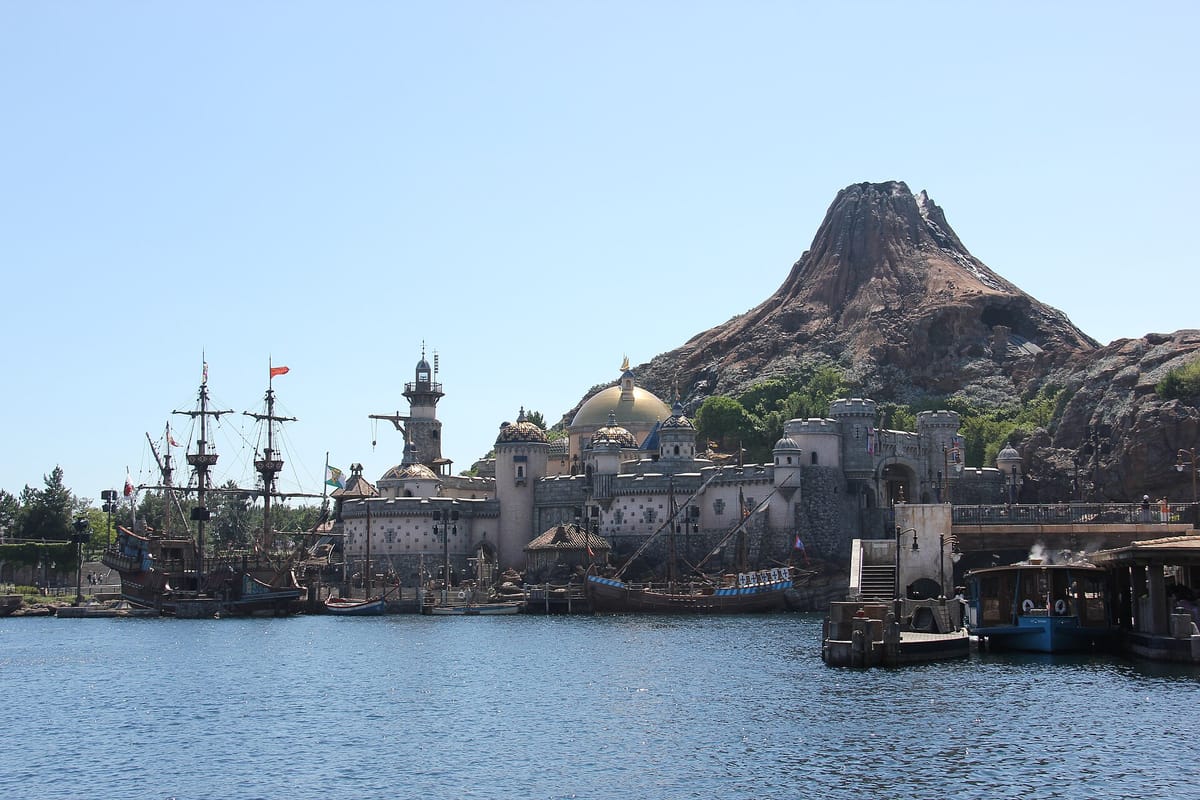
- Tokyo DisneySea: a park of themed ports of call, from Mediterranean Harbor to the Arabian Coast and the American Waterfront, found only in Tokyo.
- Mount Prometheus: the volcano at the centre of DisneySea, with Mysterious Island inside its crater.
- Fantasy Springs: DisneySea's newest area, opened in 2024, with areas based on Frozen, Tangled and Peter Pan.
- Ikspiari: a shopping, dining and cinema complex next to Maihama Station, free to enter.
Queues, rules and the words on the signs
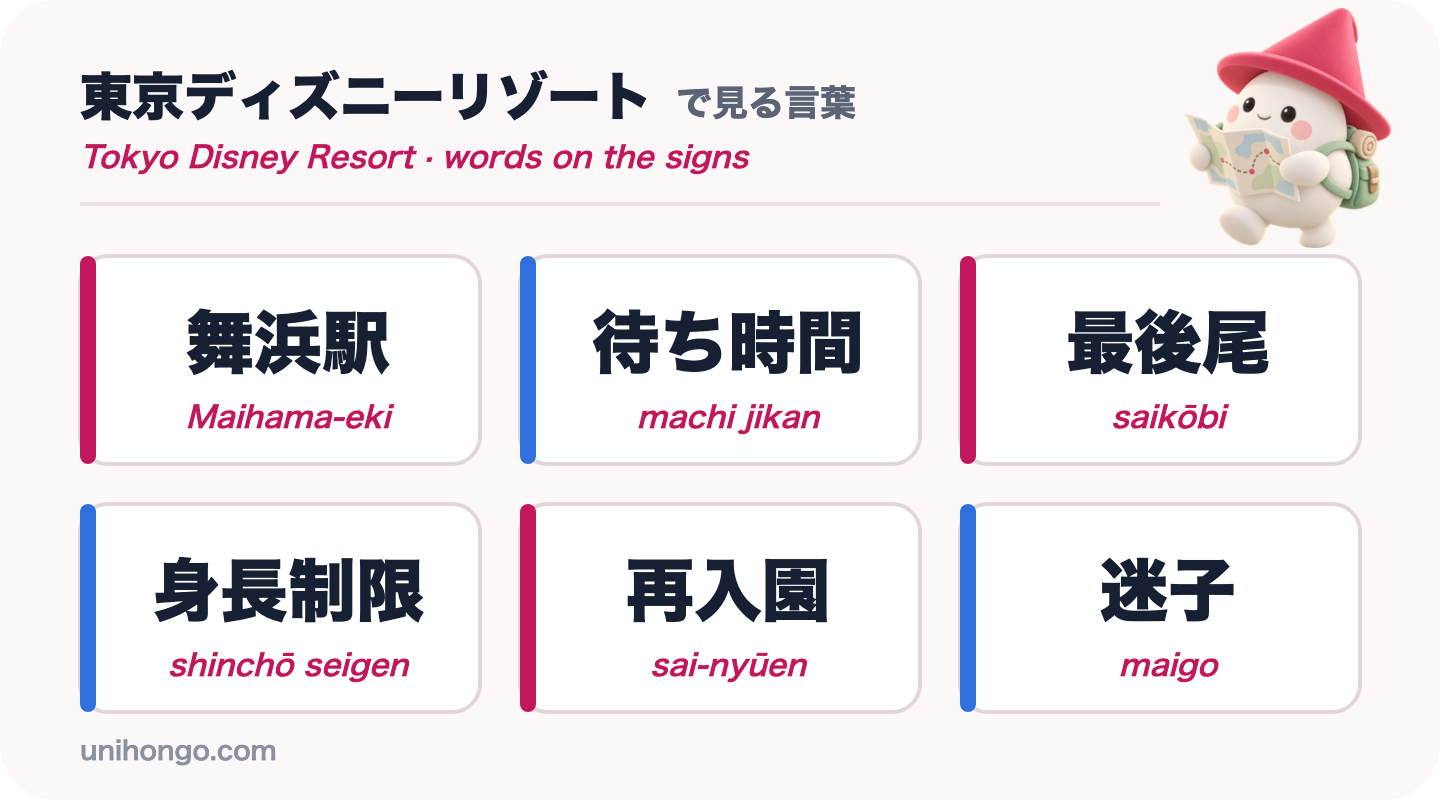
Most park signs are bilingual, but queue boards and hand-held signs are often in Japanese first. At each attraction, a board shows the 待ち時間, machi jikan, waiting time, in minutes. At the end of long lines, a cast member holds a sign reading 最後尾, saikōbi, end of the line.
Rides with a minimum height show 身長制限, shinchō seigen, height restriction, with a measuring post at the entrance. If you plan to leave and come back the same day, ask about 再入園, sai-nyūen, re-entry, and keep your ticket. And if you are separated from your group, the word to know is 迷子, maigo, a lost child, or anyone who has lost their party.
| Word | Reading | Meaning |
|---|---|---|
| 舞浜駅 | Maihama-eki | Maihama Station, gateway to the resort |
| 待ち時間 | machi jikan | Waiting time |
| 最後尾 | saikōbi | End of the queue |
| 身長制限 | shinchō seigen | Height restriction |
| 再入園 | sai-nyūen | Re-entry to the park |
| 迷子 | maigo | Lost child, lost person |
| お手洗い | o-tearai | Toilets |
| 落とし物 | otoshimono | Lost property |
Japanese for queues, food and lost property
Cast members are trained to help, and many speak some English, but a Japanese question usually gets you the fastest and warmest answer. The key moments are joining the right queue, ordering food at a counter or popcorn cart, and dealing with anything you lose.
Tickets and paid Disney Premier Access are handled in the official app, so make sure your phone is charged and connected; a portable battery is a good idea. If you lose something, tell any cast member: the words otoshimono, something dropped, and wasuremono, something left behind, will get you to the right place.
| Japanese | Romaji | Meaning |
|---|---|---|
| すみません、ここが最後尾ですか。 | Sumimasen, koko ga saikōbi desu ka. | Excuse me, is this the end of the line? |
| 待ち時間はどのくらいですか。 | Machi jikan wa dono kurai desu ka. | How long is the wait? |
| ポップコーンをひとつください。 | Poppukōn o hitotsu kudasai. | One popcorn, please. |
| お手洗いはどこですか。 | O-tearai wa doko desu ka. | Where are the toilets? |
| 再入園はできますか。 | Sai-nyūen wa dekimasu ka. | Can I re-enter the park? |
| 財布を落としてしまいました。 | Saifu o otoshite shimaimashita. | I've lost my wallet. |
| 子どもとはぐれてしまいました。 | Kodomo to hagurete shimaimashita. | I've become separated from my child. |
Park manners, timing and practical tips
Tokyo Disney visitors tend to follow the rules closely, and a few habits help you fit in and enjoy the day.
- Buy date-specific tickets in advance, and check the park calendar and app for closures and events on your date.
- Do not save places in a queue for people who are not there; the whole group should queue together.
- At parades and shows, sit where cast members indicate and do not stand up or hold items above your head in front of others.
- Check the rules on costumes, tripods and selfie sticks on the official site before you pack.
- Weekdays outside school holidays are generally less crowded than weekends, national holidays and the summer and New Year periods.
- Bring a portable phone charger: tickets, waiting times and paid access all run through the app.
- Allow time for the Tokyo Station transfer on the way back, when trains to the city are busy after the evening shows.
Practise the queue before you go
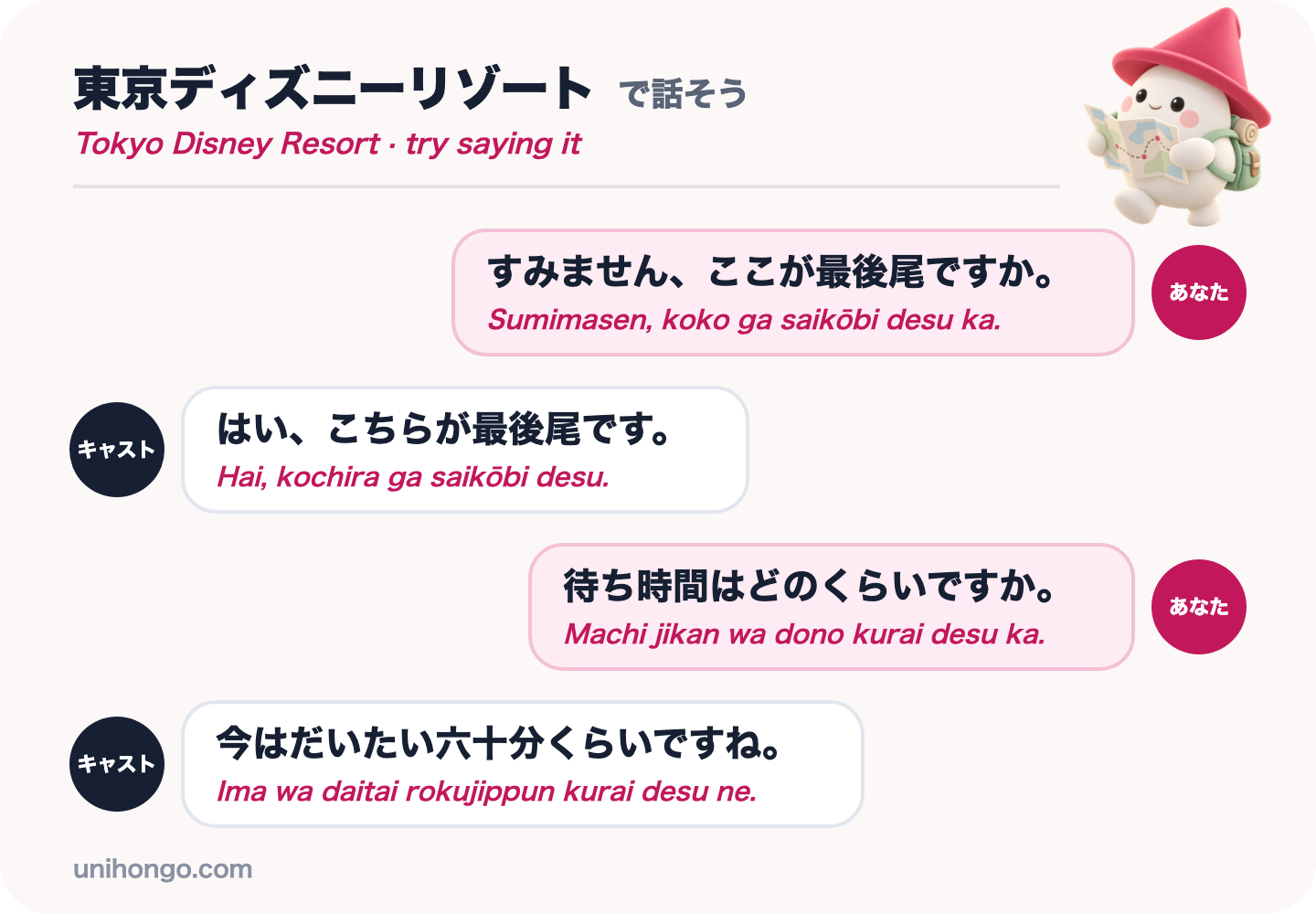
The queue exchange is short but full of useful patterns: koko ga, is this the place, kochira ga, this is the place, in its polite form, and dono kurai, how long. Listen for the number of minutes in the reply and the word kurai, about.
Then practise with a partner who answers back. In Unihongo, choose the Sightseeing topic and ask your AI Sensei to play a cast member at Tokyo DisneySea, or try the Report a Lost Wallet mission to rehearse the moment you hope never happens. Saying the lines aloud once before you go makes them come out in the queue.
| Japanese | Romaji | Meaning |
|---|---|---|
| すみません、ここが最後尾ですか。 | Sumimasen, koko ga saikōbi desu ka. | Excuse me, is this the end of the line? |
| はい、こちらが最後尾です。 | Hai, kochira ga saikōbi desu. | Yes, this is the end of the line. |
| 待ち時間はどのくらいですか。 | Machi jikan wa dono kurai desu ka. | How long is the wait? |
| 今はだいたい六十分くらいですね。 | Ima wa daitai rokujippun kurai desu ne. | At the moment it's about sixty minutes. |
Official information
Ticket prices and availability, park hours, attraction closures, paid access and the rules on costumes and photography are published on the official Tokyo Disney Resort website and in its app, which you will need on the day. The Japan National Tourism Organization's page gives a good overview of the resort and how to reach it.