

Arriving, changing money and finding the floor
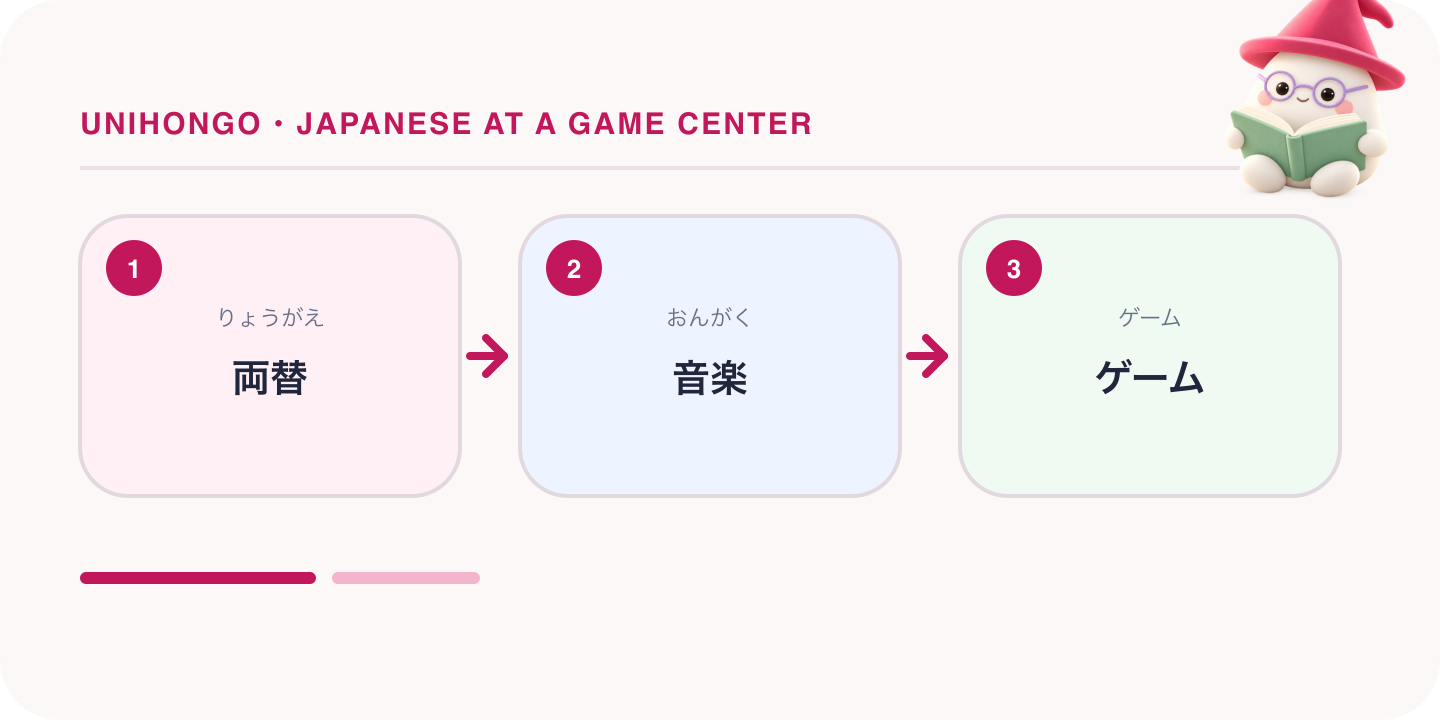
Most game centers are free to enter and open long hours, with a floor guide by the escalator listing what is on each level: kurēn gēmu on the ground floor, ongaku gēmu or rizumu gēmu for rhythm games, taisen for fighting games, medaru for medal games, and purikura, which has its own guide on this site. Coins are still the main currency for crane games, and the change machine, ryōgaeki, turns thousand-yen notes into hundred-yen coins. Some chains add a card terminal where you buy or top up an IC card for the newer machines.
Staff, tenin, wear a uniform and carry keys and a small prize hook. You can call them with the button on a cabinet, yobidashi botan, or with a raised hand and sumimasen.
| Japanese | Romaji | Meaning |
|---|---|---|
| 両替機はどこですか。 | Ryōgaeki wa doko desu ka. | Where is the change machine? |
| 音楽ゲームは何階ですか。 | Ongaku gēmu wa nankai desu ka. | Which floor are the rhythm games on? |
| この台はカードで遊べますか。 | Kono dai wa kādo de asobemasu ka. | Can I play this machine with a card? |
| カードはどこで買えますか。 | Kādo wa doko de kaemasu ka. | Where can I buy a card? |
| 千円札は使えますか。 | Sen-en satsu wa tsukaemasu ka. | Can I use a thousand-yen note? |
Crane games and asking staff to reposition a prize
Crane games are kurēn gēmu, and the classic machine with a claw is a UFO kyatchā, a brand name that has become the everyday word. The prize, keihin, sits on a shelf or bars, and the controls vary: two buttons, a joystick, or a claw that drops between two arms. Read the small instruction card, asobikata, on the glass; some machines let you move the claw in two stages, and some are designed for you to push the prize rather than lift it. The price per play and the number of plays per coin are printed by the slot, and a sign saying hyaku-en ni-kai means two plays for a hundred yen.
After a few tries, if the prize is wedged or has slid somewhere unwinnable, call a staff member and ask them to fix the position, ichi o naosu. They will open the machine and move the prize to a better spot; this is a normal service, not a favour, and it is the single most useful phrase in the building. They will not hand you the prize, and there is no refund for money already spent.
If you win something large, ask for a bag, fukuro, at the counter. Many chains have a limit on the retail value of prizes, so the big plush and figures you see are within it.
| Japanese | Romaji | Meaning |
|---|---|---|
| すみません、位置を直してもらえますか。 | Sumimasen, ichi o naoshite moraemasu ka. | Excuse me, could you fix the position of the prize? |
| この景品が引っかかっています。 | Kono keihin ga hikkakatte imasu. | This prize is stuck. |
| 取りやすい位置にしてもらえますか。 | Toriyasui ichi ni shite moraemasu ka. | Could you put it in an easier position? |
| これはどうやって取るんですか。 | Kore wa dō yatte toru n desu ka. | How do you win this one? |
| 一回いくらですか。 | Ikkai ikura desu ka. | How much is one play? |
| 取れました。袋をもらえますか。 | Toremashita. Fukuro o moraemasu ka. | I got it. Could I have a bag? |
| 別の景品に変えてもらえますか。 | Betsu no keihin ni kaete moraemasu ka. | Could you swap it for a different prize? |
Medal games and the token system
Medal games, medaru gēmu, are the quiet corner of the arcade where older customers play for hours. You buy medals, metal tokens, from a machine, medaru kashidashiki, usually in batches, and use them in coin pushers, oshidashi, slot-style machines and horse racing games with a big screen. Winning gives you more medals, and losing costs you them, but the law is clear that medals never leave the shop: no cash, no prizes, and no taking them home. What most chains offer instead is a bank, azukari, where you store medals on a membership card and draw them out on a later visit. Storage periods and fees vary by chain, so ask before you deposit.
The atmosphere is calmer than the crane floor, and it is normal to watch someone play for a while before sitting down.
| Japanese | Romaji | Meaning |
|---|---|---|
| メダルはどこで買えますか。 | Medaru wa doko de kaemasu ka. | Where can I buy medals? |
| メダルを預けることはできますか。 | Medaru o azukeru koto wa dekimasu ka. | Can I deposit my medals? |
| 預けたメダルは何日まで有効ですか。 | Azuketa medaru wa nannichi made yūkō desu ka. | How long are deposited medals valid? |
| メダルが詰まってしまいました。 | Medaru ga tsumatte shimaimashita. | The medals have jammed. |
| この台は空いていますか。 | Kono dai wa aite imasu ka. | Is this machine free? |
Rhythm games, fighting games and card systems
Rhythm games, ongaku gēmu, and fighting games, kakutō gēmu or taisen, are where the regulars are, and most cabinets now use a chain's IC card or an app rather than coins. The card saves your scores and unlocks songs and characters, and you top it up, chāji, at a terminal or with cashless payment on the cabinet.
Etiquette around these machines is strict because people wait for them. When someone is playing, stand back and do not comment. If you want the machine next, put your card or a coin in the queue slot if there is one, or simply wait visibly; regulars often play one set, then step aside if someone is waiting. In fighting games, taisen means playing against the person on the other side of the cabinet, and a challenger inserting a coin is part of the game, though beginners can play the computer, CPU-sen, to avoid that.
| Japanese | Romaji | Meaning |
|---|---|---|
| 次、待っています。 | Tsugi, matte imasu. | I'm waiting for the next turn. |
| 何曲までですか。 | Nankyoku made desu ka. | How many songs per play? |
| カードにチャージしたいんですが。 | Kādo ni chāji shitai n desu ga. | I'd like to top up the card. |
| 対戦してもいいですか。 | Taisen shite mo ii desu ka. | May I challenge you? |
| 初心者なので、ゆっくりでいいですか。 | Shoshinsha na node, yukkuri de ii desu ka. | I'm a beginner, so is it all right to go slowly? |
| この曲の難易度はどれですか。 | Kono kyoku no nan'ido wa dore desu ka. | Which difficulty is this song? |
Prize exchange and the counter
Some machines pay out tickets, chiketto, or small capsules rather than the prize itself, and you exchange them at the counter, keihin kōkan, for a prize from a display. The counter also swaps a damaged prize, kaeru, if you notice it on the spot, and sells bags.
Prizes from crane games are yours to take home, but they are not for resale inside the shop, and many arcades ask you not to open boxes at the machines. If you win something you do not want, some shops let you exchange it for a different prize from the same machine, but others do not, so ask rather than assume.
| Japanese | Romaji | Meaning |
|---|---|---|
| チケットはどこで交換できますか。 | Chiketto wa doko de kōkan dekimasu ka. | Where can I exchange the tickets? |
| この景品と交換してください。 | Kono keihin to kōkan shite kudasai. | Please exchange them for this prize. |
| 箱が壊れていました。 | Hako ga kowarete imashita. | The box was damaged. |
| 大きい袋はありますか。 | Ōkii fukuro wa arimasu ka. | Do you have a large bag? |
| これは何枚で交換できますか。 | Kore wa nanmai de kōkan dekimasu ka. | How many tickets does this cost? |
Words you will see on the machines and the walls
The words below appear on instruction cards, the floor guide and the notices by the door, and knowing them helps you read a machine before you spend anything.
| Word | Reading | Meaning |
|---|---|---|
| ゲームセンター | gēmu sentā | Game center, arcade |
| クレーンゲーム | kurēn gēmu | Crane game |
| 景品 | keihin | Prize |
| 両替機 | ryōgaeki | Change machine |
| 遊び方 | asobikata | How to play |
| 一回百円 | ikkai hyaku-en | One play, one hundred yen |
| メダル貸出機 | medaru kashidashiki | Medal dispenser |
| 対戦台 | taisen-dai | Head-to-head machine |
| 故障中 | koshō-chū | Out of order |
| 呼び出しボタン | yobidashi botan | Staff call button |
| 景品交換所 | keihin kōkansho | Prize exchange counter |
| 保護者同伴 | hogosha dōhan | Must be accompanied by a guardian |
Koshō-chū on a taped-up cabinet means broken, and chōsei-chū means being adjusted, which usually means a staff member is refilling or resetting it and it will be back shortly.
Etiquette, noise and rules for minors
Arcades are noisy, but the customers are not, and the unwritten rules are about not getting in each other's way. Filming is a sensitive point: shooting your own crane game attempt is usually fine, but filming other players or the staff without asking is not, and some chains ban tripods.
The rules for minors come from each prefecture's youth protection ordinance, and shops enforce them because their licence depends on it. Typically children under a certain age must be with a guardian, hogosha dōhan, and there are time cut-offs after which under-16s and then under-18s must leave, with the exact times varying by prefecture and sometimes by chain. Announcements before the cut-off ask minors to finish, and staff may ask for identification. Look for the notice by the entrance, nenrei seigen, or ask at the counter.
- Give up a cabinet when your credits end if someone is waiting
- Ask before filming anyone other than yourself
- Keep bags and drinks off neighbouring machines
- Do not bang, shake or lean on cabinets, especially crane games
- Check the age and time rules by the door if you are with minors
- Take your prizes with you; unattended prizes go to lost property
When something goes wrong
The common problems are a swallowed coin, a machine that did not start, a claw that dropped the prize into an unreachable gap, and a lost card or prize. For all of them, press the call button or find a staff member and describe the machine number and what happened. Shops handle these quickly because they happen all day.
Refunds for money spent on a fair attempt are not given, so if a machine seems impossible, walk away rather than argue. If you forget a prize or lose a card, ask the counter for otoshimono, lost property, and describe it.
| Japanese | Romaji | Meaning |
|---|---|---|
| お金を入れたのに動きません。 | O-kane o ireta noni ugokimasen. | I put money in but it doesn't work. |
| 百円が詰まってしまいました。 | Hyaku-en ga tsumatte shimaimashita. | A hundred-yen coin has got stuck. |
| 景品が奥に落ちてしまいました。 | Keihin ga oku ni ochite shimaimashita. | The prize fell into the back. |
| カードをなくしてしまったんですが。 | Kādo o nakushite shimatta n desu ga. | I've lost my card. |
| 景品を置き忘れました。 | Keihin o okiwasuremashita. | I left a prize behind. |