

Booking a site and choosing the type
Booking is yoyaku, and it happens on the site's website, through a camping booking portal or by phone. The form asks for the date, the number of nights, haku, the number of people, and the type of site, saito. The main choices are an auto camp pitch, ōto saito, where the car parks beside the tent; a free site, furī saito, an open lawn where you carry gear from the car park and choose your own spot; and a roofed option, kotēji, bangarō or kyabin, which range from a bare hut to a small house with a kitchen.
Fees vary widely and are usually charged per pitch plus per person, sometimes with a separate parking or facility fee, so read the ryōkin page and ask about anything unclear. Check-in and check-out times are shorter than at hotels, and arriving after the office closes can leave you locked out, so confirm the time when booking.
| Japanese | Romaji | Meaning |
|---|---|---|
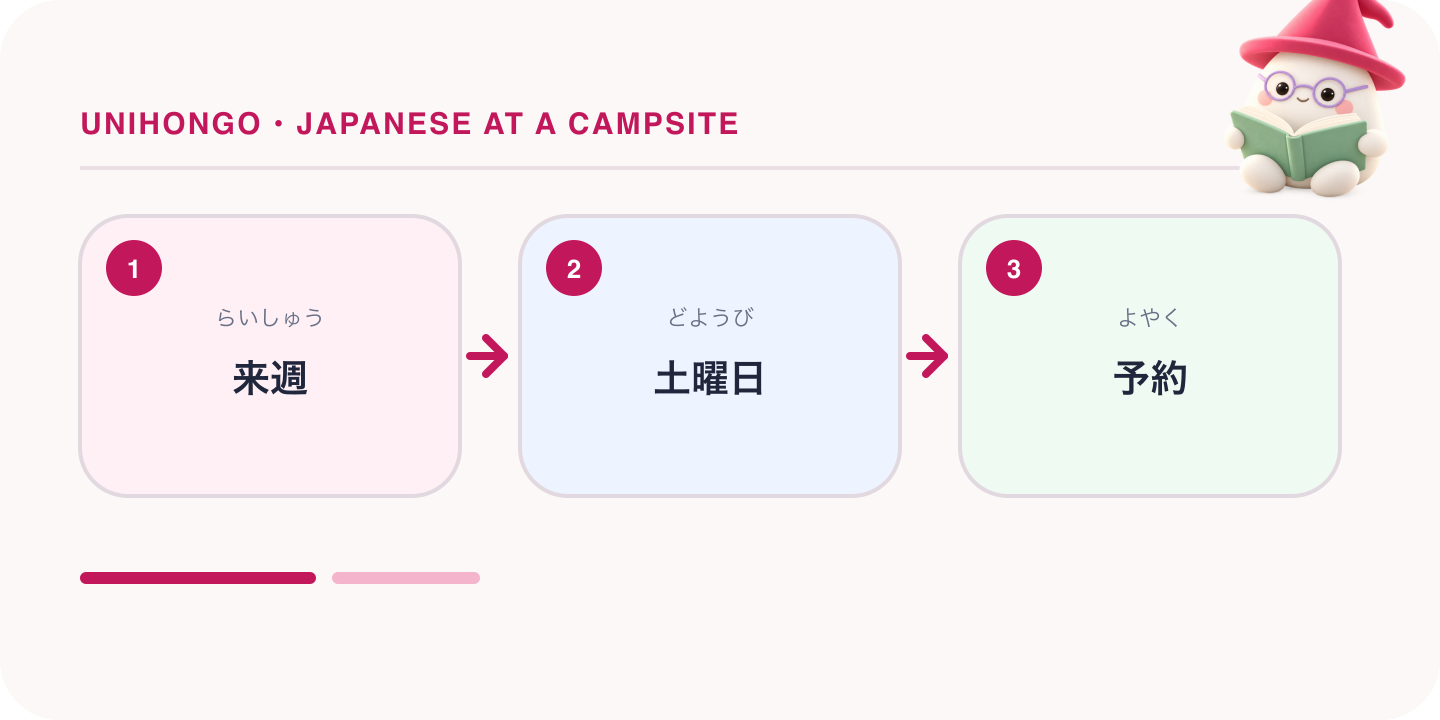
| 来週の土曜日に一泊、予約したいんですが。 | Raishū no doyōbi ni ippaku, yoyaku shitai n desu ga. | I'd like to book one night next Saturday. |
| オートサイトとフリーサイトはどう違いますか。 | Ōto saito to furī saito wa dō chigaimasu ka. | What is the difference between an auto site and a free site? |
| 電源付きのサイトはありますか。 | Dengen tsuki no saito wa arimasu ka. | Do you have sites with power? |
| 大人二人と子供一人です。 | Otona futari to kodomo hitori desu. | Two adults and one child. |
| チェックインは何時からですか。 | Chekku-in wa nanji kara desu ka. | From what time is check-in? |
| コテージは寝具付きですか。 | Kotēji wa shingu tsuki desu ka. | Does the cottage come with bedding? |
Checking in at the reception hut
Reception is the kanri-tō or uketsuke, and the person running it is the kanri-nin. You give the name on the booking, fill in a short form with your address and car registration, kuruma no nanbā, and pay if you have not paid online. The manager then hands you a map with your pitch number, explains the rules, often from a laminated sheet, and points out the toilets, water taps, suiba, and the rubbish point. Listen for the check-out time, the quiet hour and the fire rule, because those are the three things people get wrong.
If the office will be unattended overnight, ask for an emergency phone number before you leave the desk.
| Japanese | Romaji | Meaning |
|---|---|---|
| 予約した田中です。 | Yoyaku shita Tanaka desu. | I'm Tanaka; I have a booking. |
| サイトはどこですか。 | Saito wa doko desu ka. | Where is my site? |
| 水場とトイレはどこですか。 | Suiba to toire wa doko desu ka. | Where are the water taps and toilets? |
| チェックアウトは何時ですか。 | Chekku-auto wa nanji desu ka. | What time is check-out? |
| ゲートは夜、閉まりますか。 | Gēto wa yoru, shimarimasu ka. | Does the gate close at night? |
| 緊急の連絡先を教えてください。 | Kinkyū no renrakusaki o oshiete kudasai. | Please tell me the emergency contact. |
Renting gear and buying firewood
Rental gear, rentaru, is common at larger sites and lets you camp without carrying everything. Typical items are a tent, tento, a tarp, tāpu, sleeping bags, nebukuro, mats, matto, a table and chairs, a lantern, rantan, a barbecue grill, bābekyū konro, and a fire stand, takibi-dai. Some sites offer a set for a fixed fee, and some need rentals booked in advance, so ask when you reserve.
Firewood, maki, is sold at reception by the bundle, taba, and is often the only wood allowed on site, since bringing in outside wood can carry pests. Charcoal, sumi, firelighters, chakkazai, and a bag of ice, kōri, are usually sold too. Buy wood early: reception shops close in the evening and firewood sells out on busy nights.
| Japanese | Romaji | Meaning |
|---|---|---|
| テントをレンタルできますか。 | Tento o rentaru dekimasu ka. | Can I rent a tent? |
| 焚き火台を借りたいです。 | Takibi-dai o karitai desu. | I'd like to borrow a fire stand. |
| 薪を一束ください。 | Maki o hitotaba kudasai. | One bundle of firewood, please. |
| 炭と着火剤はありますか。 | Sumi to chakkazai wa arimasu ka. | Do you have charcoal and firelighters? |
| 氷は売っていますか。 | Kōri wa utte imasu ka. | Do you sell ice? |
| 返却はどこにすればいいですか。 | Henkyaku wa doko ni sureba ii desu ka. | Where should I return the gear? |
Fire, rubbish and quiet hours
The fire rule at most Japanese campsites is jikabi kinshi, no fires directly on the ground: use a raised fire stand with a heat-resistant sheet under it. Some sites ban fires entirely in dry weather or strong wind, announced on a board at reception. Ash goes in a dedicated ash bin, haisute-ba, never in ordinary rubbish and never on the ground.
Rubbish, gomi, is where visitors most often break the rules without meaning to. Sites take one of three approaches: a sorted collection point with labelled bins, a paid rubbish bag issued at check-in, or a rule that you take everything home, gomi wa o-mochikaeri kudasai. The categories, moeru gomi, burnable; purasuchikku, plastic; kan, cans; bin, bottles; and petto botoru, PET bottles, follow the local municipality, so read the sign at the collection point.
Quiet hours, shōtō jikan or kanseiji-kan, often start earlier than visitors expect, sometimes around nine or ten in the evening, and cover music, loud talking, engine noise and generators. Cars are usually asked not to move on site after that time.
- Use a fire stand and a sheet; no fires on the ground
- Put ash only in the ash bin, and make sure it is cold first
- Sort rubbish the way the sign shows, or take it home
- Keep music and voices down after the quiet hour
- Do not drive on site after quiet hours begin
- Leave your pitch as you found it, including the grass around the fire
Showers, onsen and the washing-up area
Washing facilities vary more than anything else. A basic site has cold taps at a suiba for washing dishes and a toilet block. A larger site adds coin showers, which run for a few minutes per hundred-yen coin, and sometimes a bath, o-furo, or a hot spring, onsen, with its own opening hours and fee. Some sites have no showers but sell tickets for a public bath nearby, so ask at check-in and plan around the hours.
Washing-up etiquette follows the same logic as at home: scrape food into the rubbish before washing, use only the washing-up sink for dishes, and do not pour oil or fire ash down the drain. Detergent is often provided, but sponges and tea towels rarely are.
| Japanese | Romaji | Meaning |
|---|---|---|
| シャワーは何時まで使えますか。 | Shawā wa nanji made tsukaemasu ka. | Until what time can I use the showers? |
| コインシャワーは百円で何分ですか。 | Koin shawā wa hyaku-en de nanpun desu ka. | How many minutes does the coin shower give for a hundred yen? |
| 近くに温泉はありますか。 | Chikaku ni onsen wa arimasu ka. | Is there a hot spring nearby? |
| 洗い場に洗剤はありますか。 | Araiba ni senzai wa arimasu ka. | Is there detergent at the washing-up area? |
| お湯は出ますか。 | O-yu wa demasu ka. | Is there hot water? |
Words on the rules board and the site map
The rules board at reception and the site map use a fixed set of words. Read through them once and most Japanese campsite signs become clear.
| Word | Reading | Meaning |
|---|---|---|
| 管理棟 | kanri-tō | Reception building |
| 管理人 | kanri-nin | Site manager |
| オートサイト | ōto saito | Pitch with car beside the tent |
| フリーサイト | furī saito | Open field, choose your own spot |
| 直火禁止 | jikabi kinshi | No fires on the ground |
| 焚き火台 | takibi-dai | Raised fire stand |
| 薪 | maki | Firewood |
| 炊事場 | suijiba | Cooking and washing-up area |
| 灰捨て場 | haisute-ba | Ash disposal point |
| 消灯時間 | shōtō jikan | Lights-out or quiet hour |
| ゴミ分別 | gomi bunbetsu | Rubbish sorting |
| 熊出没注意 | kuma shutsubotsu chūi | Beware of bears |
Suijiba and araiba both mean the washing-up area; sites use either. Shōtō jikan literally means lights-out time, and at a campsite it marks the start of quiet hours rather than a rule about your lantern.
Weather and wildlife notices
Japanese campsites post notices about weather and animals, and they are worth reading before you pitch. In the rainy season and typhoon season, riverside sites can close at short notice, and a notice saying zōsui chūi warns that the river may rise. Staff may ask you to move to higher ground or to a cottage, and in a typhoon the site may close entirely and refund you. Thunder, kaminari, means leaving open ground and waiting in the car or a building.
Wildlife notices cover bears, kuma, in mountain regions, wild boar, inoshishi, monkeys, saru, and, in summer, hornets, suzumebachi. The practical rules are the same everywhere: keep food and rubbish sealed and inside the car overnight, never leave a cooler outside, and carry a bell on walks. For hiking from the site, there is a separate guide to hiking and outdoor vocabulary on this site.
| Japanese | Romaji | Meaning |
|---|---|---|
| 雨が降ったらサイトはどうなりますか。 | Ame ga futtara saito wa dō narimasu ka. | What happens to the site if it rains? |
| 台風の場合はキャンセル料がかかりますか。 | Taifū no baai wa kyanseru-ryō ga kakarimasu ka. | Is there a cancellation fee in the case of a typhoon? |
| この辺りに熊は出ますか。 | Kono atari ni kuma wa demasu ka. | Do bears appear around here? |
| 食べ物は車の中に入れたほうがいいですか。 | Tabemono wa kuruma no naka ni ireta hō ga ii desu ka. | Should I keep food in the car? |
| コテージに変更できますか。 | Kotēji ni henkō dekimasu ka. | Can I change to a cottage? |
Neighbours, small talk and when something goes wrong
The pitches are close together at popular sites, so a greeting to the family next door goes a long way. Konnichiwa when you arrive and a short yoroshiku onegai shimasu are enough; in the morning, ohayō gozaimasu. A short apology in advance for children or a late arrival is appreciated.
Most problems are practical. If gear is missing or broken, go back to reception with the item rather than describing it. If you are cold, wet or unwell in the night, the emergency number from check-in is the one to call. If neighbours are noisy after quiet hours, tell the manager rather than confronting them; that is what the manager is for.
| Japanese | Romaji | Meaning |
|---|---|---|
| こんにちは。隣のサイトです。よろしくお願いします。 | Konnichiwa. Tonari no saito desu. Yoroshiku onegai shimasu. | Hello, we're on the next site. Nice to meet you. |
| うるさくしてすみません。 | Urusaku shite sumimasen. | Sorry for the noise. |
| ライターを貸してもらえますか。 | Raitā o kashite moraemasu ka. | Could you lend me a lighter? |
| テントのポールが折れてしまいました。 | Tento no pōru ga orete shimaimashita. | The tent pole has broken. |
| 夜中に体調が悪くなったら、どこに連絡すればいいですか。 | Yonaka ni taichō ga waruku nattara, doko ni renraku sureba ii desu ka. | If I feel unwell in the night, where should I contact? |
| 隣がとてもうるさいんですが。 | Tonari ga totemo urusai n desu ga. | The neighbours are very noisy. |