

Finding the shrine office and starting the conversation
After you pass through the torii, rinse your hands at the water basin and pray at the main hall, the last stop is the juyosho or shamusho, the shrine office. It is usually a wooden window beside the main hall, with charms displayed on a board and prices written on small cards. Bowing and purification are covered in our temple and shrine etiquette guide, so here we start at the window.
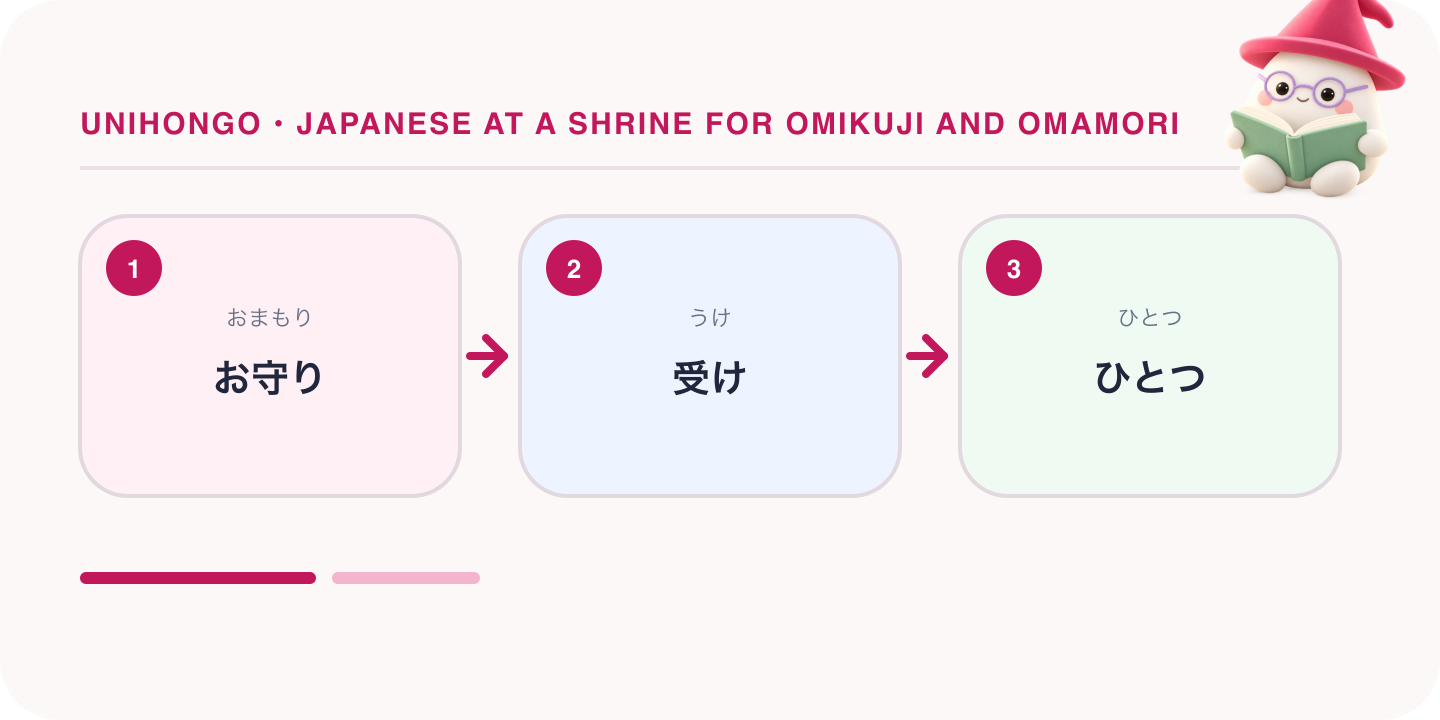
Charms are not bought but received, ukeru, and the price is called hatsuho-ryō, an offering. In practice, o kudasai and onegai shimasu work perfectly well and nobody will correct a visitor. If you are asked ikutsu desu ka, how many, answer with hitotsu, futatsu, mittsu.
| Japanese | Romaji | Meaning |
|---|---|---|
| お守りはどこで受けられますか。 | Omamori wa doko de ukeraremasu ka. | Where can I get charms? |
| これをひとつください。 | Kore o hitotsu kudasai. | One of these, please. |
| いくらですか。 | Ikura desu ka. | How much is it? |
| おいくつになさいますか。 | O-ikutsu ni nasaimasu ka. | How many would you like? |
| ふたつお願いします。 | Futatsu onegai shimasu. | Two, please. |
| カードは使えますか。 | Kādo wa tsukaemasu ka. | Can I pay by card? |
Omamori: the types and what each is for
Omamori are small brocade pouches with a blessing inside, and each one has a purpose printed on it. The board at the window is organised by purpose, so the fastest way to buy is to know the purpose word and put it in front of no omamori. Kōtsū anzen is traffic safety, the classic charm for a car or a bicycle. Gōkaku kigan is for passing an exam. En-musubi is for relationships and a good match. Anzan is for a safe birth. Kenkō or byōki heiyu is for health and recovery. Shōbai hanjō is for a thriving business, and gakugyō jōju is for success in studies.
There are also general charms: kaiun, better luck, and yaku-yoke, protection from misfortune. Pick by purpose first and design second; the miko can help if you describe who it is for. Charms are traditionally returned to a shrine after a year, so ask about the return box, the kosatsu-nōsho, if you live in Japan.
| Japanese | Romaji | Meaning |
|---|---|---|
| 交通安全のお守りをください。 | Kōtsū anzen no omamori o kudasai. | A traffic safety charm, please. |
| 合格祈願のお守りはありますか。 | Gōkaku kigan no omamori wa arimasu ka. | Do you have a charm for passing exams? |
| 友達の出産祝いに安産のお守りがほしいです。 | Tomodachi no shussan iwai ni anzan no omamori ga hoshii desu. | I'd like a safe birth charm as a gift for a friend. |
| どれが健康のお守りですか。 | Dore ga kenkō no omamori desu ka. | Which one is the health charm? |
| 色は選べますか。 | Iro wa erabemasu ka. | Can I choose the colour? |
| 古いお守りはどこに返せばいいですか。 | Furui omamori wa doko ni kaeseba ii desu ka. | Where should I return an old charm? |
Drawing an omikuji
Omikuji are paper fortunes. At most shrines you pay a small offering into a box, then either shake a hexagonal tin, the mikuji-tō, until a numbered stick falls out and hand the number to the miko, or pull a folded paper straight from a drawer or a box yourself. A few shrines have English versions, so it is worth asking.
With the shaking style, read the number on the stick and say it to the miko with ban: jūhachi-ban, number eighteen. If you draw the paper yourself, take one only; taking a second because you dislike the first is considered bad form.
| Japanese | Romaji | Meaning |
|---|---|---|
| おみくじを引いてもいいですか。 | Omikuji o hiitemo ii desu ka. | May I draw a fortune? |
| おみくじはこちらで引けます。 | Omikuji wa kochira de hikemasu. | You can draw fortunes here. |
| 十八番です。 | Jūhachi-ban desu. | Number eighteen. |
| 英語のおみくじはありますか。 | Eigo no omikuji wa arimasu ka. | Do you have fortunes in English? |
| これはどういう意味ですか。 | Kore wa dō iu imi desu ka. | What does this mean? |
| 初穂料は箱に入れてください。 | Hatsuho-ryō wa hako ni irete kudasai. | Please put the offering in the box. |
Reading the result levels
The result is printed large at the top and it is the part everyone reads first. The scale runs from daikichi, great blessing, down to daikyō, great misfortune, but the middle levels are not intuitive from the kanji alone. Suekichi, for example, is a mild future blessing, lower than shōkichi, small blessing, even though sue looks like an end. The exact number of levels and their order vary from shrine to shrine, so a chart on the wall or a question at the window settles it.
| Result | Reading | Meaning |
|---|---|---|
| 大吉 | daikichi | Great blessing, the best result |
| 吉 | kichi | Blessing; at many shrines second best |
| 中吉 | chūkichi | Middle blessing |
| 小吉 | shōkichi | Small blessing |
| 半吉 | hankichi | Half blessing, used at some shrines |
| 末吉 | suekichi | Future blessing; things will improve later |
| 凶 | kyō | Bad luck |
| 大凶 | daikyō | Great bad luck, rare |
| 願望 | ganbō | Your wish, a line on the slip |
| 待人 | machibito | The person you are waiting for |
| 旅行 | ryokō | Travel |
| 学問 | gakumon | Studies |
Below the headline come short lines on wishes, health, love, work, travel and studies, often with a classical poem above. Phrases such as kanau, will be granted, and ososhi, will be slow, are the ones to look for. The lines are meant as advice for the coming period, which is why many people keep even a middling result to reread.
Tying the fortune or keeping it
Next to the omikuji stand there is usually a rack of wires or ropes crowded with folded white papers. This is the musubidokoro, the place to tie. The common custom is to tie a bad result there so the misfortune stays at the shrine, and to keep a good one in your wallet. Plenty of people tie good ones too, as a bond with the kami.
Fold the paper into a thin strip and tie it in a simple single knot. Do not tie it onto a tree; most shrines now ask visitors to use the rack to protect the branches. If the rack is full, ask where else you can tie it.
| Japanese | Romaji | Meaning |
|---|---|---|
| おみくじはどこに結べばいいですか。 | Omikuji wa doko ni musubeba ii desu ka. | Where should I tie the fortune? |
| 木には結ばないでください。 | Ki ni wa musubanaide kudasai. | Please don't tie it on the trees. |
| 持って帰ってもいいですか。 | Motte kaettemo ii desu ka. | May I take it home? |
| 凶だったので結んでいきます。 | Kyō datta node musunde ikimasu. | It was a bad one, so I'll tie it up before I go. |
| 大吉でした。 | Daikichi deshita. | It was a great blessing. |
Ema plaques and how to write a wish
Ema are small wooden plaques with a picture on the front and a blank back for your wish. You buy them at the same window, write with the pen tied to the stand, and hang the plaque on the ema-kake, the rack near the hall. Wishes in any language are fine. Names and dates are optional, and many people write only a first name, since the plaques hang in public.
The traditional grammar for a wish is the verb plus masu yō ni: gōkaku dekimasu yō ni, may I pass; kazoku ga kenkō de imasu yō ni, may my family stay healthy; ii shigoto ga mitsukarimasu yō ni, may I find a good job. Once hung, the ema stays at the shrine until the priests burn it in a ritual, which is how the wish is delivered.
| Japanese | Romaji | Meaning |
|---|---|---|
| 絵馬をください。 | Ema o kudasai. | An ema plaque, please. |
| 絵馬はどこに掛けますか。 | Ema wa doko ni kakemasu ka. | Where do I hang the ema? |
| ペンを借りてもいいですか。 | Pen o karitemo ii desu ka. | May I borrow a pen? |
| 英語で書いても大丈夫ですか。 | Eigo de kaitemo daijōbu desu ka. | Is it all right to write in English? |
| 家族が元気でいますように。 | Kazoku ga genki de imasu yō ni. | May my family stay well. |
Goshuin stamps and the stamp book
A goshuin is a red seal stamped into a special accordion book, the goshuin-chō, with the shrine's name and the date brushed in ink around it. The book is sold at the same window or at stationery shops, and each shrine adds its own page for a fee that varies by shrine. Some shrines have a separate goshuin window with a queue or a numbered ticket, and some offer only a kakioki, a pre-written sheet to paste in yourself.
The etiquette is simple: pray first, then ask for the stamp; hand over the book open at the next blank page; do not ask for a stamp in a notebook that is not a goshuin-chō; and wait quietly while the priest writes. During busy periods and on some festival days the window may close early or only offer the paper version, so ask rather than assume.
- Goshuin-chō: the accordion stamp book, bought at the shrine or a stationery shop
- Kakioki: a pre-written stamp on loose paper, pasted into the book later
- Hatsuho-ryō: the offering for the stamp, shown on the sign and different at each shrine
- Gentei goshuin: a limited seasonal design, often with a queue
- Uketsuke jikan: the hours the window is open, usually shorter than the shrine grounds
Useful sentences: goshuin o onegai shimasu, a stamp please; goshuin-chō wa arimasu ka, do you sell stamp books; kakioki wa arimasu ka, do you have the paper version; dono kurai kakarimasu ka, how long will it take. If you are handed a number, say arigatō gozaimasu and wait until it is called.
Etiquette at the window and when something goes wrong
The window is a place of quiet transactions. Speak at a normal volume, keep the queue moving, and thank the miko with arigatō gozaimasu when you leave. Ask before photographing the staff. If you buy charms as gifts, say so; some shrines give a small paper bag for each.
Small things go wrong: a fortune you cannot read, a stick dropped before you saw the number, a goshuin window that has closed. All are fixed with a polite question. If you tied your fortune and then want it back, let it be; that is the point of tying it.
| Japanese | Romaji | Meaning |
|---|---|---|
| 読めないので教えてもらえますか。 | Yomenai node oshiete moraemasu ka. | I can't read it, could you tell me what it says? |
| 番号が見えませんでした。もう一度振ってもいいですか。 | Bangō ga miemasen deshita. Mō ichido futtemo ii desu ka. | I couldn't see the number. May I shake it once more? |
| 御朱印はもう終わりましたか。 | Goshuin wa mō owarimashita ka. | Has the goshuin window already closed? |
| 書き置きはありますか。 | Kakioki wa arimasu ka. | Do you have the paper version? |
| プレゼント用なので袋をもらえますか。 | Purezento-yō na node fukuro o moraemasu ka. | It's a gift, could I have a bag? |
| お釣りが違うと思います。 | O-tsuri ga chigau to omoimasu. | I think the change is wrong. |