
The role-play words you will hear first
From the moment you walk in, a maid café runs on a simple story: this is your home, and the staff are your household. That is why you are not welcomed with irasshaimase, the shop greeting, but with okaerinasaimase, welcome home. These four words carry the whole idea.
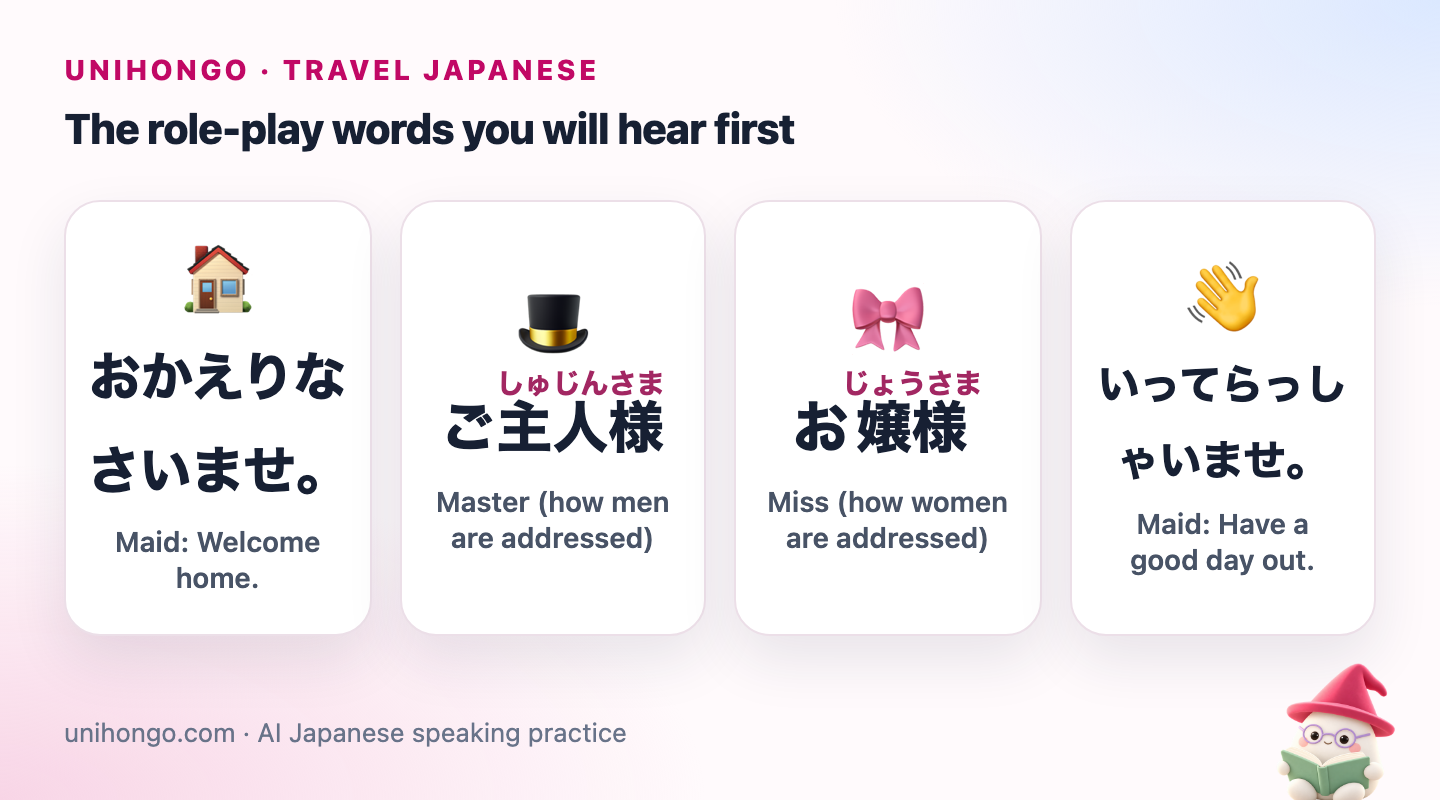
| Japanese | Romaji | Meaning |
|---|---|---|
| おかえりなさいませ。 | Okaerinasaimase. | Maid: Welcome home. |
| ご主人様 | Goshujin-sama | Master (how men are addressed) |
| お嬢様 | Ojō-sama | Miss (how women are addressed) |
| いってらっしゃいませ。 | Itterasshaimase. | Maid: Have a good day out. |
These are ordinary family phrases made extra polite. Okaerinasai and itterasshai are what any Japanese parent says when a child comes home or goes out. The -mase ending and the old honorific titles turn them into theatre.
Arriving: the first questions
At the door, a maid will usually ask whether this is your first time coming home. If it is, they explain the system: a seating or entrance charge, a time limit, and the house rules. Listen for go-kitaku (ご帰宅), literally returning home, which is the café's word for a visit.
| Japanese | Romaji | Meaning |
|---|---|---|
| ご帰宅は初めてですか。 | Go-kitaku wa hajimete desu ka. | Maid: Is this your first time coming home? |
| はい、初めてです。 | Hai, hajimete desu. | Yes, it's my first time. |
| 何名様ですか。 | Nanmei-sama desu ka. | Maid: How many of you? |
| 二人です。 | Futari desu. | Two of us. |
| お屋敷のルールをご説明しますね。 | Oyashiki no rūru o go-setsumei shimasu ne. | Maid: Let me explain the rules of the house. |
| わかりました。 | Wakarimashita. | I understand. |
Ordering and the food spell
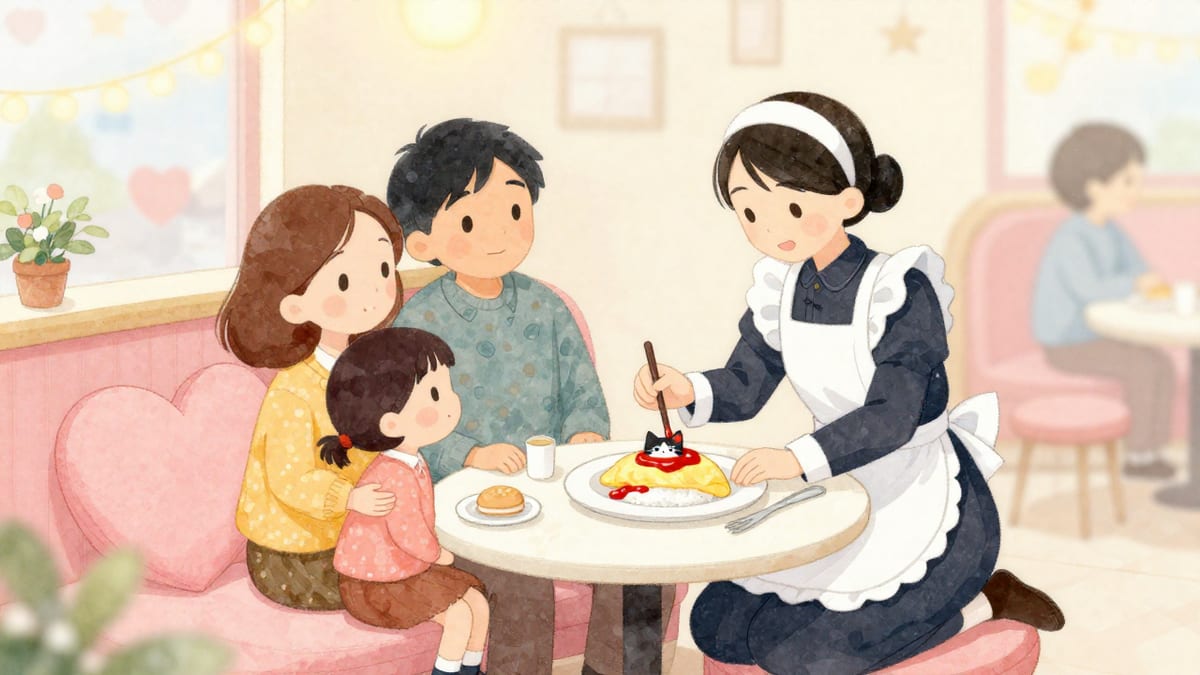
Maid cafés are famous for omuraisu, an omelette over ketchup rice, which a maid decorates with a ketchup drawing at your table. You can usually request a simple picture, such as a cat or a heart. Then comes the best-known ritual: at many cafés, the maid invites you to cast a spell together to make the food tastier, with a chant such as oishiku nāre (become delicious), hand gestures shaped like a heart, and a final moe moe kyun. The exact words differ from café to café.
Joining in is part of the fun, but nobody is forced. A shy smile and a small heart with your hands are enough.
| Japanese | Romaji | Meaning |
|---|---|---|
| オムライスをお願いします。 | Omuraisu o onegai shimasu. | The omurice, please. |
| ケチャップで猫を描いてもらえますか。 | Kechappu de neko o kaite moraemasu ka. | Could you draw a cat in ketchup? |
| 一緒に魔法をかけましょう。 | Issho ni mahō o kakemashō. | Maid: Let's cast the spell together. |
| おいしくなあれ! | Oishiku nāre! | Become delicious! (the food spell) |
| かわいいですね! | Kawaii desu ne! | That's so cute! |
House rules most cafés share
Rules are explained at the start or printed in a small guide at your table, and they exist to protect the staff. They vary between cafés, but these are very common.
| Japanese | Romaji | Meaning |
|---|---|---|
| 料理の写真を撮ってもいいですか。 | Ryōri no shashin o totte mo ii desu ka. | May I take a photo of the food? |
| チェキをお願いします。 | Cheki o onegai shimasu. | I'd like an instant photo, please. |
| すみません、注文いいですか。 | Sumimasen, chūmon ii desu ka. | Excuse me, can I order? |
- No photos of the staff or the room on your own phone. Many cafés sell a cheki, an instant photo with a maid of your choice, as an option.
- Photos of your own food and drink are often allowed; ask first.
- No touching the staff, and no asking for their contact details, real names or private information.
- Do not wait for or follow staff outside the café.
- There is often a time limit for each visit, and a charge for your seat in addition to food and drink.
Why maid café Japanese is interesting for learners
Maid cafés are a living example of role language: special ways of speaking that signal a character. Okaerinasaimase, goshujin-sama and the polite ending -mase belong to the world of a grand household, the kind of speech you otherwise meet only in period dramas, novels and anime. Hearing it in real life helps you notice how much politeness Japanese can pack into a single greeting.
It is also a reminder not to copy everything you hear. Calling a shop clerk goshujin-sama or using -mase endings in daily life would sound strange or comic. Enjoy the style inside the café, and keep using normal desu and masu outside.
| Japanese | Romaji | Meaning |
|---|---|---|
| おかえりなさい。 | Okaerinasai. | Welcome home (what families really say). |
| おかえりなさいませ。 | Okaerinasaimase. | Welcome home (maid café, extra polite). |
| いってらっしゃい。 | Itterasshai. | See you later (to someone leaving home). |
| いってきます。 | Ittekimasu. | I'm off (said by the person leaving). |
Small talk with the maids
Maids often chat briefly with guests at each table, which makes the café a surprisingly good place to try a few lines of Japanese. Keep it light and friendly: where you are from, what you like about Japan, what you ate. A compliment about the food or the drawing is always welcome. Remember that staff are working and have many tables, so short exchanges are normal.
| Japanese | Romaji | Meaning |
|---|---|---|
| ご主人様はどちらからお帰りですか。 | Goshujin-sama wa dochira kara okaeri desu ka. | Maid: Where have you come home from, master? |
| オーストラリアから来ました。 | Ōsutoraria kara kimashita. | I'm from Australia. |
| 日本語、上手ですね! | Nihongo, jōzu desu ne! | Maid: Your Japanese is good! |
| いえいえ、まだ勉強中です。 | Ieie, mada benkyōchū desu. | Oh no, I'm still learning. |
Notice the role play in the first line: the maid asks where you have come home from, not where you are from. Just answer with your country.
Leaving and common mistakes
When you are ready to go, ask for the bill in normal Japanese. The maids will see you to the door with itterasshaimase, and some cafés give regular guests a points card for each return home.
| Japanese | Romaji | Meaning |
|---|---|---|
| お会計をお願いします。 | Okaikei o onegai shimasu. | The bill, please. |
| 楽しかったです。ありがとうございました。 | Tanoshikatta desu. Arigatō gozaimashita. | I had fun. Thank you. |
| いってきます! | Ittekimasu! | I'm off! (playing along with the goodbye) |
- Taking sneaky photos. It breaks the rules and spoils the atmosphere; buy a cheki if you want a picture.
- Treating the role play as personal. The warmth is a performance, and polite distance is part of the etiquette.
- Thinking you must speak in role. Normal polite Japanese is perfect.
- Replying to itterasshaimase with sayōnara. Ittekimasu fits the story and always gets a smile.