

Why Hagi is worth the journey
After losing at the battle of Sekigahara in 1600, the Mōri clan was pushed to the far west of Honshu, and in 1604 Mōri Terumoto built his castle at Hagi, on a delta between two rivers at the foot of Mount Shizuki. For the next 260 years the town grew as the capital of the Chōshū domain, and the layout of its streets, walls and gates still reflects that time.
In the 1850s Hagi became the unlikely birthplace of a revolution. Yoshida Shōin, a young scholar of military science, taught at Shōkasonjuku, a small wooden school in his family's home, and his students included future leaders of the Meiji government. In 1863 the domain also secretly sent five young samurai to study in Britain, later known as the Chōshū Five. Hagi's castle town, the school and three early industrial sites are now part of a UNESCO World Heritage listing.
For a learner, Hagi is a calm, walkable town where people have time to talk. Shopkeepers in the old streets, guides in the samurai houses and potters in their studios are used to visitors from Japan, and fewer from overseas, so a little Japanese makes a big difference.
Getting there: Shin-Yamaguchi, the Super Hagi-gō and the Ma-ru bus
Hagi is not on the Shinkansen. The standard route is to take the Sanyō Shinkansen to Shin-Yamaguchi, then a Bōchō bus to Hagi: the direct Super Hagi-gō or a local service, taking about an hour. Buses stop at Higashi-Hagi Station and at the Hagi Bus Center in the town centre. The JR San'in Line reaches Higashi-Hagi from Masuda, but trains are few.
In town, the Hagi Jyunkan Ma-ru Bus, a community loop bus, runs an East Route and a West Route, each departing about every forty-five minutes during the day, with a flat fare per ride and one- and two-day passes; IC cards work. Hagi is flat, so bicycles are an excellent alternative, and taxis wait at stands rather than cruising.
| Japanese | Romaji | Meaning |
|---|---|---|
| 萩行きのバス乗り場はどこですか。 | Hagi-yuki no basu noriba wa doko desu ka. | Where is the bus stop for Hagi? |
| 萩バスセンターで降りたいです。 | Hagi Basu Sentā de oritai desu. | I would like to get off at the Hagi Bus Center. |
| まぁーるバスの一日乗車券をください。 | Māru Basu no ichinichi jōshaken o kudasai. | A one-day pass for the Ma-ru bus, please. |
| 松下村塾は東回りですか、西回りですか。 | Shōkasonjuku wa higashi-mawari desu ka, nishi-mawari desu ka. | Is Shōkasonjuku on the East Route or the West Route? |
| 自転車はどこで借りられますか。 | Jitensha wa doko de kariraremasu ka. | Where can I rent a bicycle? |
Castle town, Shōkasonjuku and Tōkō-ji: what you will see
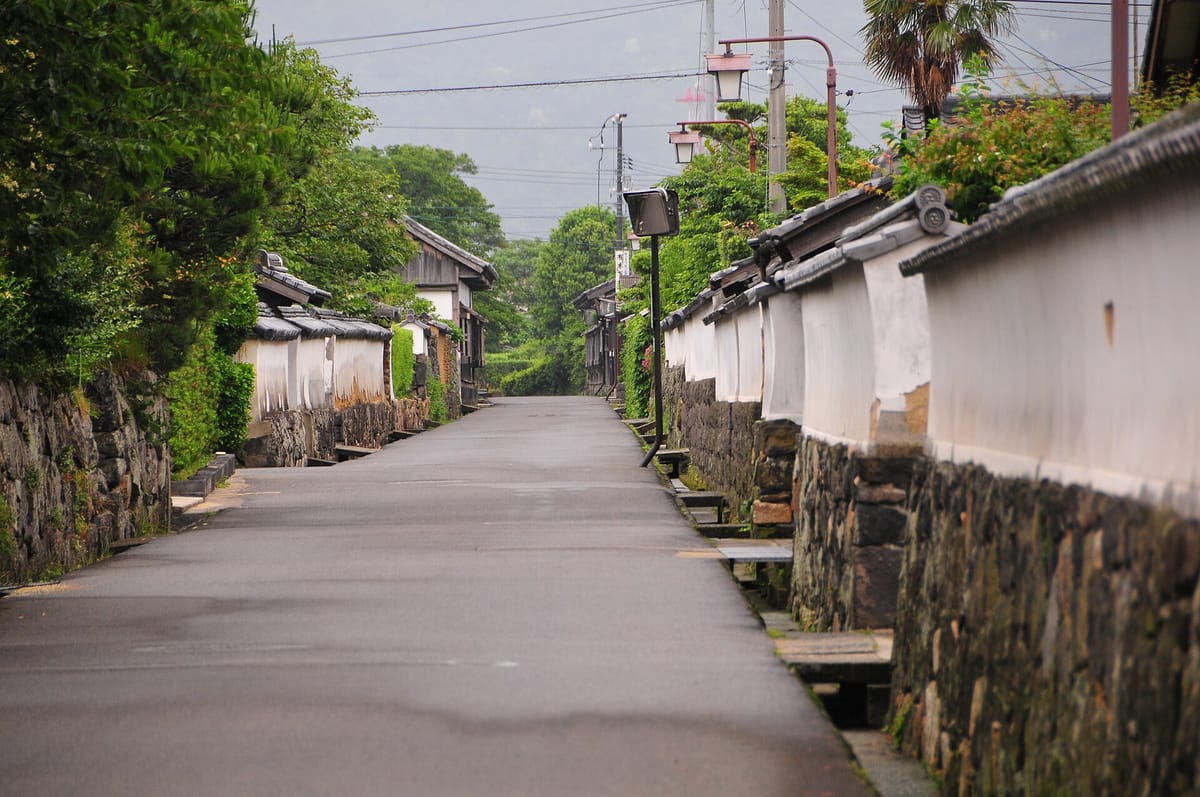
The castle town lies between the castle ruins and the town centre. In Horiuchi, the district of the senior samurai, long white walls and gatehouses line the lanes, and summer orange trees, natsumikan, lean over the walls; the samurai families planted them in their gardens after the Meiji Restoration to earn a living. Closer to the centre, the merchant streets include the house of the Kikuya family, rich merchants who served the Mōri lords and hosted official guests.
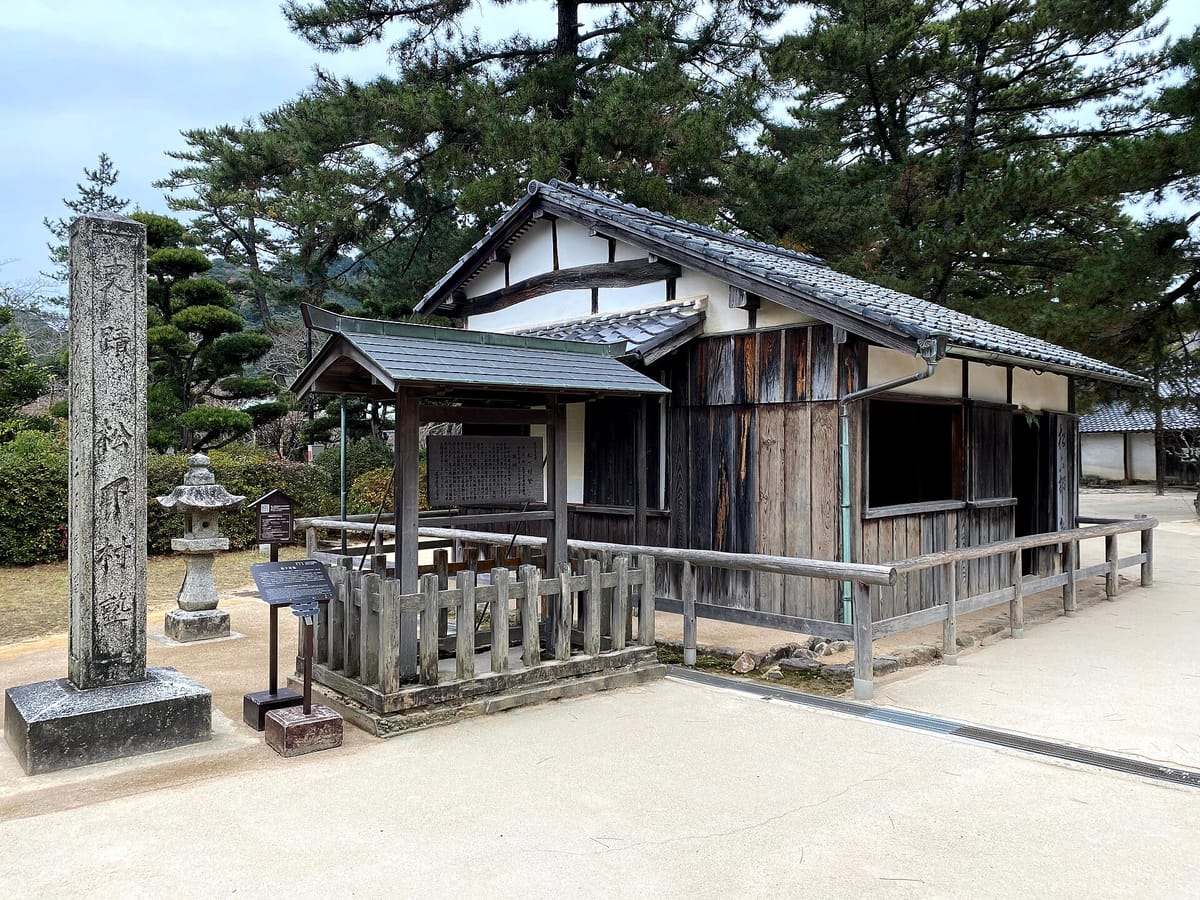
Across the Matsumoto River, Shōin Jinja, the shrine to Yoshida Shōin, holds the Shōkasonjuku school itself: a single-storey wooden house of about fifty square metres, with a lecture room of eight tatami mats. It is striking how small it is. Nearby are Tōkō-ji, a Zen temple with the graves of the Mōri lords and rows of stone lanterns, and the chimney of the Hagi reverberatory furnace, built to cast iron cannon.
- Hagi-jō ato and Shizuki Park: the stone walls and moat of the castle, below Mount Shizuki.
- Horiuchi: the senior samurai district, with walls, gates and orange trees.
- Kikuya-ke Jūtaku: the merchant house of the Kikuya family.
- Shōkasonjuku: Yoshida Shōin's school, in the grounds of Shōin Jinja.
- Tōkō-ji: the Mōri family temple and its rows of stone lanterns.
- Hagi Hanshairo: the ten-metre chimney of the reverberatory furnace.
- Kikugahama: the white sand beach beside the castle ruins.
Words on the signs in Hagi
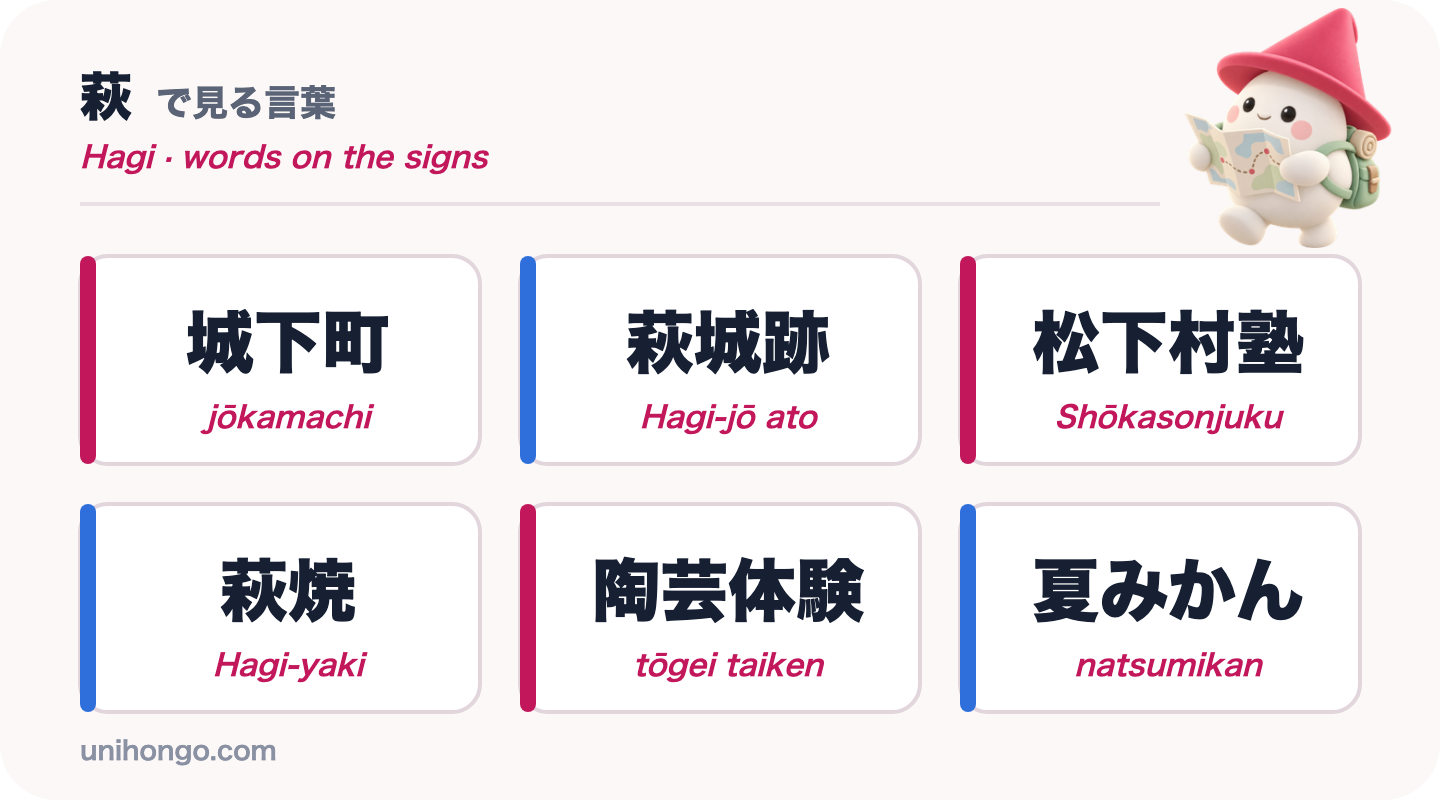
Signposts in Hagi are full of history words. 城下町, jōkamachi, castle town, and 跡, ato, remains, appear everywhere, as in 萩城跡, the castle ruins. 塾, juku, a private school, is the same word used today for cram schools, which gives the name 松下村塾 an everyday feel for Japanese visitors.
In shops you will see 萩焼, Hagi-yaki, where 焼 means fired, and 陶芸体験, tōgei taiken, a pottery experience. 夏みかん, natsumikan, summer orange, appears on sweets, juice and jelly.
| Word | Reading | Meaning |
|---|---|---|
| 城下町 | jōkamachi | Castle town |
| 萩城跡 | Hagi-jō ato | The ruins of Hagi Castle |
| 松下村塾 | Shōkasonjuku | Yoshida Shōin's private school |
| 萩焼 | Hagi-yaki | Hagi pottery |
| 陶芸体験 | tōgei taiken | Pottery class for visitors |
| 窯元 | kamamoto | Pottery studio with its own kiln |
| 夏みかん | natsumikan | Summer orange, a Hagi speciality |
| 東萩駅 | Higashi-Hagi-eki | Higashi-Hagi Station |
| 反射炉 | hanshairo | Reverberatory furnace |
Japanese for a Hagi-yaki pottery class
Many kamamoto, pottery studios, in and around Hagi offer classes for visitors, and some let you see their climbing kilns. The usual choice is between rokuro, throwing on the wheel, and tebineri, shaping by hand, which is easier for beginners. Booking a day or two ahead is sensible, and some studios require it.
Your piece is not ready the same day: it must dry, be glazed and fired, and then it is sent to you. Ask about shipping, especially if you live overseas, since not every studio can send pieces abroad.
| Japanese | Romaji | Meaning |
|---|---|---|
| 明日、二人で体験できますか。 | Ashita, futari de taiken dekimasu ka. | Can two of us take a class tomorrow? |
| 初めてですが、大丈夫ですか。 | Hajimete desu ga, daijōbu desu ka. | It's my first time. Is that all right? |
| 何を作れますか。 | Nani o tsukuremasu ka. | What can I make? |
| 海外にも送れますか。 | Kaigai ni mo okuremasu ka. | Can you send it overseas too? |
| 釉薬の色は選べますか。 | Yūyaku no iro wa erabemasu ka. | Can I choose the glaze colour? |
| この湯呑みはおいくらですか。 | Kono yunomi wa o-ikura desu ka. | How much is this teacup? |
Timing and practical tips
Hagi rewards a slow pace, and a little planning around buses makes the trip easy.
- Check bus times from Shin-Yamaguchi for both directions before you travel.
- Buy a Ma-ru bus day pass or rent a bicycle for the day; the sights are spread out but the town is flat.
- Visit the samurai district early in the morning for quiet lanes and good light.
- Book a pottery class in advance, and allow time for the piece to be shipped.
- Try the local fish, as Hagi faces the Sea of Japan, and summer orange sweets.
- Taxis do not cruise the streets; call one or go to a taxi stand.
Practise booking a pottery class
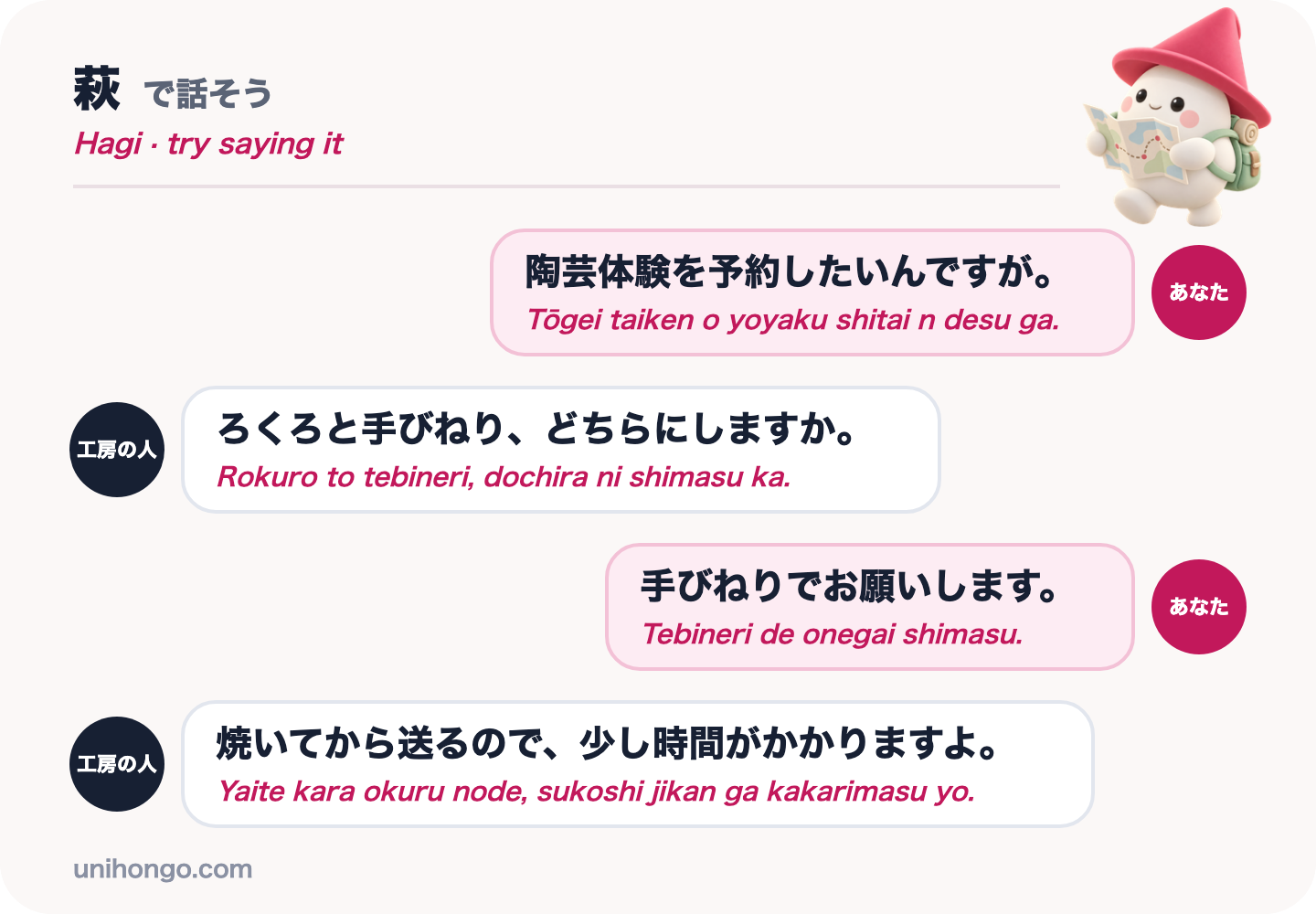
The studio's question, rokuro to tebineri, dochira ni shimasu ka, offers a choice with dochira, which of two. Answer with your choice plus de onegai shimasu. The last line uses node, because, to explain why it takes time. Practise the four lines below until they come without reading.
Then practise with a partner. In Unihongo, choose the Sightseeing topic and ask your AI Sensei to play the owner of a pottery studio in Hagi, or try the Reserve a Restaurant by Phone mission to rehearse booking by phone. Saying it aloud once before you call makes the real booking far easier.
| Japanese | Romaji | Meaning |
|---|---|---|
| 陶芸体験を予約したいんですが。 | Tōgei taiken o yoyaku shitai n desu ga. | I would like to book a pottery class. |
| ろくろと手びねり、どちらにしますか。 | Rokuro to tebineri, dochira ni shimasu ka. | The wheel or hand-building, which would you like? |
| 手びねりでお願いします。 | Tebineri de onegai shimasu. | Hand-building, please. |
| 焼いてから送るので、少し時間がかかりますよ。 | Yaite kara okuru node, sukoshi jikan ga kakarimasu yo. | We fire it and then send it, so it takes a little time. |
Official information
The Hagi city tourism association publishes access routes, the Ma-ru bus timetable and passes, sights and World Heritage information in English. Check bus times and any seasonal notices before you go.