

Why Shirahama is Kansai's favourite seaside escape
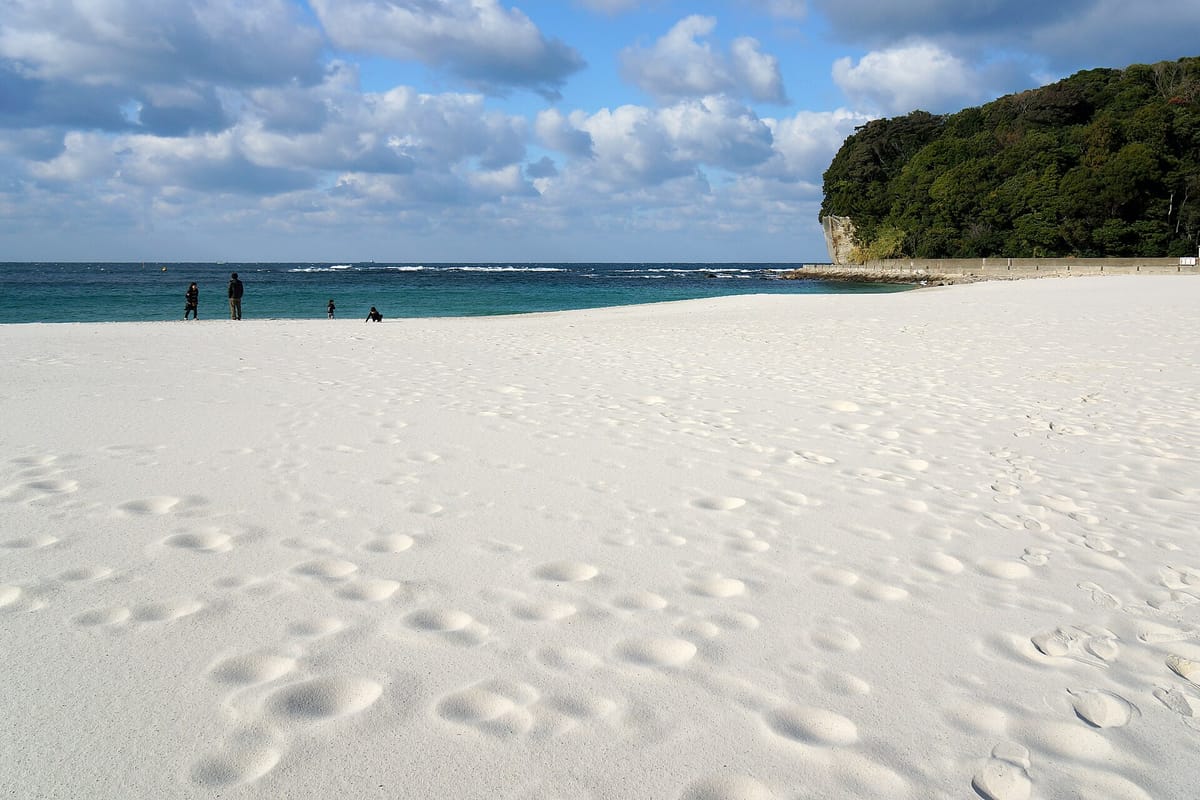
Shirahama's hot springs are among the oldest recorded in Japan. The Nihon Shoki chronicle notes visits by Empress Saimei in 658 and later emperors, and the springs, then called Muro no Yu, are counted among the three ancient hot springs of Japan. The modern resort grew up in the twentieth century around Shirarahama, a bay of white sand made of more than ninety per cent quartz, which was once shipped away to make glass.
Today Shirahama is where people from Osaka and Kyoto come for a weekend by the sea. Hotels line the beach, the town runs several public baths, sotoyu, and the coast to the south is a string of dramatic rock formations: the arch of Engetsutō, the sloping rock shelves of Senjōjiki and the sheer cliffs of Sandanbeki. It is also a good base for the Kumano Kodō and for Kii-Tanabe, a short train ride away.
For a Japanese learner, Shirahama is the perfect place to practise onsen Japanese in a relaxed setting. The public baths are small, cheap and used by locals, the procedures are the same as at any bath in Japan, and one of them, Sakinoyu, has a rule that surprises even Japanese visitors.
Getting there: Shirahama Station and the local buses
From Shin-Osaka or Tennōji, the JR Kuroshio limited express runs down the Kinokuni Line to Shirahama Station in roughly two and a half hours. The station is inland; the resort, beach and coast are a short bus ride away. Local buses leave from in front of the station for the Shirahama bus centre near the beach, and on to stops such as Shirarahama, Yuzaki for Sakinoyu, and Sandanbeki.
The station has a tourist information desk inside, useful for bus maps. Buses to the coastal sights are regular but not constant, and a one-day bus ticket is often sold for sightseers; ask at the desk what is available this season. From Tokyo, flights land at Nanki-Shirahama Airport, which is close to the town.
| Japanese | Romaji | Meaning |
|---|---|---|
| 白浜までの特急券をお願いします。 | Shirahama made no tokkyūken o onegai shimasu. | A limited express ticket to Shirahama, please. |
| 白良浜に行くバスはどれですか。 | Shirarahama ni iku basu wa dore desu ka. | Which bus goes to Shirarahama? |
| 崎の湯に一番近いバス停はどこですか。 | Sakinoyu ni ichiban chikai basutei wa doko desu ka. | Which bus stop is nearest to Sakinoyu? |
| バスの一日乗車券はありますか。 | Basu no ichinichi jōshaken wa arimasu ka. | Is there a one-day bus pass? |
| 三段壁までどのくらいかかりますか。 | Sandanbeki made dono kurai kakarimasu ka. | How long does it take to Sandanbeki? |
Shirarahama, Engetsutō, Sandanbeki and Senjōjiki
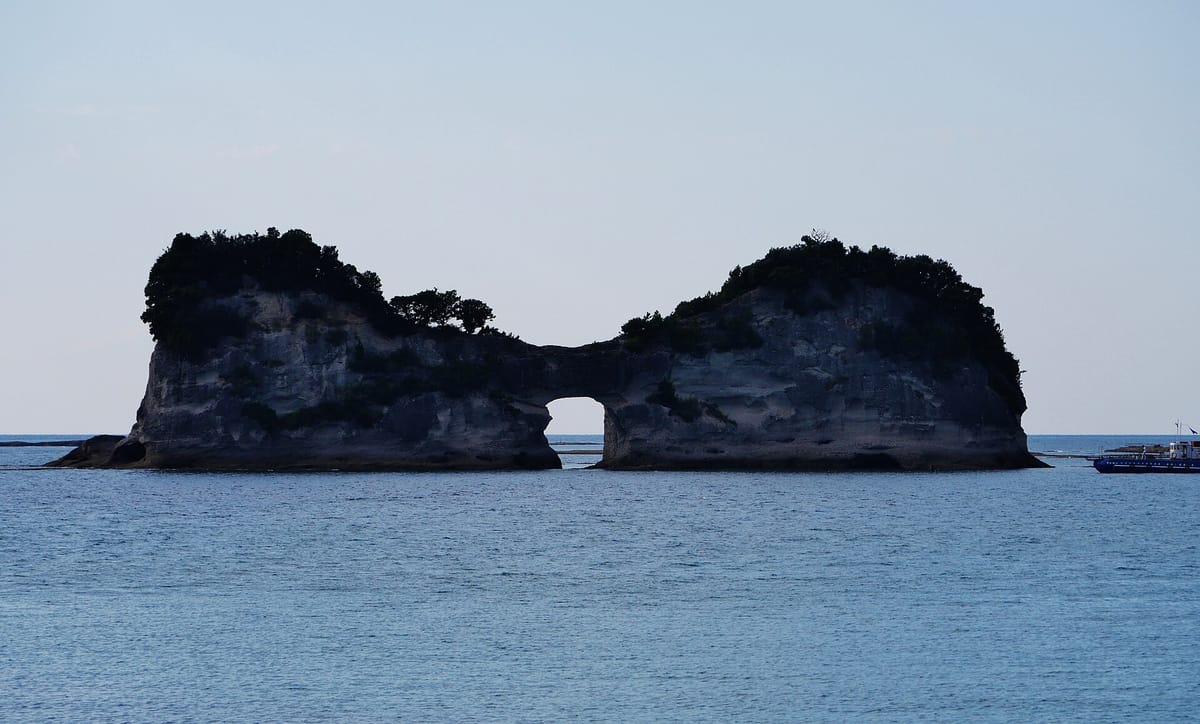
Shirarahama is the heart of the town: a curve of white sand with a promenade, beachside baths and a free open-air bath, Shirasuna, right on the sand, which in summer is used in swimwear. North of town, Engetsutō, officially called Takashima, is a small rocky island with a round arch worn through its middle. Its name means full-moon island, and the viewpoint on the coast road is crowded at sunset, when the sun sinks behind it.
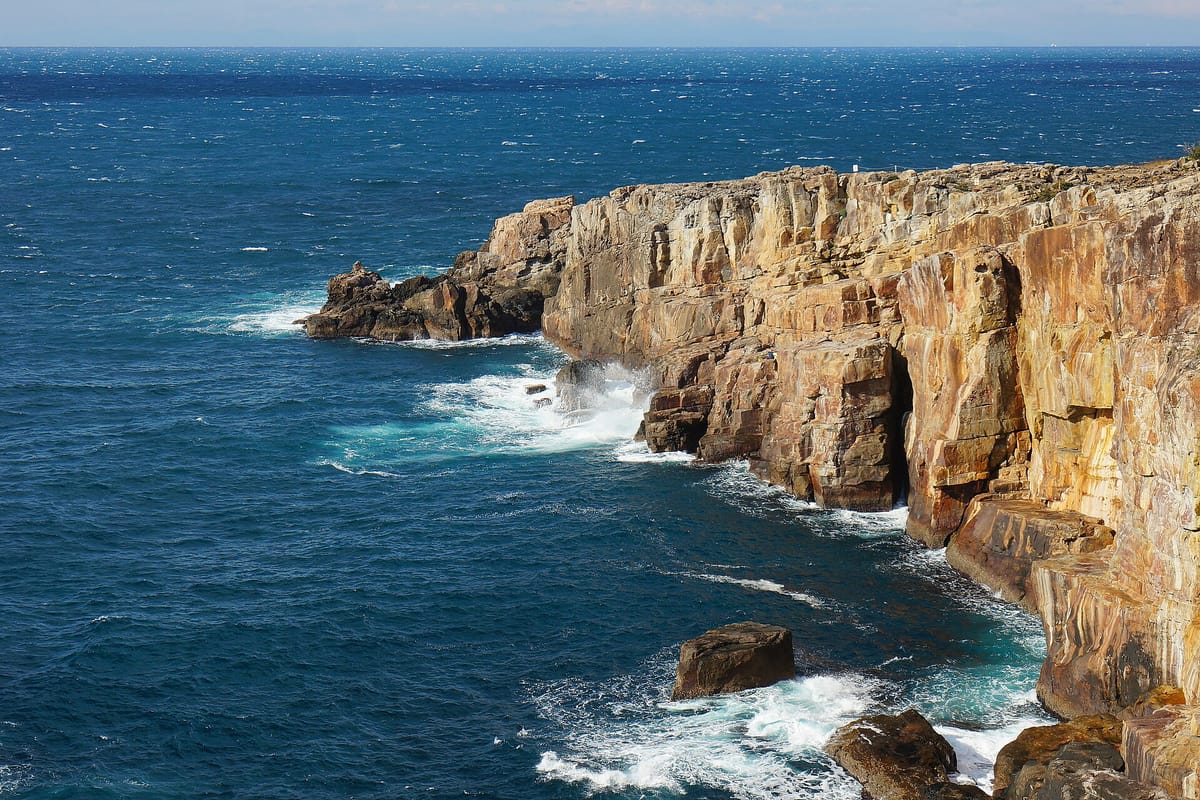
South of the beach, the Yuzaki area has the old hot spring core of the town, with Sakinoyu and Muro no Yu. Further south, Senjōjiki is a broad slope of layered sandstone running down into the sea, a thousand tatami mats in the name. A few minutes' walk beyond it, Sandanbeki is a line of sheer cliffs about fifty to sixty metres high; from the top you look straight down onto the waves, and a lift takes you down through the rock to a sea cave at the base, with a small entry fee.
Food is part of the trip. Shirahama is known for seafood, from spiny lobster to the prized kue grouper served in winter, and Toretore Ichiba, a big seafood market run by a local fishing cooperative, is the easiest place to try fresh sashimi and seafood bowls.
- Shirarahama: the white-sand beach and promenade at the centre of the resort.
- Shirasuna: a free, large open-air bath on the beach, open in the warm season, used in swimwear.
- Engetsutō: the arched island, best at sunset.
- Sakinoyu: the ancient open-air rock bath beside the Pacific.
- Senjōjiki: layered rock shelves sloping into the sea.
- Sandanbeki: fifty-metre cliffs with a lift down to a sea cave.
- Adventure World: a large zoo, safari park and aquarium on the edge of town.
Words on the signs in Shirahama
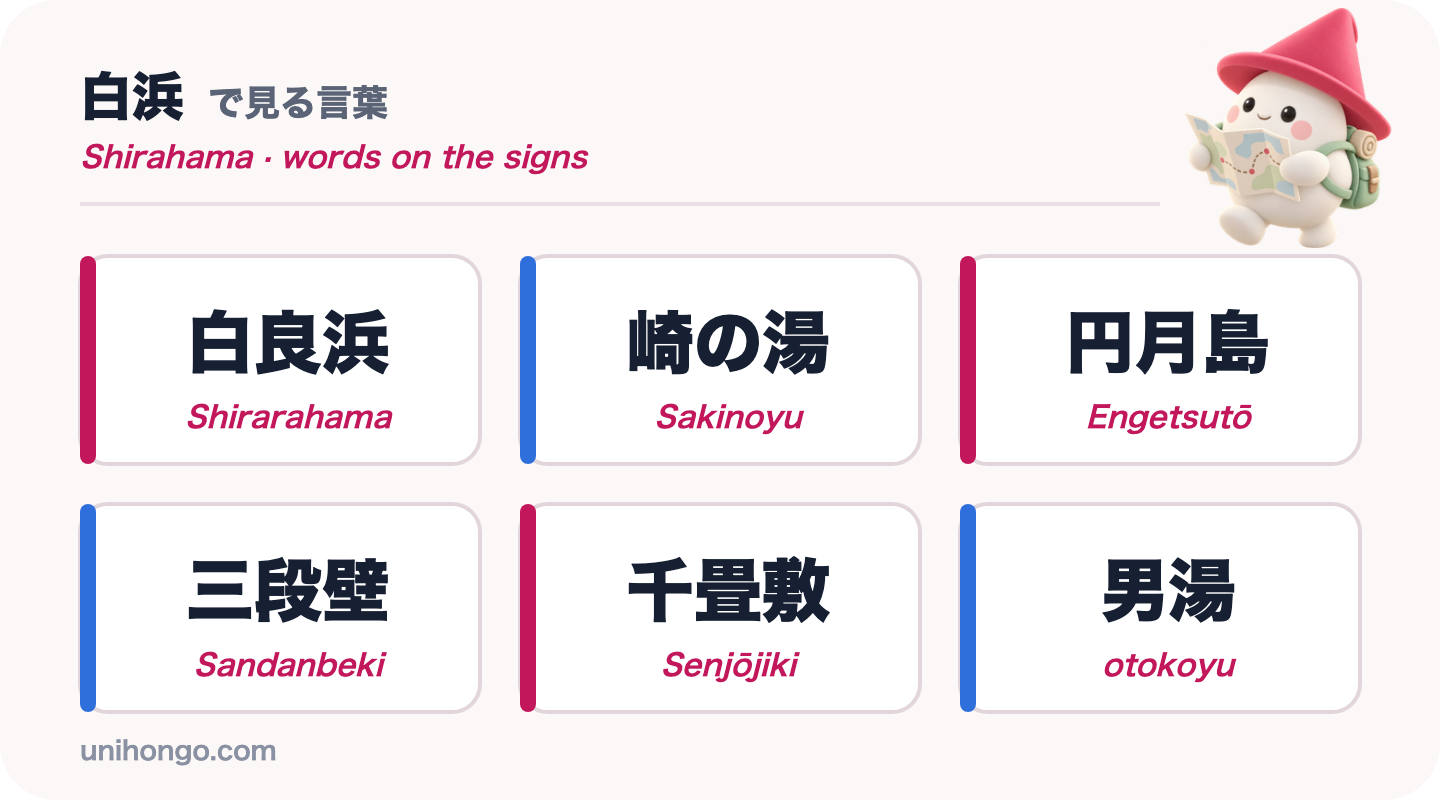
Place names in Shirahama are written in kanji on bus fronts and stop signs, so it helps to recognise them. Two readings are unusual: 白良浜 is Shirarahama, not Shiroyoshihama, and 円月島 is Engetsutō.
At the baths, the signs you must read are the ones for the men's and women's sides, often shown on curtains, noren, at the entrance. Men's is 男湯 and women's is 女湯, and the characters 男 and 女 are worth memorising before any trip to Japan.
| Word | Reading | Meaning |
|---|---|---|
| 白良浜 | Shirarahama | The white-sand beach at the centre of town |
| 崎の湯 | Sakinoyu | Ancient open-air bath on the rocks by the sea |
| 円月島 | Engetsutō | Island with a round arch, famous at sunset |
| 三段壁 | Sandanbeki | Sheer sea cliffs with a cave below |
| 千畳敷 | Senjōjiki | Wide rock shelves sloping into the sea |
| 男湯 | otokoyu | Men's bath |
| 女湯 | onnayu | Women's bath |
| 外湯 | sotoyu | Public bath outside your hotel |
| 足湯 | ashiyu | Foot bath |
| 遊泳禁止 | yūei kinshi | No swimming |
Japanese at the public baths: Sakinoyu, Shirarayu and Muro no Yu
Shirahama's town-run public baths are small and simple, and each has its own character. Sakinoyu is an open-air rock pool on the shore, said to be the last survivor of the ancient Yuzaki baths, where waves break a few metres away; the men's and women's sides are divided, and it closes when the sea is rough. Because it is only a rock pool, you cannot wash with soap or shampoo there: rinse, soak and enjoy the view. Shirarayu, on the beach, is an old-fashioned bathhouse with a bandai, a raised attendant's booth, and windows onto the white sand. Muro no Yu, in the Yuzaki area, draws from two historic springs.
The pattern is the same everywhere: pay at the window or ticket machine, find the right curtain, undress in the changing room, rinse before you get in, and keep your towel out of the water. At all three town baths, children above about seven years old use the bath for their own sex, a local rule posted at the entrance.
| Japanese | Romaji | Meaning |
|---|---|---|
| 大人一人お願いします。 | Otona hitori onegai shimasu. | One adult, please. |
| タオルは売っていますか。 | Taoru wa utte imasu ka. | Do you sell towels? |
| 石けんは使えますか。 | Sekken wa tsukaemasu ka. | Can I use soap? |
| 女湯はどちらですか。 | Onnayu wa dochira desu ka. | Which side is the women's bath? |
| 荷物を預けるロッカーはありますか。 | Nimotsu o azukeru rokkā wa arimasu ka. | Is there a locker for my things? |
| 波が高いですが、今日は入れますか。 | Nami ga takai desu ga, kyō wa hairemasu ka. | The waves are high. Can I still go in today? |
| 気持ちよかったです。ありがとうございました。 | Kimochi yokatta desu. Arigatō gozaimashita. | That was lovely. Thank you. |
Etiquette, timing and practical tips
Shirahama is laid-back, but the usual bath and beach manners apply, and the sea sets its own timetable.
- Rinse your body before getting into any bath, and keep hair up and towels out of the water.
- Tattoos may be refused at some hotel and private baths; ask before you go, or choose a private bath.
- Bring a small towel, or buy one at the entrance; public baths rarely lend them.
- Sakinoyu closes in rough weather and has seasonal hours; check before you make the trip to Yuzaki.
- Go to Engetsutō shortly before sunset, and expect a crowd along the roadside viewpoint.
- At Sandanbeki and Senjōjiki, stay back from the edge and off wet rock; waves can surge up without warning.
- Summer weekends are very busy; book hotels early and expect traffic on the coast road.
Practise the bath Japanese before you go
The one exchange you will certainly have is at the entrance window. You say how many people, the attendant may remind you of the rules, and you ask about towels. The key grammar is the potential form: araemasen, you cannot wash, and tsukaemasu ka, can I use. Practise the four lines below until they come out without reading.
Then practise with a partner who answers back. In Unihongo, choose the Onsen topic and ask your AI Sensei to play the attendant at a seaside bath, or the Japanese Cuisine topic to order at a seafood market. Saying the lines once before the trip is what makes them easy at the window.
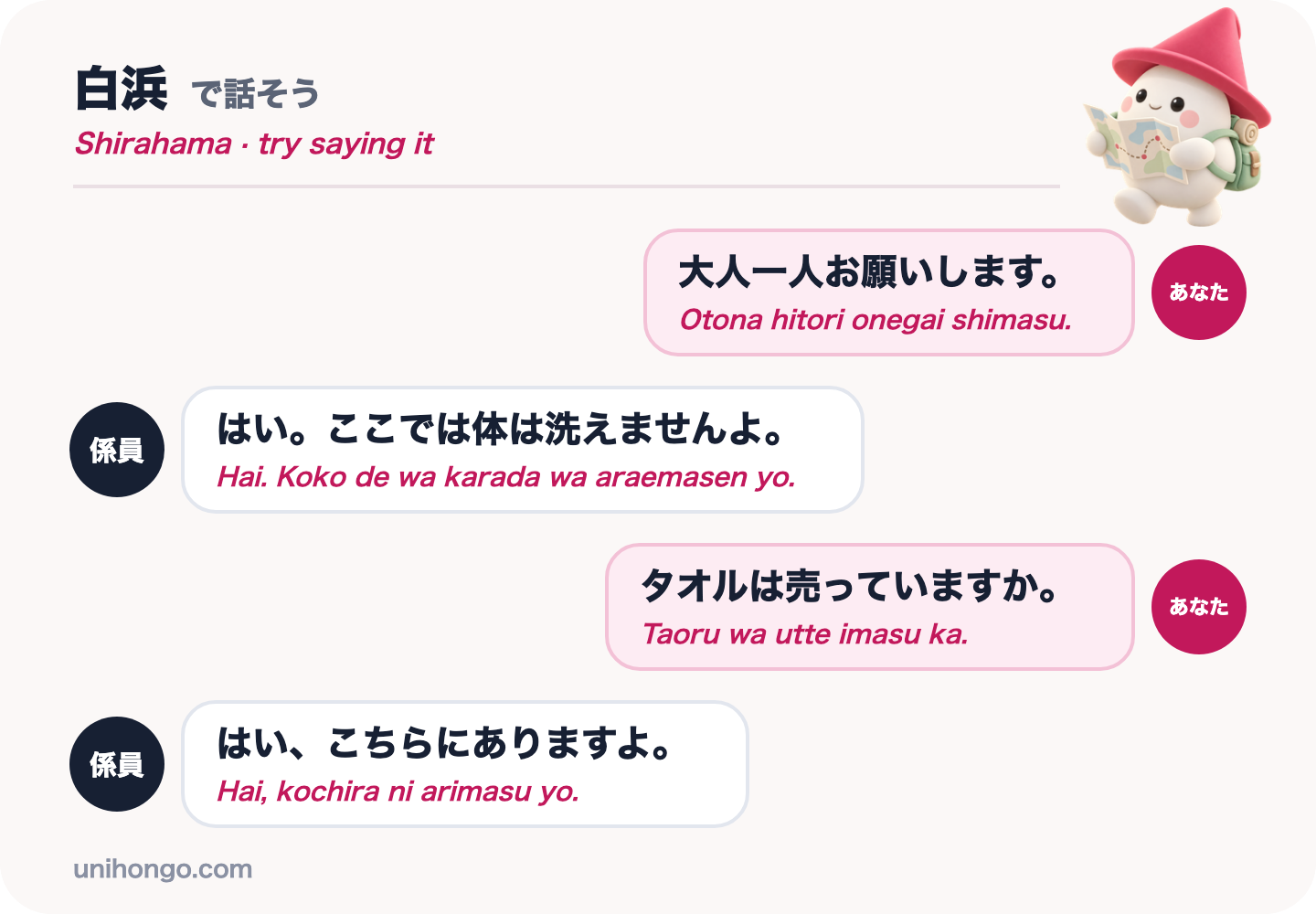
| Japanese | Romaji | Meaning |
|---|---|---|
| 大人一人お願いします。 | Otona hitori onegai shimasu. | One adult, please. |
| はい。ここでは体は洗えませんよ。 | Hai. Koko de wa karada wa araemasen yo. | Sure. Just so you know, you can't wash here. |
| タオルは売っていますか。 | Taoru wa utte imasu ka. | Do you sell towels? |
| はい、こちらにありますよ。 | Hai, kochira ni arimasu yo. | Yes, they're right here. |
Official information
The Nanki-Shirahama Tourism Association lists the public baths with their current hours and rules, the beaches and the coastal sights, and Adventure World publishes its own opening calendar. Check both before you go, especially for Sakinoyu in rough weather and for the swimming season.