

Check-in kiosks and bag drop
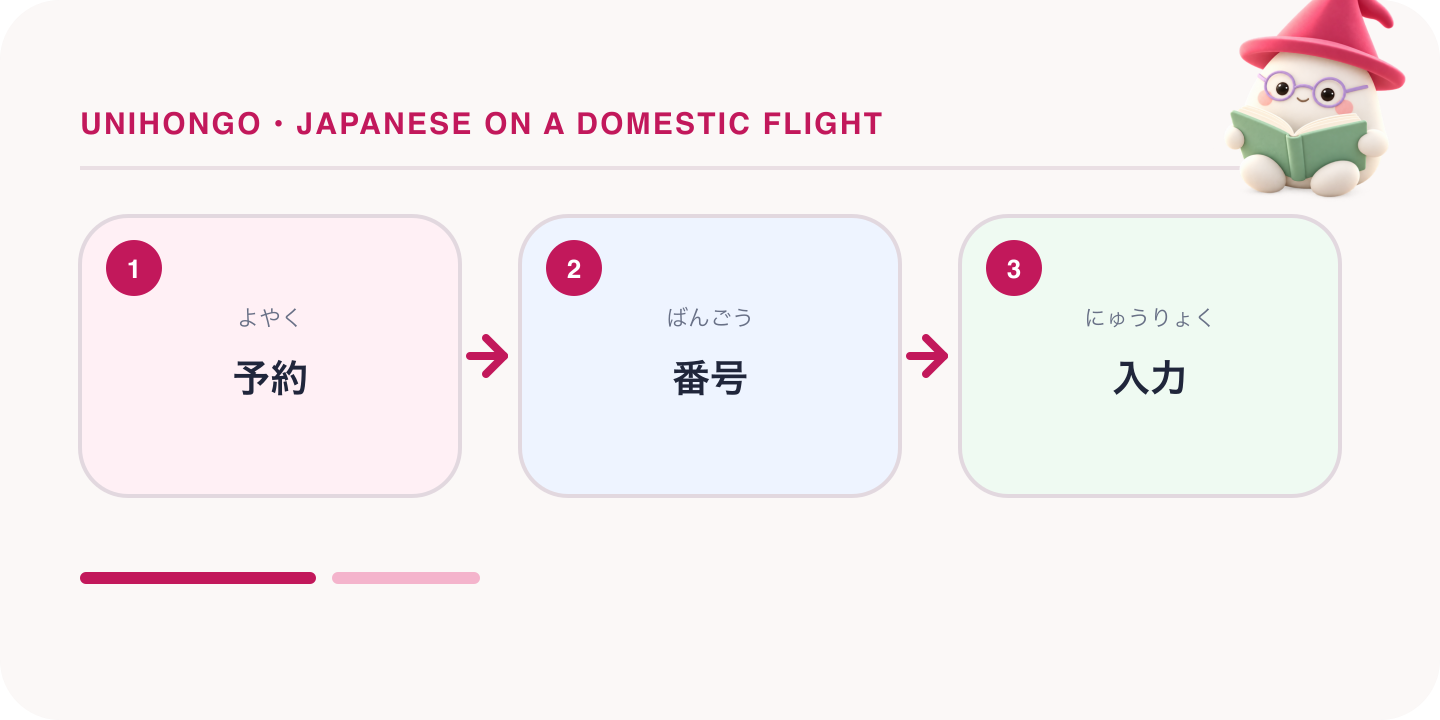
Most domestic passengers never speak to anyone at check-in. The kiosk, jidō chekku-in-ki, asks you to scan a QR code, ni-jigen kōdo, enter a reservation number, yoyaku bangō, or insert the credit card used to book. It then confirms your name, offers seat changes and prints a boarding pass, tōjōken, or a baggage tag. Larger airlines let you skip the kiosk entirely by holding the app's QR code at security and the gate.
Checked bags go to the self bag drop, jidō tenimotsu azukeki, or a staffed counter. Staff will ask whether you have any prohibited items, whether the bag contains a battery, and will hand you a claim tag, tenimotsu hikikae-shō. Free checked weight depends on the airline and fare, and LCC charge for almost every bag.
| Japanese | Romaji | Meaning |
|---|---|---|
| 予約番号を入力してください。 | Yoyaku bangō o nyūryoku shite kudasai. | Please enter your reservation number. |
| 二次元コードをかざしてください。 | Ni-jigen kōdo o kazashite kudasai. | Please hold the QR code over the reader. |
| 座席を変更しますか。 | Zaseki o henkō shimasu ka. | Would you like to change your seat? |
| 荷物を一つ預けたいんですが。 | Nimotsu o hitotsu azuketai n desu ga. | I'd like to check one bag. |
| 中にモバイルバッテリーは入っていませんか。 | Naka ni mobairu batterī wa haitte imasen ka. | Is there a power bank inside? |
| 預け荷物は何キロまで無料ですか。 | Azuke nimotsu wa nan-kiro made muryō desu ka. | Up to how many kilos is checked baggage free? |
Security without passport control
Domestic security, hoan kensa, is the same X-ray and metal detector as anywhere, but it is quicker because there is no immigration afterwards and liquids rules for domestic flights are looser than on international routes: drinks in ordinary bottles are generally allowed through, though staff may ask you to open one or test it. Laptops usually come out of the bag; shoes normally stay on.
The questions you hear are short. Staff will ask about lighters, batteries and anything sharp, and at some airports they hand you a laminated card of prohibited items and simply ask arimasen ka, you don't have any of these? Once through, look for your gate number, tōjōguchi, on the screen; at big airports the gates can be a long walk.
| Japanese | Romaji | Meaning |
|---|---|---|
| 保安検査場はこちらです。 | Hoan kensajō wa kochira desu. | The security checkpoint is this way. |
| パソコンは出してトレーに載せてください。 | Pasokon wa dashite torē ni nosete kudasai. | Please take out your laptop and put it in the tray. |
| ライターやはさみはお持ちではないですか。 | Raitā ya hasami wa o-mochi de wa nai desu ka. | You don't have a lighter or scissors, do you? |
| 入っていません。 | Haitte imasen. | No, there's nothing like that inside. |
| 飲み物は持ち込めますか。 | Nomimono wa mochikomemasu ka. | Can I bring drinks through? |
| 搭乗口は何番ですか。 | Tōjōguchi wa nanban desu ka. | Which number is the gate? |
Boarding announcements and groups
Boarding is announced in a set order that is worth learning, because the English version is often shorter or comes later. First comes the pre-boarding call for people who need extra time, small children and premium passengers, then the boarding groups, gurūpu, called by number from the back of the plane forward. Your group number is printed on the boarding pass; board out of turn and staff will politely ask you to wait.
Listen for three phrases: tōjō no go-annai, boarding announcement; saishū annai, final call; and mōshiwake gozaimasen, which introduces bad news. At the gate you scan the same QR code or pass you used at security. If your bag looks large, LCC gate staff will ask you to place it in the sizing frame, which is the moment many travellers get an unexpected fee.
| Japanese | Romaji | Meaning |
|---|---|---|
| ただいまより搭乗のご案内をいたします。 | Tadaima yori tōjō no go-annai o itashimasu. | We will now begin boarding. |
| グループ一番のお客様からご搭乗ください。 | Gurūpu ichiban no o-kyakusama kara go-tōjō kudasai. | Passengers in group one, please board first. |
| 最終のご案内です。 | Saishū no go-annai desu. | This is the final call. |
| お手荷物をこちらの枠に入れてください。 | O-tenimotsu o kochira no waku ni irete kudasai. | Please place your bag in this frame. |
| 私は何番のグループですか。 | Watashi wa nanban no gurūpu desu ka. | Which group am I in? |
In the cabin
Domestic flights are short, often under two hours, and the cabin service is light. Full-service airlines usually offer free drinks, and the crew will come through with nomimono wa ikaga desu ka; LCC sell drinks and snacks from a menu. The crew's Japanese is very polite, keigo, but the questions are predictable: what to drink, whether you need a blanket, and whether your bag can go under the seat.
The most useful contrast for a passenger is between kudasai and onegai shimasu. Both mean please, but onegai shimasu is what you say when asking the crew for something, while kudasai attached to a verb is what the crew say to you: o-suwari kudasai, please sit down. When you want to be left alone, a simple kekkō desu, I'm fine, declines the drink politely.
| Japanese | Romaji | Meaning |
|---|---|---|
| お飲み物はいかがですか。 | O-nomimono wa ikaga desu ka. | Would you like a drink? |
| 温かいお茶をお願いします。 | Atatakai o-cha o onegai shimasu. | Hot tea, please. |
| 結構です。 | Kekkō desu. | No thank you, I'm fine. |
| シートベルトをお締めください。 | Shīto beruto o o-shime kudasai. | Please fasten your seat belt. |
| 毛布をいただけますか。 | Mōfu o itadakemasu ka. | Could I have a blanket? |
| 到着は何時ごろですか。 | Tōchaku wa nanji goro desu ka. | Around what time do we arrive? |
LCC rules on bags and fees
Low-cost carriers, LCC, are cheap partly because bags are priced separately, and each airline sets its own limits on the number of pieces, the combined weight and the dimensions of hand luggage. The limits are enforced at the gate with a scale and a sizing frame, and a bag that fails is checked on the spot at a higher fee than the online price.
The vocabulary is small but important. Kinai mochikomi tenimotsu is hand luggage, azuke tenimotsu is checked luggage, chōka ryōkin is an excess fee, and jūryō seigen is the weight limit. Rules and prices change, so check the airline's page before you fly and weigh your bag at home.
| Word | Reading | Meaning |
|---|---|---|
| 国内線 | kokunaisen | Domestic flights |
| 搭乗券 | tōjōken | Boarding pass |
| 搭乗口 | tōjōguchi | Boarding gate |
| 保安検査 | hoan kensa | Security check |
| 機内持ち込み手荷物 | kinai mochikomi tenimotsu | Hand luggage |
| 預け手荷物 | azuke tenimotsu | Checked luggage |
| 重量制限 | jūryō seigen | Weight limit |
| 超過料金 | chōka ryōkin | Excess fee |
| 手荷物受取所 | tenimotsu uketorijo | Baggage claim |
| 遅延 | chien | Delay |
| 欠航 | kekkō | Cancelled flight |
| 振替 | furikae | Rebooking onto another flight |
Note the trap in kekkō: with the kanji 欠航 it means a cancelled flight, but kekkō desu, said with a smile, means no thank you. Context makes it clear, but at a counter it is worth listening for the word before it.
Delays, cancellations and rebooking
Typhoons, snow and fog cause more domestic disruption than anything else, and airlines announce it in a formula: the flight number, then chien, delay, or kekkō, cancellation, then the reason and what passengers should do. Weather cancellations are often announced the evening before in the app, with a free change or a refund offered; conditions vary by airline and cause.
At the counter, the two things to ask for are furikae, a rebooking, and haraimodoshi, a refund. If you need to reach the destination that day, ask whether a later flight has seats or whether the shinkansen is the better bet; staff will usually say honestly. If the delay makes you late, a short explanation to the person waiting matters more than the reason.
| Japanese | Romaji | Meaning |
|---|---|---|
| 本日の便は天候により欠航となりました。 | Honjitsu no bin wa tenkō ni yori kekkō to narimashita. | Today's flight has been cancelled due to weather. |
| 出発が三十分ほど遅れる見込みです。 | Shuppatsu ga sanjuppun hodo okureru mikomi desu. | Departure is expected to be delayed by about thirty minutes. |
| 次の便に振替をお願いします。 | Tsugi no bin ni furikae o onegai shimasu. | Please rebook me on the next flight. |
| 払い戻しはできますか。 | Haraimodoshi wa dekimasu ka. | Can I get a refund? |
| 今日中に着ける便はありますか。 | Kyōjū ni tsukeru bin wa arimasu ka. | Is there a flight that arrives today? |
| 飛行機が遅れているので、少し遅れます。 | Hikōki ga okurete iru node, sukoshi okuremasu. | The plane is delayed, so I'll be a bit late. |
Baggage claim and regional airports
Arrival is simple: follow tōchaku, arrivals, to the belt number shown on the screen, tenimotsu uketorijo, and match the number on your claim tag to the bag. If your bag has not appeared after the last ones come out, go to the airline counter by the belt with the tag.
Regional airports, chihō kūkō, are where domestic flying feels most Japanese. Many have one small terminal, a single belt, signs in Japanese only outside the main hall, and a bus, rimujin basu, timed to each arrival that leaves from the stand outside. Taxi ranks may be small and the last bus of the day can be earlier than you expect, so ask at the information desk, annaijo, as soon as you land.
- Check the belt number on the arrivals screen, not just the flight number
- Keep the claim tag until you leave the airport
- At a small airport, find the bus stand and timetable before doing anything else
- Ask annaijo staff which bus stop and whether you pay on the bus or buy a ticket first
- If you hired a car, look for the rental company's shuttle sign outside arrivals
Useful arrival sentences: shinai e iku basu wa doko desu ka, where is the bus to the city; tsugi no basu wa nanji desu ka, when is the next bus; and kippu wa doko de kaemasu ka, where do I buy a ticket.
When something goes wrong
The common problems on a domestic flight are missing the check-in cut-off, an overweight bag at an LCC gate, a lost bag and a missed connection. For a late arrival, go straight to the counter and say the flight number; staff will tell you honestly whether you can still make it. For an overweight bag, ask what the fee is and whether moving items to your pockets or a companion's bag solves it. For a bag that does not arrive, report it before leaving the belt area and give your hotel address.
If you need proof of a delay for insurance or work, ask for a chien shōmeisho, a delay certificate; airlines can usually provide one at the counter or online.
| Japanese | Romaji | Meaning |
|---|---|---|
| 締め切りに間に合いますか。 | Shimekiri ni maniaimasu ka. | Can I still make the cut-off? |
| 超過料金はいくらですか。 | Chōka ryōkin wa ikura desu ka. | How much is the excess fee? |
| 荷物が出てきませんでした。 | Nimotsu ga dete kimasen deshita. | My bag didn't come out. |
| ホテルに届けてもらえますか。 | Hoteru ni todokete moraemasu ka. | Could you deliver it to my hotel? |
| 遅延証明書をいただけますか。 | Chien shōmeisho o itadakemasu ka. | Could I have a delay certificate? |