

Finding lockers and reading the signs
Station signs usually show a locker icon with the words koin rokkā, and larger stations have several banks near different exits. If you cannot see any, ask a station attendant. The word for a place to store luggage in general is nimotsu azukari, so either term will be understood.
Each locker door or the central screen shows whether a locker is free. The kanji to look for are 空 for vacant and 使用中 for in use. Some lockers show a green lamp for free and red for occupied, but the colours are not universal, so the words are more reliable.
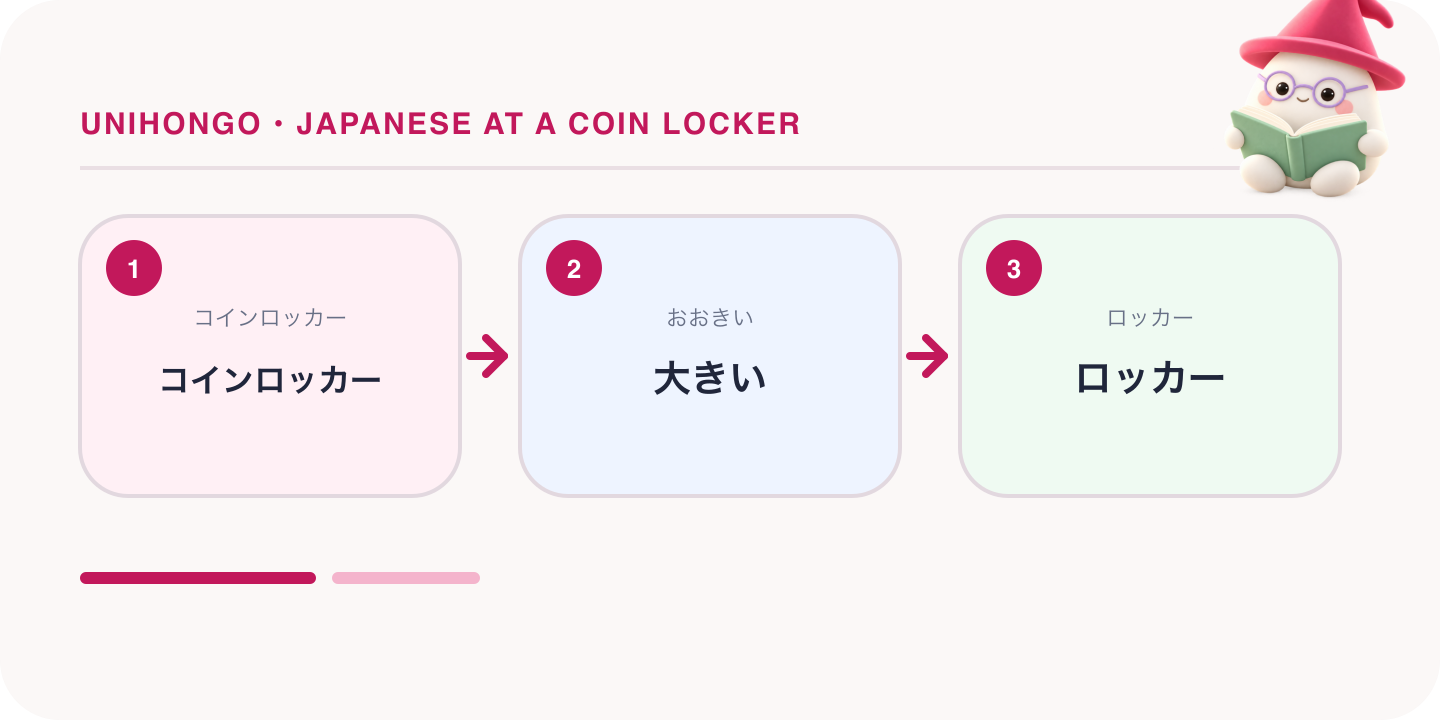
| Japanese | Romaji | Meaning |
|---|---|---|
| コインロッカーはどこですか。 | Koin rokkā wa doko desu ka. | Where are the coin lockers? |
| 大きいロッカーはありますか。 | Ōkii rokkā wa arimasu ka. | Are there any large lockers? |
| ロッカーが全部使用中です。 | Rokkā ga zenbu shiyōchū desu. | All the lockers are in use. |
| Sign | Reading | Meaning |
|---|---|---|
| コインロッカー | koin rokkā | Coin lockers |
| 空 | aki / kū | Vacant |
| 空室 | kūshitsu | Vacant (on screens) |
| 使用中 | shiyōchū | In use |
| 満 | man | Full (all lockers taken) |
| 故障中 | koshōchū | Out of order |
| 操作パネル | sōsa paneru | Control panel |
| 利用方法 | riyō hōhō | How to use |
Locker sizes and what fits
Lockers come in several sizes, usually labelled shō, chū, dai and sometimes tokudai, extra large. The size affects the price, and the fee for each size is usually shown next to the door or on the screen. The exact dimensions differ between operators, so measure by eye: a small locker takes a backpack or shopping bag, while a large suitcase may need the largest size or a staffed counter.
Some lockers show the inside dimensions in centimetres, with takasa for height, haba for width and okuyuki for depth. If your case is close to the limit, check before paying, because on touchscreen lockers the payment and locking often happen together.
| Label | Reading | Typical use |
|---|---|---|
| 小 | shō | Small: backpack, handbag |
| 中 | chū | Medium: small carry-on |
| 大 | dai | Large: carry-on suitcase |
| 特大 | tokudai | Extra large: big suitcase |
| 高さ | takasa | Height |
| 幅 | haba | Width |
| 奥行き | okuyuki | Depth |
Coin and key lockers step by step
Classic lockers work with a key. You open an empty locker, put your bag in, close the door, pay the fee shown on the door and then turn and remove the key. The key tag shows the locker number, which you will need to find the locker again. Many coin-only lockers accept only 100-yen coins, so carry some change or use a nearby change machine, ryōgaeki.
If you want to take something out and put it back in, most coin lockers treat that as a new use, and you pay again when you close it. That is worth knowing if you plan to use the locker several times during the day.
| Japanese | Romaji | Meaning |
|---|---|---|
| 扉を閉めてから料金を入れてください。 | Tobira o shimete kara ryōkin o irete kudasai. | Close the door, then insert the fee. |
| 百円硬貨のみ使用できます。 | Hyaku-en kōka nomi shiyō dekimasu. | Only 100-yen coins can be used. |
| 鍵を右に回して抜いてください。 | Kagi o migi ni mawashite nuite kudasai. | Turn the key to the right and remove it. |
| 両替機はどこですか。 | Ryōgaeki wa doko desu ka. | Where is the change machine? |
| 再度開けると料金がかかります。 | Saido akeru to ryōkin ga kakarimasu. | Opening it again will cost another fee. |
Touchscreen and IC-card lockers
Newer lockers are controlled from a central touchscreen, sōsa paneru, and many have an English button. If yours does not, the flow is short. You choose azukeru, to store, pick the locker number or size, put your bag in and close the door, then choose how to pay. After payment the machine prints a receipt, reshīto, with a PIN code, anshō bangō, or tells you to use your IC card to open it later.
To collect your bag, choose toridasu, to take out, and either enter the PIN, scan the barcode or QR code on the receipt, or touch the same IC card. If you have gone over time, the screen asks for the extra fee before the door opens.
| Japanese | Romaji | Meaning |
|---|---|---|
| 預ける | azukeru | Store (a bag) |
| 取り出す | toridasu | Take out |
| ロッカー番号を選んでください。 | Rokkā bangō o erande kudasai. | Please select the locker number. |
| 荷物を入れて扉を閉めてください。 | Nimotsu o irete tobira o shimete kudasai. | Put your bag in and close the door. |
| お支払い方法を選択してください。 | Oshiharai hōhō o sentaku shite kudasai. | Please select a payment method. |
| ICカードをタッチしてください。 | Ai-shī kādo o tatchi shite kudasai. | Please touch your IC card. |
| 暗証番号を入力してください。 | Anshō bangō o nyūryoku shite kudasai. | Please enter your PIN. |
| レシートは大切に保管してください。 | Reshīto wa taisetsu ni hokan shite kudasai. | Please keep your receipt safe. |
Time limits and overtime fees
Most lockers charge by the calendar day rather than by the hour, so the day often changes at midnight or at another time shown on the locker. If you leave a bag overnight you may pay extra when you collect it. This extra is called chōka ryōkin or tsuika ryōkin, and paying it is seisan, settling the fare.
Lockers also have a maximum storage period, hokan kigen. After it, the operator usually removes the contents and keeps them somewhere else, and getting them back involves contacting the operator and paying the fees. The period depends on the locker, so read the panel if you plan to leave a bag for more than a day.
| Word | Reading | Meaning |
|---|---|---|
| 料金 | ryōkin | Fee |
| 超過料金 | chōka ryōkin | Overtime fee |
| 追加料金 | tsuika ryōkin | Additional charge |
| 精算 | seisan | Settling the balance |
| 保管期限 | hokan kigen | Storage limit |
| 日付が変わると | hizuke ga kawaru to | When the date changes |
| 撤去 | tekkyo | Removal (of items) |
When something goes wrong
The most common problems are a lost key, a lost receipt, a forgotten PIN, a door that will not open or a locker that took your money. Each locker bank has a contact number, toiawase, printed on it, and station staff can usually tell you who manages the lockers, which may be the railway or a separate company.
Staff will ask for the locker number, roughly when you left the bag and what is inside, and they will usually ask to see identification before opening it. Keep your explanation short: what happened, which locker, and what you need.
| Japanese | Romaji | Meaning |
|---|---|---|
| ロッカーの鍵をなくしました。 | Rokkā no kagi o nakushimashita. | I've lost my locker key. |
| レシートをなくしました。 | Reshīto o nakushimashita. | I've lost the receipt. |
| 暗証番号を忘れました。 | Anshō bangō o wasuremashita. | I've forgotten the PIN. |
| 扉が開きません。 | Tobira ga akimasen. | The door won't open. |
| お金を入れたのに閉まりません。 | Okane o ireta noni shimarimasen. | I put money in but it won't lock. |
| ロッカーの番号は25番です。 | Rokkā no bangō wa nijūgo-ban desu. | The locker number is 25. |
| 中身はスーツケースです。 | Nakami wa sūtsukēsu desu. | Inside is a suitcase. |
| 身分証明書はパスポートでいいですか。 | Mibun shōmeisho wa pasupōto de ii desu ka. | Is my passport all right as ID? |
Staffed baggage counters
When lockers are full or your luggage is too large, look for a staffed counter, tenimotsu azukarisho or nimotsu azukarijo. Major stations, airports and some tourist areas have them. Staff take your bag, give you a tag or receipt and tell you until what time you can collect it. Opening hours matter here, because unlike lockers the counter closes at night.
Some counters and services can also send luggage to your hotel or the airport, often called tebura kankō, hands-free sightseeing. Availability, prices and cut-off times vary, so ask at the counter.
| Japanese | Romaji | Meaning |
|---|---|---|
| 荷物を預かってもらえますか。 | Nimotsu o azukatte moraemasu ka. | Could you keep my luggage? |
| 何時まで預けられますか。 | Nanji made azukeraremasu ka. | Until what time can I leave it? |
| スーツケース一つです。 | Sūtsukēsu hitotsu desu. | One suitcase. |
| この荷物をホテルに送れますか。 | Kono nimotsu o hoteru ni okuremasu ka. | Can you send this luggage to my hotel? |
| 預かり証をなくさないでください。 | Azukarishō o nakusanaide kudasai. | Please don't lose your claim ticket. |
| 荷物を取りに来ました。 | Nimotsu o tori ni kimashita. | I've come to collect my luggage. |
Locker etiquette and good habits
- Do not store food that can spoil, valuables you cannot replace, or anything dangerous; lockers usually list prohibited items.
- Close the door gently and check it is locked before you walk away by pulling it lightly.
- Note the exit name as well as the locker number, since large stations have many banks of lockers.
- If you are travelling as a group, one large locker is often cheaper than several small ones.
- Collect your bag before your storage period ends so that it is not removed.
The two verbs that run the whole system are azukeru, to leave in someone's care, and toridasu, to take out. Once you recognise them, almost every locker screen and baggage counter in Japan becomes easy to follow.