

Tickets, hours and audio guides
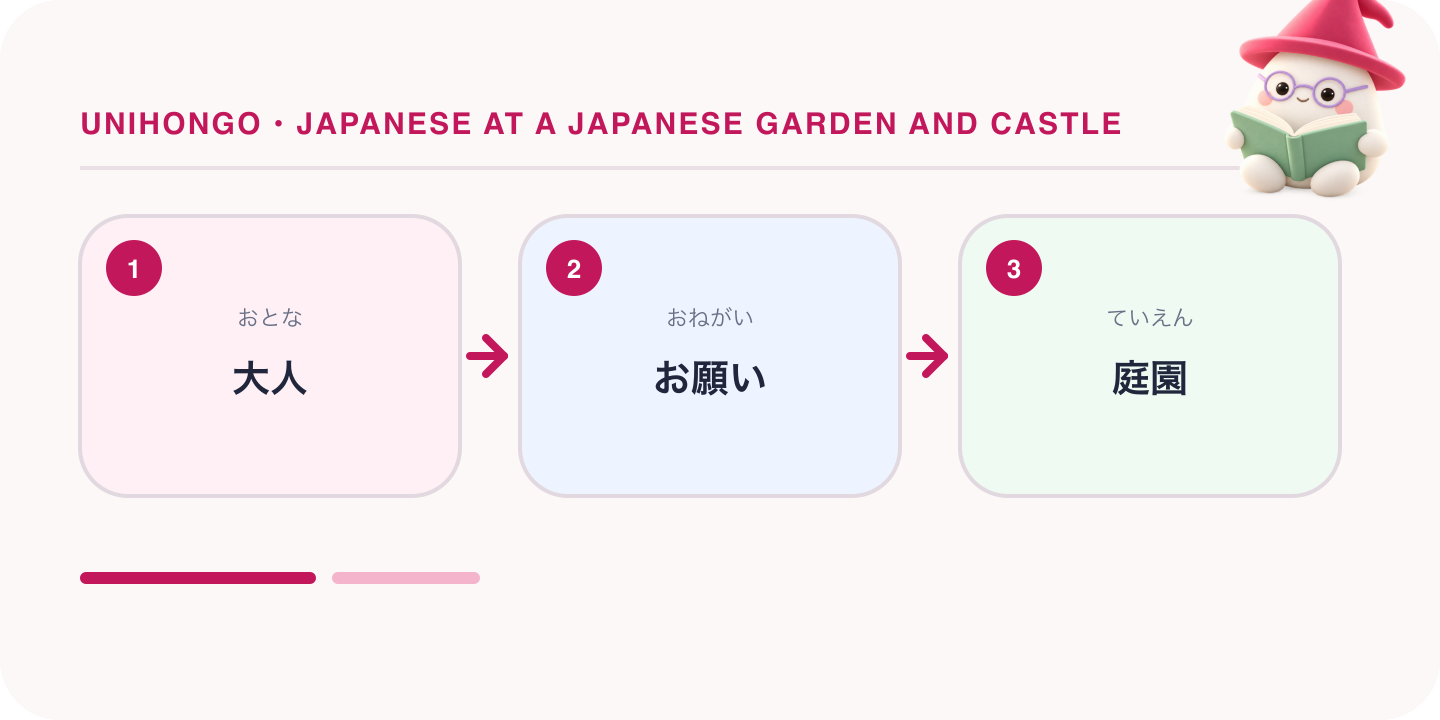
The ticket window is the kippu uriba or chiketto uriba, and the ticket itself is a nyūjōken, an entry ticket. Many castles sit inside a park with a paid inner area, and many gardens sit next to a castle, so a kyōtsūken, a combined ticket, is often available and slightly cheaper than two separate ones. Ask for it by name. Adults are otona, children kodomo, and reduced tickets for students and seniors exist at some sites but require ID.
Two times matter: heikan, closing, and saishū nyūjō, last entry, which is usually thirty minutes to an hour before closing. Audio guides, onsei gaido, are rented at the window or a nearby counter, sometimes for a fee and sometimes as a free app you download at the gate. Prices, languages and closing times all vary by site and season, so read the board beside the window or ask.
| Japanese | Romaji | Meaning |
|---|---|---|
| 大人一枚お願いします。 | Otona ichimai onegai shimasu. | One adult ticket, please. |
| お城と庭園の共通券はありますか。 | O-shiro to teien no kyōtsūken wa arimasu ka. | Is there a combined ticket for the castle and garden? |
| 最終入場は何時ですか。 | Saishū nyūjō wa nanji desu ka. | What time is last entry? |
| 英語の音声ガイドはありますか。 | Eigo no onsei gaido wa arimasu ka. | Do you have an audio guide in English? |
| 音声ガイドはいくらですか。 | Onsei gaido wa ikura desu ka. | How much is the audio guide? |
| パンフレットをもらえますか。 | Panfuretto o moraemasu ka. | Could I have a leaflet? |
Reading the castle signs
A castle is a set of enclosures, each called a maru or kuruwa. The honmaru is the innermost, where the keep stands; the ninomaru and sannomaru are the second and third enclosures, now often lawns or museums. The keep itself is the tenshu or tenshukaku, and a smaller attached tower is a ko-tenshu. Walls of fitted stone are ishigaki, and the moat is a hori: mizubori if it holds water, karabori if dry.
Gates are mon, and a masugata is the square courtyard between two gates designed to trap attackers. Along the walls stand yagura, corner turrets, and the plaster wall on top is a dobei. Signs also tell you what is genuine: genzon means original and surviving, saiken means rebuilt, and fukugen means reconstructed following old plans. A castle described as a genzon tenshu is one of the handful with an original keep, which is why its stairs are so steep.
| Japanese | Romaji | Meaning |
|---|---|---|
| 天守閣はどちらですか。 | Tenshukaku wa dochira desu ka. | Which way is the keep? |
| この天守は現存ですか。 | Kono tenshu wa genzon desu ka. | Is this keep an original? |
| 石垣はいつ頃のものですか。 | Ishigaki wa itsu goro no mono desu ka. | Roughly when do the stone walls date from? |
| 本丸まで歩いてどのくらいですか。 | Honmaru made aruite dono kurai desu ka. | How far is it on foot to the inner bailey? |
| 階段が急なので気をつけてください。 | Kaidan ga kyū na node ki o tsukete kudasai. | The stairs are steep, so please take care. |
| 靴はここで脱ぎますか。 | Kutsu wa koko de nugimasu ka. | Do I take my shoes off here? |
Castle and garden vocabulary
The explanation boards, setsumei-ban, use the same few dozen words at every site. The ones below cover most of what you will read on a castle map and a garden map.
| Word | Reading | Meaning |
|---|---|---|
| 天守 | tenshu | Castle keep, the main tower |
| 本丸 | honmaru | Inner bailey, the central enclosure |
| 二の丸 | ninomaru | Second enclosure |
| 石垣 | ishigaki | Stone walls |
| 堀 | hori | Moat |
| 櫓 | yagura | Turret |
| 枯山水 | karesansui | Dry landscape garden of gravel and rocks |
| 池泉回遊式 | chisen kaiyū-shiki | Stroll garden around a pond |
| 茶室 | chashitsu | Tea house or tea room |
| 飛び石 | tobiishi | Stepping stones |
| 灯籠 | tōrō | Stone lantern |
| 借景 | shakkei | Borrowed scenery, a view framed by the garden |
Two more useful signs: junro, the recommended route, marked with arrows so that visitors flow one way through a keep; and tachiiri kinshi, no entry, on ropes across moss and gravel.
Walking the garden
Most large gardens attached to castles are chisen kaiyū-shiki teien, stroll gardens around a pond, designed so the view changes at every turn of the path. The pond is the ike, islands are shima, and the bridges are hashi, often a stone slab or an arched red taikobashi. Paths of tobiishi, stepping stones, set the pace: you walk slowly because the stones make you. Lanterns, tōrō, and a small waterfall, taki, mark the viewpoints.
A karesansui garden is different. It is viewed from a veranda, the engawa, and never entered. The gravel, shirakawa-suna, is raked into patterns representing water, and the rocks stand for mountains or islands. Sit, look, and keep your voice low; these gardens usually belong to a temple and the rooms behind you may be in use. Moss, koke, is fragile everywhere, and the ropes and small signs are there to protect it.
| Japanese | Romaji | Meaning |
|---|---|---|
| 順路はこちらですか。 | Junro wa kochira desu ka. | Is the route this way? |
| この庭は何時代に作られましたか。 | Kono niwa wa nani jidai ni tsukuraremashita ka. | In what period was this garden made? |
| ここは立ち入り禁止です。 | Koko wa tachiiri kinshi desu. | This area is off limits. |
| 苔を踏まないでください。 | Koke o fumanaide kudasai. | Please don't step on the moss. |
| 一番きれいな眺めはどこですか。 | Ichiban kirei na nagame wa doko desu ka. | Where is the best view? |
| 紅葉はいつ頃が見頃ですか。 | Kōyō wa itsu goro ga migoro desu ka. | When are the autumn leaves at their best? |
Guided tours and asking questions
Many castles have volunteer guides, borantia gaido, waiting near the entrance with a sash or a badge, and some offer tours in English. A tour in Japanese is still worth joining if you know the vocabulary above, because guides point as they speak. They tend to use a few fixed patterns: kore wa X to iimasu, this is called X; X wa Y no tame ni tsukuraremashita, X was built for Y; and a date in the form sen-roppyaku-nen goro, around 1600.
To ask a question, catch the pause after an explanation and use sumimasen, shitsumon ga arimasu, excuse me, I have a question. Questions about purpose, nan no tame desu ka, and age, itsu no mono desu ka, are the easiest and most welcome. If the explanation is too fast, ask mō sukoshi yukkuri onegai shimasu. Guides will often slow down and simplify without being asked once they notice a learner.
| Japanese | Romaji | Meaning |
|---|---|---|
| ガイドツアーは何時からですか。 | Gaido tsuā wa nanji kara desu ka. | What time does the guided tour start? |
| 英語のツアーはありますか。 | Eigo no tsuā wa arimasu ka. | Is there a tour in English? |
| これは何のためのものですか。 | Kore wa nan no tame no mono desu ka. | What was this for? |
| 石垣はどうやって積んだんですか。 | Ishigaki wa dō yatte tsunda n desu ka. | How were the stone walls built? |
| もう少しゆっくりお願いします。 | Mō sukoshi yukkuri onegai shimasu. | A little slower, please. |
| とても勉強になりました。 | Totemo benkyō ni narimashita. | I learned a lot, thank you. |
Photography and other rules
Rules differ from site to site, so treat these as the common patterns rather than a fixed list. Grounds and views are almost always free to photograph. Inside a keep or a museum room, look for the pictogram and the words below.
- Satsuei kinshi: no photography, usually where original artefacts are displayed
- Furasshu kinshi: no flash, common in wooden keeps and painted rooms
- Sankyaku kinshi: no tripods, and jidori-bō kinshi, no selfie sticks
- Dosoku kinshi: no outdoor shoes, take them off at the entrance
- Inshoku kinshi: no eating or drinking, typical inside buildings
- Dorōn kinshi: no drones, standard at nearly every castle and garden
- Shōgyō satsuei wa yoyaku ga hitsuyō: commercial photography requires prior permission
When in doubt, ask a member of staff: koko de shashin o tottemo ii desu ka, may I take a photo here? A wedding party in kimono having pictures taken in the garden is a common sight; give them room and do not photograph them without asking.
The tea house in the garden
Many stroll gardens have a chashitsu or a chaya, a tea house, where you can sit with a bowl of matcha and a seasonal sweet. It is a relaxed version of a tea ceremony rather than the formal event itself. You order at the entrance or from a server, choose a seat inside on tatami or outside on a red-covered bench, and the tea arrives with the sweet on a small plate. Eat the sweet first, then drink the tea in a few sips. Whether tea is included in your garden ticket, and what it costs if not, varies by garden.
Staff may explain the sweet, the season and the view, so a few questions go a long way. A formal tea ceremony has its own phrases and manners, which are covered in a separate guide; here, simply being quiet and unhurried is enough.
| Japanese | Romaji | Meaning |
|---|---|---|
| お抹茶とお菓子のセットをお願いします。 | O-matcha to okashi no setto o onegai shimasu. | The matcha and sweet set, please. |
| 中で座ってもいいですか。 | Naka de suwattemo ii desu ka. | May I sit inside? |
| このお菓子は何ですか。 | Kono okashi wa nan desu ka. | What is this sweet? |
| お菓子を先にどうぞ。 | Okashi o saki ni dōzo. | Please have the sweet first. |
| お庭を見ながらいただきます。 | O-niwa o minagara itadakimasu. | I'll enjoy it while looking at the garden. |
| ごちそうさまでした。 | Gochisōsama deshita. | Thank you for the tea (said when leaving). |
When something goes wrong
The usual problems are timing and access. If you arrive after last entry, the staff will say honjitsu no nyūjō wa shūryō shimashita, entry has finished for today; ask what time it opens tomorrow rather than arguing. Steep stairs in original keeps are difficult for some visitors, and lifts are rare in historic buildings, so ask at the window whether a step-free route exists. Lost items go to the office, jimusho, and large sites have a lost property desk.
If you have left something on the audio guide counter, forgotten to return the guide, or cannot find the exit because the one-way route has closed a path, any staff member in a uniform or with an armband will help. A calm sumimasen and a short sentence is enough.
| Japanese | Romaji | Meaning |
|---|---|---|
| 明日は何時に開きますか。 | Ashita wa nanji ni akimasu ka. | What time does it open tomorrow? |
| 階段を使わないルートはありますか。 | Kaidan o tsukawanai rūto wa arimasu ka. | Is there a route without stairs? |
| 音声ガイドを返し忘れました。 | Onsei gaido o kaeshi wasuremashita. | I forgot to return the audio guide. |
| 出口はどこですか。 | Deguchi wa doko desu ka. | Where is the exit? |
| 庭で帽子を落としたみたいです。 | Niwa de bōshi o otoshita mitai desu. | I seem to have dropped my hat in the garden. |