

Why Rikugi-en is worth the stroll
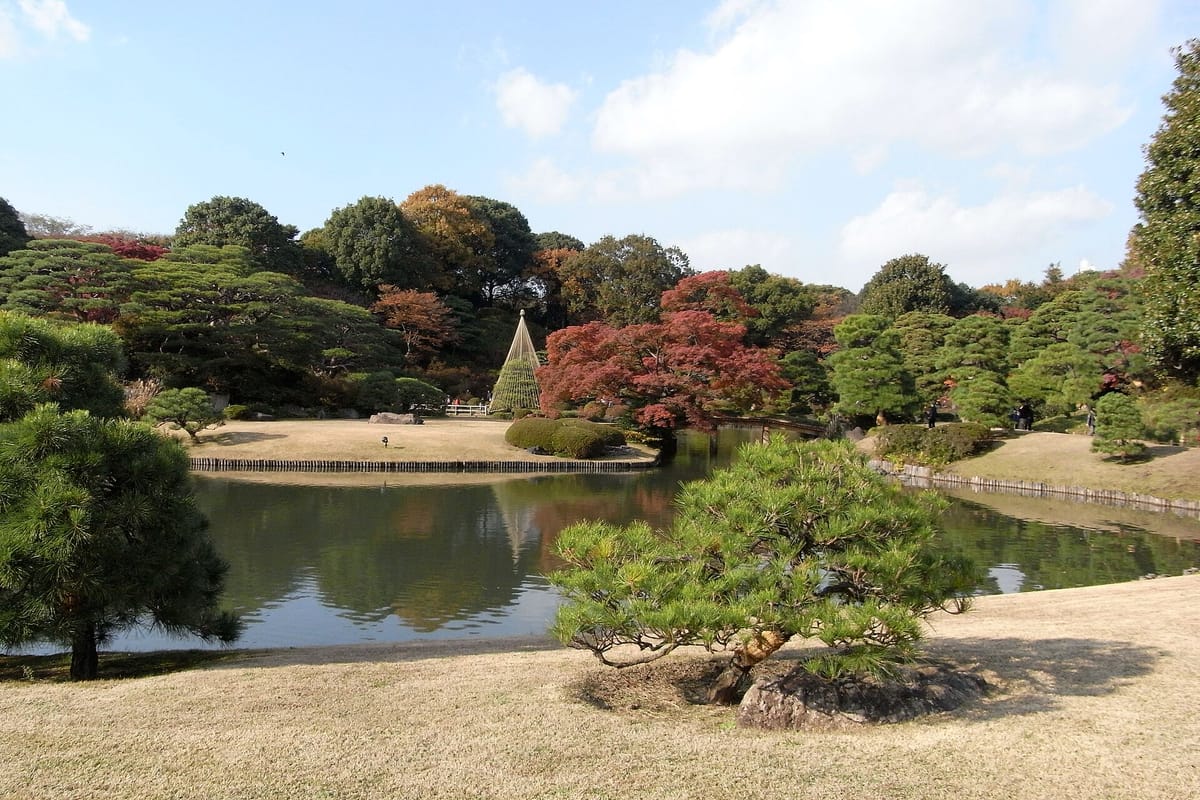
Rikugi-en was laid out in 1702 by Yanagisawa Yoshiyasu, lord of the Kawagoe domain and one of the most trusted men of the fifth shogun, Tokugawa Tsunayoshi. He designed it as a kaiyū-style garden, a circuit garden, with artificial hills and a large pond that you walk around, and he filled it with references to waka, the classical 31-syllable poetry of the court. The garden recreates eighty-eight scenes, many from Wakanoura, a famous stretch of coast in Wakayama that appears again and again in old poems.
In 1878 the garden became a villa of Iwasaki Yatarō, the founder of Mitsubishi, and in 1938 the Iwasaki family gave it to the City of Tokyo. It was named a Special Place of Scenic Beauty by the national government in 1953, and it is now one of the nine Tokyo Metropolitan cultural heritage gardens.
What makes it special today is the calm. The garden is not huge, a little under nine hectares, but the paths twist through woods, over small bridges and up and down hills so that the pond is always changing shape. For a learner, the poetic names on the signs are an invitation to look up words: tōge, a mountain pass; hashi, a bridge; chaya, a teahouse; shima, an island.
Getting there: Komagome Station and the Main Gate
The easiest route is from Komagome Station. From the JR Yamanote Line, use the south exit, minamiguchi; from the Tokyo Metro Namboku Line, use exit 2. The garden's leaflet gives about seven minutes on foot to the Main Gate, seimon, following the garden wall along Hongō-dōri to the south. The Someimon gate is much closer to the station, but it opens only occasionally, for events and busy seasons.
From the Toei Mita Line, Sengoku Station exit A3 is about ten minutes from the Main Gate. There is no parking. The ticket window at the Main Gate accepts cash, major credit cards, transport IC cards and several QR code payment apps, and a daytime ticket can also be bought online.
| Japanese | Romaji | Meaning |
|---|---|---|
| 六義園はどちらですか。 | Rikugien wa dochira desu ka. | Which way is Rikugi-en? |
| 南口はどこですか。 | Minamiguchi wa doko desu ka. | Where is the south exit? |
| 正門まで歩いて何分くらいですか。 | Seimon made aruite nanpun kurai desu ka. | About how many minutes on foot to the Main Gate? |
| 染井門は今日開いていますか。 | Someimon wa kyō aite imasu ka. | Is the Someimon gate open today? |
| 入園券を大人一枚ください。 | Nyūenken o otona ichimai kudasai. | One adult entry ticket, please. |
| 交通系ICカードで払えますか。 | Kōtsūkei IC kādo de haraemasu ka. | Can I pay with a transport IC card? |
Around the pond: what you will see
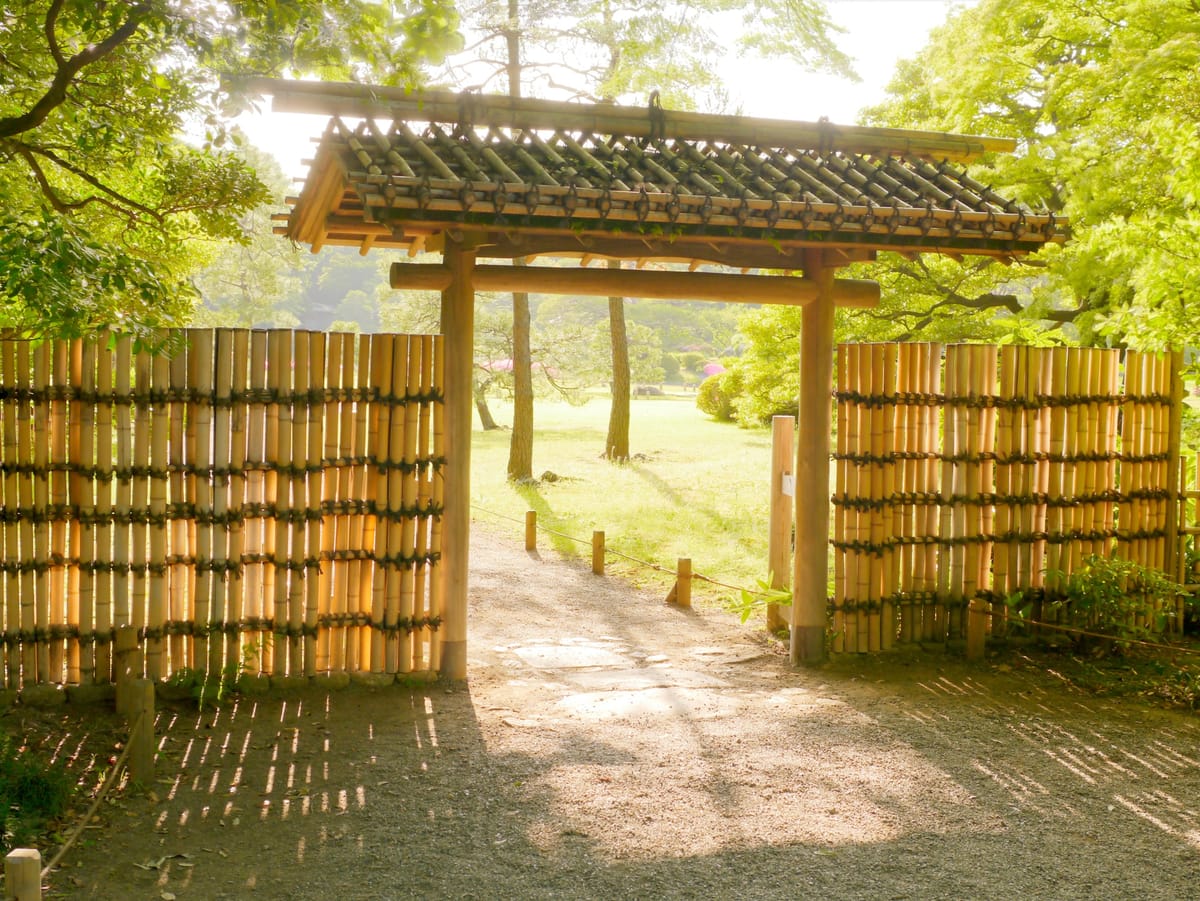
From the Main Gate, walk through the Naitei Daimon, the inner gate, and you arrive at the garden's most famous tree, a large weeping cherry. Beyond it the pond opens up, and the path loops all the way round it, past the islands and teahouses and up the hill at the back. The garden's English leaflet includes a map that names the main viewpoints.
Only thirty-two of the original stone pillars that once marked the eighty-eight poetic scenes survive, but many of the names are still used on the signs and the map.
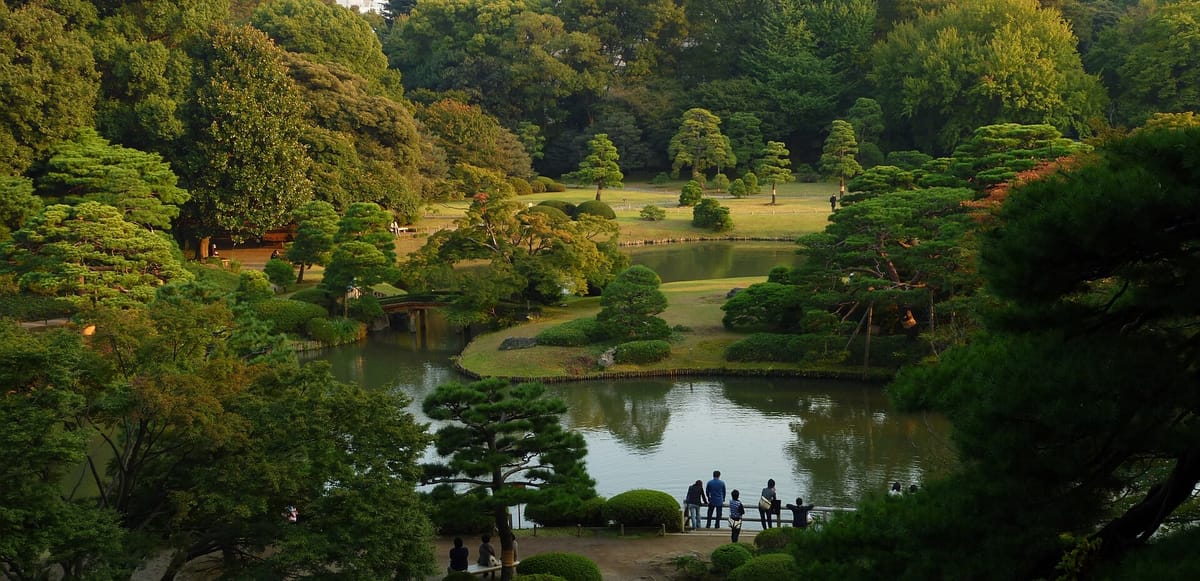
- Naitei Daimon: the inner gate that leads into the centre of the garden, with the great weeping cherry, shidarezakura, beside it.
- Fujishiro-tōge: the highest artificial hill, about 35 metres high, with a panoramic view over the pond from the top.
- Togetsukyō: a stone bridge named after a poem about the moon crossing the sky like a traveller crossing a bridge.
- Tsutsuji-chaya: a Meiji-era teahouse built from azalea wood, which survived the war and is framed by maples in autumn.
- Takimi-chaya: an arbour beside a mountain stream where you can watch and hear a small waterfall over the rocks.
- Hōrai-jima: a stone arch islet representing the mythical island of immortals, a classic motif of Japanese gardens.
- Imo-no-yama and Se-no-yama: twin hills on the central island, Naka-no-shima, representing woman and man; the island itself is off-limits.
- Fukiage-chaya: the teahouse by the pond where you can sit down with matcha and a Japanese sweet.
Words on the garden signs
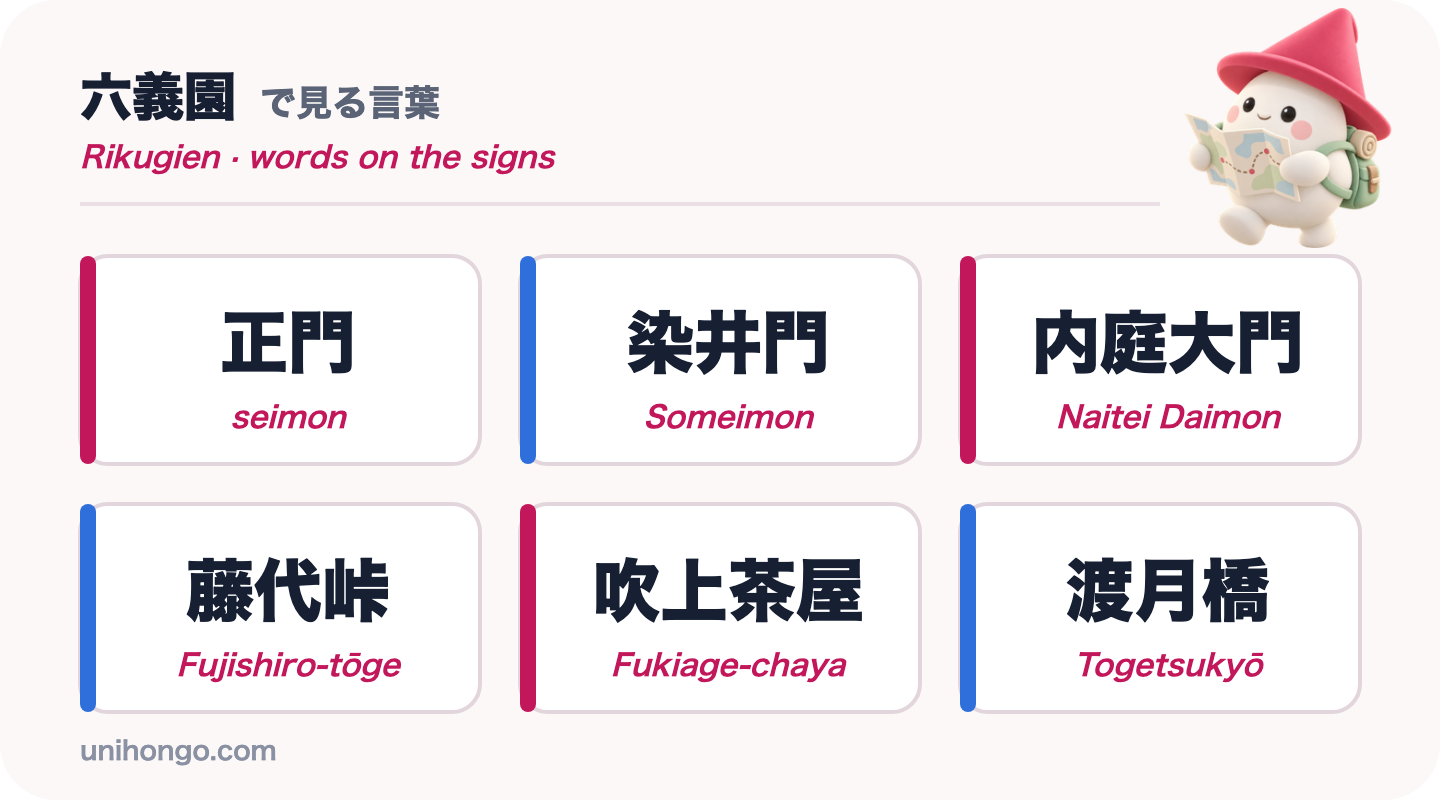
The signs at Rikugi-en mix everyday garden words with poetic place names. The everyday words are easy to learn: 門, mon, gate; 峠, tōge, a pass or hilltop; 橋, hashi or -kyō, bridge; 茶屋, chaya, teahouse; 島, shima or -jima, island. Once you know them, the names on the map become readable even if the poetry behind them takes longer to understand.
The kanji in 渡月橋, Togetsukyō, are a good example: 渡 is to cross, 月 is the moon and 橋 is a bridge. The bridge of the crossing moon is the same name as a famous bridge in Arashiyama in Kyoto.
| Word | Reading | Meaning |
|---|---|---|
| 正門 | seimon | Main Gate, the usual entrance |
| 染井門 | Someimon | Side gate near Komagome, opened only at times |
| 内庭大門 | Naitei Daimon | Inner gate into the centre of the garden |
| 藤代峠 | Fujishiro-tōge | The highest artificial hill, a viewpoint |
| 吹上茶屋 | Fukiage-chaya | Teahouse by the pond serving matcha |
| 渡月橋 | Togetsukyō | Stone bridge of the crossing moon |
| つつじ茶屋 | Tsutsuji-chaya | Meiji-era teahouse of azalea wood |
| 蓬莱島 | Hōrai-jima | Stone arch islet of the immortals |
| 入園券 | nyūenken | Garden entry ticket |
| しだれ桜 | shidarezakura | Weeping cherry tree |
Japanese at the teahouse: matcha by the pond
Fukiage-chaya, on the edge of the pond, is the place to rest. You order matcha, powdered green tea, served with a small Japanese sweet, wagashi, and drink it looking out over the water. It is not a formal tea ceremony, and nobody expects you to know the rules, but a few polite phrases and one or two habits make it more enjoyable.
Eat the sweet first: its sweetness balances the bitterness of the tea. Hold the bowl with your right hand and support it with your left palm, and if the bowl has a decorated front, turn it slightly so you do not drink from the front. When you finish, gochisōsama deshita, thank you for the meal, is the natural thing to say.
| Japanese | Romaji | Meaning |
|---|---|---|
| 吹上茶屋はどちらですか。 | Fukiage-chaya wa dochira desu ka. | Which way is Fukiage-chaya? |
| お抹茶とお菓子のセットをお願いします。 | O-matcha to o-kashi no setto o onegai shimasu. | The matcha and sweet set, please. |
| 外の席に座ってもいいですか。 | Soto no seki ni suwatte mo ii desu ka. | May I sit outside? |
| お菓子は先に食べますか。 | O-kashi wa saki ni tabemasu ka. | Do I eat the sweet first? |
| このお菓子は何という名前ですか。 | Kono o-kashi wa nan to iu namae desu ka. | What is this sweet called? |
| とてもおいしかったです。ごちそうさまでした。 | Totemo oishikatta desu. Gochisōsama deshita. | It was delicious. Thank you. |
Etiquette, seasons and practical tips
Rikugi-en is a cultural property as well as a park, and its rules are there to protect the landscape.
- Stay on the paths; the central island and some slopes are off-limits.
- Pets are not allowed (assistance dogs are welcome), and neither are alcohol, picnic mats or collecting plants.
- Photography and sketching are allowed in most places but prohibited in certain areas to protect the buildings and landscape; look for the signs.
- Smoking is not allowed anywhere in the garden.
- Come on a weekday morning in cherry blossom and autumn leaf season, when queues at the gate can be long.
- Check the official site for this season's hours and any evening illuminations, which need a separate night ticket.
- The garden is closed only over the New Year holidays, from 29 December to 1 January.
- Join a free English guided tour on the first or third Sunday of the month, outside July and August.
Practise the garden walk before you go
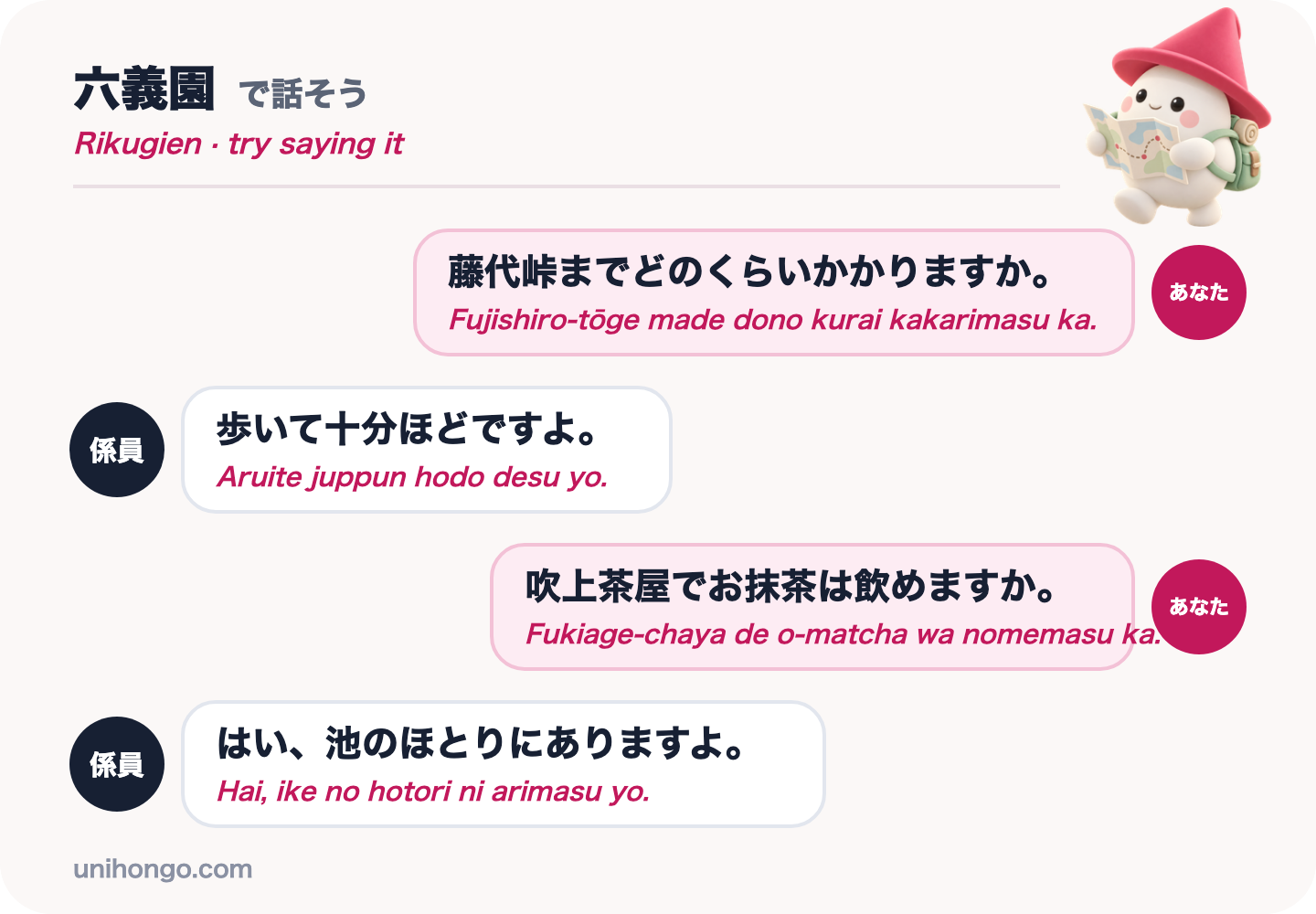
The conversation you are most likely to have at Rikugi-en is with an attendant near the gate or on the path: how far to the hilltop, and where to find tea. Listen for hodo, about, after the number of minutes, and for hotori, the edge or side of the pond, which is a lovely word to add to your vocabulary.
Practise the four lines aloud until you can say them without reading, then rehearse with a partner who answers back. In Unihongo, choose the Sightseeing topic and ask your AI Sensei to play a garden attendant, then try the Tea Ceremony topic to rehearse the teahouse.
| Japanese | Romaji | Meaning |
|---|---|---|
| 藤代峠までどのくらいかかりますか。 | Fujishiro-tōge made dono kurai kakarimasu ka. | How long does it take to get to Fujishiro-tōge? |
| 歩いて十分ほどですよ。 | Aruite juppun hodo desu yo. | About ten minutes on foot. |
| 吹上茶屋でお抹茶は飲めますか。 | Fukiage-chaya de o-matcha wa nomemasu ka. | Can I have matcha at Fukiage-chaya? |
| はい、池のほとりにありますよ。 | Hai, ike no hotori ni arimasu yo. | Yes, it's by the edge of the pond. |
Official information
Rikugi-en is run by the Tokyo Metropolitan Park Association, which publishes the fees, access details, guided tour dates and any special evening openings. Check before you go, especially in cherry blossom and autumn leaf seasons.