

Why Tsukiji Outer Market is still worth an early start
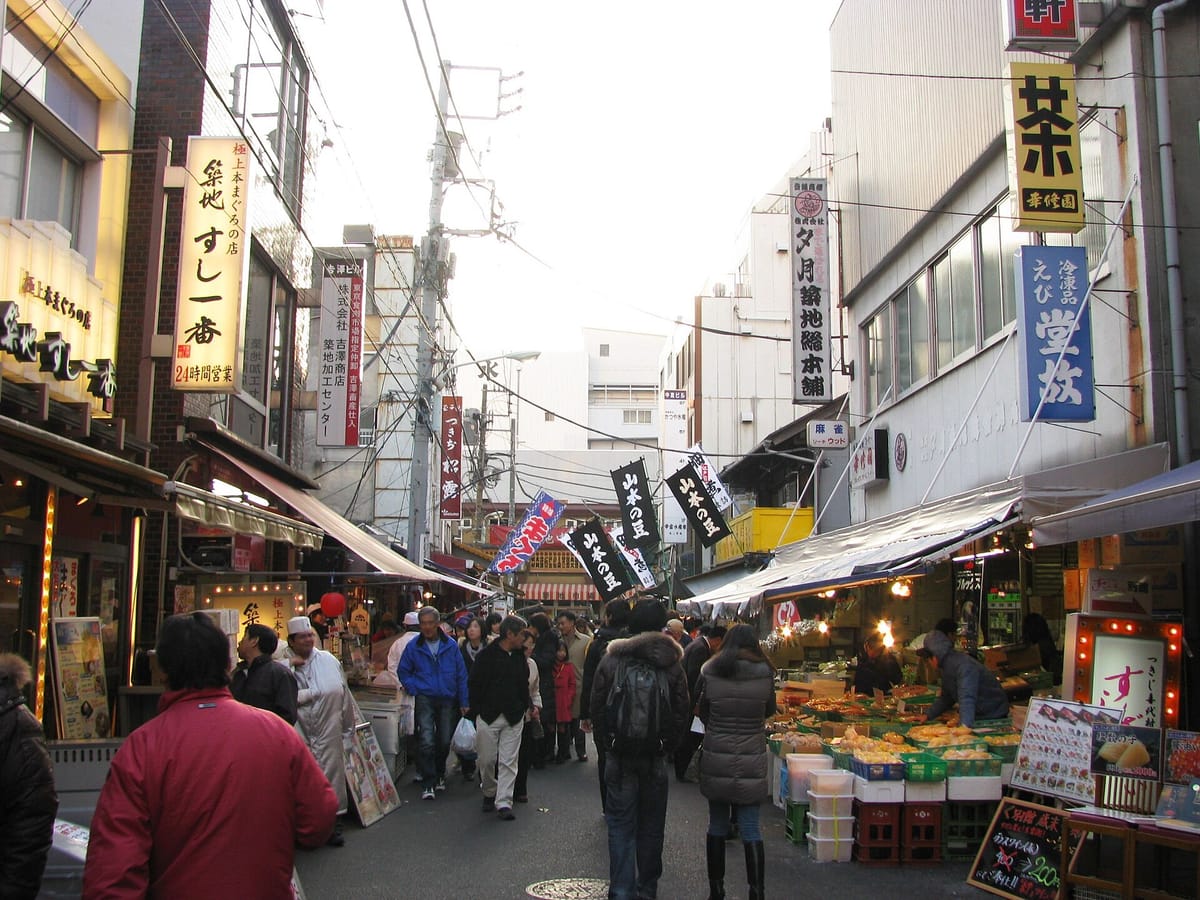
Tsukiji means built land. The area was reclaimed from the sea in the seventeenth century, after the Great Fire of Meireki in 1657, and Tokyo's central wholesale market moved here in 1935, after the 1923 Great Kantō earthquake destroyed the old fish market at Nihonbashi. Around its walls grew the outer market, where restaurants, chefs and ordinary shoppers bought fish, vegetables, dried goods and the knives and tools of the kitchen trade.
When the wholesale market moved to Toyosu in 2018, the outer market stayed. Today it is a few blocks of narrow lanes with several hundred shops, many of them family businesses running for generations, alongside sushi counters and seafood-bowl restaurants that open early. It is a working market as well as a sight: professionals shop here in the early morning, and the market asks visitors to let them go first.
For a learner, Tsukiji is ordering practice in its simplest form. Everything is on display, one piece of something costs little, and each stall is a short conversation: what is this, one please, can I eat it here. By the end of the morning you will have said kudasai a dozen times.
Getting there: Tsukiji and Tsukiji-shijō stations
Two subway stations sit at the edge of the market. Tsukiji Station on the Tokyo Metro Hibiya Line is a short walk from its eastern side, past the striking Tsukiji Hongan-ji temple. Tsukiji-shijō Station on the Toei Ōedo Line is on its western side. Higashi-Ginza Station, on the Hibiya and Toei Asakusa lines, is a slightly longer walk, and from central Ginza you can simply walk in fifteen minutes or so.
Come early and on a weekday. The shops open in the early morning, the restaurants from around breakfast time, and the market is liveliest until late morning; by early afternoon many stalls are closing. Check the market calendar before you go, because most shops close on Sundays and national holidays and many also close on some Wednesdays.
| Japanese | Romaji | Meaning |
|---|---|---|
| 築地場外市場はどちらですか。 | Tsukiji jōgai shijō wa dochira desu ka. | Which way is Tsukiji Outer Market? |
| 築地市場駅と築地駅、どちらが近いですか。 | Tsukiji-shijō-eki to Tsukiji-eki, dochira ga chikai desu ka. | Which is closer, Tsukiji-shijō Station or Tsukiji Station? |
| このお店は何時まで開いていますか。 | Kono o-mise wa nanji made aite imasu ka. | Until what time is this shop open? |
| コインロッカーはありますか。 | Koin rokkā wa arimasu ka. | Are there coin lockers? |
| 波除神社はどこですか。 | Namiyoke Jinja wa doko desu ka. | Where is Namiyoke Shrine? |
What to eat and see in the lanes
The best approach is grazing. Start with tamagoyaki, the sweet, layered omelette that several shops make in front of you and sell by the slice on a stick. Move on to grilled seafood: scallops, oysters or skewers cooked over charcoal or on a hot plate. Then sit down for a kaisendon, a bowl of rice topped with raw fish, or a set of sushi at one of the counters, many of which open for breakfast.
Between bites, look at the shops that serve the trade: knife makers who will engrave your name on a blade, sellers of dried bonito and kelp for making dashi, tea merchants and kitchenware shops. On the market's edge, Namiyoke Inari Jinja, the shrine that protects against waves, has huge carved lion heads and memorial stones for eggs, sushi and fish, put up by the trades that depend on them.
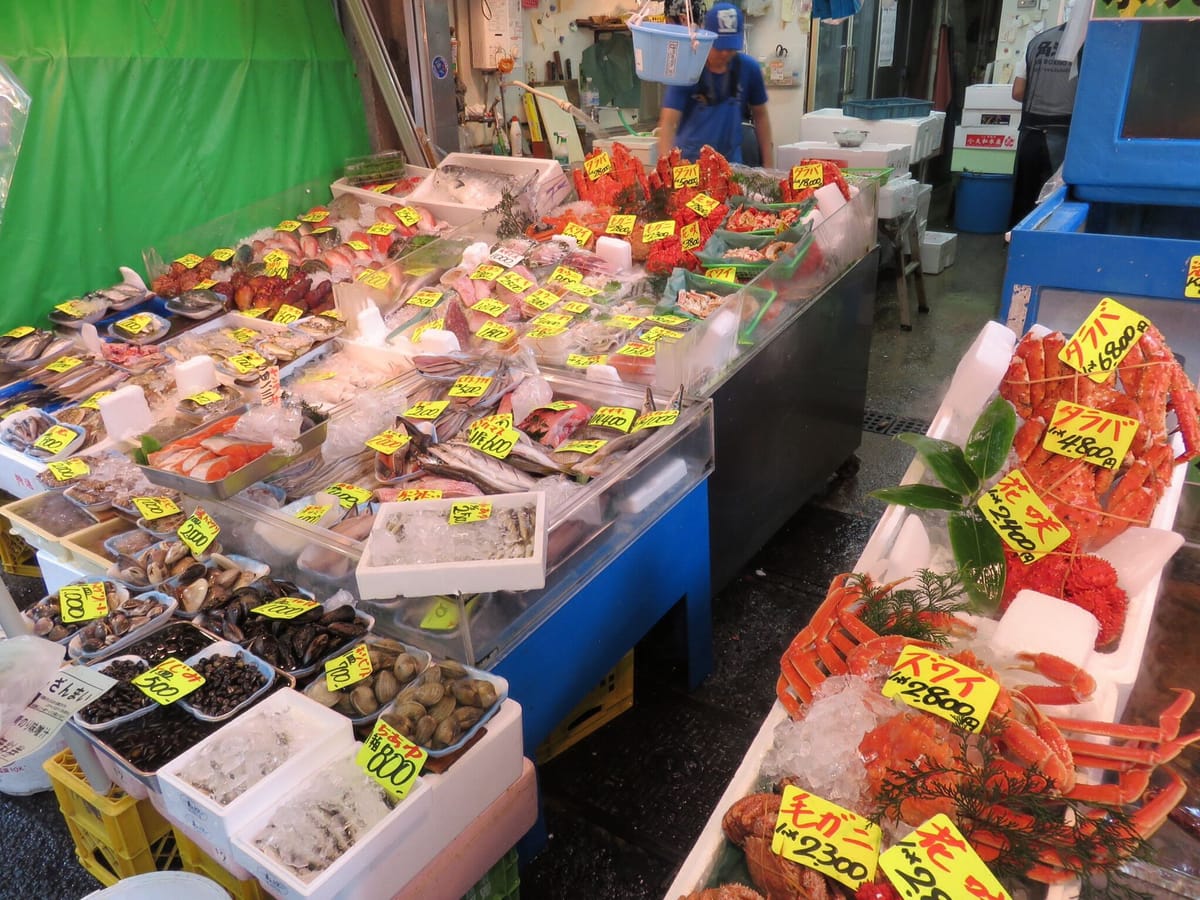
- Tamagoyaki (玉子焼): sweet rolled omelette, sold hot on a stick.
- Kaisendon (海鮮丼): rice topped with raw seafood.
- Sushi (寿司): counters serving nigiri and sets from the early morning.
- Yaki-hotate (焼きホタテ): grilled scallops, cooked while you wait.
- Katsuobushi (かつお節) and konbu (昆布): dried bonito and kelp for dashi.
- Hōchō (包丁): kitchen knives, often engraved to order.
- Namiyoke Inari Jinja (波除稲荷神社): the market's shrine, with its giant lion heads.
The words on the market signs
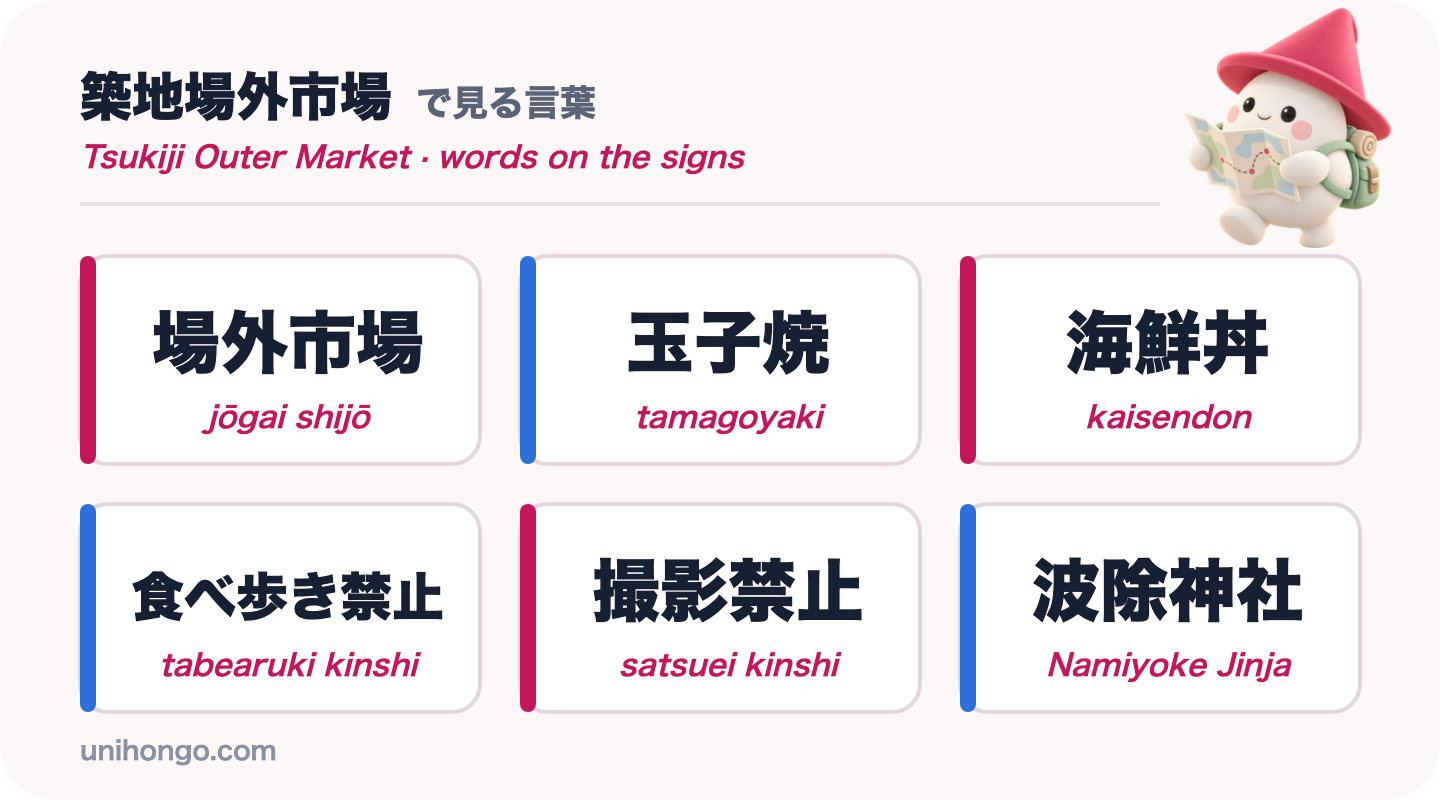
Market signs are mostly food names and rules. The food names often use kanji that are written differently from textbook forms: shops write 玉子 for eggs as food, where a textbook might write 卵, and 丼, don, is a bowl of rice with a topping, as in kaisendon and tendon.
The rule signs are short and use 禁止, kinshi, prohibited. 食べ歩き禁止 means no eating while walking, and 撮影禁止 means no photos, and when you see one, respect it.
| Word | Reading | Meaning |
|---|---|---|
| 場外市場 | jōgai shijō | Outer market |
| 玉子焼 | tamagoyaki | Rolled omelette |
| 海鮮丼 | kaisendon | Seafood rice bowl |
| 食べ歩き禁止 | tabearuki kinshi | No eating while walking |
| 撮影禁止 | satsuei kinshi | No photography |
| 波除神社 | Namiyoke Jinja | The market's shrine against waves |
| 生 | nama | Raw |
| 本日のおすすめ | honjitsu no osusume | Today's recommendation |
| 定休日 | teikyūbi | Regular closing day |
Japanese for ordering food at the stalls
Every stall conversation follows the same pattern: point, name the item or say kore, this, add a number, and finish with kudasai. Numbers use the general counter tsu: hitotsu, futatsu, mittsu. Sellers often ask a follow-up, such as whether you want it on a stick or warmed up, and a simple hai or iie is enough.
At restaurants, look for a picture menu or the food models in the window, and order by name or by pointing. If you do not eat raw fish, ask whether something is cooked: kore wa nama desu ka, is this raw?
| Japanese | Romaji | Meaning |
|---|---|---|
| これを一つください。 | Kore o hitotsu kudasai. | One of these, please. |
| ここで食べてもいいですか。 | Koko de tabete mo ii desu ka. | May I eat here? |
| これは生ですか。 | Kore wa nama desu ka. | Is this raw? |
| 海鮮丼には何が入っていますか。 | Kaisendon ni wa nani ga haitte imasu ka. | What is in the seafood bowl? |
| わさび抜きでお願いします。 | Wasabi-nuki de onegai shimasu. | Without wasabi, please. |
| 写真を撮ってもいいですか。 | Shashin o totte mo ii desu ka. | May I take a photo? |
| カードは使えますか。 | Kādo wa tsukaemasu ka. | Can I pay by card? |
Market manners and practical tips
The outer market publishes its own manners for visitors, and following them is the easiest way to be welcome in a working market.
- Let professional buyers go first in the early morning, and do not block them.
- Eat inside the shop or in a space set aside for eating, not while walking through the lanes.
- Leave large bags in a coin locker; the lanes are narrow.
- Avoid moving around in large groups, and hold children's hands.
- Ask before photographing a shop, and respect signs that forbid photos.
- Do not touch the food on display, and do not bargain; prices are set.
- Smoke only in designated areas.
Practise the visit before you go
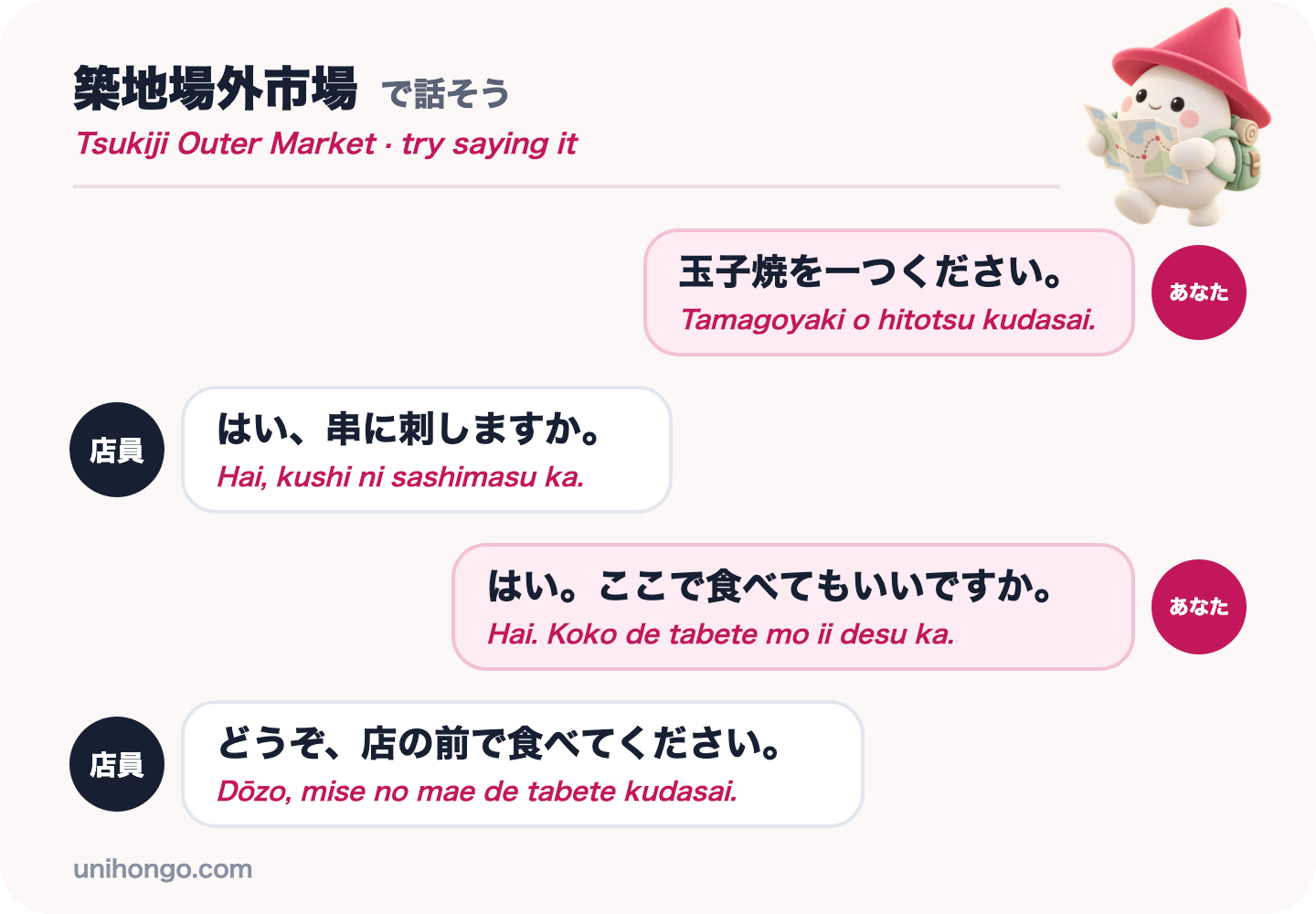
The dialogue below happens at every snack stall in the market. The seller's question, kushi ni sashimasu ka, shall I put it on a stick, is typical of the small follow-ups you will hear; listen for the verb and answer hai or iie.
Then practise with someone who answers back. In Unihongo, choose the Festival Food topic and ask your AI Sensei to play a stall keeper at Tsukiji, or choose Sushi Counter to rehearse ordering at a sushi bar. Saying the lines once before you arrive makes them come out naturally at the counter.
| Japanese | Romaji | Meaning |
|---|---|---|
| 玉子焼を一つください。 | Tamagoyaki o hitotsu kudasai. | One tamagoyaki, please. |
| はい、串に刺しますか。 | Hai, kushi ni sashimasu ka. | Sure. Shall I put it on a stick? |
| はい。ここで食べてもいいですか。 | Hai. Koko de tabete mo ii desu ka. | Yes. May I eat it here? |
| どうぞ、店の前で食べてください。 | Dōzo, mise no mae de tabete kudasai. | Go ahead, please eat it in front of the shop. |
Official information
The market's official site lists its shops, a map, the calendar of closing days and the manners it asks visitors to follow. Check the calendar before you go, especially around Wednesdays and holidays.