

The festival scene and its words
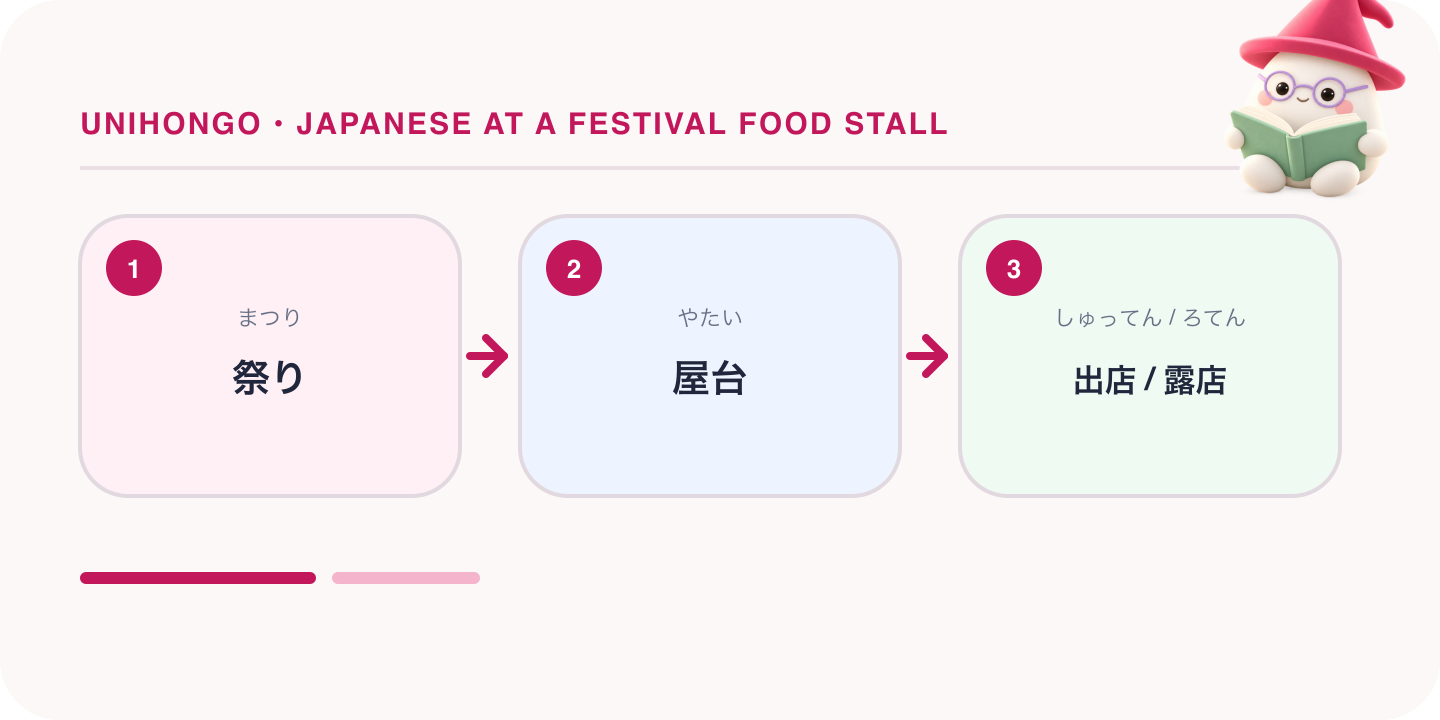
A festival is a matsuri, and the stalls that set up along the approach to a shrine or temple, or along a street or riverbank, are yatai, also called demise or roten. Big summer events such as hanabi taikai, fireworks displays, and bon odori dances attract long rows of stalls, and many people wear yukata, light cotton kimono.
Stalls usually have the food's name painted in large letters on the awning, often in hiragana or katakana, sometimes with a price board. Reading those few words tells you what is on offer from a distance, before you join a queue.
| Word | Reading | Meaning |
|---|---|---|
| 祭り | matsuri | Festival |
| 屋台 | yatai | Food stall |
| 出店 / 露店 | demise / roten | Stall, street stall |
| 花火大会 | hanabi taikai | Fireworks display |
| 盆踊り | bon odori | Bon dance |
| 浴衣 | yukata | Light summer kimono |
| 境内 | keidai | Shrine or temple grounds |
| 参道 | sandō | Approach to a shrine or temple |
Classic festival foods
Every festival is different, but a handful of foods turn up almost everywhere. Knowing their names lets you read the signs and order in one breath.
| Food | Reading | What it is |
|---|---|---|
| たこ焼き | takoyaki | Batter balls with octopus, sauce and mayonnaise |
| 焼きそば | yakisoba | Stir-fried noodles with sauce |
| お好み焼き | okonomiyaki | Savoury pancake with cabbage |
| いか焼き | ikayaki | Grilled squid |
| 焼き鳥 | yakitori | Grilled chicken skewers |
| 唐揚げ | karaage | Japanese fried chicken |
| フランクフルト | furankufuruto | Frankfurter on a stick |
| じゃがバター | jagabatā | Steamed potato with butter |
| かき氷 | kakigōri | Shaved ice with syrup |
| りんご飴 | ringo-ame | Candied apple |
| チョコバナナ | choko banana | Chocolate-dipped banana |
| わたあめ | wataame | Candy floss |
| ラムネ | ramune | Bottled soda with a marble |
Ordering and paying at a stall
Ordering is simple: the food, a counter word or number, and kudasai. Hitotsu, futatsu and mittsu cover one, two and three portions. If the stall sells different sizes or pack counts, such as six or eight takoyaki, point at the board and say the number.
Many stalls prefer cash, and some are cash only, so carry coins and small notes; handing over a large note for one small item can be awkward. Prices vary between festivals and stalls, so check the board or ask ikura desu ka before ordering.
| Japanese | Romaji | Meaning |
|---|---|---|
| たこ焼きひとつください。 | Takoyaki hitotsu kudasai. | One takoyaki, please. |
| 焼きそばを二つお願いします。 | Yakisoba o futatsu onegai shimasu. | Two yakisoba, please. |
| いくらですか。 | Ikura desu ka. | How much is it? |
| いちご味にします。 | Ichigo-aji ni shimasu. | I'll have strawberry flavour. |
| 青のりなしでお願いします。 | Aonori nashi de onegai shimasu. | Without seaweed flakes, please. |
| 現金だけですか。 | Genkin dake desu ka. | Is it cash only? |
| お箸をもう一膳もらえますか。 | O-hashi o mō ichizen moraemasu ka. | Could I have another pair of chopsticks? |
What stall holders say to you
Stall holders speak fast and casually, and some use regional dialect. You will hear calls to passers-by, questions about toppings, and warnings that the food is hot. Mai do, a friendly word for thanks used especially in the Kansai region, is common at the end of a sale.
| Japanese | Romaji | Meaning |
|---|---|---|
| いらっしゃい! | Irasshai! | Come on over! |
| 焼きたてだよ! | Yakitate da yo! | Freshly cooked! |
| マヨネーズかける? | Mayonēzu kakeru? | Want mayonnaise on it? |
| ちょっと待ってね、あと五分くらい。 | Chotto matte ne, ato go-fun kurai. | Just a moment, about five more minutes. |
| 熱いから気をつけてね。 | Atsui kara ki o tsukete ne. | Careful, it's hot. |
| はい、お待たせ。 | Hai, o-matase. | Here you go, thanks for waiting. |
| まいど! | Maido! | Thanks, come again! |
Stall games: kingyo-sukui and more
Between the food stalls you will find games, especially popular with children. Kingyo-sukui is goldfish scooping with a thin paper scoop, the poi, which tears as soon as it gets too wet. Yōyō-tsuri is fishing for small water balloons with a paper string and hook. Shateki is a shooting gallery with cork guns, and kuji is a lottery for prizes.
Pay the stall holder first and they will hand you the scoop, hook or corks. Rules and prizes differ from stall to stall; for kingyo-sukui, some stalls give you the fish in a bag, some give a fixed number regardless, and some offer a toy instead. If you are travelling and cannot keep a fish, you can say so.
| Japanese | Romaji | Meaning |
|---|---|---|
| 金魚すくい | kingyo-sukui | Goldfish scooping |
| ヨーヨー釣り | yōyō-tsuri | Water balloon fishing |
| 射的 | shateki | Shooting gallery |
| くじ引き | kujibiki | Lottery draw |
| 一回いくらですか。 | Ikkai ikura desu ka. | How much for one go? |
| どうやって遊びますか。 | Dō yatte asobimasu ka. | How do you play? |
| 金魚は持って帰れないので、大丈夫です。 | Kingyo wa motte kaerenai node, daijōbu desu. | I can't take the fish home, so I'm fine without it. |
Festival etiquette
- Join the back of the queue and have your money ready before you reach the front.
- Step aside to eat, or use an eating area if one is set up, rather than walking into dense crowds with hot food and skewers.
- Bins can be few and full; many festivals ask you to take your rubbish home, gomi wa o-mochikaeri kudasai.
- On shrine and temple grounds, keep the atmosphere respectful and avoid sitting on steps or structures that are part of the shrine.
- Follow staff and police directions, especially at fireworks displays where routes may be one way.
- Ask before photographing stall holders or people in yukata close up.
- Toilets have long queues at big events, so use them before the crowd peaks.
Losing your friends in the crowd
At big festivals, mobile data can slow down, groups get separated and everything looks the same after dark. Agree a meeting point, machiawase basho, before you start, ideally something fixed such as a torii gate, a station exit or a named shop. Families with children should also know where the lost child centre, maigo sentā, or the event's information tent, honbu, is.
Describing where you are is the skill that matters. Name something you can see, say which side you are on and give a direction. This is exactly what the Find a Friend at a Festival mission practises.
| Japanese | Romaji | Meaning |
|---|---|---|
| 今どこにいる? | Ima doko ni iru? | Where are you now? |
| りんご飴の屋台の前にいるよ。 | Ringo-ame no yatai no mae ni iru yo. | I'm in front of the candied apple stall. |
| 鳥居のところで会おう。 | Torii no tokoro de aō. | Let's meet at the torii gate. |
| 人が多すぎて進めない。 | Hito ga ōsugite susumenai. | There are too many people, I can't get through. |
| 迷子センターはどこですか。 | Maigo sentā wa doko desu ka. | Where is the lost child centre? |
| 友達とはぐれてしまいました。 | Tomodachi to hagurete shimaimashita. | I got separated from my friend. |
When something goes wrong
Small problems at stalls are usually solved by pointing and a quick sumimasen. If you receive the wrong change, say so politely at the stall; if you drop your food, stall holders are often kind about it, but you will normally need to buy another. For lost property or injuries, head for the event headquarters tent, the honbu, or a police box, kōban.
| Japanese | Romaji | Meaning |
|---|---|---|
| すみません、おつりが違うと思います。 | Sumimasen, otsuri ga chigau to omoimasu. | Excuse me, I think the change is wrong. |
| 落としてしまいました。 | Otoshite shimaimashita. | I dropped it. |
| 財布をなくしました。 | Saifu o nakushimashita. | I've lost my wallet. |
| 本部はどこですか。 | Honbu wa doko desu ka. | Where is the event headquarters? |
| 気分が悪いです。 | Kibun ga warui desu. | I feel unwell. |
On hot summer nights, heatstroke, necchūshō, is a real risk in crowds. Drink water, rest in the shade when you can, and ask staff for help early if you or a friend feel faint.