

Why Nagoya Castle still matters, even with the keep closed
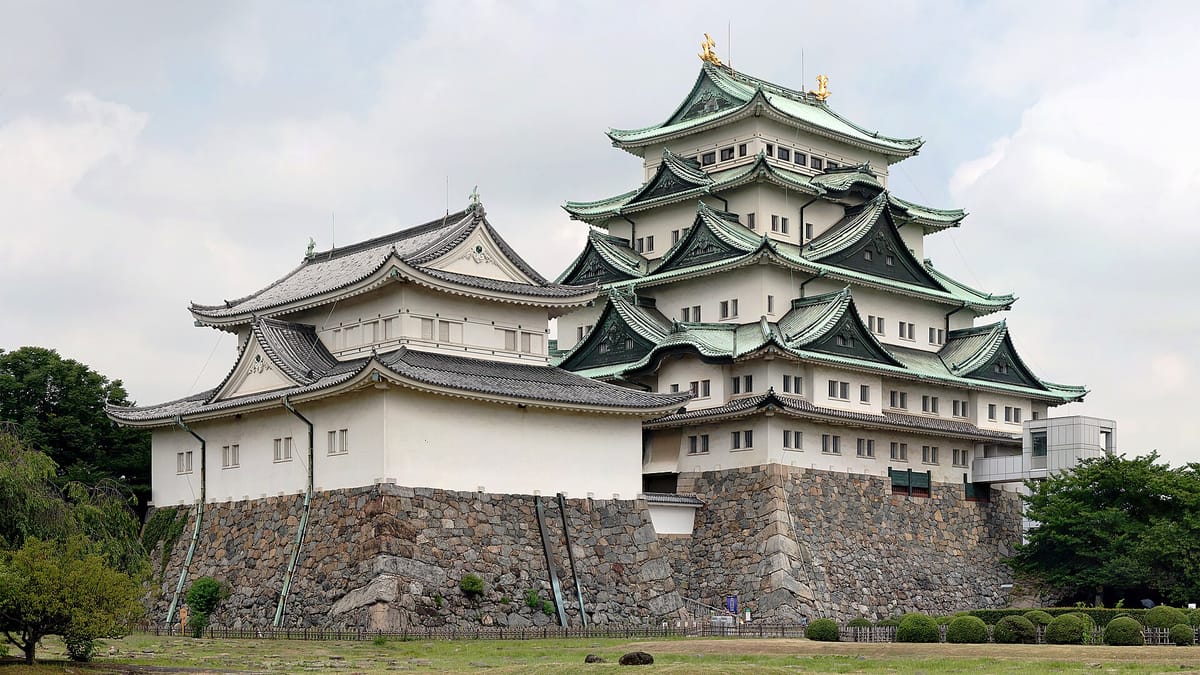
After winning the Battle of Sekigahara and becoming shogun, Tokugawa Ieyasu ordered a new castle at Nagoya in 1610, and made the lords who had fought against him pay for and build it. The keep was finished around 1612 and the palace in 1615. For the next two and a half centuries it was the seat of the Owari Tokugawa, one of the three senior branches of the shogun's family, and the townspeople of nearby Kiyosu were moved here wholesale, which is how the city of Nagoya began.
It was the first castle in Japan to be designated a National Treasure, in 1930, and it lost almost everything in the air raids of 1945. The keep was rebuilt in reinforced concrete in 1959 with the same outline and a new pair of golden shachihoko. That concrete keep has been closed since May 2018 because of its age and earthquake resistance. Nagoya City plans to replace it with a faithful wooden reconstruction, based on detailed prewar surveys and photographs, but the project has been repeatedly delayed and no completion date has been fixed. When you visit, the keep is something to look at, not to enter.
The good news is that the palace next to it is back. The Hommaru Goten, the palace of the inner enclosure, was rebuilt with traditional techniques and fully reopened in 2018, and it is the real reason to come. For a Japanese learner, the castle is also a lesson in reading: 城, 門, 御殿 and 櫓 turn up on every sign.
Getting there: Nagoyajo Station and the East Gate
The simplest route is the subway. From Nagoya Station, take the Sakura-dōri Line two stops to Hisaya-ōdōri and change to the Meijo Line for one stop to Nagoyajo Station, the station formerly called Shiyakusho. The whole trip takes about ten minutes, and the castle's East Gate, Higashimon, is a few minutes' walk from the exit. You can also use Sengen-chō Station on the Tsurumai Line or Higashi-Ōte Station on the Meitetsu Seto Line.
The Main Gate, Seimon, on the west side is served by city buses and by the Me-guru sightseeing loop bus from Nagoya Station. From either gate, allow about ten minutes on foot to the Hommaru Palace. Tickets are sold at both gates, and the official site says you can pay in cash, by credit card or with a transport IC card such as Suica or manaca.
| Japanese | Romaji | Meaning |
|---|---|---|
| 名古屋城に行きたいんですが、何線ですか。 | Nagoya-jō ni ikitai n desu ga, nanisen desu ka. | I want to go to Nagoya Castle. Which line is it? |
| 久屋大通で乗り換えですか。 | Hisaya-ōdōri de norikae desu ka. | Do I change at Hisaya-ōdōri? |
| 名古屋城駅は何番出口ですか。 | Nagoyajō-eki wa nanban deguchi desu ka. | Which exit number at Nagoyajo Station? |
| 東門はどちらですか。 | Higashimon wa dochira desu ka. | Which way is the East Gate? |
| 交通系ICカードで払えますか。 | Kōtsūkei IC kādo de haraemasu ka. | Can I pay with a transport IC card? |
What you will see: palace, turrets and walls
The Hommaru Palace, Honmaru Goten in standard romaji, was the official residence and office of the lords of Owari and was once counted, with the keep, among the finest castle buildings in Japan. It was rebuilt using Edo-period plans, old photographs and hinoki cypress, and the paintings on its sliding doors and ceilings have been recreated by artists copying the originals, many of which were saved before the war. Walking its corridors, you pass from the entrance hall with its painted tigers and leopards to ever grander reception rooms, ending in the rooms built for the shogun's visits.
The rest of the castle is outside. The stone walls are among the largest in Japan, and some stones still carry the marks of the lords' teams that cut them. Three corner turrets, sumi-yagura, survive from the early seventeenth century and are Important Cultural Properties. The Nishinomaru Okura Castle Treasure Museum shows original paintings and objects from the castle, and a pair of food streets called Kinshachi Yokochō stand just outside the Main and East Gates.
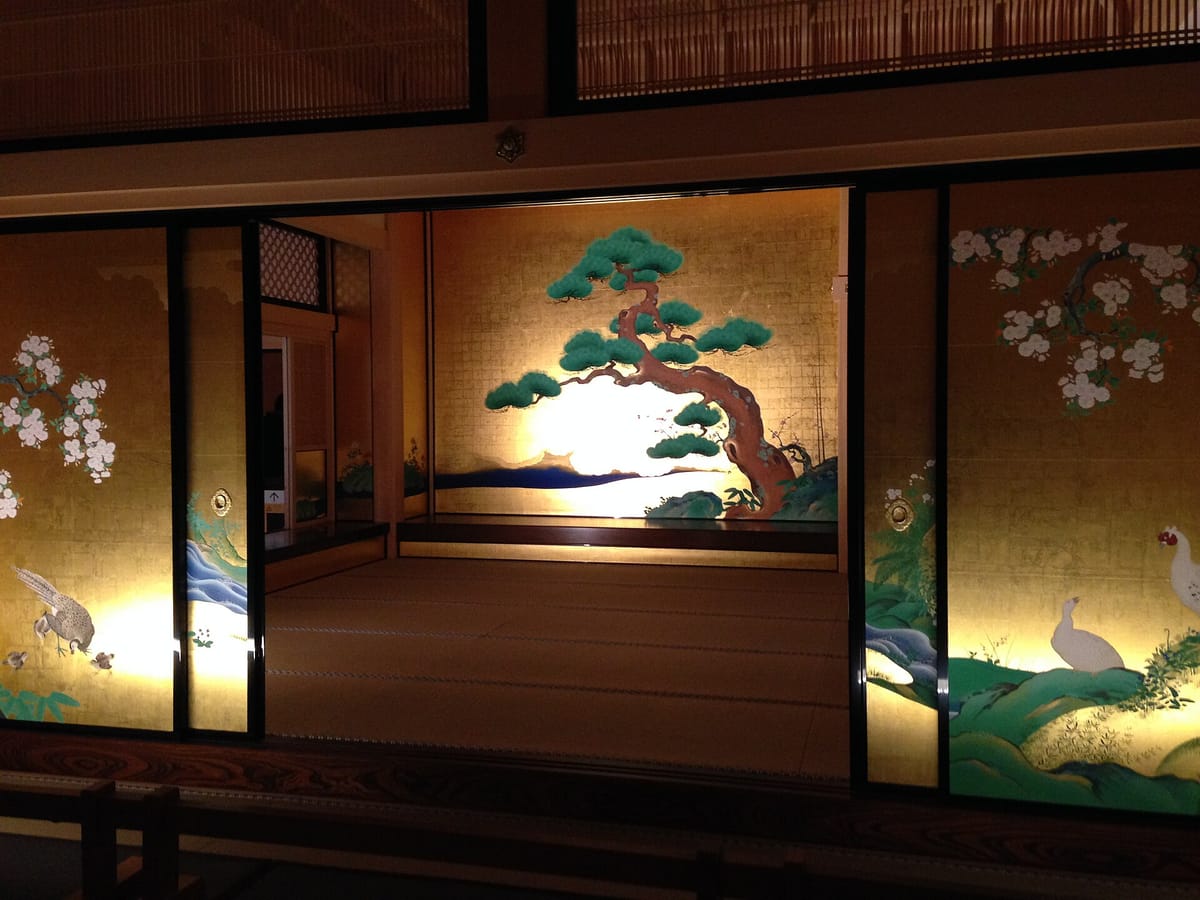
- Honmaru Goten: the rebuilt palace, included in the castle admission.
- Tenshukaku: the main keep, closed but still the best photo from the grounds.
- Kinshachi: the golden shachihoko on the keep's roof, the symbol of the city.
- Sumi-yagura: the original Edo-period corner turrets on the Honmaru walls.
- Kiyomasa-ishi: a huge stone in the walls traditionally linked to the general Katō Kiyomasa.
- Ninomaru Garden: a lord's garden, designated a Place of Scenic Beauty.
- Nishinomaru Okura Castle Treasure Museum: original paintings and treasures of the castle.
- Kinshachi Yokochō: food streets by the Main and East Gates serving Nagoya dishes.
Words on the castle signs
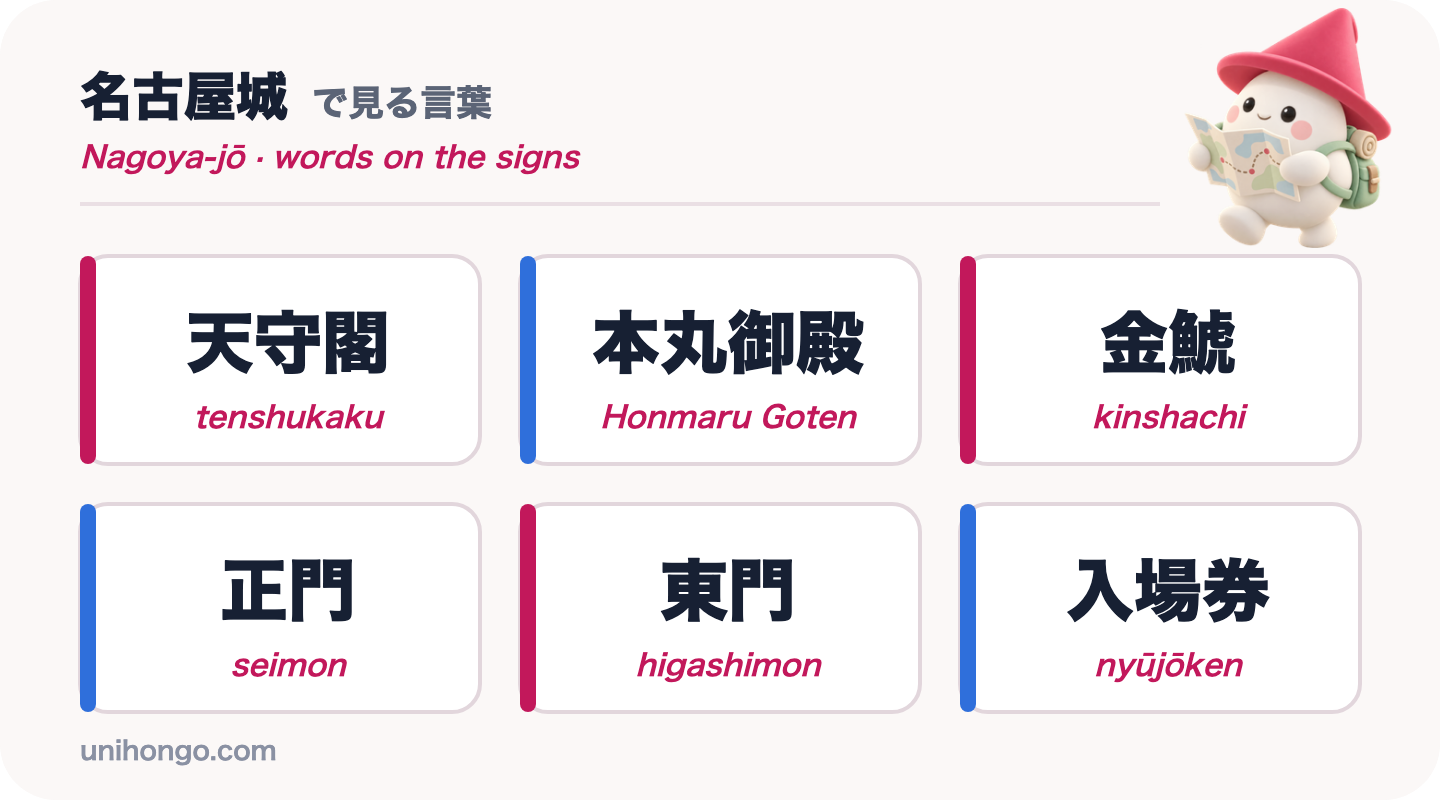
Castle signs repeat a small family of words. 丸, maru, is an enclosure of the castle, so 本丸 is the inner enclosure and 二之丸 the second. 門, mon, is a gate, and it is often read with a sound change when joined to another word. 御殿, goten, is a palace, and the honorific 御 at the front tells you it belonged to the lord.
One word to watch for is 見学, kengaku, visit or tour, on the palace's direction signs, and 順路, junro, the suggested route, which keeps the flow of visitors moving one way through the rooms.
| Word | Reading | Meaning |
|---|---|---|
| 天守閣 | tenshukaku | Castle keep, the main tower |
| 本丸御殿 | Honmaru Goten | The palace of the inner enclosure |
| 金鯱 | kinshachi | The golden shachihoko on the keep |
| 正門 | seimon | Main Gate |
| 東門 | higashimon | East Gate |
| 入場券 | nyūjōken | Admission ticket |
| 隅櫓 | sumi-yagura | Corner turret |
| 石垣 | ishigaki | Stone walls |
| 順路 | junro | Suggested route |
Japanese at the ticket gate and in the Hommaru Palace
At the gate you buy one admission ticket that covers the grounds, the Hommaru Palace and the museum. Inside the palace, the official rules are clear: shoes off at the entrance, slippers for anyone in bare feet or stockings, large luggage in the free lockers inside the entrance, no touching the sliding doors or metal fittings, no flash, no food or drink and no phone calls. The palace has no air conditioning or toilets, to keep the Edo-period atmosphere, so use the toilets before you go in.
Staff at the palace speak in polite, fixed phrases, and they are used to pointing visitors in the right direction. The phrases below cover what you need to ask, and the answers you will hear.
| Japanese | Romaji | Meaning |
|---|---|---|
| 大人一枚お願いします。 | Otona ichimai onegai shimasu. | One adult ticket, please. |
| このチケットで本丸御殿にも入れますか。 | Kono chiketto de Honmaru Goten ni mo hairemasu ka. | Can I also enter the Hommaru Palace with this ticket? |
| スーツケースを預けられますか。 | Sūtsukēsu o azukeraremasu ka. | Can I leave my suitcase? |
| フラッシュなしなら写真を撮ってもいいですか。 | Furasshu nashi nara shashin o totte mo ii desu ka. | May I take photos without flash? |
| 御殿の入口はどこですか。 | Goten no iriguchi wa doko desu ka. | Where is the palace entrance? |
| 待ち時間はどのくらいですか。 | Machi jikan wa dono kurai desu ka. | How long is the wait? |
| 英語のパンフレットはありますか。 | Eigo no panfuretto wa arimasu ka. | Do you have a leaflet in English? |
Etiquette, timing and a Nagoya lunch
Nagoya Castle is large and mostly outdoors, so good shoes and a plan help. The palace is the most delicate part of the visit, and its rules protect paintings and woodwork that took years to recreate.
- Go to the Hommaru Palace first if you arrive in the afternoon: it stops admitting visitors before the grounds close.
- Do not touch the sliding doors or lean on the painted walls, and keep your bag close in narrow corridors.
- Turn off your flash before you enter; ask staff if you are not sure how.
- Free English-speaking guided walks are offered by a volunteer guide group on many days; check the official site for the current schedule.
- Admission fees were revised from October 2026, so check the official site for the current price before you go.
- For lunch, try Kinshachi Yokochō by the gates: hitsumabushi, grilled eel over rice, miso katsu, flat kishimen noodles and tebasaki chicken wings are Nagoya's signature dishes.
Practise the visit before you go
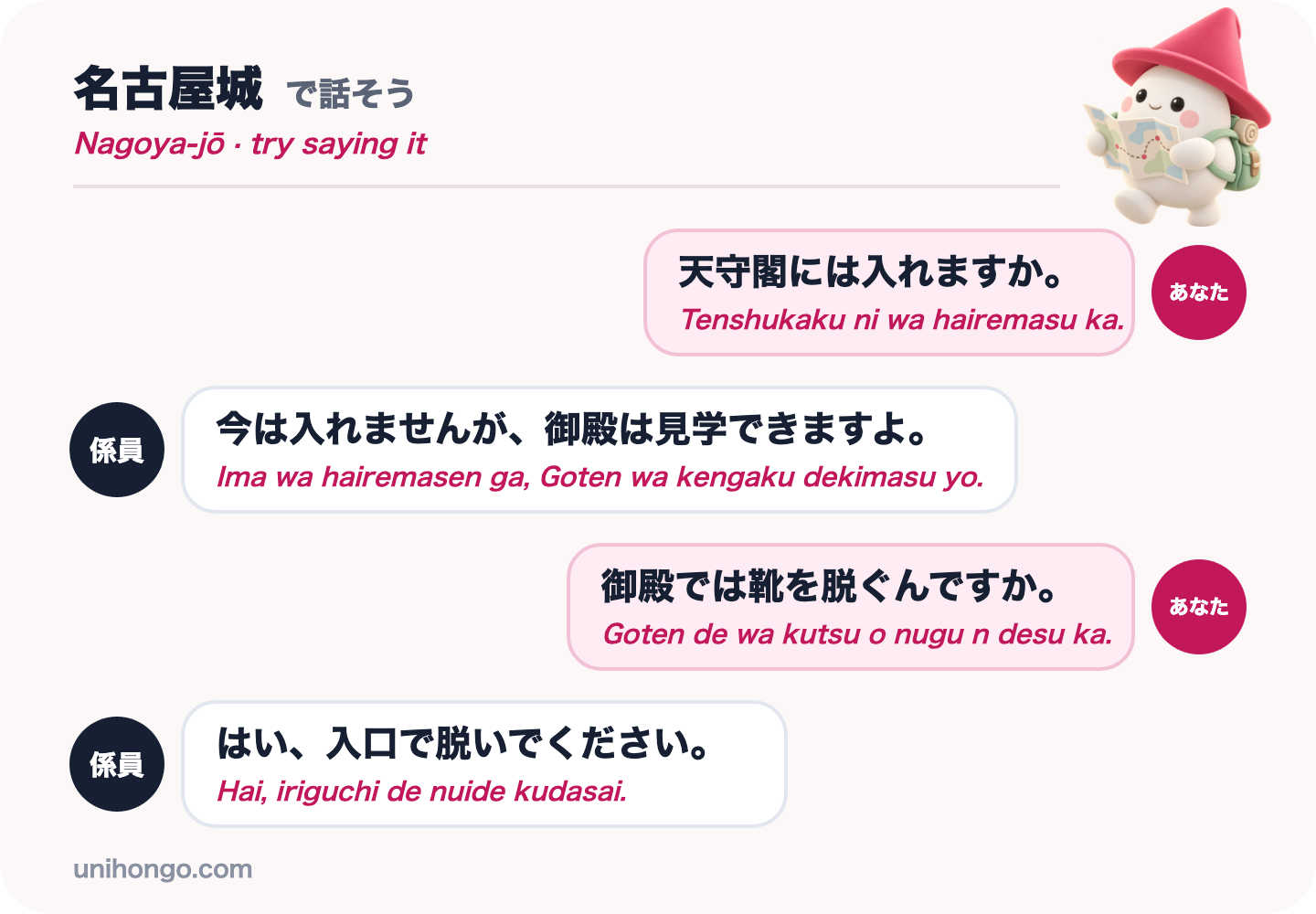
Many visitors arrive expecting to climb the keep, so this is the conversation you are most likely to have. The attendant's answer uses the useful pattern hairemasen ga, you cannot enter, but, followed by what you can do instead. Practise the four lines until you can say them without reading.
Then practise with someone who answers back. In Unihongo, choose the Sightseeing topic and ask your AI Sensei to play a castle attendant, or try the Ask the Way to the Station mission to rehearse getting back to the subway afterwards. A little speaking practice before you go makes the real conversation much easier.
| Japanese | Romaji | Meaning |
|---|---|---|
| 天守閣には入れますか。 | Tenshukaku ni wa hairemasu ka. | Can I go into the keep? |
| 今は入れませんが、御殿は見学できますよ。 | Ima wa hairemasen ga, Goten wa kengaku dekimasu yo. | Not at the moment, but you can visit the palace. |
| 御殿では靴を脱ぐんですか。 | Goten de wa kutsu o nugu n desu ka. | Do I take off my shoes in the palace? |
| はい、入口で脱いでください。 | Hai, iriguchi de nuide kudasai. | Yes, please take them off at the entrance. |
Official information
Opening hours, the revised admission fees, closures and the latest news on the keep reconstruction are published on the castle's official site. Check it before you go, especially for seasonal events and evening openings.