

Why Amanohashidate is one of the Three Views of Japan
Amanohashidate is a natural sandbar across the mouth of Asoumi lagoon in Miyazu Bay. It is about three kilometres long and in places only around twenty metres wide, and it is covered with roughly eight thousand pine trees, many of them twisted by the wind. In the seventeenth century it was named one of the Nihon Sankei, the Three Views of Japan, with the islands of Matsushima and the floating torii of Miyajima, and it has been drawn and written about for over a thousand years.
The name means something like the floating bridge of heaven. According to legend, it was the ladder or bridge the gods used to cross between heaven and earth, which fell and landed in the sea. That idea is why people look at it upside down: seen between your legs, the sandbar seems to rise into the sky.
Amanohashidate is also a small, friendly resort. The streets around the station and the far end of the sandbar are full of bike rentals, ferry counters, lift ticket windows and seafood restaurants, all of which need a quick exchange in Japanese.
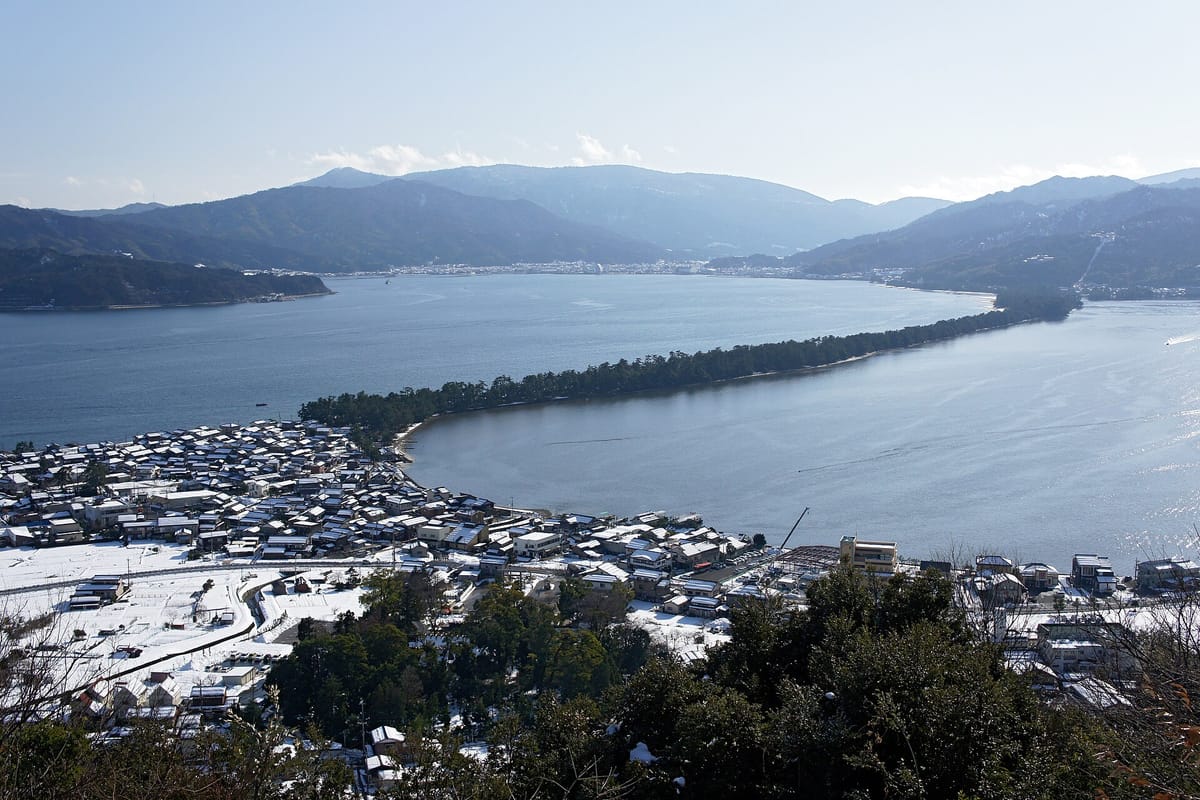
Getting there: Amanohashidate Station on the Kyoto Tango Railway
Amanohashidate Station, Amanohashidate-eki, is on the Kyoto Tango Railway. The tourist association gives the journey as about two hours from Kyoto and two hours twenty minutes from Osaka. Limited express trains such as the Hashidate run directly from Kyoto on some services; others need a change at Fukuchiyama. Because the final section is not JR, JR passes do not cover the whole trip, and the conductor or station staff can sell you the extra fare.
Highway buses run from Kyoto Station and Osaka to Amanohashidate in about two and a half hours, and they can be reserved up to a month ahead. From the station, the southern end of the sandbar, Chion-ji temple and the View Land lift are all within a few minutes' walk.
| Japanese | Romaji | Meaning |
|---|---|---|
| 天橋立駅まで行きますか。 | Amanohashidate-eki made ikimasu ka. | Does this go to Amanohashidate Station? |
| 福知山で乗り換えですか。 | Fukuchiyama de norikae desu ka. | Do I change at Fukuchiyama? |
| JRパスで乗れますか。 | JR pasu de noremasu ka. | Can I ride with a JR Pass? |
| 差額はここで払えますか。 | Sagaku wa koko de haraemasu ka. | Can I pay the difference here? |
| 天橋立はどちらですか。 | Amanohashidate wa dochira desu ka. | Which way is the sandbar? |
Crossing the sandbar: what you will see at each end
Start at the southern end, near the station. Chion-ji, a temple dedicated to Monju, the bodhisattva of wisdom, sits just before the sandbar, and the small Kaisenkyō bridge beyond it swings round to let boats pass through the channel. Then the path enters the pines, with the calm lagoon on one side and white sand beaches on the bay side, popular for swimming in summer.
At the northern end, cross the road to Moto-Ise Kono Jinja, an ancient shrine connected in legend with the great shrine at Ise, and walk a few minutes to the cable car and chairlift that climb to Kasamatsu Park. From the top you look down the length of the sandbar, and you can try matanozoki from the viewing platforms. To return, walk or cycle back, or take the sightseeing boat from Ichinomiya pier to the southern end.
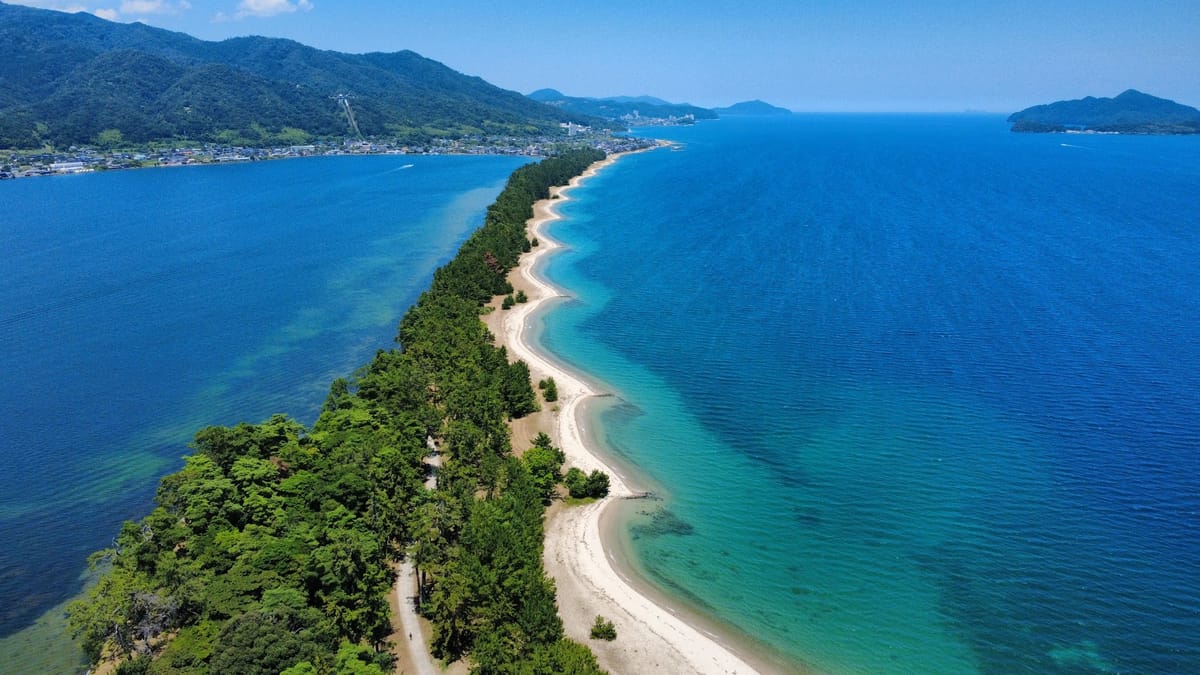
- Chion-ji: a temple of Monju, the bodhisattva of wisdom, at the southern end.
- Kaisenkyō: the turning bridge that swings open for boats.
- The pine path: about three kilometres through the trees, with benches and small shrines.
- The beaches: white sand on the bay side, busy in summer.
- Moto-Ise Kono Jinja: an ancient shrine at the northern end.
- Kasamatsu Park: the classic viewpoint, reached by cable car or chairlift.
- Amanohashidate View Land: the southern viewpoint by chairlift or monorail, with small rides.
- Sightseeing boat: links the two ends across the lagoon.
Words on the signs at Amanohashidate
The key word is on the viewing platforms: 股のぞき, matanozoki. 股 is the crotch or the space between the legs, and のぞき is peeping or looking through, so the word is a very literal description of what you do. Signs often show a little figure bent double to explain it.
Transport signs use 観光船 for the sightseeing boat, ケーブルカー for the cable car and リフト for the chairlift. The name of the place itself breaks down neatly: 天 heaven, 橋 bridge, 立 standing.
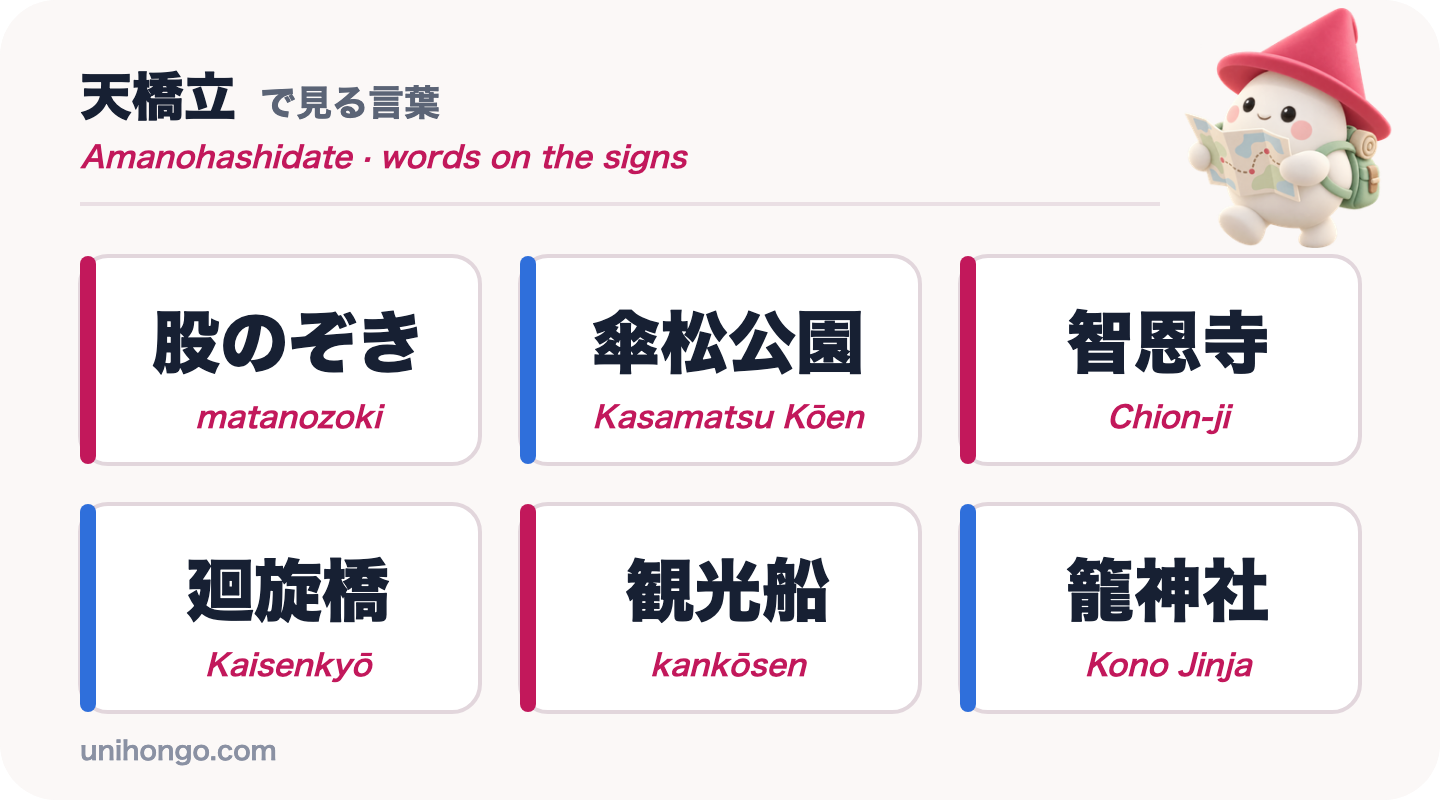
| Word | Reading | Meaning |
|---|---|---|
| 天橋立 | Amanohashidate | The sandbar, literally heaven's standing bridge |
| 股のぞき | matanozoki | Looking at the view upside down between your legs |
| 傘松公園 | Kasamatsu Kōen | Kasamatsu Park, the northern viewpoint |
| 智恩寺 | Chion-ji | Temple of Monju at the southern end |
| 廻旋橋 | Kaisenkyō | The turning bridge |
| 観光船 | kankōsen | Sightseeing boat |
| 籠神社 | Kono Jinja | The ancient shrine at the northern end |
| ケーブルカー | kēburukā | Cable car |
| リフト | rifuto | Chairlift |
Japanese for bike rental, the lift and the boat
Bike rental shops cluster around the station and the southern end of the sandbar. You pay by the hour or the day, and some shops will ask you to write your name. Ask where you can return the bike before you set off: if you plan to take the boat back, you may need a shop with a partner at the other end.
At the northern end, the cable car and chairlift share a station, and tickets are sold as one-way or return. The chairlift is open to the air, so it is the better choice for photos in good weather, and the cable car is covered.
| Japanese | Romaji | Meaning |
|---|---|---|
| 自転車を借りたいんですが。 | Jitensha o karitai n desu ga. | I'd like to rent a bike. |
| 一日でいくらですか。 | Ichinichi de ikura desu ka. | How much is it for a day? |
| 向こう側で返せますか。 | Mukōgawa de kaesemasu ka. | Can I return it on the other side? |
| リフトの往復券を二枚ください。 | Rifuto no ōfukuken o nimai kudasai. | Two return tickets for the chairlift, please. |
| 観光船は何分おきに出ますか。 | Kankōsen wa nanpun oki ni demasu ka. | How often does the sightseeing boat leave? |
| 股のぞきはどこでできますか。 | Matanozoki wa doko de dekimasu ka. | Where can I do the matanozoki? |
Etiquette, timing and practical tips
The sandbar is a park, a beach and a sacred landscape at once, and a few simple habits help.
- Ride slowly on the sandbar path and ring your bell gently when passing walkers.
- Do not climb or damage the pine trees, which are protected.
- Take your rubbish home; bins on the sandbar are few.
- Check the last trains back to Kyoto before you set off; services on the coast are not frequent.
- Go early in summer and at weekends, when the beaches and lifts are busiest.
- Hold on to your phone and hat when doing matanozoki from the platforms.
Practise the visit before you go
Renting a bike is the conversation most visitors have here, and it follows a pattern you can use anywhere in Japan: say what you want and for how long, fill in a form, and ask about the route. Practise the four lines below until you can say them without reading.
Then practise with a partner who answers back. In Unihongo, choose the Sightseeing topic and ask your AI Sensei to play the attendant at a bike rental shop by Amanohashidate Station, then a ticket clerk at the Kasamatsu Park lift.
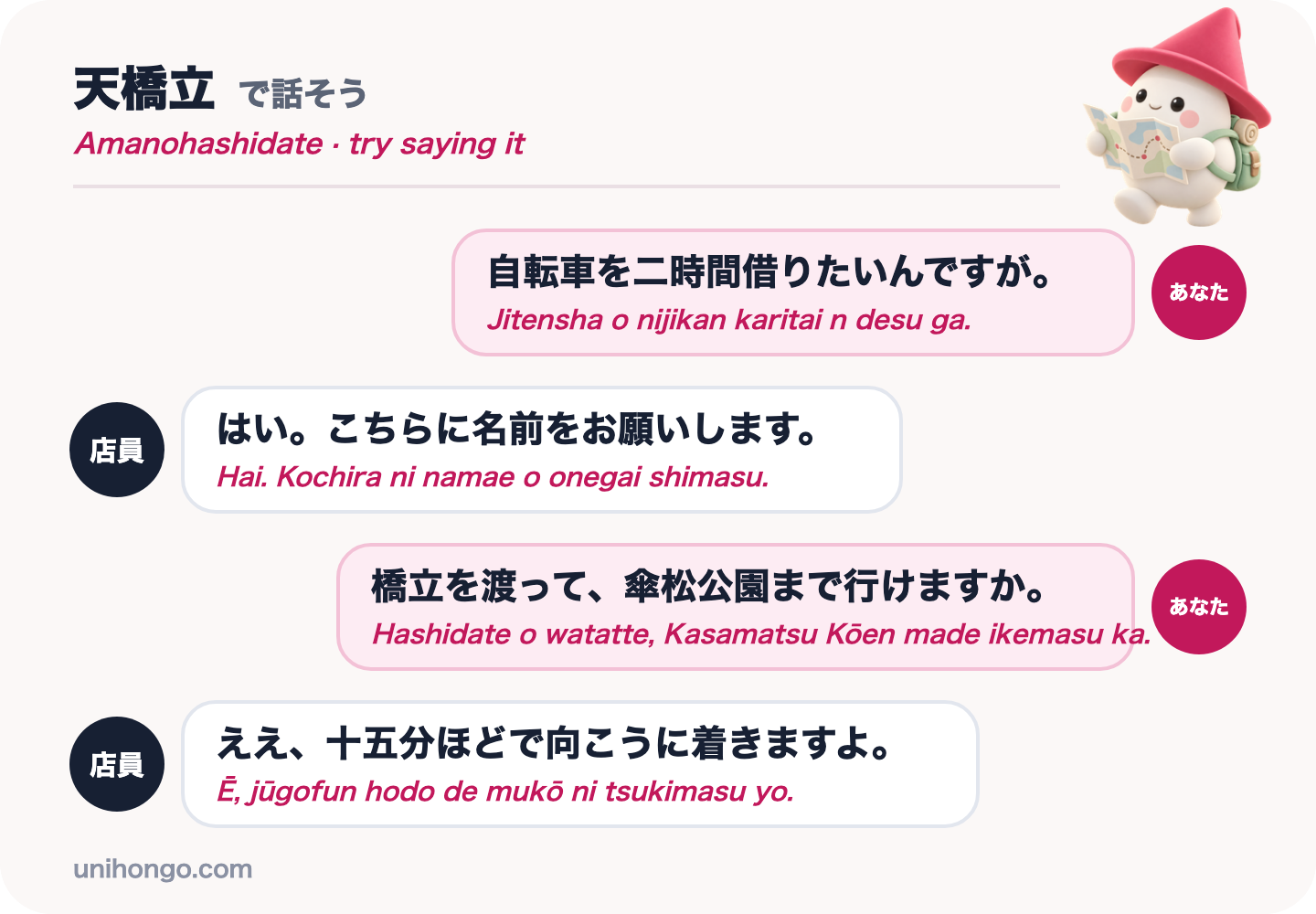
| Japanese | Romaji | Meaning |
|---|---|---|
| 自転車を二時間借りたいんですが。 | Jitensha o nijikan karitai n desu ga. | I'd like to rent a bike for two hours. |
| はい。こちらに名前をお願いします。 | Hai. Kochira ni namae o onegai shimasu. | Certainly. Please write your name here. |
| 橋立を渡って、傘松公園まで行けますか。 | Hashidate o watatte, Kasamatsu Kōen made ikemasu ka. | Can I cross the sandbar and get to Kasamatsu Park? |
| ええ、十五分ほどで向こうに着きますよ。 | Ē, jūgofun hodo de mukō ni tsukimasu yo. | Yes, you'll reach the other side in about fifteen minutes. |
Official information
The Amanohashidate tourist association publishes access information from Kyoto and Osaka, bus reservation details and guides to each viewpoint. Check lift and boat times before you go, as they change with the season.