

Why the Iya Valley is worth the journey
The Iya Valley is what many people imagine rural Japan to be: villages clinging to steep mountainsides, thatched and wooden farmhouses, terraced fields, and a river of astonishing blue-green far below. It lies in the middle of Shikoku, in the west of Tokushima Prefecture, and until well into the twentieth century it was one of the hardest places in Japan to reach.
That isolation is at the heart of its legend. After the Heike clan lost the wars of the late twelfth century, survivors are said to have fled into these mountains, and the vine bridges they supposedly built could be cut quickly if enemies followed. Another story credits the bridges to the monk Kōbō Daishi. Whichever you believe, the valley kept many old customs, and the vine bridges are now protected as an Important Tangible Folk Cultural Property.
For a Japanese learner, Iya is the opposite of Tokyo. Signs are simpler, English is rarer, and buses, inns and restaurants run on local rhythms. A few questions about times and stops, asked politely and clearly, will get you further here than anywhere else on Shikoku.
Getting there: JR Ōboke Station and the valley buses
The railway gateway is the JR Dosan Line, which runs through the mountains between Tadotsu in Kagawa and Kōchi. Limited express trains between Okayama and Kōchi stop at Awa-Ikeda and at Ōboke, a small station right beside the gorge. From Okayama the ride takes about an hour and a half.
From Ōboke or Awa-Ikeda, Shikoku Kōtsū buses run into the valley. The Kazurabashi stop is roughly half an hour from Ōboke and an hour from Awa-Ikeda, but buses are infrequent, so plan your day around the timetable and note the last bus back. For Oku-Iya, you change at Kubo to a local bus that runs only a few times a day in season, which is why most visitors to the upper valley drive or join a tour. Roads are often one lane wide with blind curves, so drive slowly and use the passing places.
| Japanese | Romaji | Meaning |
|---|---|---|
| 大歩危に止まる特急はどれですか。 | Ōboke ni tomaru tokkyū wa dore desu ka. | Which limited express stops at Ōboke? |
| かずら橋行きのバスはどこから出ますか。 | Kazurabashi-yuki no basu wa doko kara demasu ka. | Where does the bus to Kazurabashi leave from? |
| このバスは奥祖谷まで行きますか。 | Kono basu wa Oku-Iya made ikimasu ka. | Does this bus go as far as Oku-Iya? |
| 最終バスは何時ですか。 | Saishū basu wa nanji desu ka. | What time is the last bus? |
| タクシーを呼んでもらえますか。 | Takushī o yonde moraemasu ka. | Could you call me a taxi? |
Vine bridges, gorges and viewpoints: what you will see
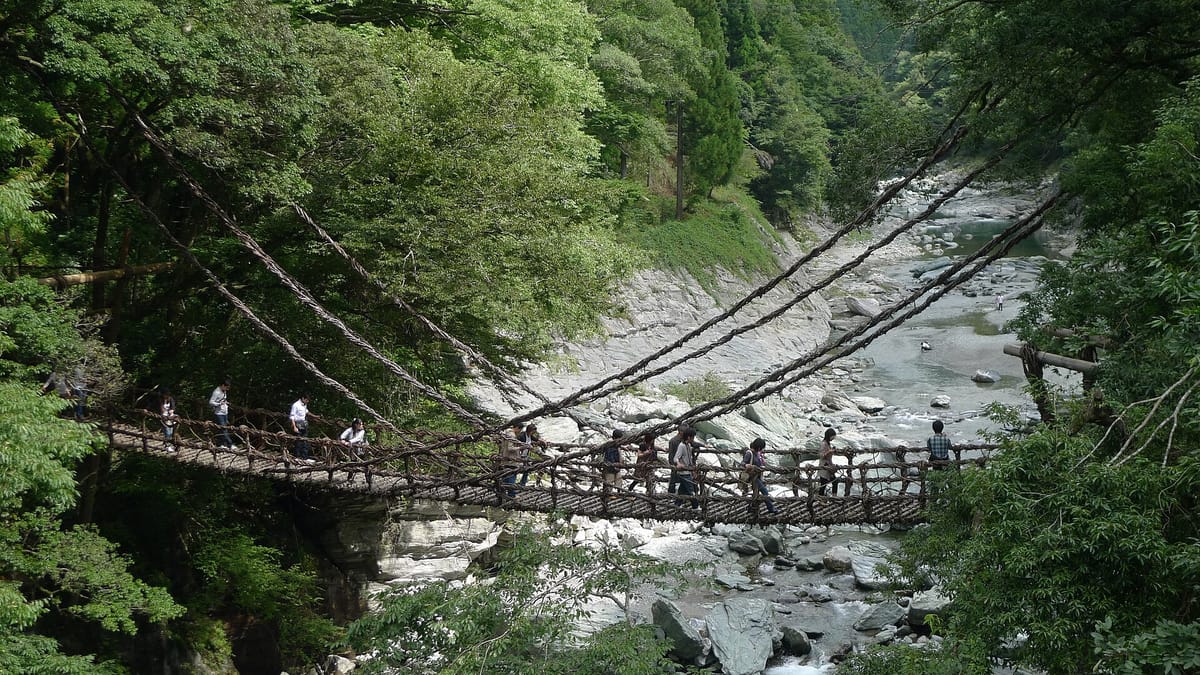
The Iya no Kazurabashi is woven from about six tons of shirakuchi kazura vines gathered in the depth of winter. It is 45 metres long, about two metres wide and hangs 14 metres above the river, and it is completely rebuilt every three years. The slats are spaced wide apart, so you watch your feet all the way across. Crossing is in one direction only, and in the evenings the bridge is lit up, though you cannot cross it then.
Oku-Iya, the inner valley, is an hour or more further up the road. Its two vine bridges, the Otto no Hashi, husband bridge, and the Tsuma no Hashi, wife bridge, hang side by side in the forest, and beside them is a yaen, a wooden cart on a rope that you pull yourself across the river in. It is quieter and wilder than the main bridge, and it is closed in winter.
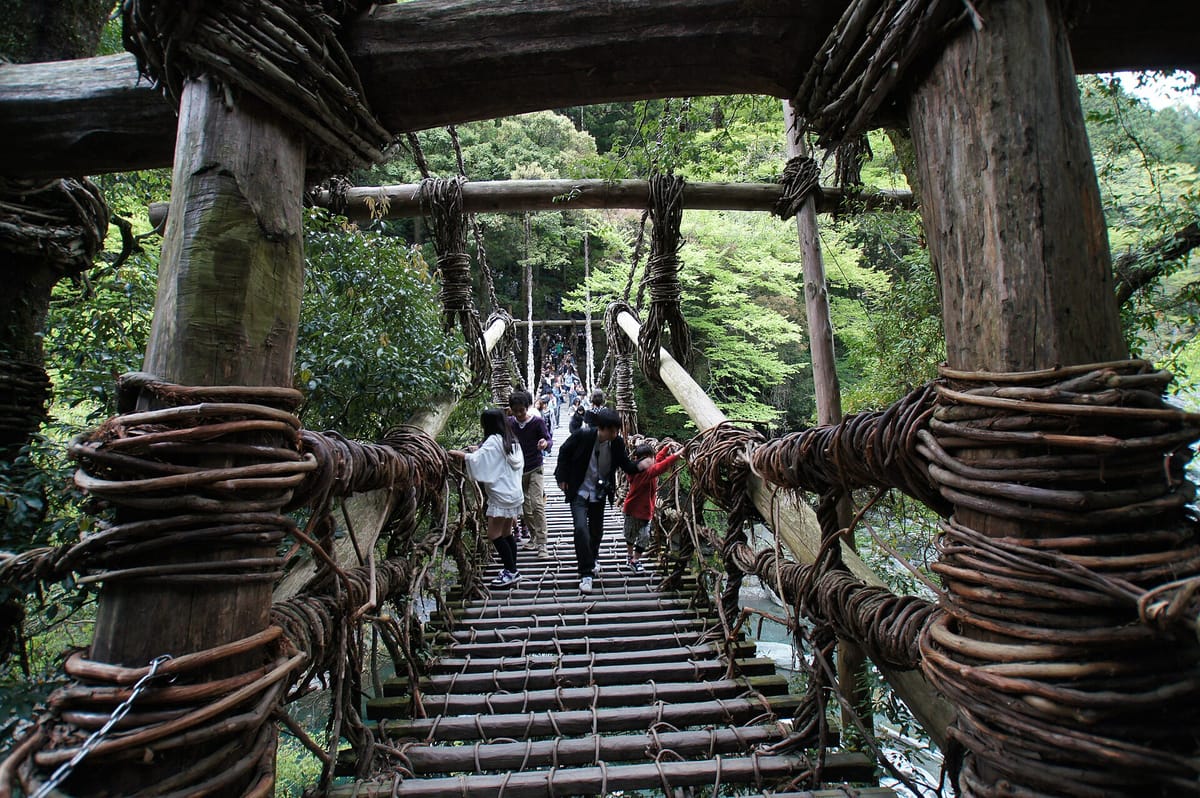
- Iya no Kazurabashi (祖谷のかずら橋): the main vine bridge, open all year, a short walk from the Kazurabashi Yumebutai parking area and shop.
- Biwa no Taki (琵琶の滝): a waterfall about 40 metres high, just along the path after you cross the bridge.
- Oku-Iya Nijū Kazurabashi (奥祖谷二重かずら橋): the double vine bridges of the inner valley, closed from 1 December to 31 March.
- Ōboke and Koboke (大歩危・小歩危): gorges of the Yoshino River carved through crystalline schist, with a sightseeing boat and rafting.
- Hi-no-ji Keikoku (ひの字渓谷): a bend in the valley shaped like the hiragana ひ, seen from a roadside viewpoint.
- Shōben Kozō (小便小僧): the statue of a peeing boy on a cliff above the gorge, recalling local children's old test of courage.
- Iya soba (祖谷そば): the valley's thick, rustic buckwheat noodles, served at restaurants near the bridge.
Words on the signs: bridges, boats and closures
The key signs in the valley are about direction, seasons and weather. The Kazurabashi is one-way, the Oku-Iya bridges close for winter, and the gorge boat stops when the river runs high, so the notices you need most are practical ones. The table below covers them, together with the place names you will see on bus fronts.
The name 祖谷 itself is unusual: 祖 means ancestor and 谷 means valley, but together they are read Iya, a reading you would not guess from the kanji alone.
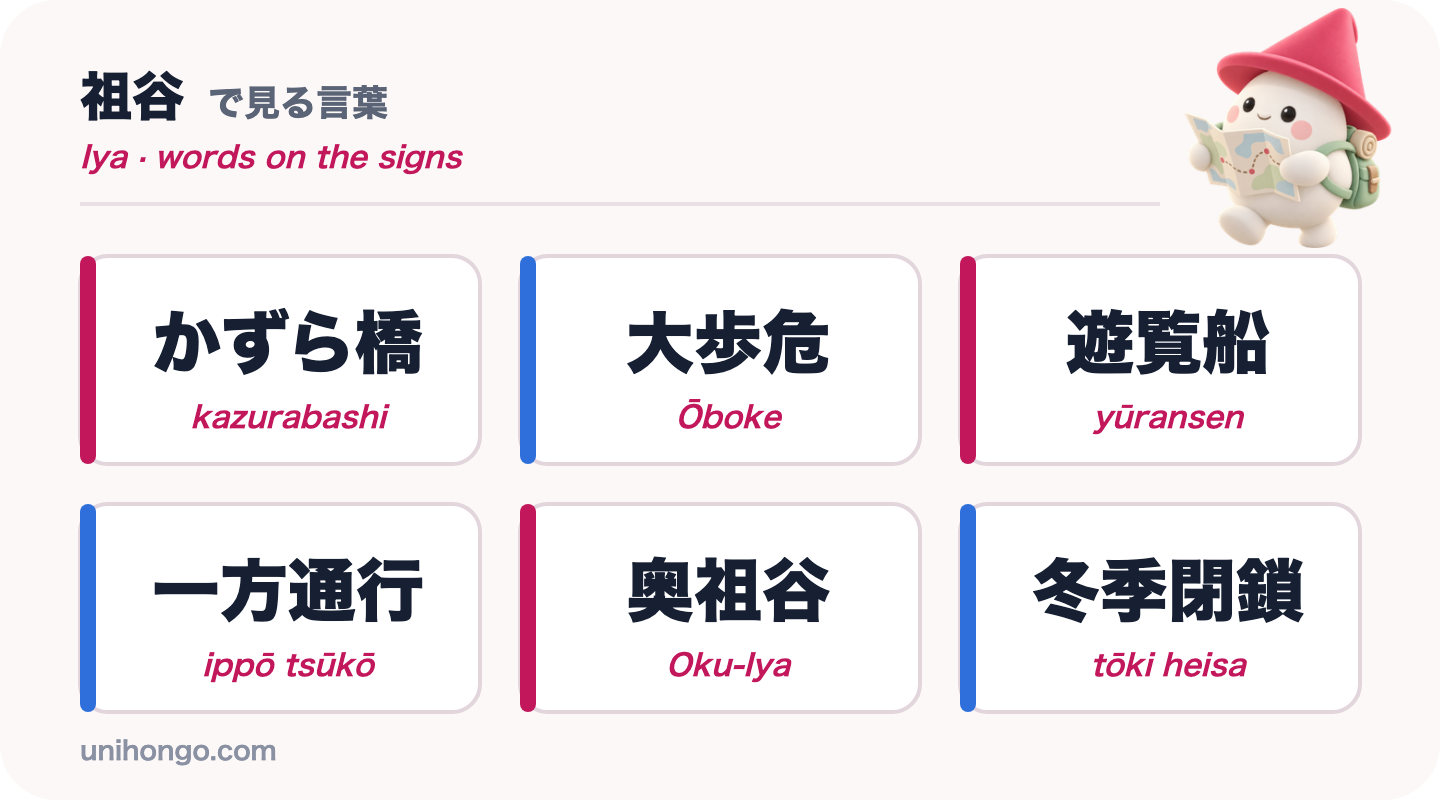
| Word | Reading | Meaning |
|---|---|---|
| 祖谷 | Iya | The Iya Valley area |
| かずら橋 | kazurabashi | Vine bridge |
| 大歩危 | Ōboke | Ōboke gorge and station |
| 小歩危 | Koboke | Koboke gorge, downstream |
| 遊覧船 | yūransen | Sightseeing boat |
| 一方通行 | ippō tsūkō | One way only |
| 奥祖谷 | Oku-Iya | The inner Iya Valley |
| 冬季閉鎖 | tōki heisa | Closed for winter |
| 欠航 | kekkō | Sailing cancelled |
Japanese for buses, the gorge boat and the bridge
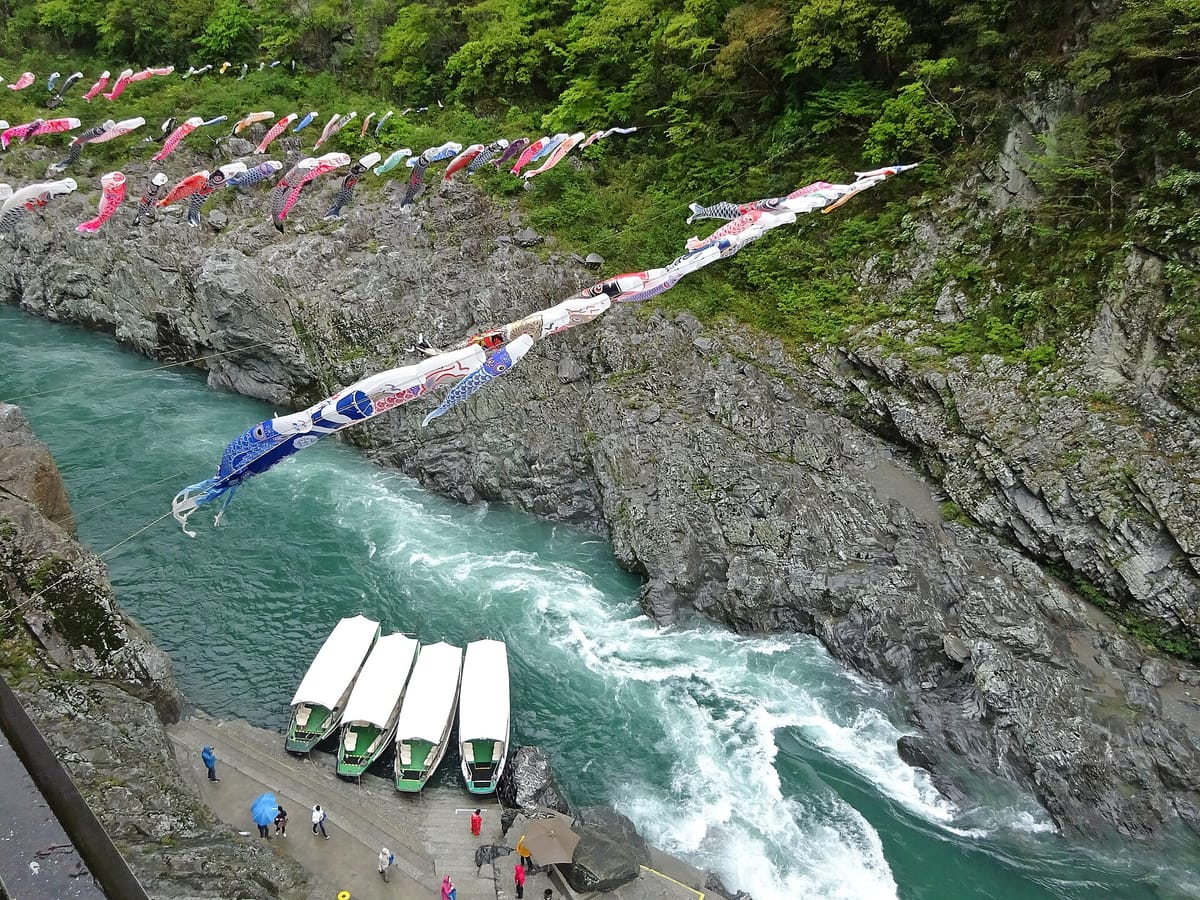
The Ōboke gorge sightseeing boat takes about thirty minutes and returns to the same landing, which is about 25 minutes' walk from Ōboke Station. You take off your shoes and sit on the floor of the boat while the boatman points out rocks shaped like animals. Boats can be cancelled in strong wind or when the river rises, so ask at the landing if the weather looks uncertain.
At the Kazurabashi, you buy a ticket at the entrance and cross one way, returning along the road. Staff may remind you to hold on and not to stop in the middle when others are behind you.
| Japanese | Romaji | Meaning |
|---|---|---|
| 遊覧船は今日出ていますか。 | Yūransen wa kyō dete imasu ka. | Is the sightseeing boat running today? |
| 次の船は何時に出ますか。 | Tsugi no fune wa nanji ni demasu ka. | What time does the next boat leave? |
| 靴は脱ぎますか。 | Kutsu wa nugimasu ka. | Do I take my shoes off? |
| かずら橋の入口はどこですか。 | Kazurabashi no iriguchi wa doko desu ka. | Where is the entrance to the vine bridge? |
| 渡ったあと、どうやって戻りますか。 | Watatta ato, dō yatte modorimasu ka. | How do I get back after crossing? |
| 祖谷そばを一つお願いします。 | Iya soba o hitotsu onegai shimasu. | One Iya soba, please. |
| この辺りに泊まれる所はありますか。 | Kono atari ni tomareru tokoro wa arimasu ka. | Is there somewhere to stay around here? |
Etiquette, timing and practical tips
The Iya Valley rewards careful planning. Distances are short on the map but long on the road, and services close early.
- Photograph the bus timetable at every stop you use, and build your day backwards from the last bus.
- On the Kazurabashi, hold the vine handrails, keep moving, and do not stop to pose in the middle when people are waiting.
- Visit Oku-Iya between April and November only; its bridges are closed from 1 December to 31 March.
- Drive slowly on single-lane roads, and pull into a passing place, taihisho, to let oncoming cars by; a small raised hand says thank you.
- Carry cash: many small restaurants, buses and inns in the valley do not take cards.
- Autumn colours usually peak in November and draw crowds to the bridges; weekday mornings are quietest.
- Stay a night if you can: onsen inns in the valley offer baths with views over the gorge, and the valley is at its most beautiful early in the morning.
Practise the bus ride before you go
The most important conversation in the Iya Valley is with the bus driver. Tell them where you want to get off as you board, and they will usually make sure you do. Then ask about the return bus: the answer may be a time, or, as here, a friendly pointer to the timetable at the stop.
Say the four lines aloud until they come without thinking. Then open Unihongo, choose the Directions topic and ask your AI Sensei to play a rural bus driver who answers with real stop names such as Kazurabashi, Ōboke and Kubo. Try the Travel Emergency topic too, and practise what to say if you miss the last bus.
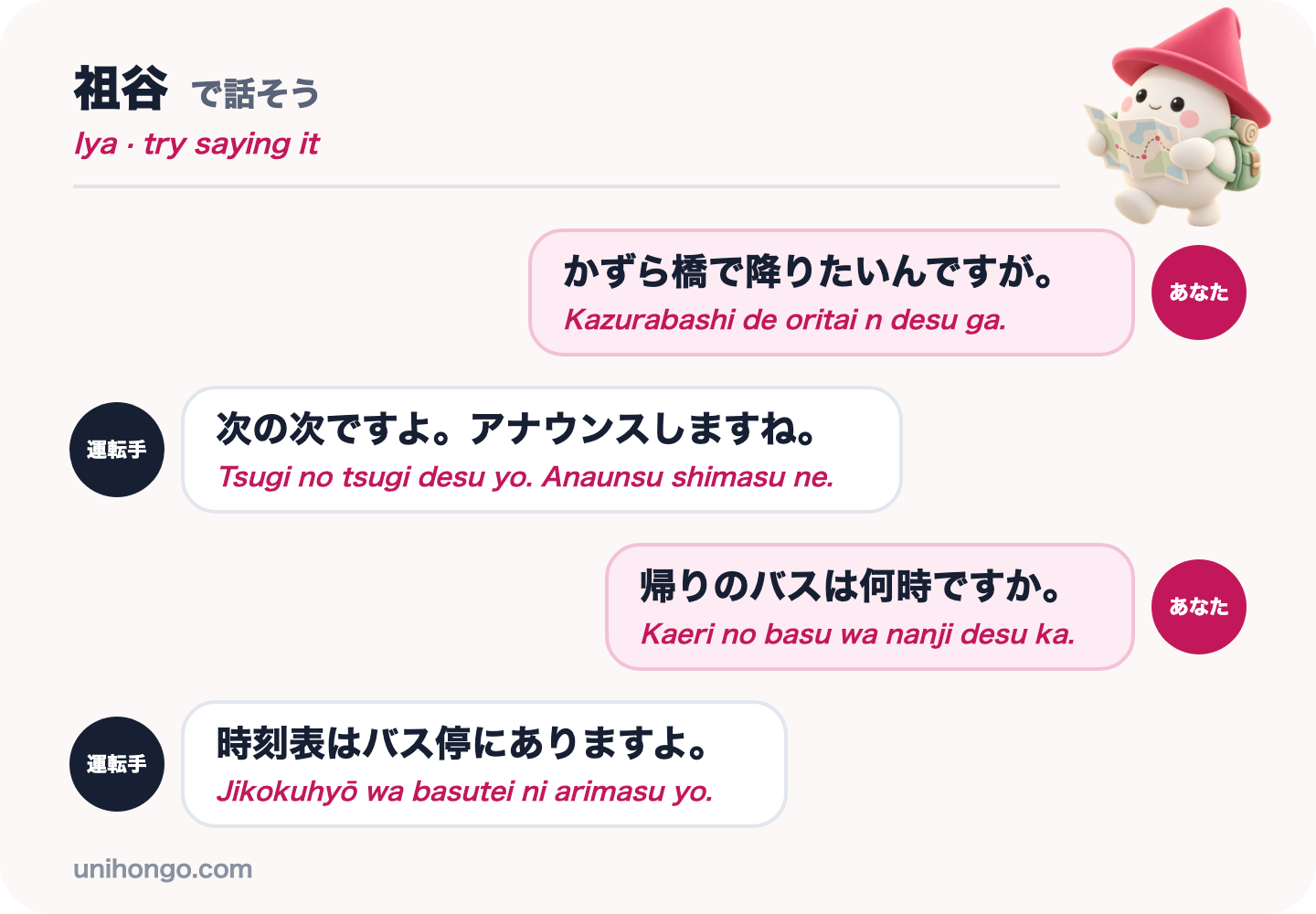
| Japanese | Romaji | Meaning |
|---|---|---|
| かずら橋で降りたいんですが。 | Kazurabashi de oritai n desu ga. | I'd like to get off at Kazurabashi. |
| 次の次ですよ。アナウンスしますね。 | Tsugi no tsugi desu yo. Anaunsu shimasu ne. | It's the stop after next. I'll announce it. |
| 帰りのバスは何時ですか。 | Kaeri no basu wa nanji desu ka. | What time is the bus back? |
| 時刻表はバス停にありますよ。 | Jikokuhyō wa basutei ni arimasu yo. | The timetable is at the bus stop. |
Official information
Opening seasons, bus timetables, boat conditions and any closures after heavy rain are published by the Miyoshi City tourism association. Check them the day before you travel into the valley.