

Why Enoshima is worth crossing the bridge for
Enoshima is small enough to walk around in a few hours but packs in more than its size suggests: three shrines, a lighthouse tower in a garden, cliffs, tide pools and two sea caves. The whole island is dedicated to Benzaiten, often shortened to Benten, the only goddess among the Seven Lucky Gods, who looks after music, eloquence, the arts and money. Her shrines have drawn pilgrims from Edo, the old name of Tokyo, since long before the railway arrived.
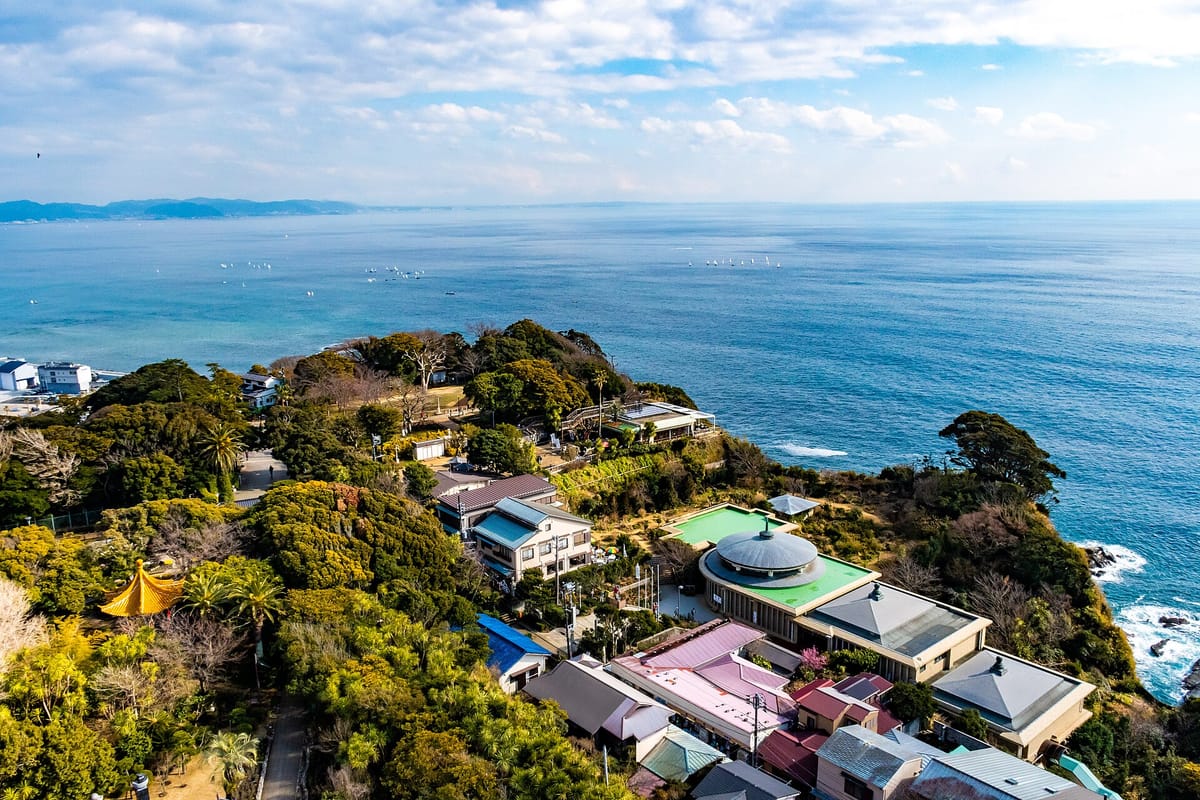
The island has two halves. The low eastern end is a yacht harbour, built for the sailing events of the 1964 Tokyo Olympics, and the rest is a forested hill criss-crossed with steps. From the top, on a clear day, you look west across the bay to Mount Fuji and east along the beaches towards Kamakura.
For a learner, Enoshima has the charm of a place you can take in slowly. The shop signs, shrine names and ticket boards repeat a small set of words, and the one real question of the day, how far is it to the caves, has a short answer you can understand.
Getting there: Enoden, Odakyu or the Shōnan Monorail
Three lines stop near the island, each at its own station. The Enoden, the little coastal train from Kamakura and Fujisawa, stops at Enoshima Station, Enoshima-eki; the Odakyu line from Shinjuku ends at Katase-Enoshima Station, whose front is built like a dragon palace from the island's legends; and the Shōnan Monorail, which hangs beneath its track, runs from Ōfuna on JR to Shōnan-Enoshima Station. All three are about fifteen minutes' walk from the island.
From Tokyo, the cheapest route is the Odakyu line from Shinjuku to Fujisawa and a change for Katase-Enoshima; on some days a direct Romancecar limited express runs all the way. On JR, ride the Tōkaidō Line from Tokyo Station, or the Shōnan-Shinjuku Line from Shinjuku, to Fujisawa and change to the Enoden or Odakyu. If you are already in Kamakura, the Enoden takes about twenty-five minutes, and between Koshigoe and Enoshima it runs right down the middle of a narrow shopping street, a ride worth sitting at the window for.
From any of the stations, follow the signs to Benten-bashi, the long bridge across to the island. Suica and Pasmo work on all three lines.
| Japanese | Romaji | Meaning |
|---|---|---|
| 片瀬江ノ島行きはどのホームですか。 | Katase-Enoshima-yuki wa dono hōmu desu ka. | Which platform is the train for Katase-Enoshima? |
| 藤沢で乗り換えですか。 | Fujisawa de norikae desu ka. | Do I change at Fujisawa? |
| 江の島へはどちらの出口ですか。 | Enoshima e wa dochira no deguchi desu ka. | Which exit is for Enoshima? |
| 江の島まで歩いて何分くらいですか。 | Enoshima made aruite nanpun kurai desu ka. | About how many minutes on foot to Enoshima? |
| 鎌倉行きの江ノ電はここから乗れますか。 | Kamakura-yuki no Enoden wa koko kara noremasu ka. | Can I catch the Enoden to Kamakura from here? |
From the bronze torii to the Iwaya caves: what you will see
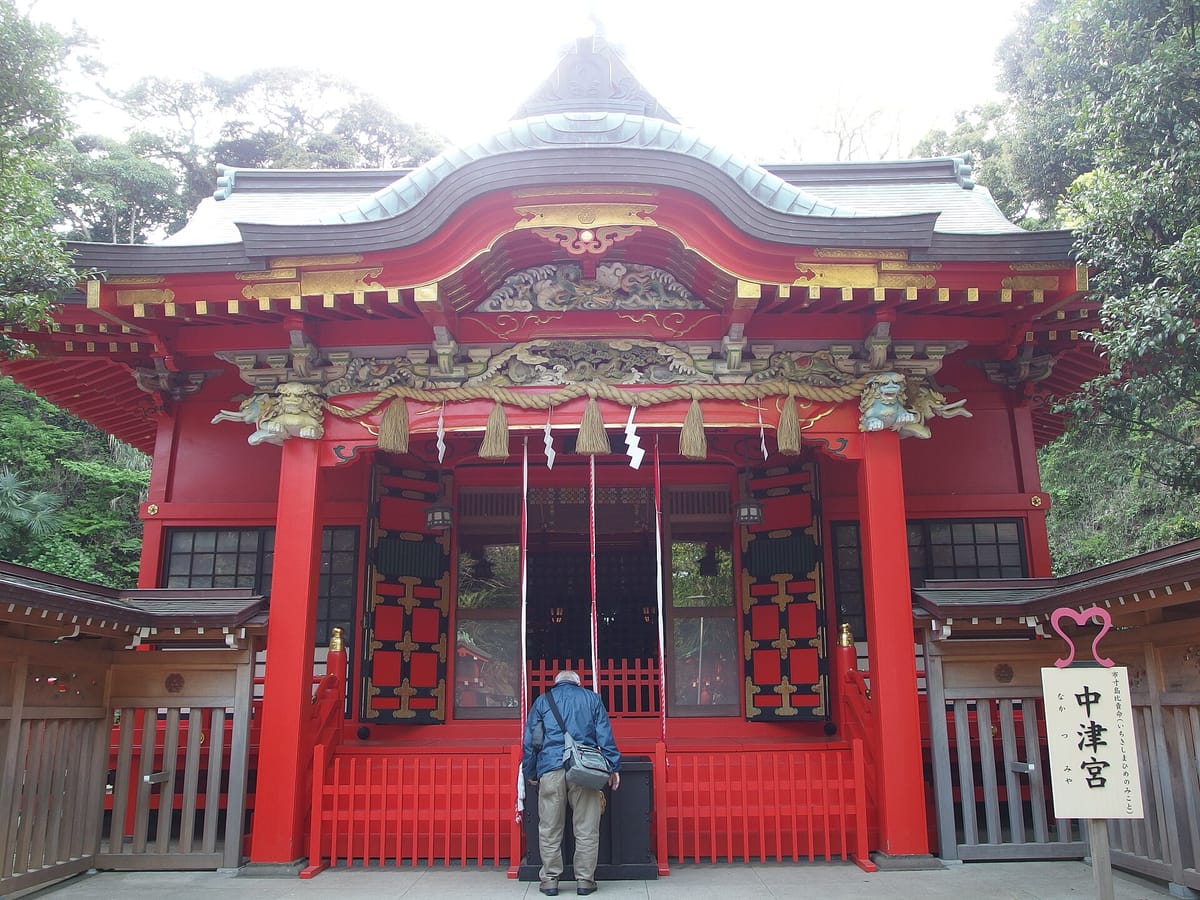
Across the bridge a bronze torii marks the start of the approach, a steep, narrow street of seafood restaurants, souvenir stalls and shops pressing tako-senbei, flat octopus crackers, on hot iron plates. At the top, a red torii and a gate built like the Dragon King's undersea palace lead into Enoshima Shrine, Enoshima Jinja, which is really three shrines. Hetsunomiya is the lowest and busiest; beside it the octagonal Hōanden hall displays statues of Benzaiten, including a famous seated Benten playing the biwa lute, for a small fee. Nakatsunomiya, painted bright vermilion, sits halfway up, and Okutsunomiya stands in the woods near the far end of the island.
On the summit, the Samuel Cocking Garden grows on the site of a botanical garden laid out by a British trader in the late nineteenth century, and the Sea Candle, a lighthouse and observation tower about sixty metres tall, rises from its centre. Past Okutsunomiya a side path leads to the Ryūren no Kane, a bell that couples ring together, remembering the legend of Benten and the dragon.
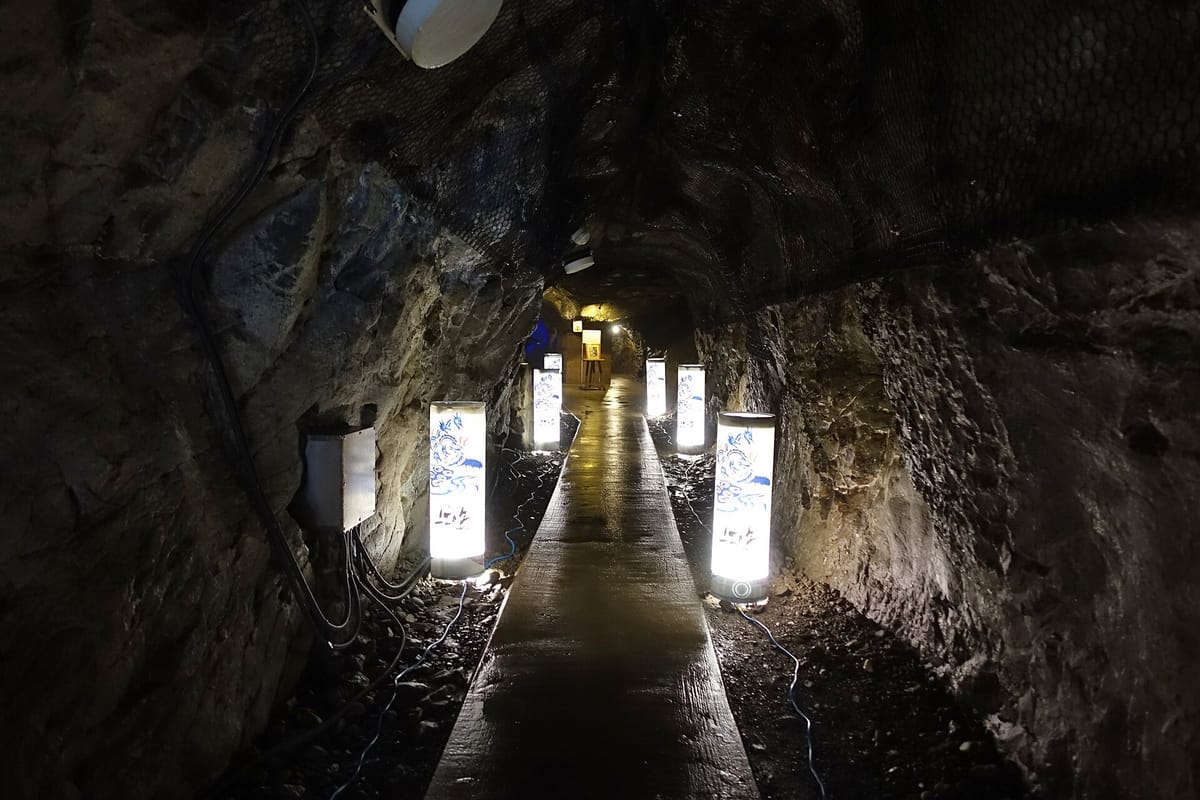
Finally, steps drop down the cliffs to Chigogafuchi, a wide rock shelf at sea level, and the Iwaya caves. The first cave runs 152 metres into the cliff and the second 56 metres; both are lit by lanterns and candlelight, with stone statues along the walls, and the second is associated with the dragon god of the legend. The caves close when the sea is rough.
- Benten-bashi: the bridge to the island, with Mount Fuji visible to the west on clear days.
- Nakamise-dōri: the steep approach street of restaurants, crackers and souvenirs.
- Hetsunomiya and the Hōanden: the lowest shrine and the hall of Benzaiten statues.
- Nakatsunomiya and Okutsunomiya: the middle and inner shrines higher up the hill.
- Samuel Cocking Garden and the Sea Candle: the garden and the observation tower on the summit.
- Ryūren no Kane: the bell of the dragon's love, on a lookout above the sea.
- Chigogafuchi and the Iwaya caves: the rock shelf and sea caves at the far end.
Shrine and island words on the signs
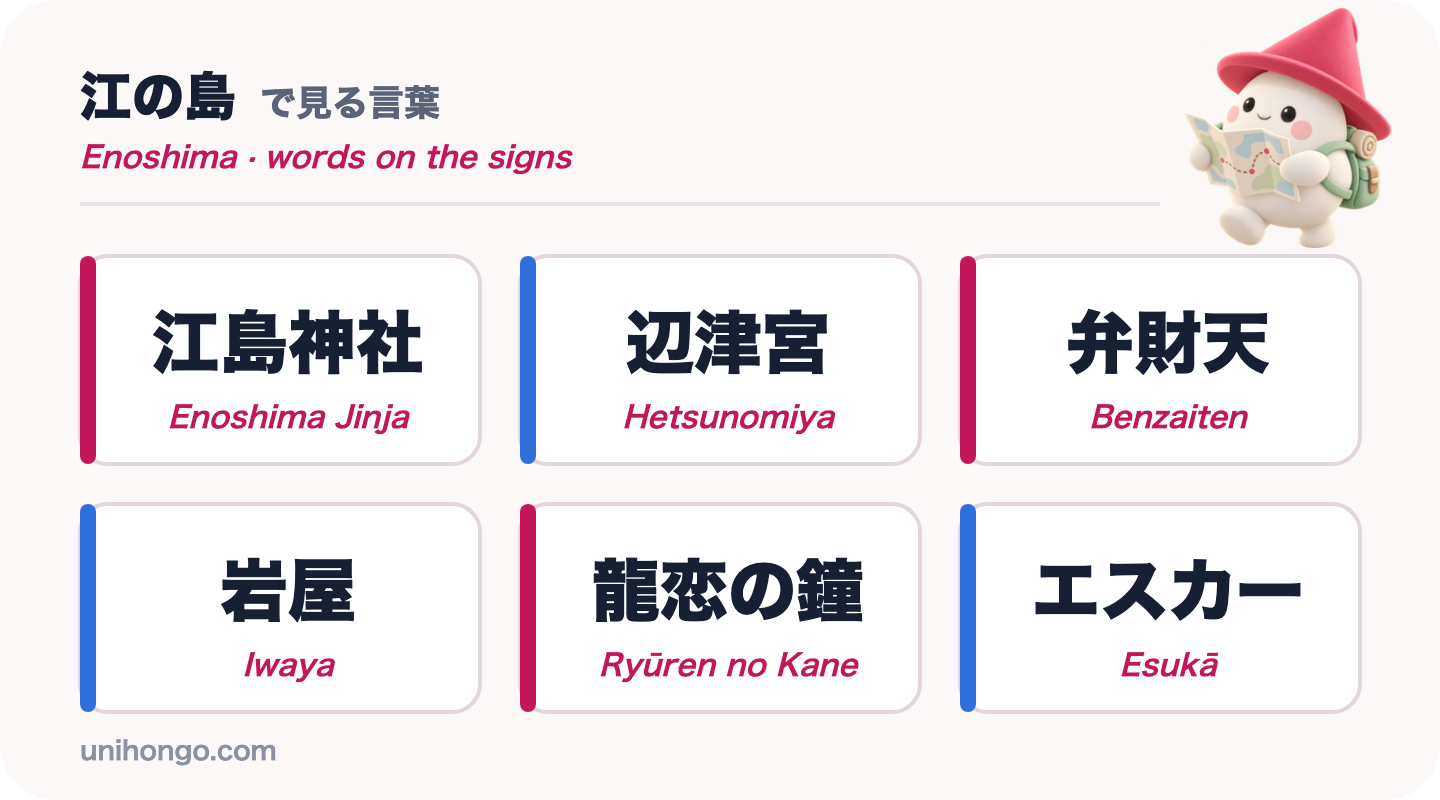
Most signposts on Enoshima point either up, to the shrines and the Sea Candle, or onward, to the caves. The three shrines share an ending, 宮, miya, meaning shrine or palace, and their names are read with old-fashioned readings that even Japanese visitors check. The escalators are signed エスカー in katakana, the island's own name for its escalator service.
The table below covers the words you meet on the map boards, at the shrines and at the ticket windows.
| Word | Reading | Meaning |
|---|---|---|
| 江島神社 | Enoshima Jinja | Enoshima Shrine, the island's three shrines together |
| 辺津宮 | Hetsunomiya | The lowest of the three shrines |
| 中津宮 | Nakatsunomiya | The middle shrine |
| 奥津宮 | Okutsunomiya | The inner shrine near the far end of the island |
| 奉安殿 | Hōanden | Octagonal hall that displays the Benzaiten statues |
| 弁財天 | Benzaiten | Goddess of music, the arts and wealth |
| 弁天橋 | Benten-bashi | The bridge from the mainland to the island |
| エスカー | Esukā | The paid escalators up the hill |
| 龍恋の鐘 | Ryūren no Kane | Bell of the dragon's love |
| 稚児ヶ淵 | Chigogafuchi | Rock shelf at sea level near the caves |
| 岩屋 | Iwaya | The sea caves |
Japanese for the escalators, tickets and snacks
Most of your spending on Enoshima happens at small windows: the Escar escalators, which carry you up the hill in stages, the Sea Candle, the Iwaya caves and the Benzaiten hall. Each sells its own ticket, and a combination ticket that bundles several of them is sold on the island. Walking down needs no ticket, so many people ride up and walk back.
The other place you will talk is at the food stalls. Tako-senbei are made to order and handed over hot, shirasu whitebait appears in rice bowls and on crackers, and turban shells, sazae, are grilled in their shells outside the restaurants. Near Hetsunomiya, a small spring called Zeniarai Hakuryūō is where visitors wash coins in the hope that Benten will multiply them.
| Japanese | Romaji | Meaning |
|---|---|---|
| エスカーのチケットを二枚ください。 | Esukā no chiketto o nimai kudasai. | Two Escar tickets, please. |
| 岩屋も入れるセット券はありますか。 | Iwaya mo haireru setto-ken wa arimasu ka. | Is there a combination ticket that includes the caves? |
| 岩屋は今日、開いていますか。 | Iwaya wa kyō, aite imasu ka. | Are the caves open today? |
| 富士山はどちらに見えますか。 | Fujisan wa dochira ni miemasu ka. | In which direction can I see Mount Fuji? |
| お金を洗う場所はどこですか。 | Okane o arau basho wa doko desu ka. | Where is the place to wash money? |
| たこせんべいをひとつください。 | Tako-senbei o hitotsu kudasai. | One octopus cracker, please. |
Etiquette, weather and timing on the island
Enoshima is a sacred island as well as a resort, and on summer weekends it is very crowded. A few habits make the day easier.
- At each shrine, rinse your hands at the temizuya, then bow twice, clap twice, pray and bow once.
- Keep to one side on the narrow Nakamise-dōri and the steps so people can pass in both directions.
- Carry your rubbish with you; there are few bins on the island, and kites overhead will snatch food from open hands.
- Check the sea before heading to the caves: the Iwaya caves and the Bentenmaru boat stop in rough weather.
- Come on a weekday or early in the morning. In July and August the beaches beside the island fill with swimmers.
- If you visit the Kamakura-kōkōmae level crossing on the Enoden, stay on the pavement and do not stand in the road for photos.
Practise the island walk before you go
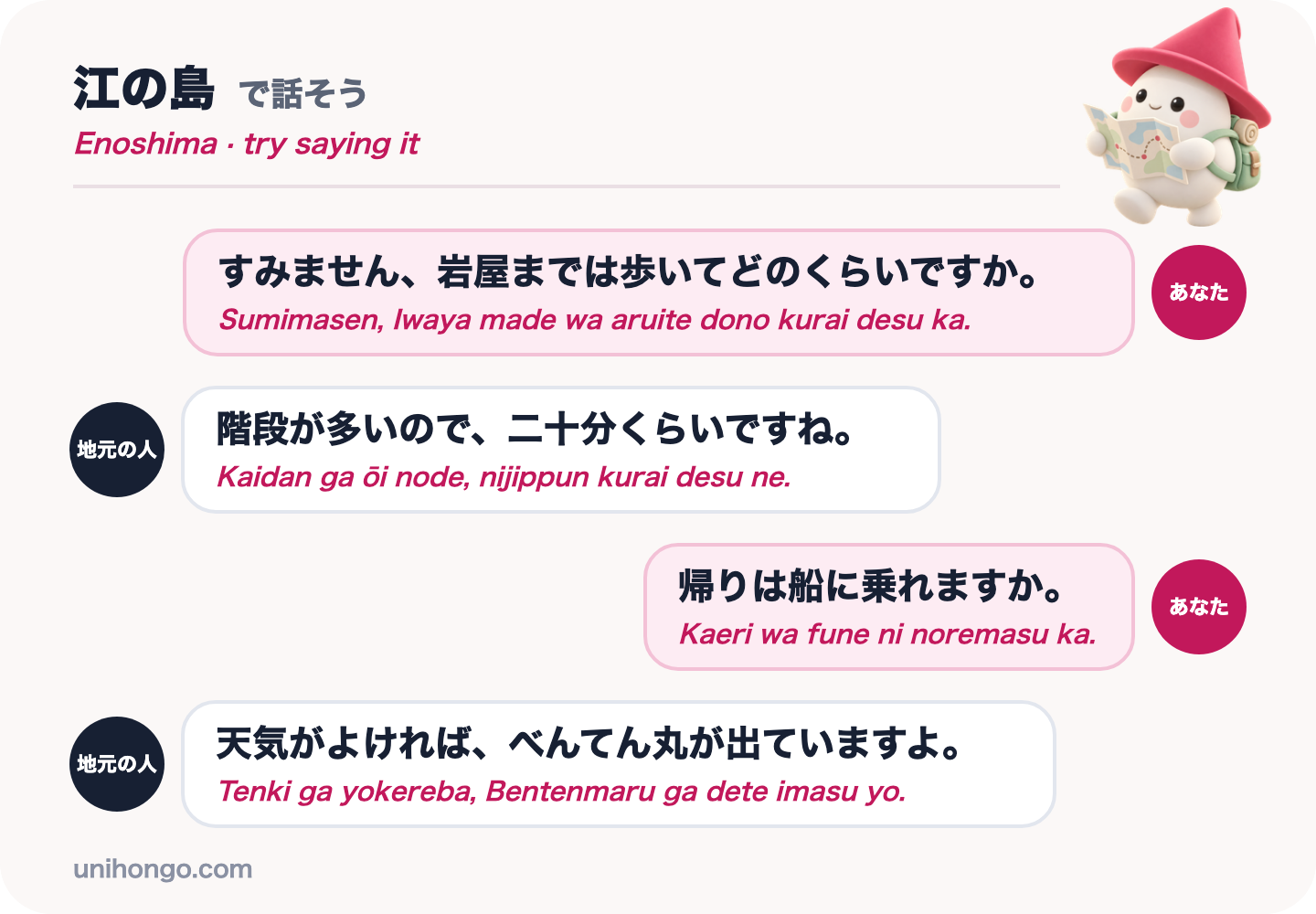
At the top of the island, the question everyone asks is how far it is to the caves. The answer usually comes with a warning about the steps, and a follow-up question about getting back naturally leads to the Bentenmaru, the small boat that runs from Chigogafuchi to the bridge when the weather allows. Practise the four lines below until you can say them without looking.
Then rehearse with a partner who replies. In Unihongo, choose the Sightseeing topic and ask your AI Sensei to play a local on Enoshima, or the Directions topic to practise the route from the station. Saying the lines once beforehand is what makes them easy to use on the day.
| Japanese | Romaji | Meaning |
|---|---|---|
| すみません、岩屋までは歩いてどのくらいですか。 | Sumimasen, Iwaya made wa aruite dono kurai desu ka. | Excuse me, how long does it take to walk to the caves? |
| 階段が多いので、二十分くらいですね。 | Kaidan ga ōi node, nijippun kurai desu ne. | There are a lot of steps, so about twenty minutes. |
| 帰りは船に乗れますか。 | Kaeri wa fune ni noremasu ka. | Can I take a boat on the way back? |
| 天気がよければ、べんてん丸が出ていますよ。 | Tenki ga yokereba, Bentenmaru ga dete imasu yo. | If the weather is good, the Bentenmaru is running. |
Official information
Opening times for the Sea Candle, the Iwaya caves and the Escar, the current combination tickets, the Bentenmaru's running days and seasonal events such as the winter illuminations are published by Fujisawa city's tourism site and the Sea Candle operator. Check them on the day, as weather often changes plans on the island.