

Why Tō-ji is worth a stop near Kyoto Station
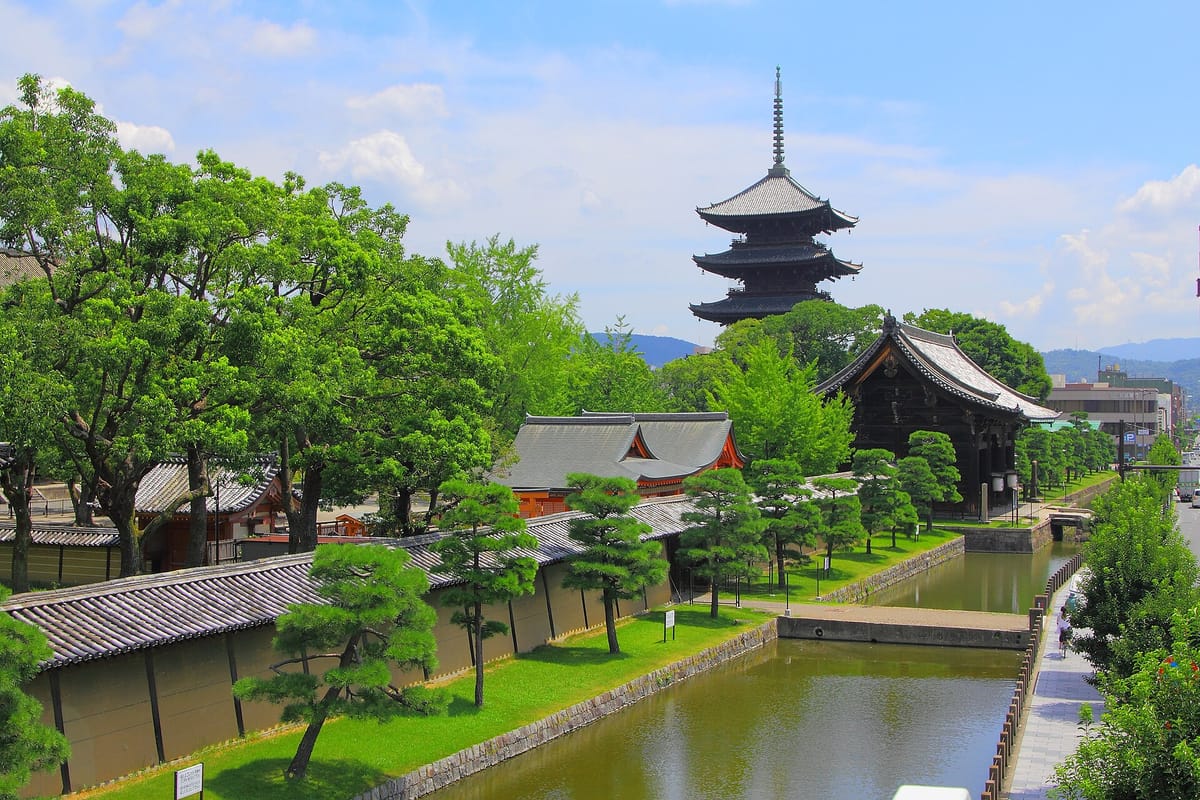
When Emperor Kanmu built Heiankyō in 794, he placed two state temples either side of Rashōmon, the great southern gate: Tō-ji in the east and Sai-ji in the west. Sai-ji has long gone. Tō-ji, officially Kyōō Gokoku-ji, the temple for the protection of the nation by the king of teachings, is still on its original site, and its grid of halls still lines up with the plan of the ancient city.
Its second founder matters as much as the first. In 823 the emperor Saga gave Tō-ji to Kūkai, the monk who had brought esoteric Buddhism back from China and founded the Shingon school. Kūkai designed the Kōdō and began the pagoda, and to this day Kyoto people call him Kōbō-san with real affection. The Mieidō, the hall where he lived, is still a place of daily prayer.
For a learner, Tō-ji is a lesson in reading. The temple uses old Buddhist readings for familiar kanji, the market is full of cheerful bargaining, and the pagoda gives you an easy landmark to ask about anywhere in southern Kyoto.
Getting there: Tōji Station, Kyoto Station and the gate bus stops
Tō-ji is within walking distance of Kyoto Station: about fifteen minutes from the Hachijō exit on the south side. Kintetsu Tōji Station, one stop from Kyoto on the Kintetsu Kyoto Line, is about ten minutes' walk. City buses stop at the east, south and west gates, Tōji-higashimon-mae, Tōji-minamimon-mae and Tōji-nishimon-mae, and the grounds are right in front of you when you get off.
The main entrance for visitors is the Tōdaimon, the east gate, or the Minamidaimon, the great south gate. On market days, walk in from any side and follow the crowd; on other days the ticket office is near the Kondō. Note that the station is written Tōji without a hyphen, while the temple is Tō-ji; the kanji are the same.
| Japanese | Romaji | Meaning |
|---|---|---|
| 東寺駅は近鉄の何番線ですか。 | Tōji-eki wa Kintetsu no nanbansen desu ka. | Which Kintetsu platform is for Tōji Station? |
| 八条口から東寺まで歩けますか。 | Hachijōguchi kara Tō-ji made arukemasu ka. | Can I walk to Tō-ji from the Hachijō exit? |
| 五重塔が見えるほうへ行けばいいですか。 | Gojūnotō ga mieru hō e ikeba ii desu ka. | Should I head towards where I can see the pagoda? |
| 拝観の受付はどこですか。 | Haikan no uketsuke wa doko desu ka. | Where is the ticket office for visitors? |
| 東寺南門前に止まりますか。 | Tōji-minamimon-mae ni tomarimasu ka. | Does this stop at Tōji-minamimon-mae? |
The pagoda, the Kondō and the statue mandala in the Kōdō
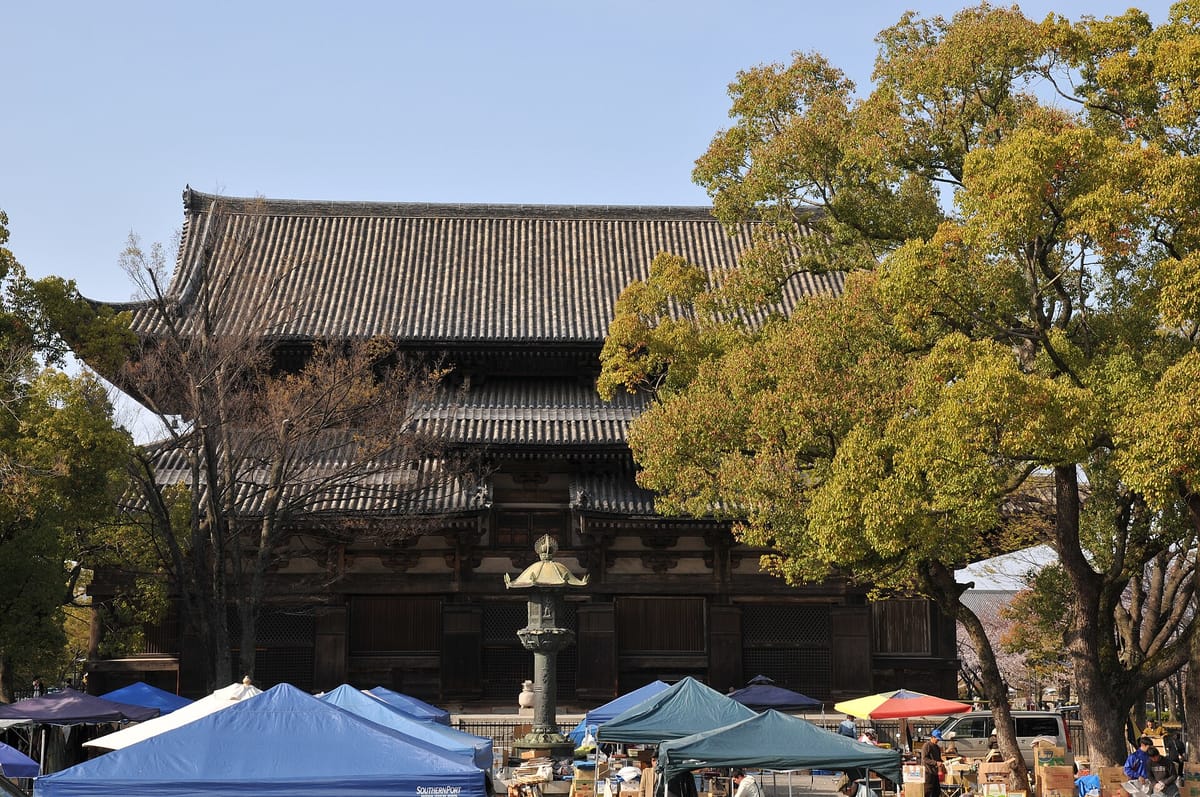
The paid area centres on three buildings. The Kondō, the main hall, burned in 1486 and was rebuilt around 1600 on a grand scale; it houses a seated Yakushi Nyorai, the Buddha of healing, flanked by two bodhisattvas, with twelve guardian generals round the base. Next to it, the Kōdō, the lecture hall, was the building Kūkai planned first. Inside, twenty-one statues, many of them National Treasures from the ninth century, are arranged on a great platform around Dainichi Nyorai, the cosmic Buddha. Kūkai meant them as a mandala you can walk in front of rather than a painting, and even visitors who know nothing about Shingon tend to stand in silence.
The pagoda rises from its own garden with a pond. The current tower is the fifth, rebuilt in 1644 after earlier ones were lost to fire, often caused by lightning. It is about 55 metres high and the tallest wooden structure in Japan. Outside the paid area, walk to the Mieidō in its own walled enclosure, where Kūkai lived; morning services begin there at six every day and anyone may attend.
- Gojūnotō: the five-storey pagoda, a National Treasure; the ground floor opens only on special occasions.
- Kondō: the main hall with the Yakushi triad and twelve generals.
- Kōdō: the lecture hall with the three-dimensional mandala of twenty-one statues.
- Mieidō: Kūkai's residence, a National Treasure, free to enter and pray.
- Jikidō: the old dining hall, now the place for temple stamps and sutra copying.
- Hōmotsukan: the treasure house, open only in spring and autumn exhibition periods.
- Kanchi-in: a sub-temple with a separate ticket and paintings attributed to Miyamoto Musashi.
Words on the signs at Tō-ji
Building names at Tō-ji all end in 堂, dō, hall, except the pagoda, 塔, tō. What changes is the first part, and several use readings you will not find in a beginner's textbook: 金 is kon rather than kin in Kondō, 食 is jiki rather than shoku in Jikidō, and 御影 is miei in Mieidō.
At the market the useful words are practical: 値段, nedan, price, 札, fuda, a tag, and 骨董, kottō, antiques. You will also see 市, ichi, market, on banners, the same kanji as in the names of many towns.
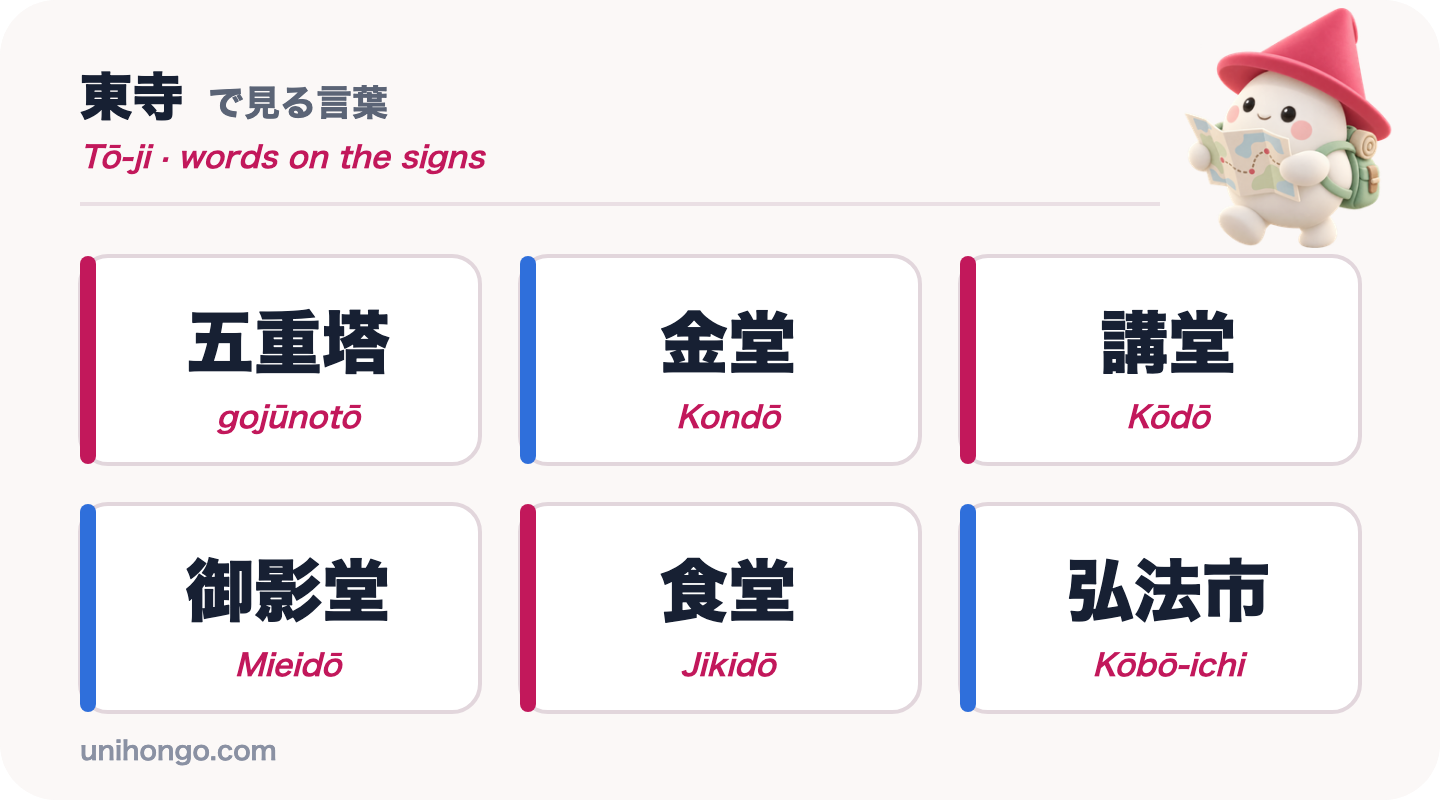
| Word | Reading | Meaning |
|---|---|---|
| 五重塔 | gojūnotō | Five-storey pagoda |
| 金堂 | Kondō | Main hall of the temple |
| 講堂 | Kōdō | Lecture hall, home of the statue mandala |
| 御影堂 | Mieidō | Hall where Kūkai lived, also called Daishi-dō |
| 食堂 | Jikidō | The monks' old dining hall, read jikidō in temples |
| 弘法市 | Kōbō-ichi | The market on the 21st of each month |
| 弘法さん | Kōbō-san | Friendly name for Kūkai and for the market day |
| 納経所 | nōkyōsho | Office where temple stamps are written |
| 骨董 | kottō | Antiques |
Japanese for the Kōbō-san market
The market grew from tea stalls set up for pilgrims at the monthly memorial service for Kūkai, and it has been growing for centuries. Today you will find old pottery, lacquer, used kimono and obi, tools, plants, pickles and hot food such as yakitori and oden. Many sellers are regulars who have kept the same spot for years and enjoy a chat.
Bargaining is gentle rather than aggressive. Asking if a price can come down a little, especially when you buy more than one thing, is normal; haggling hard over a small item is not. Cash is the rule, and small notes and coins make life easier for everyone.
| Japanese | Romaji | Meaning |
|---|---|---|
| これは何年ぐらい前のものですか。 | Kore wa nannen gurai mae no mono desu ka. | About how old is this? |
| 手に取って見てもいいですか。 | Te ni totte mite mo ii desu ka. | May I pick it up and look? |
| もう少し安くなりませんか。 | Mō sukoshi yasuku narimasen ka. | Could it be a little cheaper? |
| 割れないように包んでもらえますか。 | Warenai yō ni tsutsunde moraemasu ka. | Could you wrap it so it does not break? |
| カードは使えますか。 | Kādo wa tsukaemasu ka. | Can I pay by card? |
| じゃあ、これにします。 | Jā, kore ni shimasu. | Then I will take this one. |
Etiquette and timing at Tō-ji
Tō-ji is both a busy place of worship and, once a month, a crowded market. A few habits help on both kinds of day.
- Ask before picking up fragile antiques, and hold them over the table, not above the ground.
- Carry cash in small denominations; many stalls do not take cards.
- Arrive early on the 21st. The best finds go in the morning and the paths are packed by midday.
- Do not take photos inside the halls unless a sign says you may; the statues are objects of worship, not exhibits.
- Check the special-opening schedule if you want to see inside the pagoda or visit the treasure house.
- Parking is not available on market days, so come by train or bus.
Practise the market before you go
The four lines below are a typical Kōbō-san exchange. You ask the price, the stallholder points to the tag, and you try the most natural bargaining move in Japan: offering to buy two. Listen for omake in the answer.
Say the lines aloud until you can do it without reading, then practise with a partner who can say no as well as yes. In Unihongo, choose the Shopping topic and ask your AI Sensei to play a stallholder at the Tō-ji market, or choose Sightseeing to rehearse questions about the pagoda. A friendly exchange you have spoken once before comes out easily on the day.
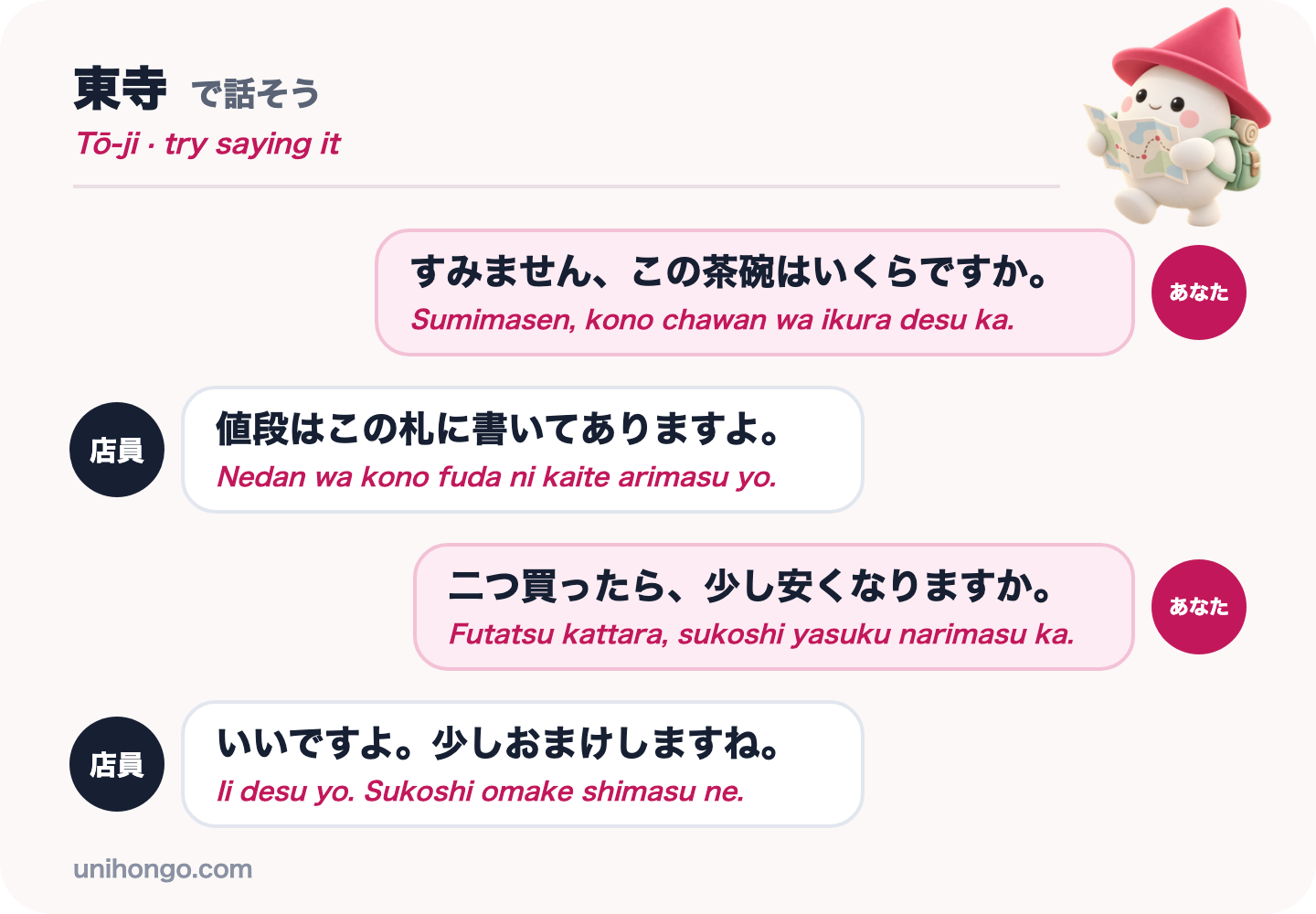
| Japanese | Romaji | Meaning |
|---|---|---|
| すみません、この茶碗はいくらですか。 | Sumimasen, kono chawan wa ikura desu ka. | Excuse me, how much is this tea bowl? |
| 値段はこの札に書いてありますよ。 | Nedan wa kono fuda ni kaite arimasu yo. | The price is written on this tag. |
| 二つ買ったら、少し安くなりますか。 | Futatsu kattara, sukoshi yasuku narimasu ka. | If I buy two, would it be a little cheaper? |
| いいですよ。少しおまけしますね。 | Ii desu yo. Sukoshi omake shimasu ne. | Sure. I will give you a little discount. |
Official information
Tō-ji publishes its hours, fees, the yearly calendar of pagoda and treasure house openings, and access directions on its website, with an English section. Check it before you go, especially for special openings and night illuminations.