
Two spellings, one sound: 懐石 and 会席
Kaiseki is written two ways. 懐石 joins the characters for bosom and stone. The usual explanation is a story about Zen monks who held a warmed stone inside their robes to quiet their hunger, so the word suggests a modest meal that takes the edge off. That is the meal served before tea in the tea ceremony.
会席 joins meeting and seat. It names the food served at gatherings, built around enjoying sake, and it is the ancestor of most ryokan dinners and banquet courses. In everyday use the line is blurred: plenty of restaurants write 懐石 for a luxurious course dinner, so do not judge a restaurant by the spelling.
| Point | Tea-ceremony kaiseki | Banquet kaiseki |
|---|---|---|
| Original purpose | A light meal before tea | Dishes to enjoy with sake at a gathering |
| When rice appears | Near the beginning | At the end, with pickles and soup |
| Where you meet it | Tea gatherings and some specialist restaurants | Ryokan dinners, banquets and most restaurants |
The course order, name by name
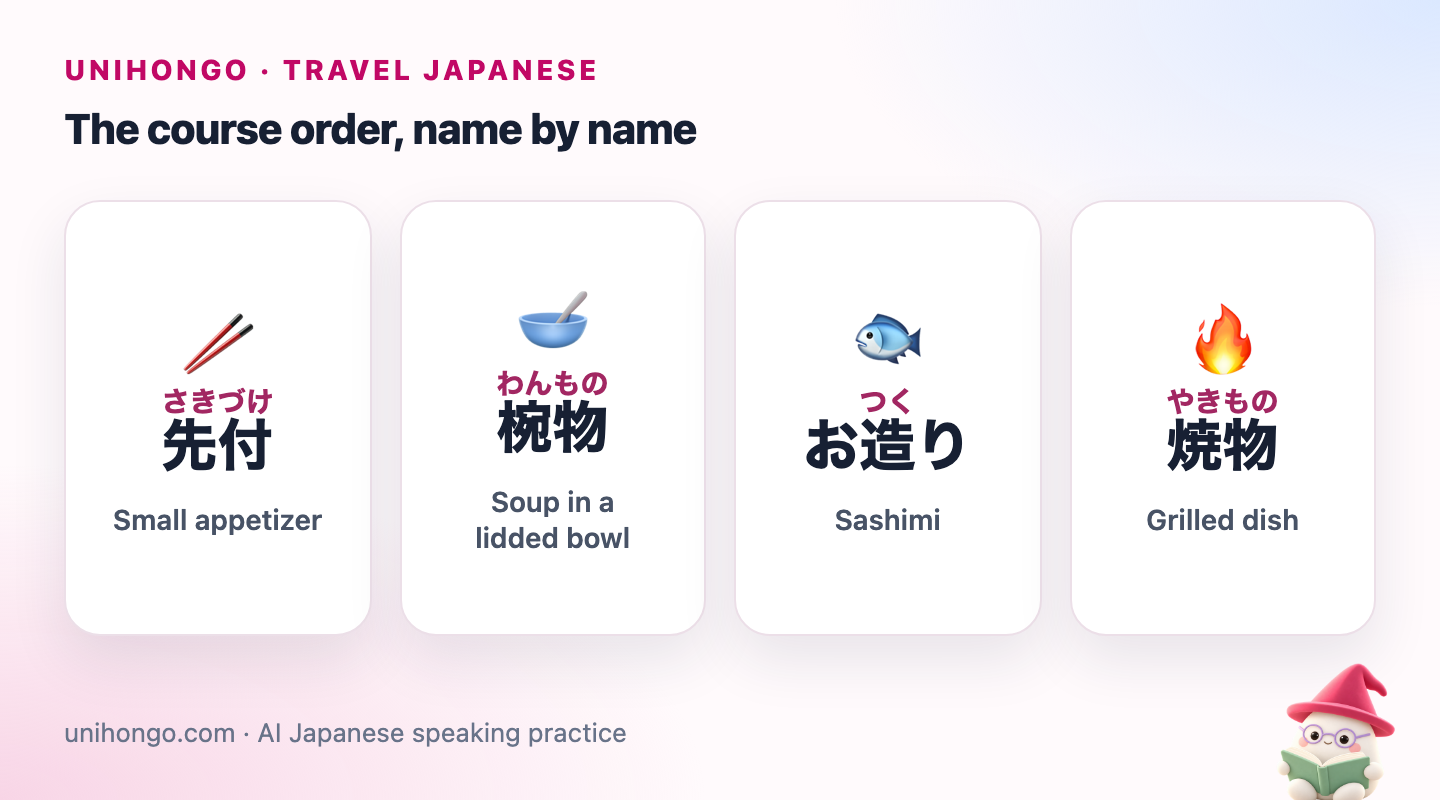
Most menus follow the banquet order below. Restaurants add, drop and rename courses, so treat it as a map and not a law. Notice that most names end in mono (物), thing: grilled thing, simmered thing, fried thing.
| Japanese | Romaji | Meaning |
|---|---|---|
| 先付 | Sakizuke | Small appetizer |
| 椀物 | Wanmono | Soup in a lidded bowl |
| お造り | Otsukuri | Sashimi |
| 焼物 | Yakimono | Grilled dish |
| 煮物 | Nimono | Simmered dish |
| 揚物 | Agemono | Deep-fried dish |
| 酢の物 | Sunomono | Vinegared dish |
| ご飯 | Gohan | Rice |
| 香の物 | Kōnomono | Pickles |
| 止め椀 | Tomewan | Closing miso soup |
| 水菓子 | Mizugashi | Fruit or dessert |
The sashimi course is also headed mukōzuke (向付), a tea-ceremony word for the dish placed on the far side of the tray. Other headings you may meet are hassun (八寸), a platter of seasonal bites, and mushimono (蒸し物), a steamed dish such as savoury egg custard. Rice, pickles and soup arrive together and signal that the savoury courses are over.
Reading the oshinagaki
The menu card at your seat is the oshinagaki (お品書き), sometimes headed kondate (献立). Each line is a course heading followed by that day's dish, often with rare fish and vegetable kanji that Japanese guests also ask about. A few words explain how the meal was planned.
| Japanese | Romaji | Meaning |
|---|---|---|
| お品書き | Oshinagaki | The menu card |
| おまかせ | Omakase | Chef's choice |
| 旬 | Shun | In season, at its best |
| 季節の野菜 | Kisetsu no yasai | Seasonal vegetables |
| 本日のお造り | Honjitsu no otsukuri | Today's sashimi |
Shun is the short period when an ingredient is at its peak, and a kaiseki menu is built around it. Another post on this blog covers seasonal foods in detail; here it is enough to recognise the kanji 旬.
What staff say when a dish arrives, and what you say back
Each course is set down with a short introduction. The pattern is fixed: Kochira wa, this, then the dish name, then de gozaimasu, a very polite form of desu. You are not expected to match that level. Ordinary desu and masu forms are exactly right for a guest.
| Japanese | Romaji | Meaning |
|---|---|---|
| こちらは先付でございます。 | Kochira wa sakizuke de gozaimasu. | Staff: This is the appetizer. |
| ありがとうございます。いただきます。 | Arigatō gozaimasu. Itadakimasu. | You: Thank you. I will enjoy it. |
| これは何ですか。 | Kore wa nan desu ka. | You: What is this? |
| これは何のお魚ですか。 | Kore wa nan no osakana desu ka. | You: What fish is this? |
| とてもおいしいです。 | Totemo oishii desu. | You: It is delicious. |
| お下げしてもよろしいですか。 | Osage shite mo yoroshii desu ka. | Staff: May I clear this? |
| はい、お願いします。 | Hai, onegai shimasu. | You: Yes, please. |
| すみません、まだ食べています。 | Sumimasen, mada tabete imasu. | You: Sorry, I am still eating. |
Say itadakimasu once, at the first course, not before every dish. At the end, gochisōsama deshita (ごちそうさまでした) thanks everyone who prepared the meal.
Kaiseki dinner at a ryokan
At a ryokan, dinner is part of the stay and usually a kaiseki course. At check-in you are asked to choose a time. The meal is served either in your room, called heyashoku (部屋食), or in a dining room, the oshokujidokoro (お食事処). The attendant who serves you is the nakai-san (仲居さん).
| Japanese | Romaji | Meaning |
|---|---|---|
| ご夕食は何時になさいますか。 | Goyūshoku wa nanji ni nasaimasu ka. | Staff: What time would you like dinner? |
| 6時半でお願いします。 | Rokuji han de onegai shimasu. | You: At half past six, please. |
| お飲み物はいかがなさいますか。 | Onomimono wa ikaga nasaimasu ka. | Staff: What would you like to drink? |
| お茶をお願いします。 | Ocha o onegai shimasu. | You: Tea, please. |
Allergies and dislikes: say them when you book
A kaiseki kitchen plans and prepares the whole menu in advance, so a request made at the table is often impossible to meet. Tell the restaurant or ryokan when you reserve, and repeat it briefly when you arrive. Keep the sentence simple and name the food.
| Japanese | Romaji | Meaning |
|---|---|---|
| 食べられないものがあります。 | Taberarenai mono ga arimasu. | There is something I cannot eat. |
| えびとかにのアレルギーがあります。 | Ebi to kani no arerugī ga arimasu. | I am allergic to shrimp and crab. |
| 生の魚が食べられません。 | Nama no sakana ga taberaremasen. | I cannot eat raw fish. |
| 予約のときにお伝えしました。 | Yoyaku no toki ni otsutae shimashita. | I mentioned it when I booked. |
Arerugī ga arimasu signals a medical need and is treated seriously. For a simple dislike, nigate desu (苦手です), I am not good with it, is the soft and polite word.
Small manners at the table
- Eat each course when it arrives; hot dishes are served at the moment they are best.
- When you finish a lidded bowl, put the lid back the way it came.
- Lift small bowls in your hand and leave large plates on the table.
- You do not have to finish everything. If you are full, Onaka ga ippai desu (お腹がいっぱいです) is a graceful explanation.