
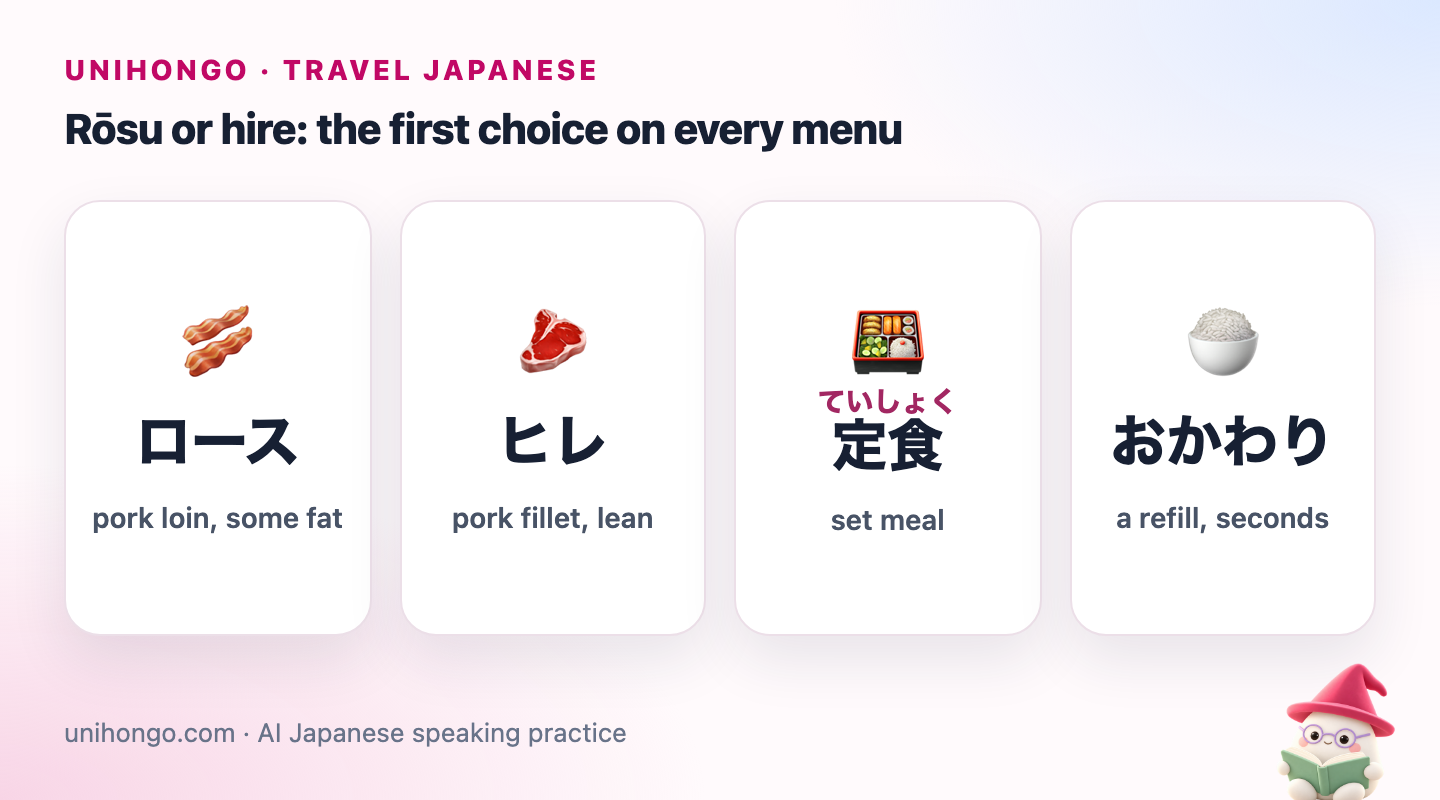
Rōsu or hire: the first choice on every menu
Tonkatsu joins ton (豚), pork, and katsu, short for katsuretsu, the Japanese form of the word cutlet. A thick slice of pork is coated in flour, egg and coarse breadcrumbs, deep-fried, and cut into strips you can pick up with chopsticks. Every tonkatsu menu is built on two cuts.
Rōsu (ロース) is loin. It has a band of fat along one edge and is the juicier, more strongly flavoured choice. Hire (ヒレ) is fillet, also called tenderloin: lean, soft and mild. In Kansai you may see it written here (ヘレ). Neither is better; regulars simply have a side. Menus often add jō (上), premium, for a thicker or finer piece, and some list the weight of the meat in grams.
| Japanese | Romaji | Meaning |
|---|---|---|
| ロース | rōsu | pork loin, some fat |
| ヒレ | hire | pork fillet, lean |
| 定食 | teishoku | set meal |
| おかわり | okawari | a refill, seconds |
| ロースかつ定食 | rōsu katsu teishoku | loin cutlet set meal |
| ヒレかつ定食 | hire katsu teishoku | fillet cutlet set meal |
| 上ロース | jō rōsu | premium loin |
What arrives with a teishoku
Teishoku means a fixed meal: one main dish with everything a Japanese meal is supposed to have. With tonkatsu, the tray holds the cutlet and four companions.
| Japanese | Romaji | Meaning |
|---|---|---|
| ご飯 | gohan | rice |
| 味噌汁 | misoshiru | miso soup |
| キャベツ | kyabetsu | cabbage |
| 漬物 | tsukemono | pickles |
| 豚汁 | tonjiru | miso soup with pork and vegetables |
| 単品 | tanpin | single item, without the set |
The cabbage is not decoration. It is cut into fine shreds, served cold and raw, and eaten between bites of cutlet to refresh the mouth, with dressing from the table or a little sauce. Some shops upgrade the soup to tonjiru. If you want only the cutlet, for example to share over drinks, look for tanpin.
Okawari jiyū: asking for refills
Many tonkatsu shops print gohan, kyabetsu okawari jiyū (ご飯・キャベツおかわり自由) on the menu or the wall: refills of rice and cabbage are unlimited and included. Okawari is a second helping, and jiyū (自由) means free in the sense of as you like. Some shops include the miso soup as well; others do not, so read which items are named.
Staff often walk round with a bowl of cabbage and offer it. If not, raise a hand, say sumimasen and name what you want.
| Japanese | Romaji | Meaning |
|---|---|---|
| おかわりお願いします。 | Okawari onegai shimasu. | A refill, please. |
| ご飯のおかわりをお願いします。 | Gohan no okawari o onegai shimasu. | A refill of rice, please. |
| キャベツのおかわりをください。 | Kyabetsu no okawari o kudasai. | More cabbage, please. |
| 少なめでお願いします。 | Sukuname de onegai shimasu. | Just a small amount, please. |
| キャベツのおかわりはいかがですか。 | Kyabetsu no okawari wa ikaga desu ka. | Would you like more cabbage? |
| もう大丈夫です。 | Mō daijōbu desu. | I am fine now, thank you. |
Sauce, mustard and sesame
Tonkatsu is seasoned at the table. The dark, thick, fruity sauce in the pot is simply called sōsu (ソース); in everyday Japanese that word alone points to this family of brown sauces. Pour a little over the cut pieces or dip each one. The yellow paste on the edge of the plate is karashi (からし), Japanese mustard, which is much hotter than it looks, so start with a dab.
Some shops hand you a small ridged mortar of sesame seeds, goma (ごま). Grind the seeds with the wooden pestle, pour sauce on top and dip into the mix. Others suggest salt for the first piece so that you can taste the pork. The bottle of dressing is for the cabbage.
Ordering by set: the exchange
Order by the name of the set, not by its parts. The pattern is the cut, then katsu, then teishoku, then the number. A thick cutlet is fried to order, so a wait is a good sign.
| Japanese | Romaji | Meaning |
|---|---|---|
| お決まりでしたらお伺いします。 | O-kimari deshitara o-ukagai shimasu. | I can take your order when you are ready. |
| ロースとヒレ、どちらがおすすめですか。 | Rōsu to hire, dochira ga osusume desu ka. | Which do you recommend, loin or fillet? |
| ロースかつ定食を一つお願いします。 | Rōsu katsu teishoku o hitotsu onegai shimasu. | One loin cutlet set, please. |
| ヒレかつ定食を一つ、ご飯少なめで。 | Hire katsu teishoku o hitotsu, gohan sukuname de. | One fillet set, with less rice. |
| ご飯とキャベツはおかわり自由です。 | Gohan to kyabetsu wa okawari jiyū desu. | Rice and cabbage refills are unlimited. |
| 少々お時間をいただきます。 | Shōshō o-jikan o itadakimasu. | It will take a little time. |
Katsu beyond the set meal
| Romaji | Where | What it is |
|---|---|---|
| katsudon | Everywhere | Cutlet simmered with egg and onion in a sweet soy broth, served on rice in a bowl |
| miso katsu | Nagoya | Cutlet covered with a thick, dark, slightly sweet sauce made from red miso |
| kushikatsu | Osaka | Small skewers of meat, seafood and vegetables, breaded, fried and dipped in a thin sauce |
| katsu karē | Everywhere | Cutlet on curry rice |
| katsu sando | Everywhere | Cutlet with sauce between slices of soft white bread |
Katsudon (かつ丼) is the one visitors often meet first, because soba shops and simple diners serve it. Miso katsu (味噌カツ) is a point of pride in Nagoya, where the local dark miso goes into the sauce. And because katsu sounds like katsu (勝つ), to win, students eat it before exams for luck.
Kushikatsu in Osaka: no double dipping
Kushikatsu (串カツ) is a different way of eating. Kushi (串) is a skewer, and you order skewers by name, a few at a time, with a drink. Traditional shops keep one deep container of sauce on the counter for every customer to share, which is why the sign nidozuke kinshi (二度づけ禁止) hangs on the wall: dipping twice is forbidden. Dip the fresh skewer once, fully, before your first bite, and never after.
If you want more sauce halfway through, use a piece of the raw cabbage that comes with the meal as a spoon and drip sauce onto the skewer. Some shops now give each table its own bottle instead, and then the rule no longer applies.
| Japanese | Romaji | Meaning |
|---|---|---|
| 串カツ | kushikatsu | fried skewers |
| 二度づけ禁止 | nidozuke kinshi | no double dipping |
| おすすめを五本お願いします。 | Osusume o gohon onegai shimasu. | Five skewers that you recommend, please. |
| ソースは一回だけです。 | Sōsu wa ikkai dake desu. | Dip in the sauce only once. |