

Why Onomichi is worth a day
Onomichi has been a port since the Middle Ages, when ships carrying rice and goods along the Seto Inland Sea stopped in its sheltered channel. Wealthy merchants paid for temples, and because the flat land by the water was taken up by warehouses and shops, the temples went up the hill. The result is the town's defining shape: a waterfront of shops, a steep slope of temples and houses reached by steps, and the channel below busy with ferries and shipyards.
The town has a strong literary and film identity. The novelist Hayashi Fumiko spent part of her youth here, Ozu Yasujirō set the opening of Tokyo Story in Onomichi, and many later Japanese films were shot on its slopes. You will see quotations from writers carved into rocks along the Path of Literature, Bungaku no Komichi, on the hill.
For a Japanese learner, Onomichi is a good town to practise asking the way. Lanes branch and double back, many signs are only in Japanese, and residents, used to lost visitors, are generally kind about pointing you towards the next temple.
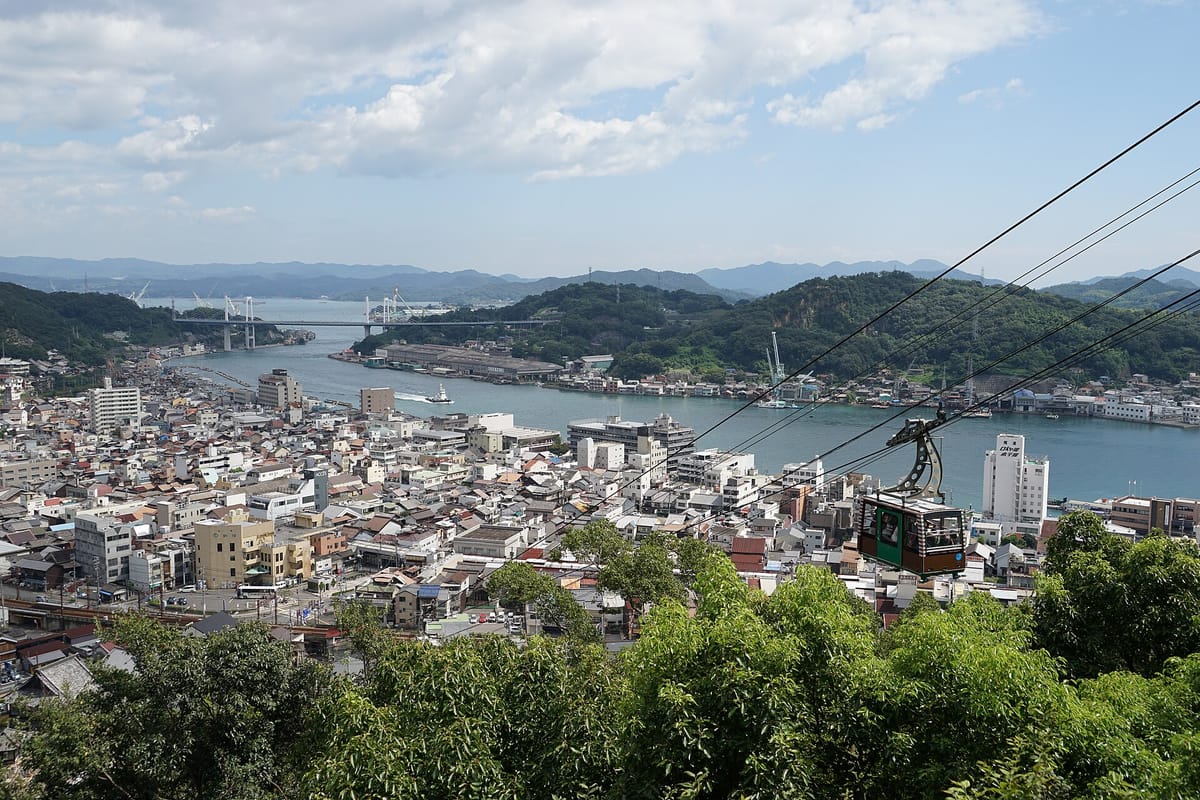
Getting there and up the hill
Onomichi Station is on the JR San'yō Line. From Hiroshima, take the shinkansen to Mihara or Fukuyama and change to a local train; the final stretch is short. Shin-Onomichi Station, on the shinkansen line in the hills north of town, is served by only some trains and is about fifteen minutes from the centre by bus, so most visitors arrive at Onomichi Station itself.
From the station, walk east along the waterfront or through the covered shopping arcade, Honmachi Shōtengai, for about fifteen minutes to the base station of the Senkō-ji ropeway, 千光寺山ロープウェイ. Buses also run to the nearby Nagaeguchi stop. The ropeway climbs to the top of Senkō-ji hill in about three minutes, with the whole town opening up below you.
| Japanese | Romaji | Meaning |
|---|---|---|
| ロープウェイ乗り場はどちらですか。 | Rōpuwei noriba wa dochira desu ka. | Which way is the ropeway station? |
| 片道一枚お願いします。 | Katamichi ichimai onegai shimasu. | One one-way ticket, please. |
| 往復にしたほうがいいですか。 | Ōfuku ni shita hō ga ii desu ka. | Should I get a return? |
| 次のゴンドラは何分に出ますか。 | Tsugi no gondora wa nanpun ni demasu ka. | At what minute does the next car leave? |
| 千光寺まで歩いてどのくらいですか。 | Senkō-ji made aruite dono kurai desu ka. | How long is it to Senkō-ji on foot? |
From Senkō-ji Park to the waterfront: what you will see
At the top of the ropeway, Senkō-ji Park has an observation deck with a wide view over the channel, the islands and the bridges of the Shimanami Kaidō. From there, footpaths lead down past giant boulders to Senkō-ji itself, a temple perched on the rock with a vermilion hall looking out over the town. Tradition dates the temple's founding to the early ninth century.
Below Senkō-ji, the Temple Walk, koji meguri, winds down and along the hillside. Follow the small signposts with the temple names, or just keep heading down towards the sea; every lane eventually reaches the railway line and the shopping arcade below it.
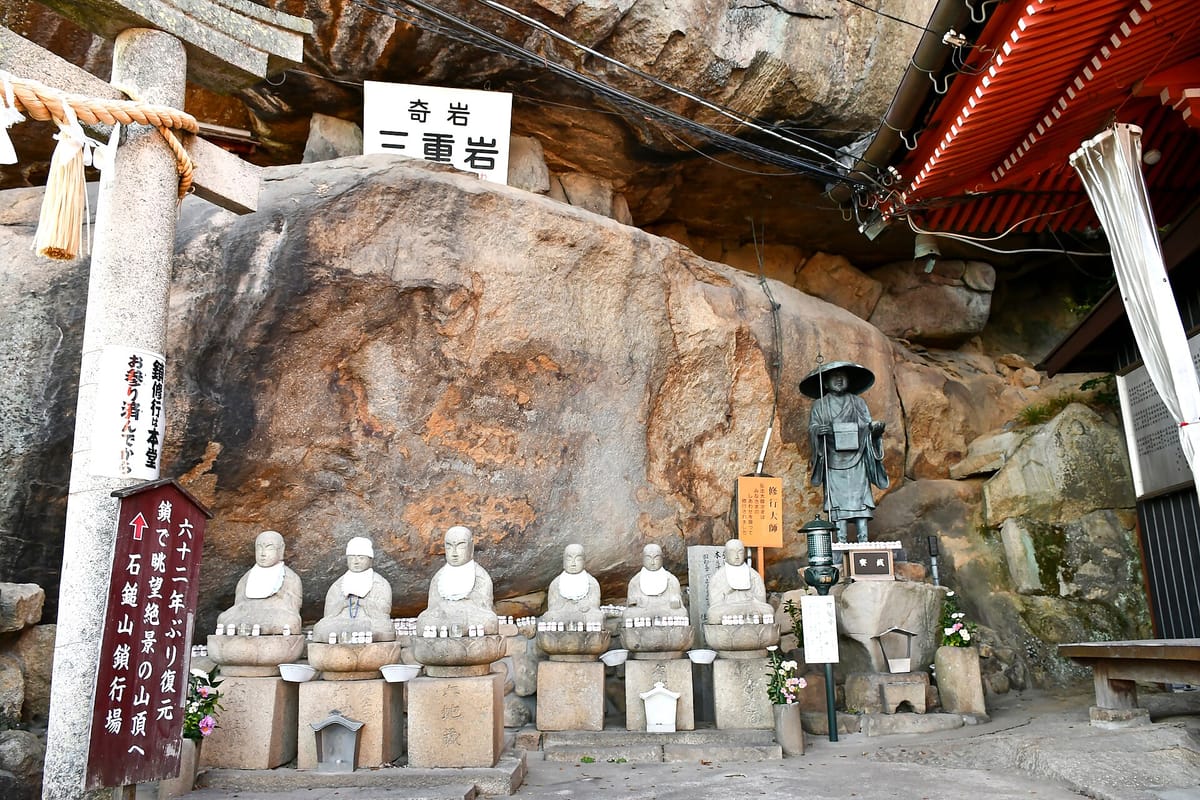
- Senkō-ji Kōen: the park at the top of the ropeway, with an observation deck and cherry trees.
- Senkō-ji: the temple on the rocks, with its boulders, stone Buddhas and view.
- Bungaku no Komichi: the Path of Literature, with passages by writers linked to Onomichi carved into the rocks.
- Neko no Hosomichi, Cat Alley: a narrow lane lined with stones painted as cats, and often real cats too.
- Koji meguri: the Temple Walk, linking around two dozen temples across the slope.
- Honmachi Shōtengai: the long covered shopping arcade parallel to the waterfront.
- The waterfront: ferries across to Mukaishima, a promenade and a converted warehouse with shops and a café popular with cyclists.
Words on the signs
Temple names end in 寺, read ji when it follows the name, as in Senkō-ji. You will also see 山, san, mountain, in the names of temples, since every temple has a formal mountain name, and in the ropeway's own name, 千光寺山, Senkō-ji-san. On the hill, arrows marked 展望台 point to viewpoints, and small stones carry the temple walk route.
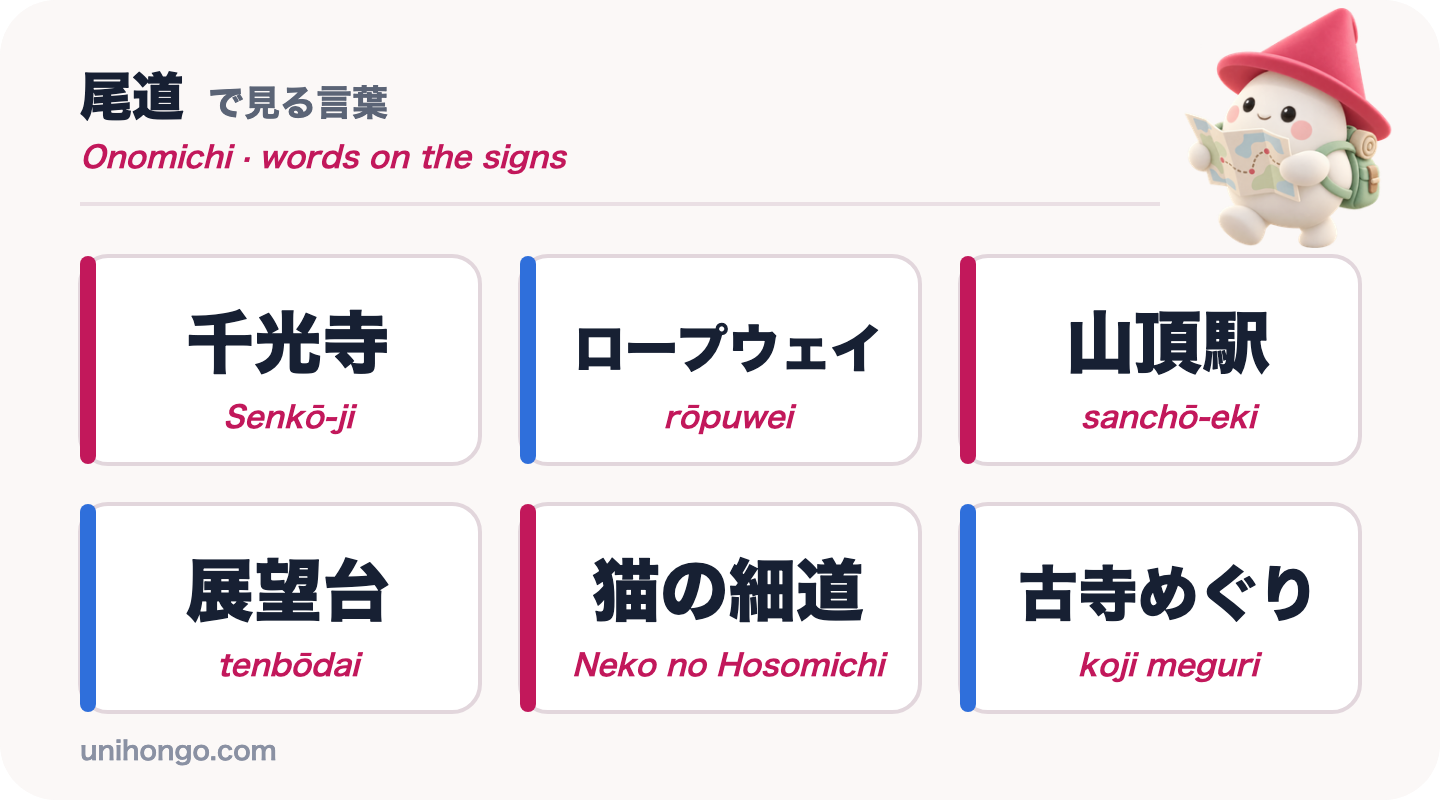
| Word | Reading | Meaning |
|---|---|---|
| 千光寺 | Senkō-ji | The temple at the top of the hill |
| ロープウェイ | rōpuwei | Ropeway, aerial cable car |
| 山頂駅 | sanchō-eki | Top station |
| 展望台 | tenbōdai | Observation deck |
| 猫の細道 | Neko no Hosomichi | Cat Alley, literally cat's narrow lane |
| 古寺めぐり | koji meguri | The Temple Walk |
| 文学のこみち | Bungaku no Komichi | The Path of Literature |
| 商店街 | shōtengai | Shopping street or arcade |
| 坂道 | sakamichi | Sloping road |
Japanese for asking the way and ordering Onomichi ramen
The lanes on the hill are a maze, and your map app will sometimes send you up a flight of steps that turns out to be someone's front garden. Asking is quicker. Residents will usually point and say massugu, straight on, or the name of the next temple. Keep your questions short and add sumimasen first.
Lunch in Onomichi means ramen. Some shops take your order at the counter and others use a ticket machine by the door, where you choose and pay before you sit down. Portions and toppings are simple: ramen, chāshū-men with extra pork, and sometimes a bowl of rice or gyōza.
| Japanese | Romaji | Meaning |
|---|---|---|
| すみません、猫の細道はどちらですか。 | Sumimasen, Neko no Hosomichi wa dochira desu ka. | Excuse me, which way is Cat Alley? |
| この道で駅まで下りられますか。 | Kono michi de eki made oriraremasu ka. | Can I get down to the station this way? |
| 次のお寺はどこですか。 | Tsugi no o-tera wa doko desu ka. | Where is the next temple? |
| 尾道ラーメンを一つください。 | Onomichi rāmen o hitotsu kudasai. | One Onomichi ramen, please. |
| 食券はどこで買いますか。 | Shokken wa doko de kaimasu ka. | Where do I buy a meal ticket? |
| 背脂は少なめにできますか。 | Seabura wa sukuname ni dekimasu ka. | Can I have less back fat? |
Etiquette and practical tips on the slopes
The temple lanes are also people's neighbourhoods, with homes opening straight onto the steps. A little quiet goes a long way.
- Keep your voice down in the residential lanes, and do not photograph inside gardens or open doorways.
- Leave the cats alone and let them come to you. They belong to the neighbourhood, not to the visitors.
- Visit temples as you would anywhere in Japan: a small bow at the gate, a coin at the offering box if you pray, and no noise in the halls.
- Wear shoes with grip. The steps are uneven stone and can be slippery after rain.
- Ride up, walk down. The walk down from Senkō-ji to the station takes one to two hours with stops.
- If you plan to cycle the Shimanami Kaidō, book a bicycle in advance at busy times and allow a separate day.
Practise the walk before you go
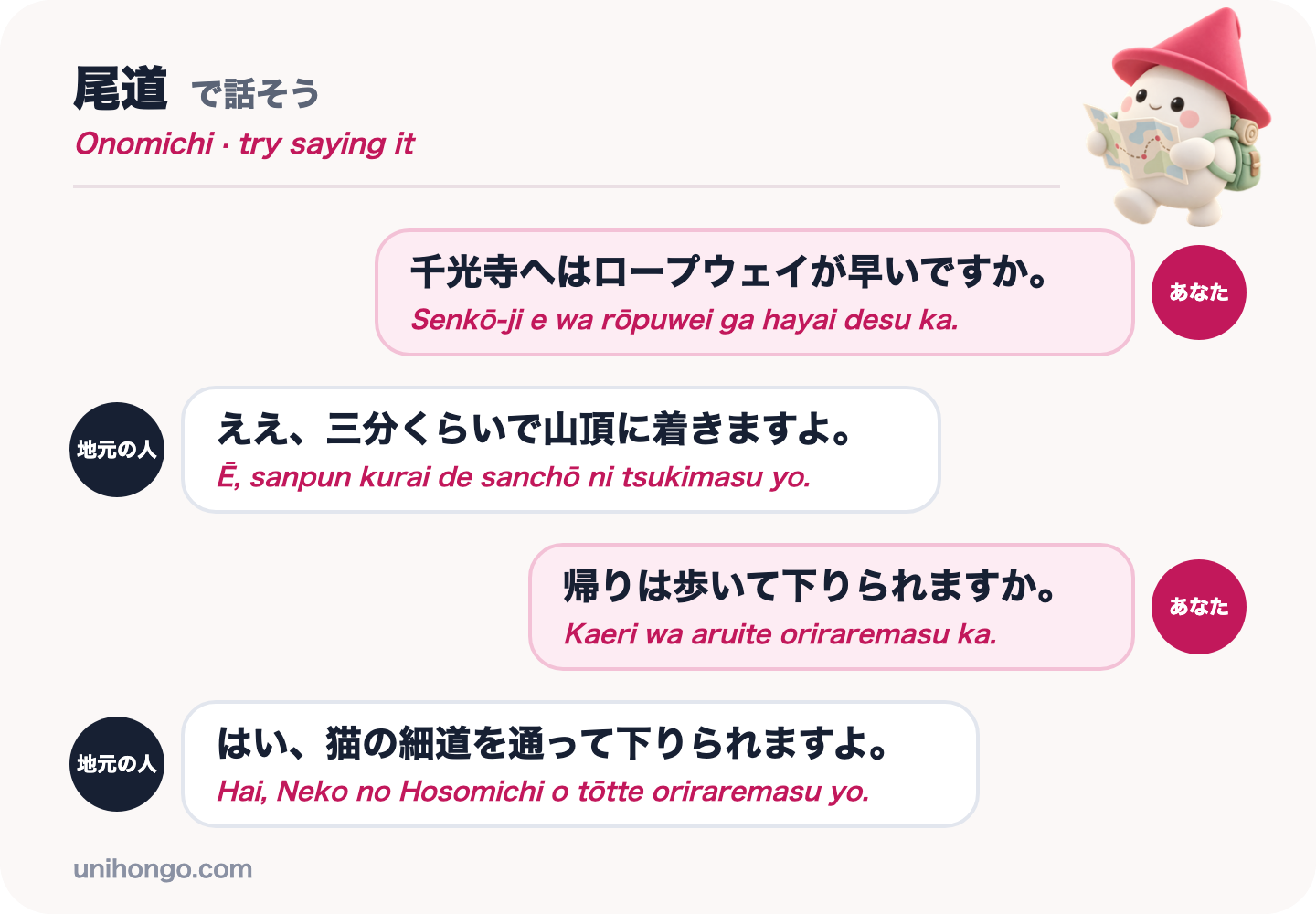
This is the conversation to have at the bottom of the hill, when you are deciding how to go up. The reply includes a time with kurai, about, and a route with o tōtte, going through, which is worth hearing a few times before you need it.
Then practise with a partner who answers back. In Unihongo, choose the Directions topic and ask your AI Sensei to play a local on the slopes of Onomichi, or run the Ask the Way to the Station mission for the walk back to your train. Speaking the lines once in advance makes them easy to use on the day.
| Japanese | Romaji | Meaning |
|---|---|---|
| 千光寺へはロープウェイが早いですか。 | Senkō-ji e wa rōpuwei ga hayai desu ka. | Is the ropeway the quickest way to Senkō-ji? |
| ええ、三分くらいで山頂に着きますよ。 | Ē, sanpun kurai de sanchō ni tsukimasu yo. | Yes, you reach the top in about three minutes. |
| 帰りは歩いて下りられますか。 | Kaeri wa aruite oriraremasu ka. | Can I walk down on the way back? |
| はい、猫の細道を通って下りられますよ。 | Hai, Neko no Hosomichi o tōtte oriraremasu yo. | Yes, you can go down through Cat Alley. |
Official information
The ropeway company and the city publish the ropeway's operating hours and its annual maintenance closure. Check before you go, especially in December.