
Washoku or yōshoku: the question you will be asked
Hotels and ryokan that serve a set breakfast ask you to choose a style, sometimes the evening before. Wa (和) stands for Japan and yō (洋) for the West, and shoku (食) is a meal. Where there is no set tray, the same two words label the two halves of the buffet.
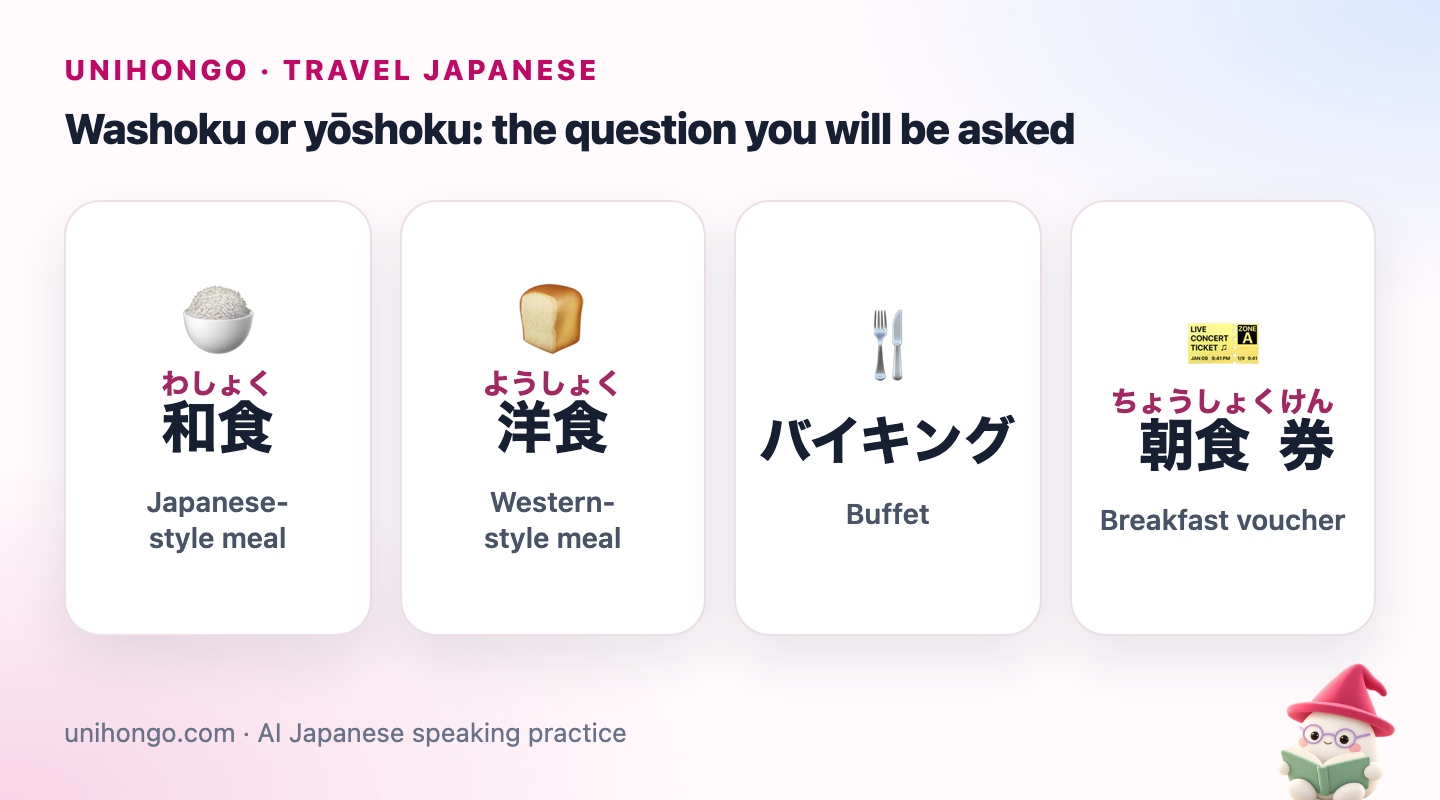
| Japanese | Romaji | Meaning |
|---|---|---|
| 和食 | Washoku | Japanese-style meal |
| 洋食 | Yōshoku | Western-style meal |
| バイキング | Baikingu | Buffet |
| 朝食券 | Chōshokuken | Breakfast voucher |
| 和食と洋食、どちらになさいますか。 | Washoku to yōshoku, dochira ni nasaimasu ka. | Staff: Japanese-style or Western-style? |
| 和食でお願いします。 | Washoku de onegai shimasu. | You: Japanese-style, please. |
| 洋食でお願いします。 | Yōshoku de onegai shimasu. | You: Western-style, please. |
What is on a Japanese breakfast tray
A washoku tray is built around rice and soup, with fish as the main dish and several small plates. Nothing is sweet. Eat in any order, moving between rice and the other dishes.
| Japanese | Romaji | Meaning |
|---|---|---|
| ご飯 | Gohan | Steamed rice |
| 味噌汁 | Misoshiru | Miso soup |
| 焼き魚 | Yakizakana | Grilled fish |
| 卵焼き | Tamagoyaki | Rolled omelette |
| 納豆 | Nattō | Fermented soybeans |
| 漬物 | Tsukemono | Pickles |
| 海苔 | Nori | Dried seaweed sheets |
| 梅干し | Umeboshi | Salty pickled plum |
The fish is most often salted salmon or mackerel. Nori at breakfast is usually seasoned and comes in small packs: lay a sheet over rice and pinch it up with your chopsticks. Umeboshi is far saltier and sourer than it looks, so take a small piece with plenty of rice.
Nattō: how to eat it and how to skip it
Nattō (納豆) is fermented soybeans, sticky and strong-smelling, served in a small pack with sauce and mustard. Stir it well with your chopsticks until it turns stringy, mix in the sauce, and pour it over rice. People who grew up with it love it; many visitors, and many Japanese people, do not.
Declining is easy and causes no offence. The key word is nigate (苦手), not good with, which is softer than saying you dislike something.
| Japanese | Romaji | Meaning |
|---|---|---|
| 納豆は苦手です。 | Nattō wa nigate desu. | Nattō is not for me. |
| 納豆なしでお願いします。 | Nattō nashi de onegai shimasu. | Without nattō, please. |
| 食べてみます。 | Tabete mimasu. | I will try it. |
Raw egg and tamago kake gohan
An egg in its shell on a breakfast tray may be boiled, soft-set or raw. A raw egg is nama tamago (生卵), and it is there for tamago kake gohan (卵かけご飯): crack it over hot rice, add a little soy sauce and mix. A soft-set egg served in a small dish with broth is an onsen tamago (温泉卵).
If you cannot tell which kind you have, ask before you crack it.
| Japanese | Romaji | Meaning |
|---|---|---|
| これは生卵ですか。 | Kore wa nama tamago desu ka. | Is this a raw egg? |
| 卵かけご飯 | Tamago kake gohan | Rice with raw egg and soy sauce |
| ご飯のおかわりはできますか。 | Gohan no okawari wa dekimasu ka. | May I have more rice? |
Baikingu, vouchers and time slots
Larger hotels serve breakfast as a buffet, called baikingu (バイキング), a use of the word Viking found only in Japan. At check-in you may receive a chōshokuken (朝食券), a breakfast voucher, to hand to staff at the entrance. Ryokan and smaller hotels ask you to choose a time instead.
| Japanese | Romaji | Meaning |
|---|---|---|
| 朝食券をお預かりします。 | Chōshokuken o oazukari shimasu. | Staff: I will take your breakfast voucher. |
| お部屋番号をお願いします。 | Oheya bangō o onegai shimasu. | Staff: Your room number, please. |
| ご朝食は何時になさいますか。 | Gochōshoku wa nanji ni nasaimasu ka. | Staff: What time would you like breakfast? |
| 7時半でお願いします。 | Shichiji han de onegai shimasu. | You: At half past seven, please. |
| 朝食は何時から何時までですか。 | Chōshoku wa nanji kara nanji made desu ka. | You: From what time until what time is breakfast? |
| 朝食会場はどこですか。 | Chōshoku kaijō wa doko desu ka. | You: Where is the breakfast room? |
Room numbers are read digit by digit, with maru for zero: room 305 is san maru go. Practise your own number before you go down.
Asa teishoku: breakfast at a chain restaurant
Outside hotels, the Japanese breakfast lives on as asa teishoku (朝定食), a morning set meal. Rice bowl chains and set-meal restaurants serve it in the morning hours: rice, miso soup and a main item, often with a kobachi (小鉢), a small side dish you choose.
Cafés offer a different tradition called mōningu (モーニング), short for morning service: toast and an egg served with your coffee. The Nagoya area is especially known for it.
| Japanese | Romaji | Meaning |
|---|---|---|
| 朝定食を一つお願いします。 | Asa teishoku o hitotsu onegai shimasu. | One morning set meal, please. |
| 小鉢はどれになさいますか。 | Kobachi wa dore ni nasaimasu ka. | Staff: Which side dish would you like? |
| 納豆以外でお願いします。 | Nattō igai de onegai shimasu. | Anything but nattō, please. |
| モーニングはまだありますか。 | Mōningu wa mada arimasu ka. | Is the morning set still available? |