

Why Himeji is the castle to see in Japan
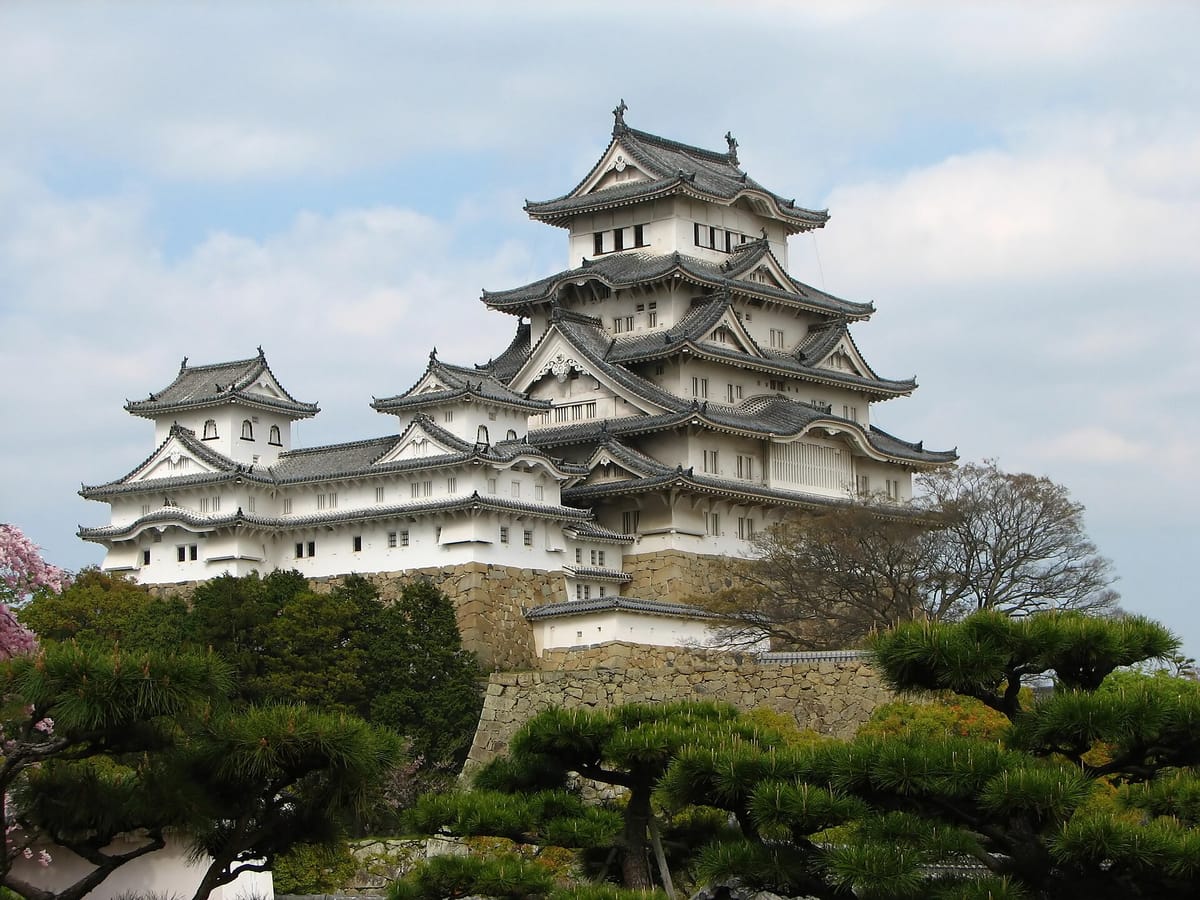
Most castles you visit in Japan are modern reconstructions, their keeps rebuilt in concrete in the twentieth century. Himeji is the real thing. Fortifications stood on the hill from the medieval period, Toyotomi Hideyoshi built a keep here, and between 1601 and 1609 the lord Ikeda Terumasa built the great castle you see today. It survived the end of the samurai era, the Meiji period's demolition of castles and the air raids of 1945, when much of Himeji burned around it.
The complex has more than eighty buildings: gates, turrets, walls and long corridors arranged in a maze designed to confuse attackers. The main keep, the daitenshu, is linked to three smaller keeps, and from outside it seems to have five layers of roofs, while inside there are six floors and a basement. In 1993 Himeji became one of the first places in Japan listed as a UNESCO World Heritage Site, and the keep was restored between 2009 and 2015.
For a learner, Himeji is a reading lesson in castle vocabulary. Signs name every gate and turret, the route through the keep is marked with arrows, and even the rules about shoes are written in simple, useful Japanese.
Getting there: Himeji Station and Ōtemae-dōri
Himeji Station is on the Sanyō Shinkansen and on the JR Kobe Line. From Shin-Osaka the shinkansen takes about thirty minutes; JR Special Rapid trains from Osaka Station, stopping at Sannomiya in Kobe, take about an hour. Private Sanyō Railway trains also run from Kobe to Sanyō Himeji, next to the JR station.
Leave by the north exit and the castle is in front of you at the end of Ōtemae-dōri, a broad avenue about a kilometre long. The walk takes fifteen to twenty minutes and the view of the castle grows with every step. Buses run from the station for a few minutes' ride if you prefer, and taxis wait outside the north exit.
| Japanese | Romaji | Meaning |
|---|---|---|
| 姫路までの新幹線は何番線ですか。 | Himeji made no shinkansen wa nanbansen desu ka. | Which platform is the shinkansen to Himeji? |
| 姫路城へは北口から出ればいいですか。 | Himeji-jō e wa kitaguchi kara dereba ii desu ka. | Should I leave by the north exit for Himeji Castle? |
| お城まで歩いて何分くらいですか。 | O-shiro made aruite nanpun kurai desu ka. | About how many minutes' walk is it to the castle? |
| 姫路城に行くバスはどれですか。 | Himeji-jō ni iku basu wa dore desu ka. | Which bus goes to Himeji Castle? |
| 帰りの新快速は何時ですか。 | Kaeri no shinkaisoku wa nanji desu ka. | What time is the Special Rapid back? |
Through the gates to the main keep: what you will see
After the ticket gate you pass through the Hishi no Mon, the diamond gate, named for the diamond-shaped crests on its beams, and enter a winding series of gates and narrow paths that double back on themselves. The route to the keep is deliberately confusing: at times you seem to be walking away from it. Look for the small openings in the walls, sama, in round, triangular and square shapes, for guns and bows.
Inside the keep, floors of heavy dark wood rise through six levels, with steep stairs that feel more like ladders near the top. The rooms are largely empty, so the building itself is the exhibit: huge pillars, weapon racks, and windows with views that widen as you climb. At the top is a small shrine. Leave time for the Nishinomaru, the western enclosure, where a long corridor of rooms is linked to Princess Sen, and for Okiku's Well, the setting of a famous ghost story.
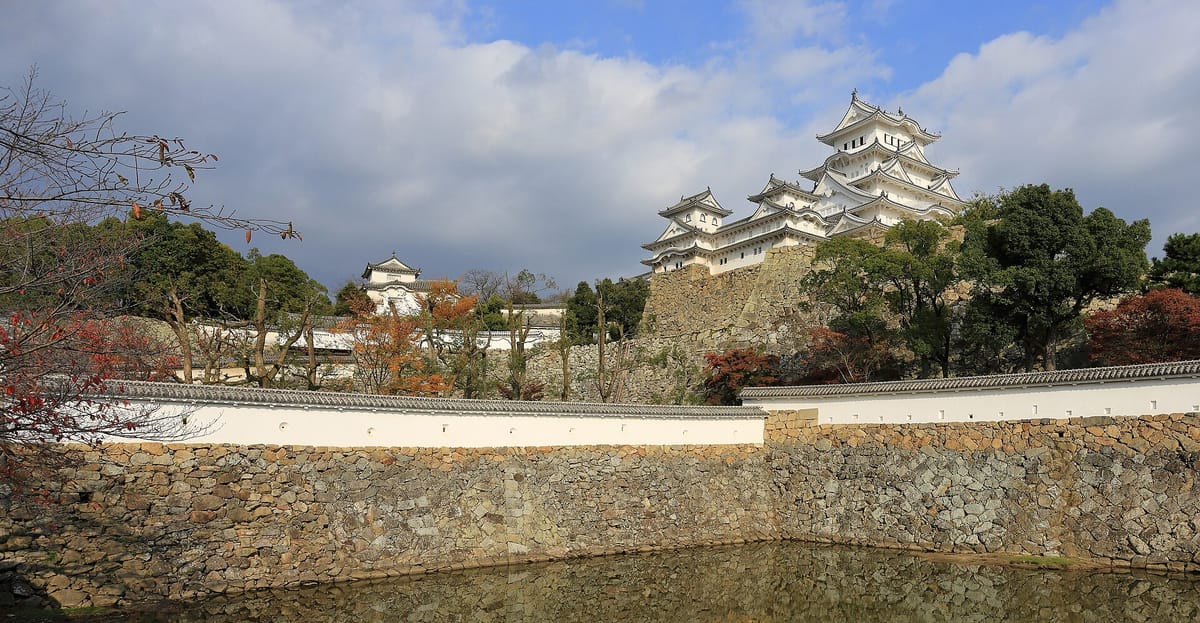
- Hishi no Mon: the diamond gate, the first large gate after the entrance.
- The maze of gates: named i, ro, ha and so on, after the old Japanese alphabet order.
- Daitenshu: the main keep, six floors and a basement, climbed on foot.
- The top floor shrine: a small shrine at the highest point of the keep.
- Nishinomaru: the western enclosure with its long corridor.
- Okiku-ido: Okiku's Well, from the ghost story Banchō Sarayashiki.
- Kōko-en: a garden next to the castle, made up of several walled gardens; separate or combined ticket.
Words on the castle signs
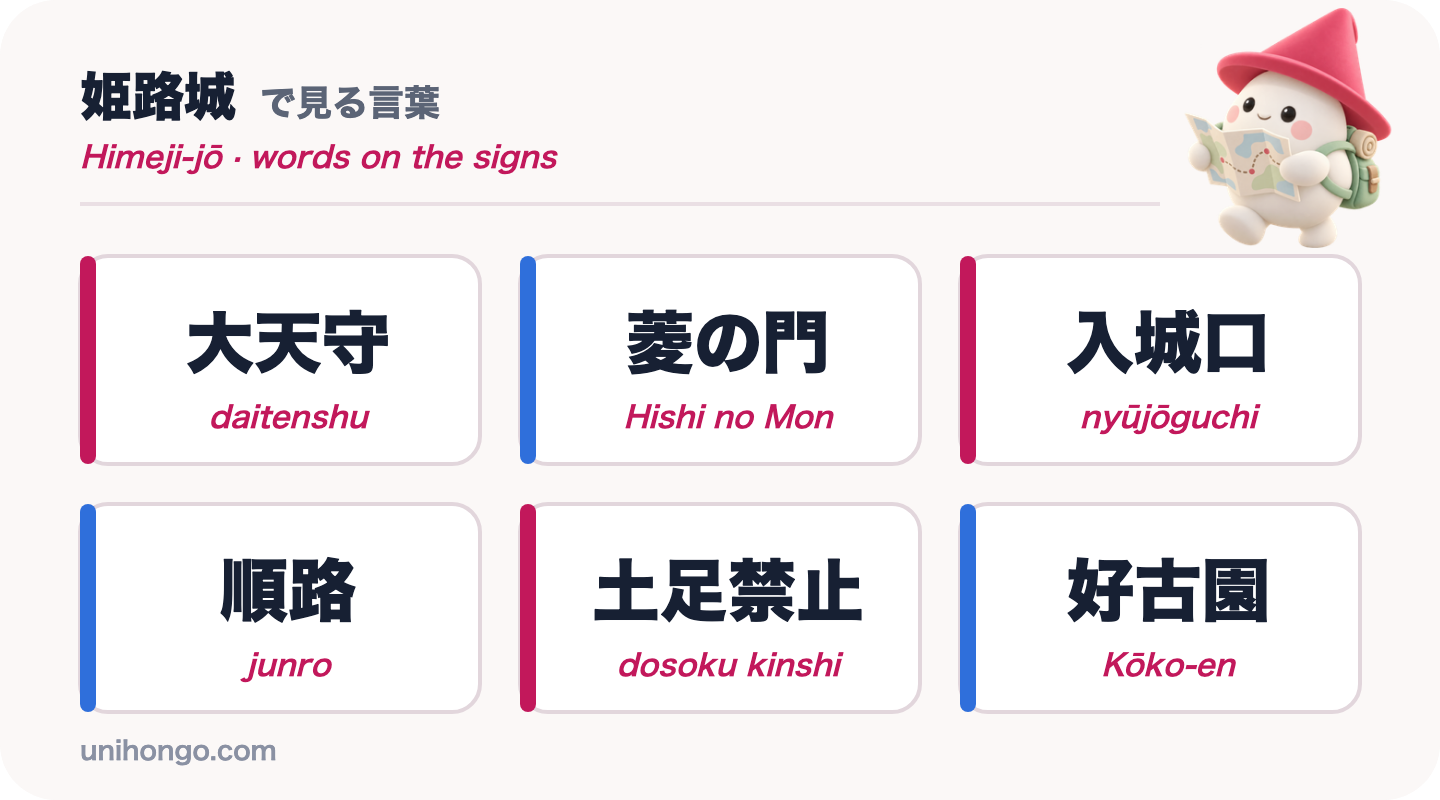
Two signs matter most inside the keep. 順路, junro, marks the set route with an arrow, and inside a building like this you must follow it: the stairs are one-way on busy days. 土足禁止, dosoku kinshi, means no outdoor shoes, and it is where you take yours off and put them in a plastic bag to carry with you.
At the entrance, 入城口, nyūjōguchi, is the castle entrance and 入城券, nyūjōken, the admission ticket. 城, jō, castle, appears in both, which is a nice reminder that the same kanji is read shiro on its own.
| Word | Reading | Meaning |
|---|---|---|
| 大天守 | daitenshu | The main keep |
| 菱の門 | Hishi no Mon | The diamond gate after the entrance |
| 入城口 | nyūjōguchi | Castle entrance |
| 順路 | junro | Set route, follow the arrows |
| 土足禁止 | dosoku kinshi | No outdoor shoes |
| 好古園 | Kōko-en | The garden next to the castle |
| 西の丸 | Nishinomaru | The western enclosure |
| 白鷺城 | Shirasagi-jō | White Heron Castle, the nickname |
| 整理券 | seiriken | Numbered ticket on busy days |
Japanese for tickets, shoes and the climb
The ticket office is at the foot of the castle, before the Hishi no Mon. With the 2026 fee change, staff may ask whether you live in Himeji; as a visitor, you simply pay the standard non-resident fee. On busy days, numbered tickets, seiriken, may be issued for the keep, and you enter at the time shown.
Inside the keep, staff mostly guide the flow of people up and down the stairs. The phrases below cover what visitors usually need to ask.
| Japanese | Romaji | Meaning |
|---|---|---|
| 大人一枚お願いします。 | Otona ichimai onegai shimasu. | One adult ticket, please. |
| 好古園とのセット券はありますか。 | Kōko-en to no setto-ken wa arimasu ka. | Is there a combined ticket with Kōko-en? |
| 整理券は必要ですか。 | Seiriken wa hitsuyō desu ka. | Do I need a numbered ticket? |
| 大きい荷物はどこに預けられますか。 | Ōkii nimotsu wa doko ni azukeraremasu ka. | Where can I leave a large bag? |
| 階段が急なので、ゆっくり上がってください。 | Kaidan ga kyū na node, yukkuri agatte kudasai. | The stairs are steep, so please go up slowly. |
| 靴の袋はどこに返せばいいですか。 | Kutsu no fukuro wa doko ni kaeseba ii desu ka. | Where should I return the shoe bag? |
Etiquette, timing and practical tips
Himeji is busy and the keep is narrow, so a little planning goes a long way.
- Arrive soon after opening, especially at weekends, in cherry blossom season and in autumn.
- Wear socks you do not mind showing and shoes that are quick to take off and put on.
- Leave large bags in lockers at Himeji Station; the keep's stairs are too steep for luggage.
- Follow the one-way route and keep to the side on the stairs so people can pass.
- Hold the handrail: the top flights are very steep, and the polished floors are slippery in socks.
- The last admission is well before closing; check the official site for this season's hours.
Practise the visit before you go
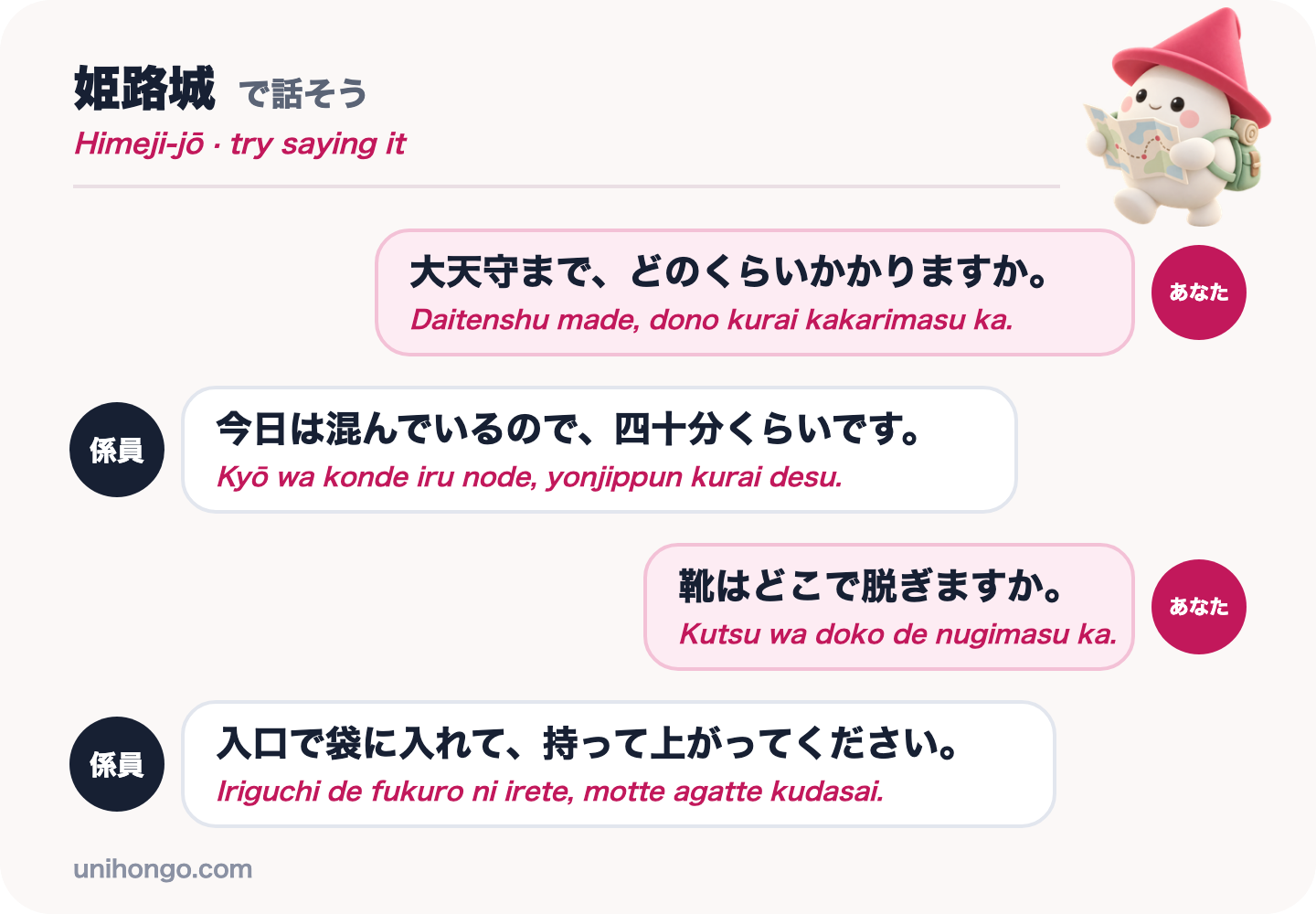
This exchange covers the two things every visitor asks at Himeji: how long, and where do the shoes go. Listen for yonjippun, forty minutes, and for the instructions in the last line: fukuro ni irete, put them in the bag, and motte agatte kudasai, please carry them up with you.
Then practise with a partner who answers back. In Unihongo, choose the Sightseeing topic and ask your AI Sensei to play a castle attendant at Himeji, answering at natural speed. Rehearse the ticket, the numbered ticket and the shoe rule, and the real visit will feel easy.
| Japanese | Romaji | Meaning |
|---|---|---|
| 大天守まで、どのくらいかかりますか。 | Daitenshu made, dono kurai kakarimasu ka. | How long does it take to get to the main keep? |
| 今日は混んでいるので、四十分くらいです。 | Kyō wa konde iru node, yonjippun kurai desu. | It's busy today, so about forty minutes. |
| 靴はどこで脱ぎますか。 | Kutsu wa doko de nugimasu ka. | Where do I take off my shoes? |
| 入口で袋に入れて、持って上がってください。 | Iriguchi de fukuro ni irete, motte agatte kudasai. | Put them in a bag at the entrance and carry them up with you. |
Official information
Himeji City runs the castle's official site, with opening hours, closures and notices about restoration work, and the city's tourism site explains the 2026 fee change. Check both before you go.