

Why Jinbōchō is worth a slow afternoon
Jinbōchō became a book town in the Meiji era, when new schools for Western learning opened nearby and students needed textbooks. Bookshops followed, and so did publishers: the Iwanami Shoten publishing house began here as a bookshop after a great fire in 1913, and the manga publisher Shueisha still has its headquarters in the district. Over the twentieth century the area became the place where scholars, collectors and students came to buy and sell second-hand books, and it still is.
What makes it special is specialisation. The shops along Yasukuni-dōri and the side streets each have their own subject, from classical Japanese literature and Buddhist texts to film, theatre, cookery, fashion magazines, old maps, children's books and manga. Some sell rare first editions and woodblock-printed books that belong in museums; others fill trolleys on the pavement with paperbacks at a single low price.
For a learner, the area is a gift. Shop signs, price tags and the handwritten labels on the shelves use a small set of words again and again, and the booksellers, many of whom have run the same shop for decades, are knowledgeable and patient with a polite question.
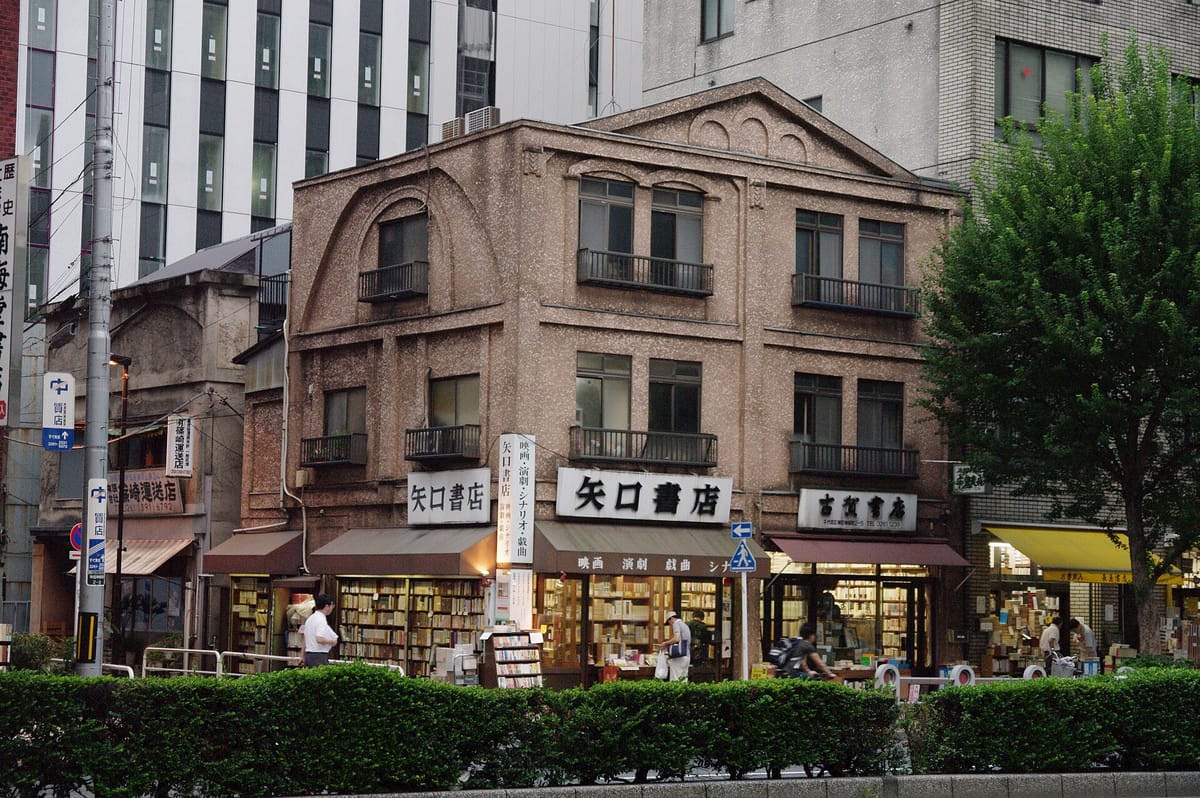
Getting there: Jimbōchō Station and Ochanomizu
The heart of the book town is the crossing of Yasukuni-dōri and Hakusan-dōri, directly above Jimbōchō Station, which is served by the Tokyo Metro Hanzōmon Line and the Toei Mita and Shinjuku Lines. The official book town site gives exit A6 as about a minute on foot from the crossing. On station signs and maps the name is written Jimbocho in English.
From the JR lines, Ochanomizu Station, Ochanomizubashi exit, and Suidōbashi Station, east exit, are each about ten minutes' walk; from Ochanomizu the walk downhill passes the musical instrument shops of Meidai-dōri. Kudanshita and Takebashi on the Tōzai Line are also within walking distance.
| Japanese | Romaji | Meaning |
|---|---|---|
| 神保町駅はどの線ですか。 | Jinbōchō-eki wa dono sen desu ka. | Which line is Jimbōchō Station on? |
| 一番近い出口はどこですか。 | Ichiban chikai deguchi wa doko desu ka. | Which is the nearest exit? |
| 古本屋街はどちらですか。 | Furuhon'ya-gai wa dochira desu ka. | Which way is the used-bookshop area? |
| 靖国通りはこの道ですか。 | Yasukuni-dōri wa kono michi desu ka. | Is this road Yasukuni-dōri? |
| 御茶ノ水駅まで歩いて何分くらいですか。 | Ochanomizu-eki made aruite nanpun kurai desu ka. | About how many minutes on foot to Ochanomizu Station? |
What you will find: shops, coffee and curry
Most of the famous bookshops line the south side of Yasukuni-dōri, facing north. The usual explanation is that this keeps direct sunlight off the books in the windows, and it means that the shady side of the street is the one to walk. Behind the main road, Suzuran-dōri and the smaller lanes hold more bookshops, publishers, old coffee houses and restaurants.
The official book town site has a searchable list of shops by subject and a downloadable map from the Kanda used-book dealers' association, which is the best way to plan if you are hunting for something specific.
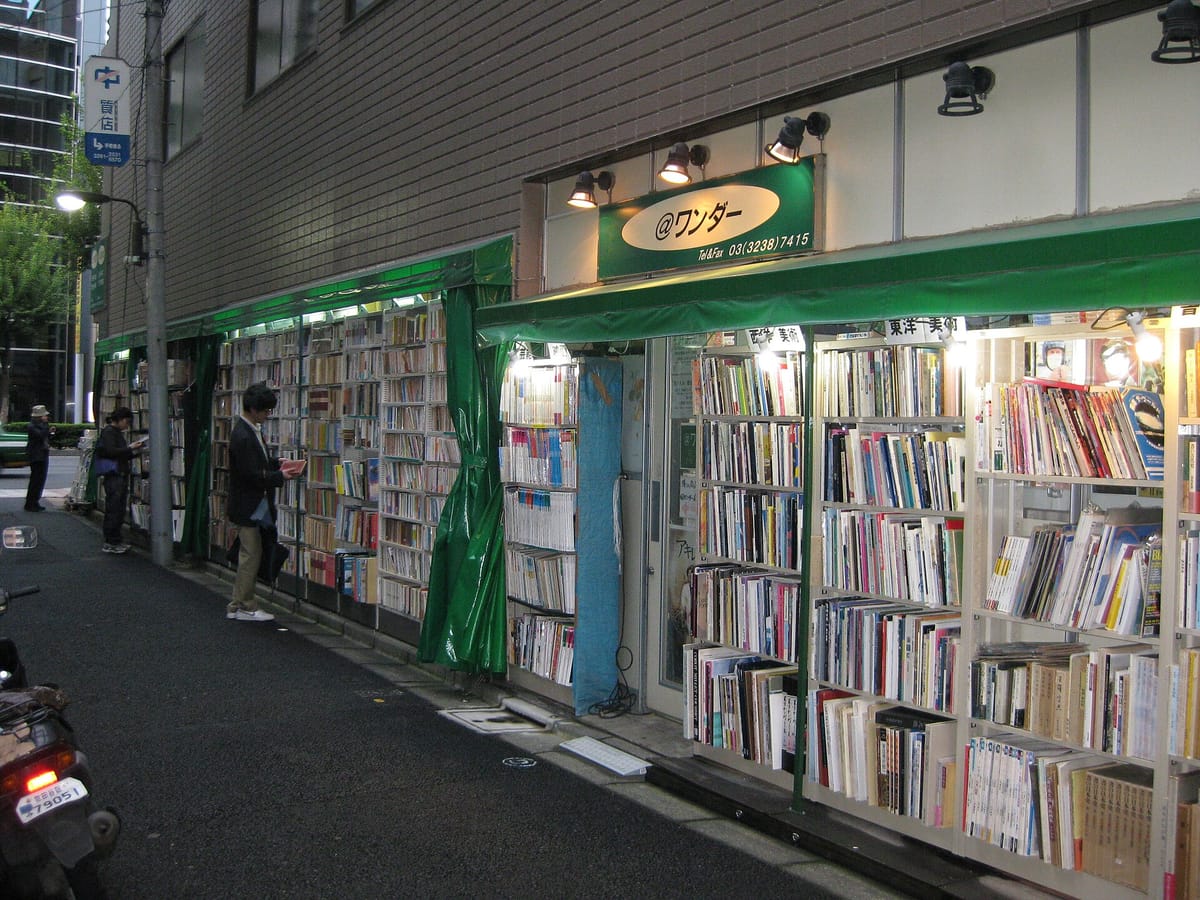
- Specialist bookshops: literature, history, art, film scripts, theatre, science, travel, mountaineering, cookery and more, each shop to its own subject.
- Ukiyo-e and old maps: a few shops sell original woodblock prints, Edo-period illustrated books and antique maps, with prices marked on each piece.
- Manga and subculture: several shops deal in old manga, magazines and film posters, alongside the new-book stores of the big chains.
- Kin'itsu carts: trolleys and shelves outside shops where every book is the same low price, a good place to find a cheap souvenir paperback.
- Kissaten: Shōwa-era coffee houses with dark wood, hand-drip coffee and customers reading their new purchases.
- Curry: Jinbōchō is known for its many curry restaurants, Japanese, Indian and European-style, a favourite quick meal for book hunters.
- The Kanda Furuhon Matsuri: the used-book festival during Reading Week in late October and early November, when stalls fill the pavement of Yasukuni-dōri.
Words on the bookshop signs
Almost every shop front says 古書, kosho, old books, and many add 買取, kaitori, we buy, because the trade depends on buying collections as well as selling them. On the carts outside, 均一, kin'itsu, means that every book on that shelf is one price, and the number next to it is the price.
Inside, price slips in the back of the books use collectors' words. 初版, shohan, is a first edition; 絶版, zeppan, is out of print; 帯付, obi-tsuki, means the paper band that wraps a new Japanese book is still there, which collectors care about. Many shops also display 撮影禁止, satsuei kinshi, no photography.
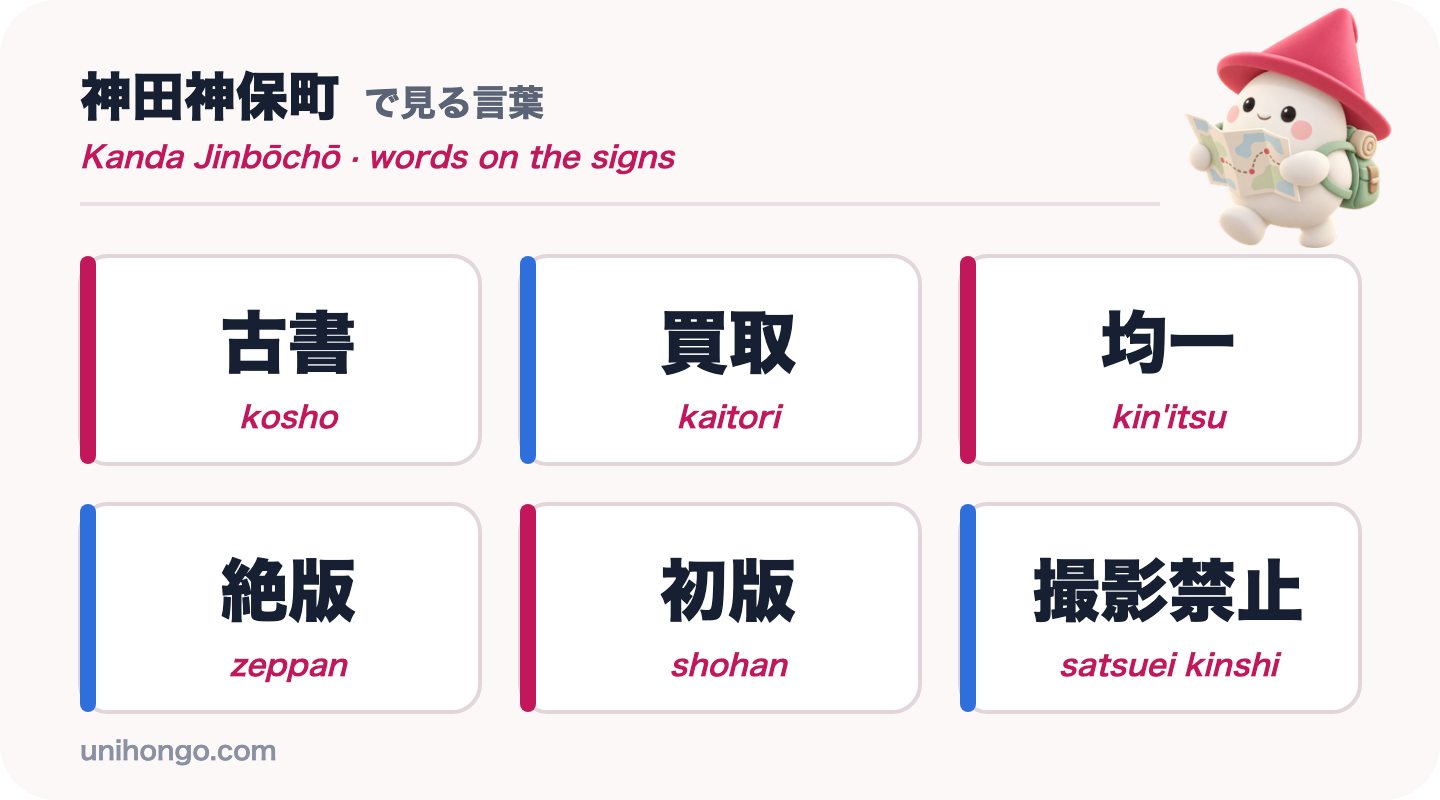
| Word | Reading | Meaning |
|---|---|---|
| 古書 | kosho | Old or antiquarian books |
| 古本 | furuhon | Second-hand books |
| 買取 | kaitori | We buy books |
| 均一 | kin'itsu | Everything one price, on the carts outside |
| 初版 | shohan | First edition |
| 絶版 | zeppan | Out of print |
| 帯付 | obi-tsuki | With the original paper band |
| 浮世絵 | ukiyo-e | Woodblock prints |
| 撮影禁止 | satsuei kinshi | No photography |
| 定休日 | teikyūbi | Regular closing day |
Japanese for finding and buying a book
Booksellers in Jinbōchō are used to precise questions. Say the subject or the author, and if you have the title written down, show it: many shops will check their stock or tell you which other shop in the area specialises in that subject. It is normal to ask whether a book is a first edition, whether the band or box is included, and whether you may look at a print more closely.
Rare books and prints are often kept behind the counter or in glass cases, and some expensive items are wrapped in plastic. Ask before you open anything, and hold old books gently with clean, dry hands.
| Japanese | Romaji | Meaning |
|---|---|---|
| 浮世絵の本はありますか。 | Ukiyo-e no hon wa arimasu ka. | Do you have books on ukiyo-e? |
| この作家の本を探しています。 | Kono sakka no hon o sagashite imasu. | I'm looking for books by this author. |
| これは初版ですか。 | Kore wa shohan desu ka. | Is this a first edition? |
| 中を見てもいいですか。 | Naka o mite mo ii desu ka. | May I look inside? |
| この地図はいつごろのものですか。 | Kono chizu wa itsu goro no mono desu ka. | About when is this map from? |
| この分野のお店はほかにありますか。 | Kono bun'ya no o-mise wa hoka ni arimasu ka. | Are there other shops for this subject? |
| これをください。 | Kore o kudasai. | I'll take this, please. |
| 飛行機で持って帰るので、包んでもらえますか。 | Hikōki de motte kaeru node, tsutsunde moraemasu ka. | I'm taking it home by plane. Could you wrap it? |
Etiquette, timing and practical tips
Bookshops in Jinbōchō are small businesses with fragile, valuable stock, and a few habits make you a welcome browser.
- Ask before taking photos inside a shop; many do not allow it, and some say so on the door.
- Put books back exactly where you found them, spine out, and do not stack them on the shelves.
- Leave a large backpack at your hotel if you can, or carry it in front of you in narrow aisles.
- Go on a weekday or Saturday. Many shops close on Sundays and national holidays, and some open only from late morning; check the official site for this season's hours of any shop you particularly want.
- Carry some cash. Many shops accept cards, but some smaller ones and the pavement carts may not.
- Visit during the autumn used-book festival for the biggest selection, and early in the day, before the best stalls are picked over.
- Save lunch for Jinbōchō's curry restaurants or a kissaten, and take your new book with you.
Practise the bookshop conversation before you go
The two questions you will ask most in Jinbōchō are whether a shop has what you want and whether you may take a photo. Listen for the location words in the reply, nikai, second floor, oku, at the back, and tana, shelf, and for the soft refusal na n desu, which explains a rule rather than scolding you.
Practise the four lines aloud until they feel natural, then rehearse with a partner who answers back. In Unihongo, choose the Shopping topic and ask your AI Sensei to play a Jinbōchō bookseller, or the Café topic to practise ordering in a kissaten afterwards.
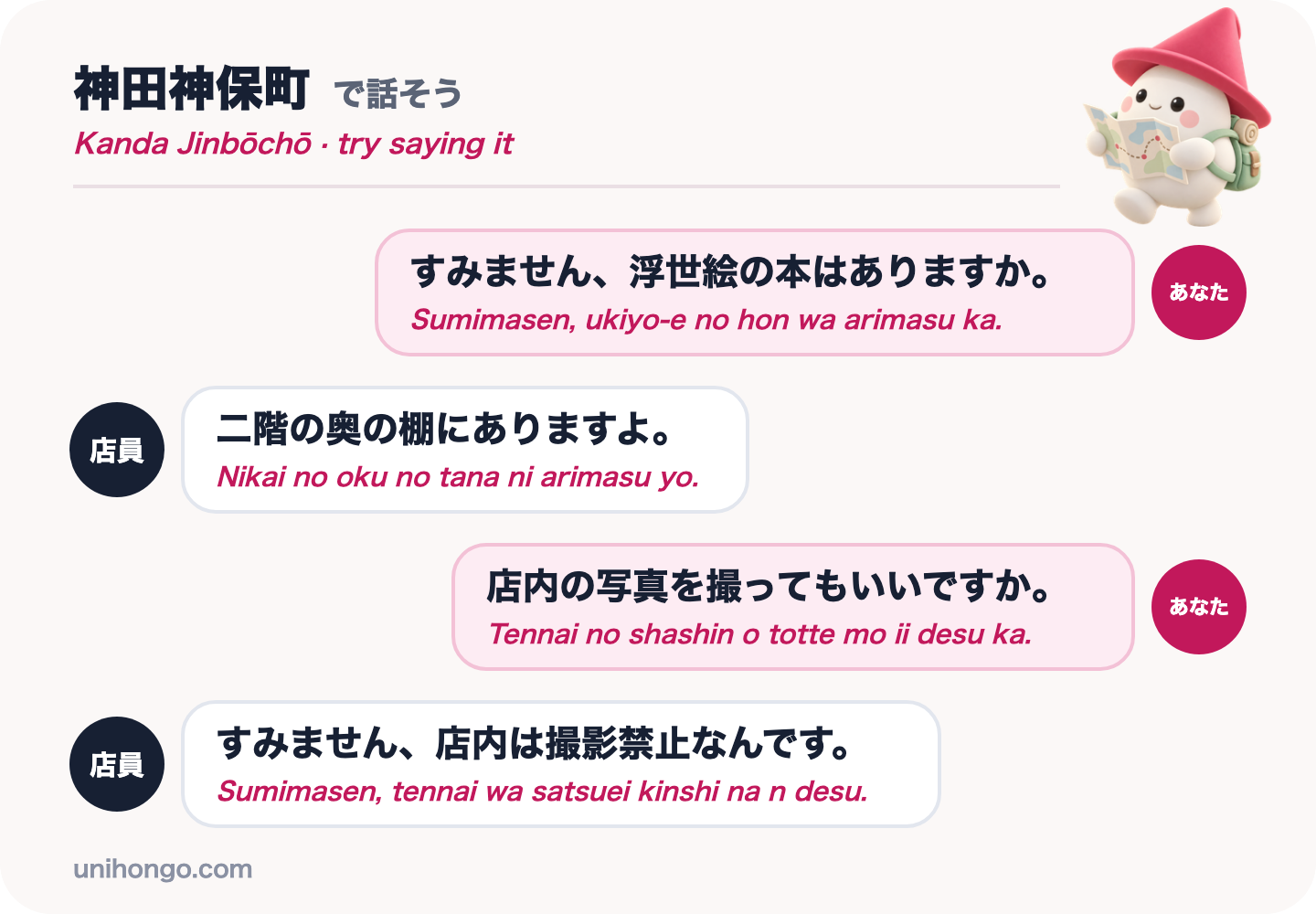
| Japanese | Romaji | Meaning |
|---|---|---|
| すみません、浮世絵の本はありますか。 | Sumimasen, ukiyo-e no hon wa arimasu ka. | Excuse me, do you have books on ukiyo-e? |
| 二階の奥の棚にありますよ。 | Nikai no oku no tana ni arimasu yo. | They're on the shelves at the back of the second floor. |
| 店内の写真を撮ってもいいですか。 | Tennai no shashin o totte mo ii desu ka. | May I take photos inside the shop? |
| すみません、店内は撮影禁止なんです。 | Sumimasen, tennai wa satsuei kinshi na n desu. | Sorry, photos aren't allowed inside the shop. |
Official information
Book Town Jimbou, the official site supported by the Kanda used-book dealers' association, lists the bookshops with their specialities, offers a searchable catalogue for some of them and publishes the book town map and festival news. Check it before you go, since each shop sets its own hours and closing days.