

Why Chūson-ji is worth the trip north
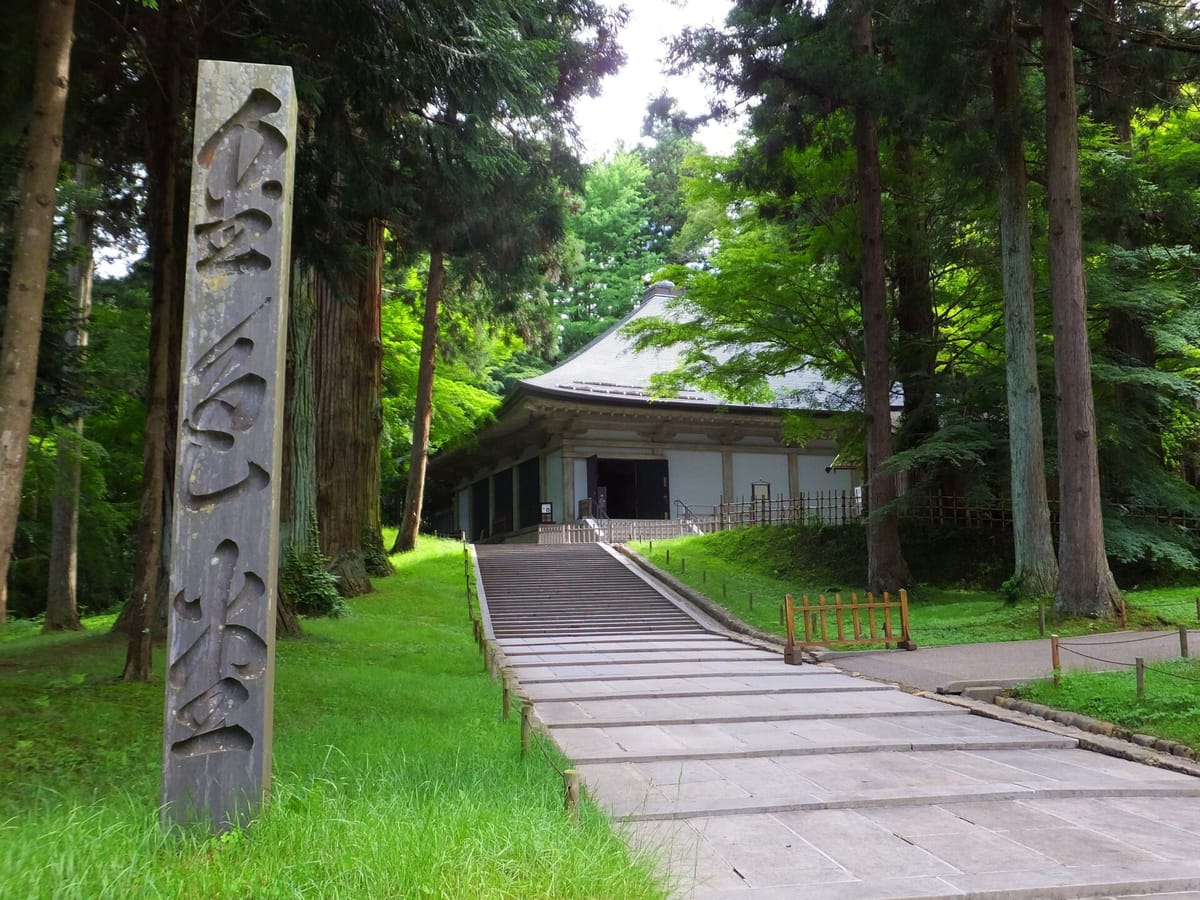
Chūson-ji traces its founding to 850, when the monk Ennin, known after his death as Jikaku Daishi, is said to have established a temple here. Its golden age came in the early twelfth century, when Fujiwara no Kiyohira, the first of the Ōshū Fujiwara lords, rebuilt it on a grand scale. He had survived years of war in the north, and the temple was meant to console the spirits of everyone who had died in those conflicts, friend and enemy alike. At its height it had more than forty halls and some three hundred residences for monks.
The Fujiwara fell in 1189, and fire and time took most of the buildings. The Konjikidō, finished in 1124, is the one survivor from the twelfth century in its original form. It is a small hall, only a few metres across, but it is covered in gold leaf inside and out and inlaid with mother-of-pearl, and it was the first building in Japan to be designated a National Treasure. The remains of the four Fujiwara lords rest beneath its altars.
For a learner, Chūson-ji is also a lesson in old readings. The same kanji you know from everyday words turn up here with Buddhist or classical readings, such as konjiki for gold colour, and working them out on the signs is part of the fun.
Getting there: Ichinoseki, Hiraizumi Station and the bus
Hiraizumi is not on the Shinkansen. Take the Tōhoku Shinkansen from Tokyo or Sendai to Ichinoseki, then the JR Tōhoku Line north for one stop to Hiraizumi, a ride of under ten minutes. Local trains are not frequent, so check the connection before you leave the Shinkansen platform.
From Hiraizumi Station, a local bus reaches Chūson-ji in about five minutes, and the Hiraizumi loop bus, which also links Mōtsū-ji and the town's other sights, takes around ten. Walking takes twenty to thirty minutes along the main road. The bus stop is at the bottom of Tsukimizaka, where the climb begins.
| Japanese | Romaji | Meaning |
|---|---|---|
| 平泉に行くのは何番線ですか。 | Hiraizumi ni iku no wa nanbansen desu ka. | Which platform is the train to Hiraizumi? |
| 中尊寺に行くバスはどこから乗りますか。 | Chūson-ji ni iku basu wa doko kara norimasu ka. | Where do I catch the bus to Chūson-ji? |
| このバスは毛越寺にも止まりますか。 | Kono basu wa Mōtsū-ji ni mo tomarimasu ka. | Does this bus also stop at Mōtsū-ji? |
| 中尊寺まで歩いてどのくらいですか。 | Chūson-ji made aruite dono kurai desu ka. | How long does it take to walk to Chūson-ji? |
| 月見坂の入口はここですか。 | Tsukimizaka no iriguchi wa koko desu ka. | Is this the start of Tsukimizaka? |
Up Tsukimizaka: the halls on the way to the golden hall
Tsukimizaka, the moon-viewing slope, is the main approach: a steep path lined with cedars that are centuries old, with small halls and viewpoints on the way up. It flattens out at the Hondō, the main hall, rebuilt in 1909, where the temple's daily rituals take place and where you can ask for a goshuin.
Beyond the main hall the path continues through the woods to the ticket gate, the Sankōzō museum and the protective hall around the Konjikidō. Inside, behind glass, the golden hall glows in the dim light: gilded pillars, lacquer and mother-of-pearl, and on each of three altars a seated Amida Buddha surrounded by attendant figures. Just past it stands the Kyōzō, the sutra repository, which also has parts dating from the Fujiwara era, and further on, a thatched Noh stage.
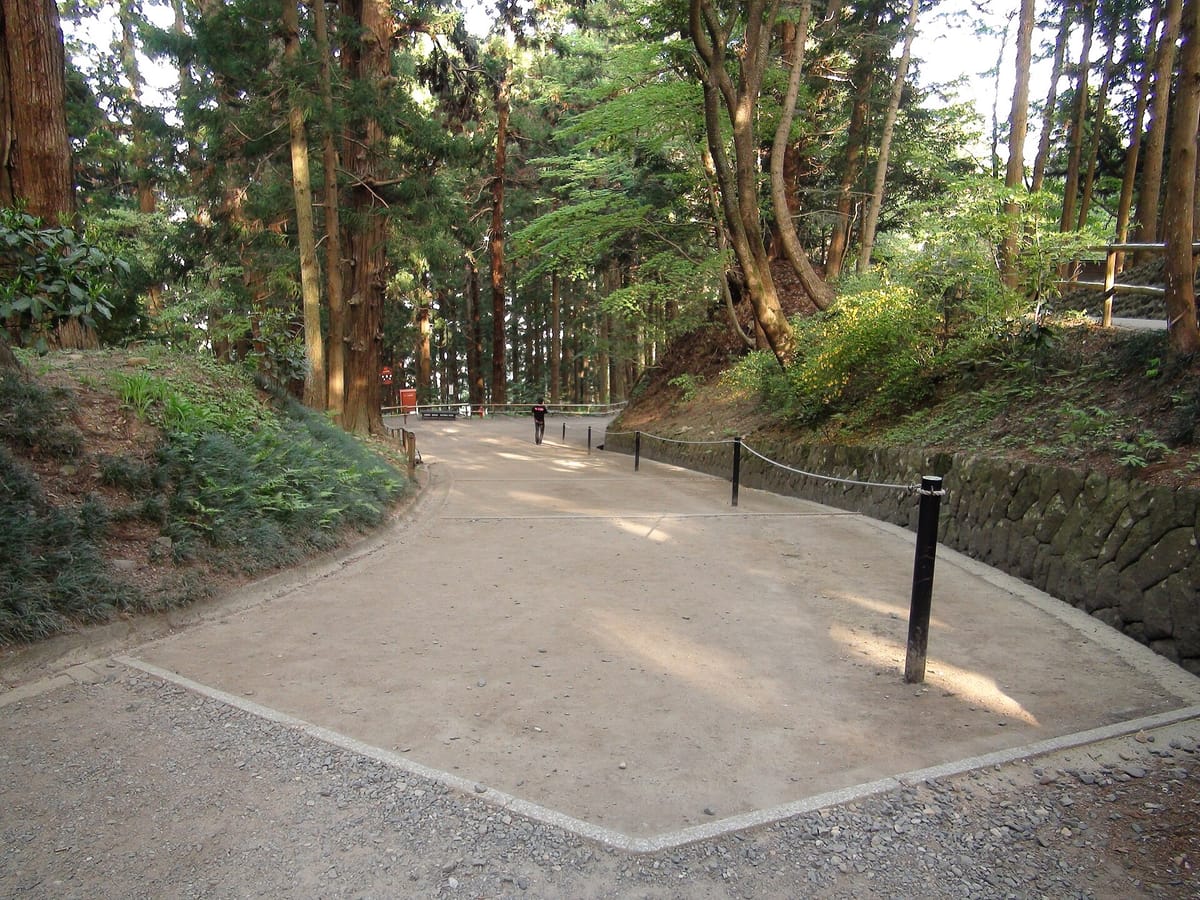
- Tsukimizaka: the cedar-lined slope from the bus stop to the main hall.
- Hondō: the main hall, rebuilt in 1909; the place to ask for a goshuin.
- Sankōzō: the treasure museum, opened in 2000, with Buddhist statues and objects from the Fujiwara era.
- Konjikidō: the golden hall of 1124, inside its protective hall; ticketed, no photography.
- Kyōzō: the sutra repository near the golden hall.
- The old protective hall: an earlier wooden shelter for the Konjikidō, moved a short way along the path.
- The Noh stage: a thatched outdoor stage in the woods beyond the halls.
Words on the signs at Chūson-ji
The signs at Chūson-ji name the halls, and most names end in the same few kanji: 堂, dō, a hall, and 蔵, zō or kura, a storehouse. The museum's name, 讃衡蔵, Sankōzō, is hard to read even for Japanese visitors, so do not worry if it looks unfamiliar: recognise the 蔵 at the end and you know it is where treasures are kept.
The sign you most need to obey is 撮影禁止, satsuei kinshi, photography prohibited, which you will see at the entrance to the golden hall. The table below covers the rest.
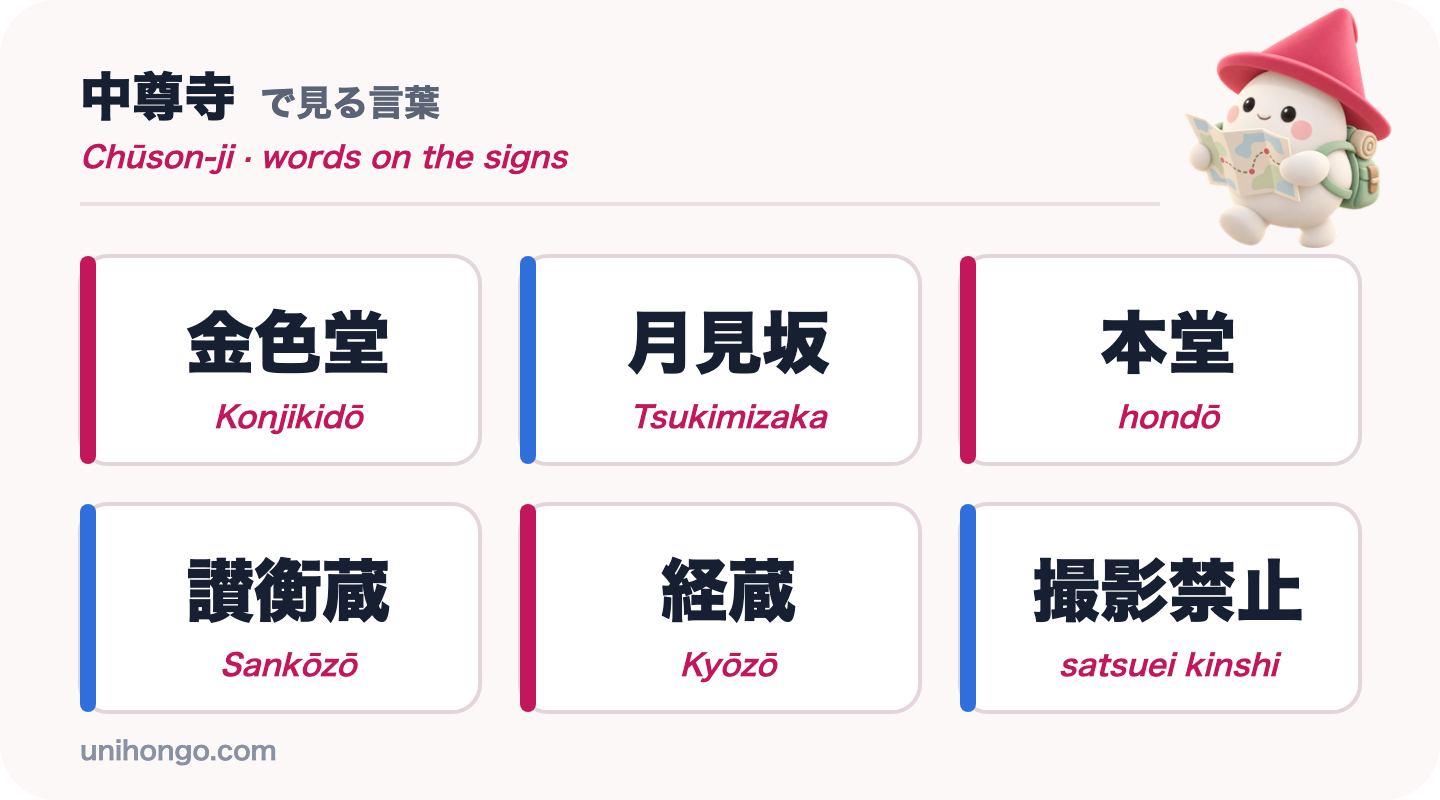
| Word | Reading | Meaning |
|---|---|---|
| 金色堂 | Konjikidō | The golden hall |
| 光堂 | Hikaridō | Shining hall, another name for the golden hall |
| 月見坂 | Tsukimizaka | The moon-viewing slope, the main approach |
| 本堂 | hondō | Main hall |
| 讃衡蔵 | Sankōzō | The treasure museum |
| 経蔵 | Kyōzō | Sutra repository |
| 覆堂 | ōidō | Protective hall built around another hall |
| 撮影禁止 | satsuei kinshi | Photography prohibited |
| 拝観券 | haikanken | Entry ticket |
Japanese for the ticket gate, the golden hall and the goshuin
The ticket gate is where most visitors speak to someone, and the questions are nearly always the same: what does the ticket cover, can I take photos, where do I go next. If you hear an explanation in Japanese at the golden hall, listen for Amida, Fujiwara and the word yondai, four generations.
The goshuin, the handwritten stamp, is written at the main hall. Chūson-ji is one of the great pilgrimage temples of the north, so bring a goshuin book if you collect them, and hand it over open at a blank page.
| Japanese | Romaji | Meaning |
|---|---|---|
| 金色堂の拝観券を一枚ください。 | Konjikidō no haikanken o ichimai kudasai. | One ticket for the Konjikidō, please. |
| この券で讃衡蔵にも入れますか。 | Kono ken de Sankōzō ni mo hairemasu ka. | Can I enter the Sankōzō with this ticket too? |
| 金色堂はどちらですか。 | Konjikidō wa dochira desu ka. | Which way is the Konjikidō? |
| ここで写真を撮ってもいいですか。 | Koko de shashin o totte mo ii desu ka. | May I take photos here? |
| 御朱印はどこでいただけますか。 | Goshuin wa doko de itadakemasu ka. | Where can I receive a goshuin? |
| 芭蕉の句碑はどこにありますか。 | Bashō no kuhi wa doko ni arimasu ka. | Where is the stone with Bashō's haiku? |
Etiquette, weather and timing
Chūson-ji is an active Tendai temple as well as a World Heritage Site, and the golden hall is a place of prayer for the Fujiwara lords who rest there.
- Put your camera and phone away before entering the Konjikidō's protective hall.
- Keep your voice low inside the hall and do not tap on the glass.
- Tsukimizaka is steep. Wear good shoes, and take it slowly on a hot summer day or when it is icy in winter.
- Arrive early in the day or late in the afternoon to see the golden hall with fewer tour groups.
- Autumn colours along the slope and fresh green in early summer are the most beautiful seasons; winter brings snow and far fewer visitors.
- Combine Chūson-ji with Mōtsū-ji and its Pure Land garden for a full day in Hiraizumi.
Practise the golden hall before you go
The two questions visitors most often ask at Chūson-ji are about photos and the ticket. Practise the four lines below until you can say them without reading, and listen for the key words in the replies: kinshi, prohibited, and ryōhō, both.
Then practise with a partner who answers back. In Unihongo, choose the Sightseeing topic and ask your AI Sensei to play the attendant at the golden hall, or use Cultural Etiquette to rehearse temple manners. Speaking the lines once before you travel is what makes them come out naturally on the day.
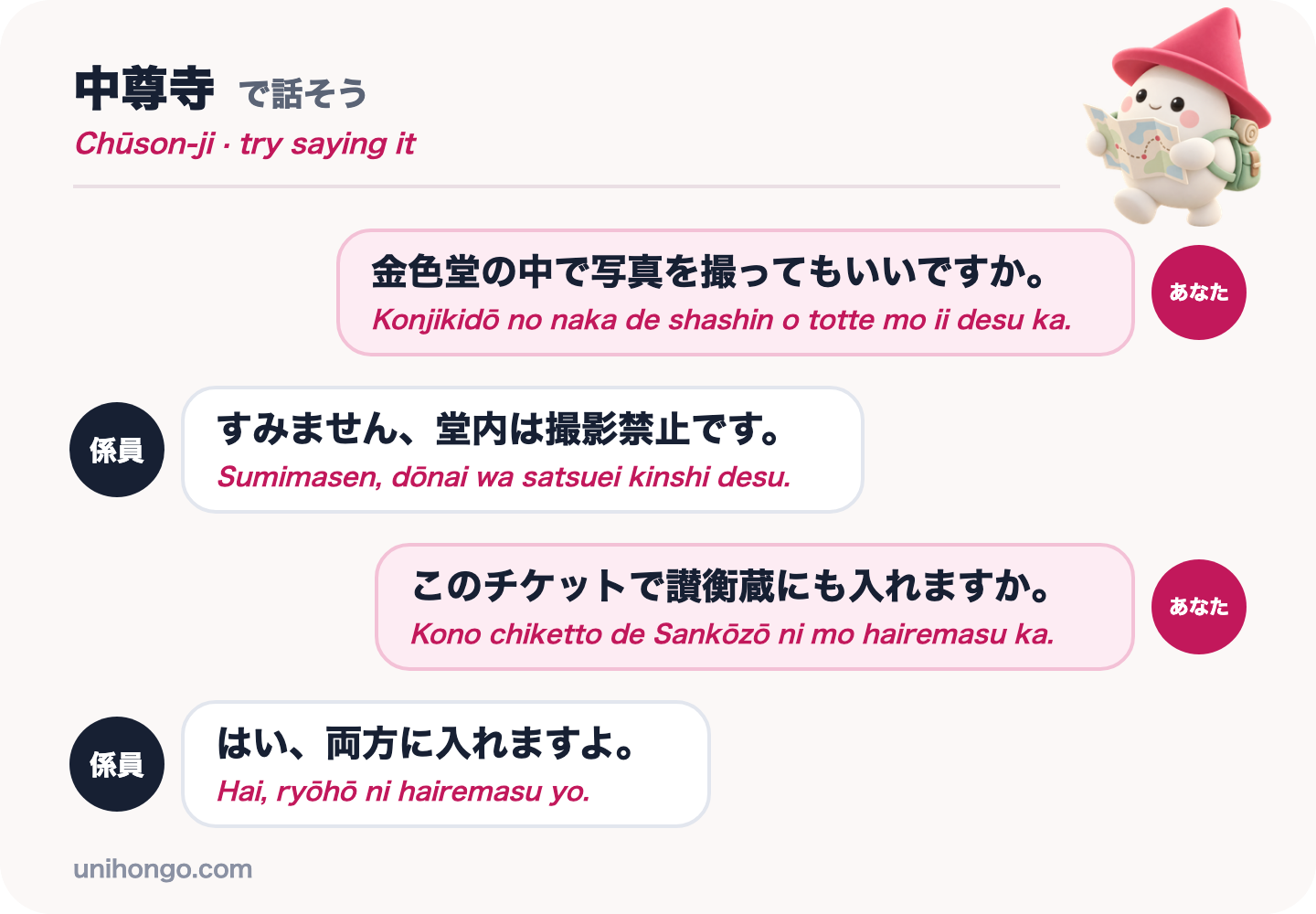
| Japanese | Romaji | Meaning |
|---|---|---|
| 金色堂の中で写真を撮ってもいいですか。 | Konjikidō no naka de shashin o totte mo ii desu ka. | May I take photos inside the Konjikidō? |
| すみません、堂内は撮影禁止です。 | Sumimasen, dōnai wa satsuei kinshi desu. | I'm sorry, photography is not allowed inside the hall. |
| このチケットで讃衡蔵にも入れますか。 | Kono chiketto de Sankōzō ni mo hairemasu ka. | Can I also enter the Sankōzō with this ticket? |
| はい、両方に入れますよ。 | Hai, ryōhō ni hairemasu yo. | Yes, it covers both. |
Official information
Chūson-ji publishes its history, hours and fees on its English site. Check it for seasonal events and any changes to access before you go.