

Why Kappabashi is worth a detour from Asakusa
Every restaurant in Japan needs chopsticks, bowls, lanterns, knives and a window of plastic food, and for more than a century many of them have come to Kappabashi to buy them. The street runs north to south between Ueno and Asakusa, and at about 800 metres long, with over 170 shops, it is the largest shopping street for kitchen goods in Japan. Most shops are family businesses that specialise in one thing, and the staff know their stock thoroughly.
For visitors, the appeal is being able to buy professional tools at shop prices, and to see the everyday material culture of Japanese food up close. You can compare hand-forged knives from Sakai and Seki, pick a rice bowl from a wall of hundreds, buy a noren curtain for your own kitchen, or choose a plastic bowl of ramen that looks good enough to eat.
It is also a very good place to practise shopping Japanese, because the conversations are specific and people are pleased to explain. A knife seller will ask what you cook, which hand you use and whether you want it sharpened, and the answers fit into the simplest sentence patterns.
Getting there: Tawaramachi, Iriya and Asakusa
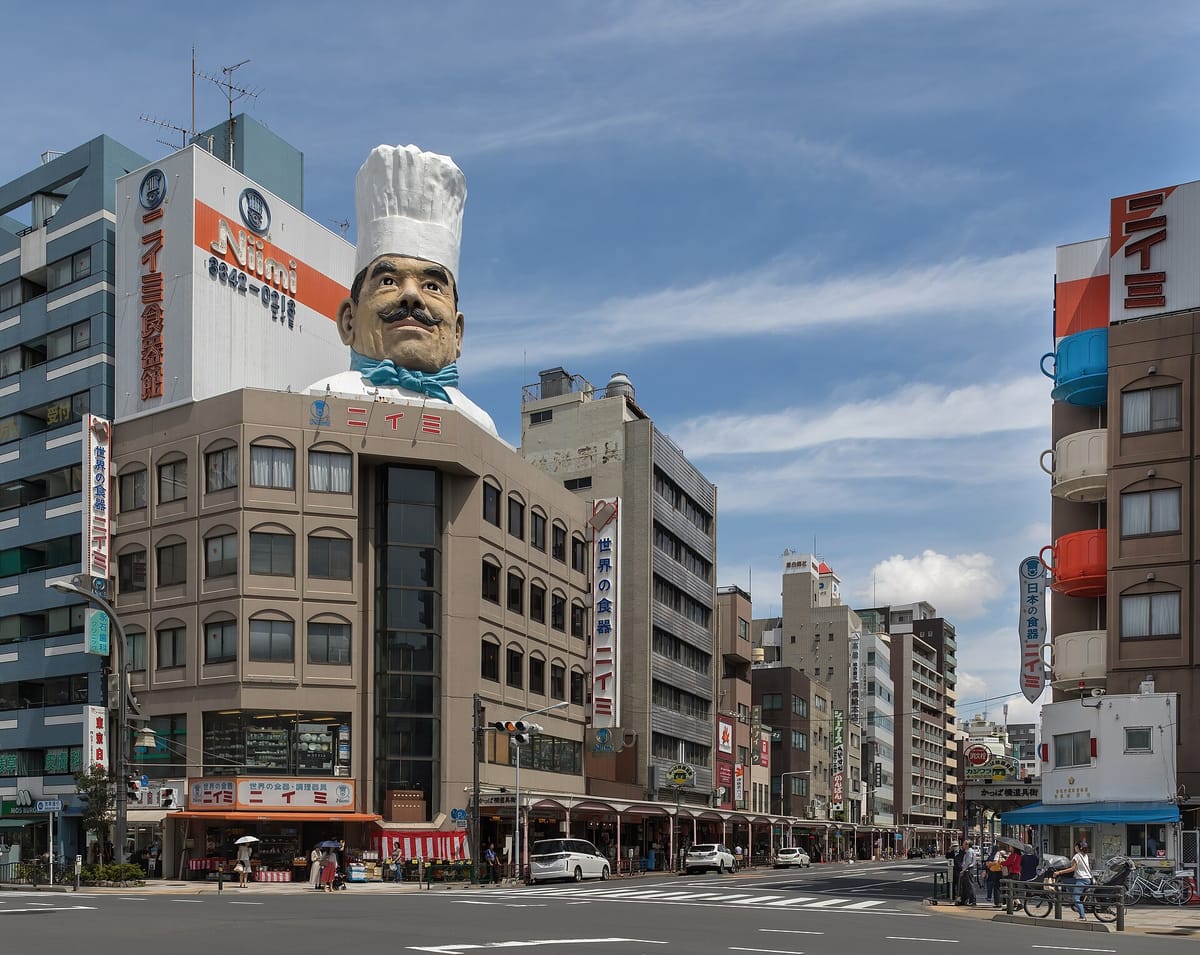
The closest station is Tawaramachi on the Tokyo Metro Ginza Line, one stop from Asakusa; the street's association puts it about five minutes on foot. Walk west along Asakusa-dōri until you see the giant chef's head at the corner, and the street runs north from there. Iriya Station on the Hibiya Line is about six minutes from the northern end, and Asakusa Station on the Tsukuba Express is around five minutes away.
From Asakusa's Sensō-ji area it is an easy walk of around ten to fifteen minutes west, and many visitors combine the two. From JR Ueno or Uguisudani the association gives about fifteen minutes on foot. There is no single entrance: you can walk the street end to end in either direction and cut through side streets on the way.
| Japanese | Romaji | Meaning |
|---|---|---|
| かっぱ橋道具街はどちらですか。 | Kappabashi Dōgugai wa dochira desu ka. | Which way is Kappabashi Dōgu-gai? |
| 田原町駅から歩いて行けますか。 | Tawaramachi-eki kara aruite ikemasu ka. | Can I walk from Tawaramachi Station? |
| 包丁の店はこの通りにありますか。 | Hōchō no mise wa kono tōri ni arimasu ka. | Are there knife shops on this street? |
| 食品サンプルの店を探しています。 | Shokuhin sanpuru no mise o sagashite imasu. | I'm looking for a food sample shop. |
| 浅草駅にはどう戻ればいいですか。 | Asakusa-eki ni wa dō modoreba ii desu ka. | How do I get back to Asakusa Station? |
What you will find along the street
Each shop tends to cover one trade, so a walk down the street feels like touring the back room of every kind of restaurant. Look up as well as in: some buildings are decorated with giant coffee cups, and kappa figures appear on signs and doorways all along the street.
The official association lists everything from bakery equipment and Chinese tableware to refrigerators and shop design, but these are the shops most visitors come for.
- Hōchō, knives: shops selling Japanese kitchen knives, whetstones and sharpening services, many of which will engrave your name on the blade.
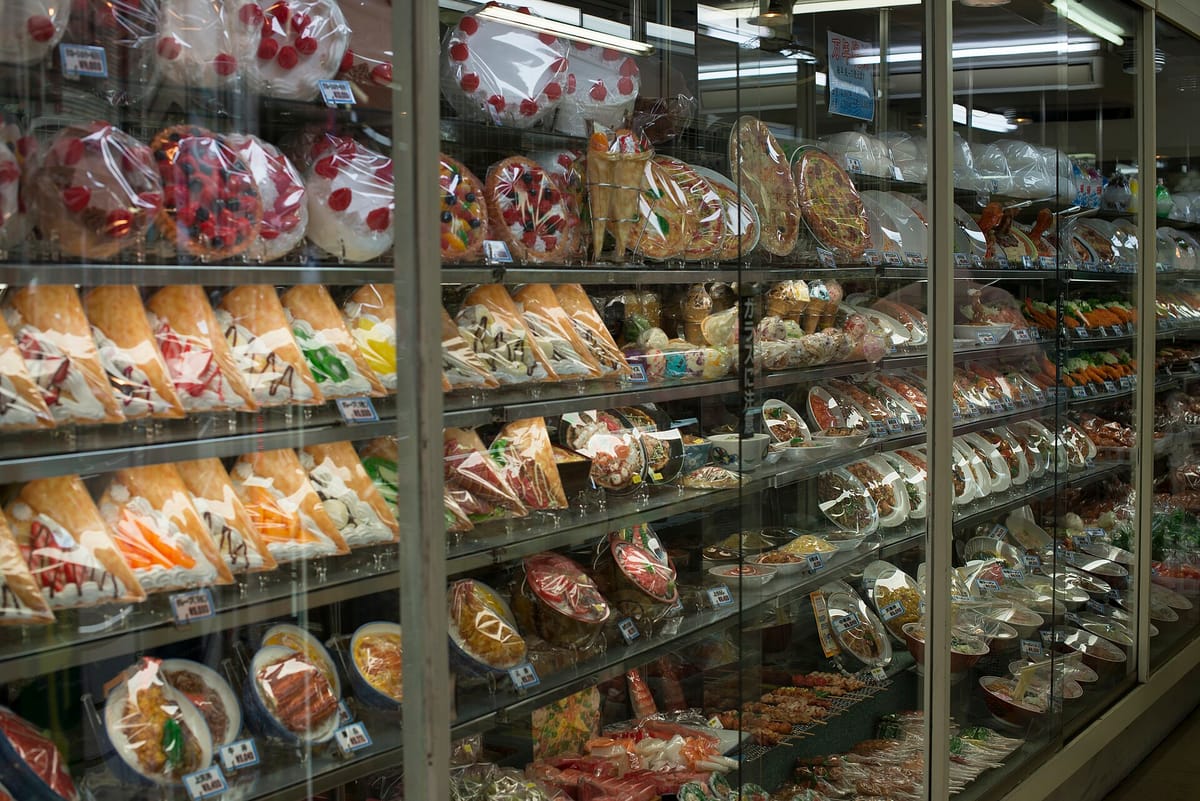
- Shokuhin sanpuru, food samples: the plastic replicas made for restaurant windows, sold as whole dishes, key rings and fridge magnets; some shops run hands-on workshops that usually need booking.
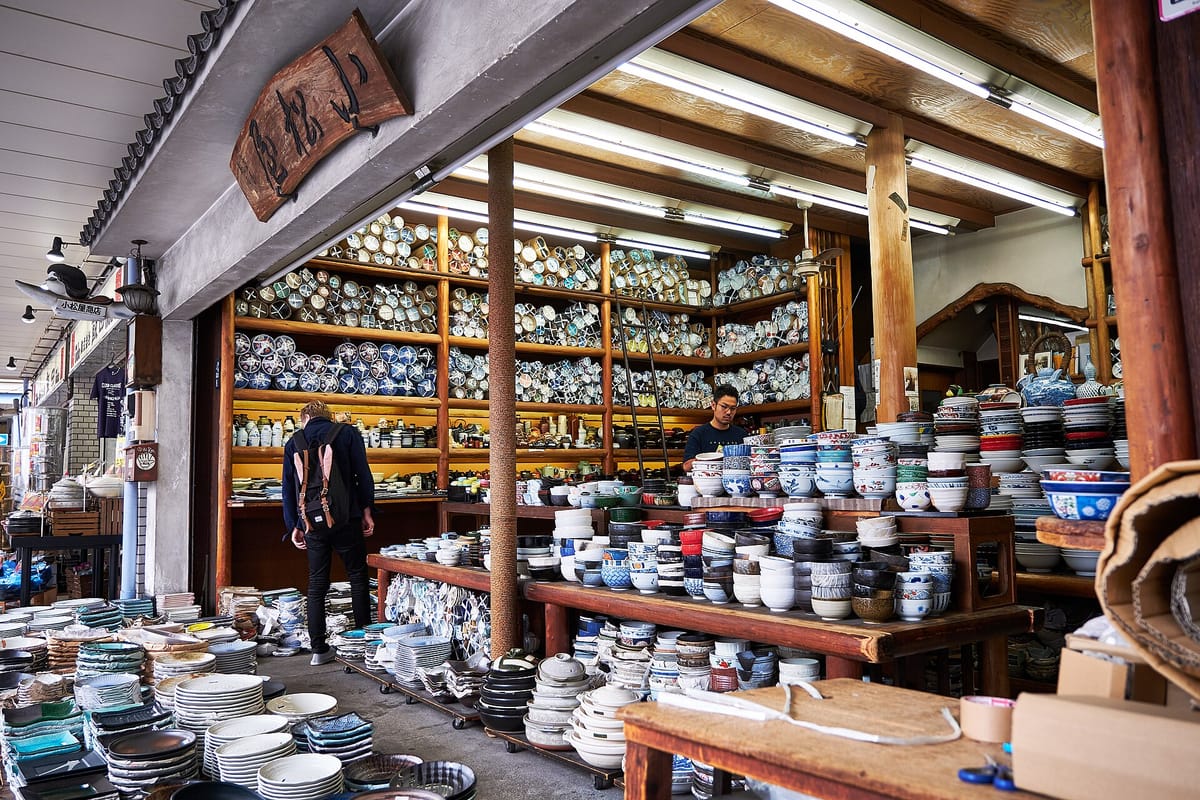
- Shokki, tableware: rice bowls, sake cups, plates and teapots by the hundred, from everyday ware to handmade pieces.
- Shikki, lacquerware: soup bowls, trays and bentō boxes.
- Noren and signs: shop curtains, paper lanterns, wooden menus and hand-painted signboards.
- Baking and sweets: moulds for taiyaki and wagashi, cutters, packaging and ingredients.
- Kappa-dera: a short walk away, the temple Sōgen-ji is known for its kappa connection and cucumber offerings.
Words on the shop signs
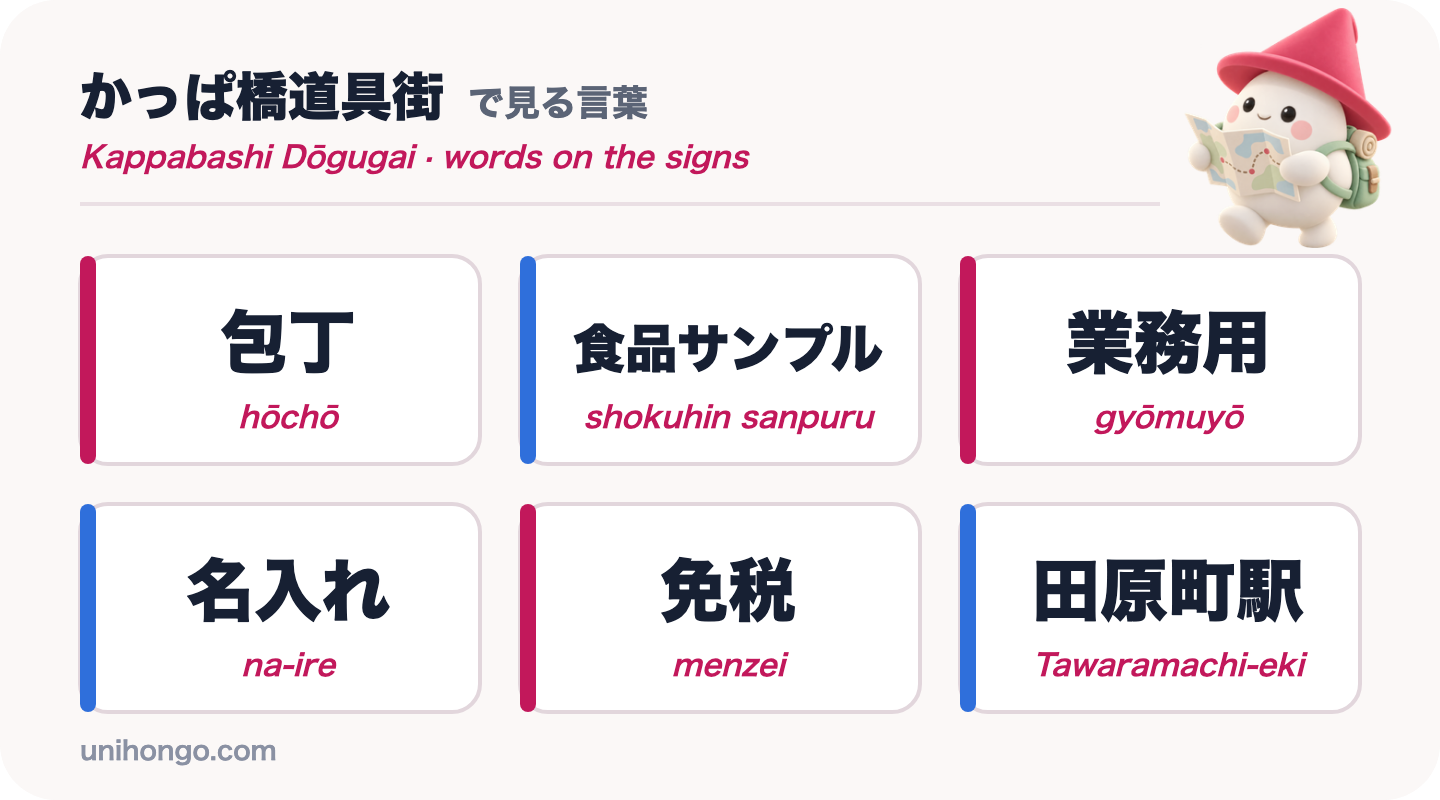
Shop signs in Kappabashi tell you exactly what is inside. 包丁, hōchō, marks a knife shop; 食器, shokki, a tableware shop; 食品サンプル, shokuhin sanpuru, the plastic food makers. Many signs add 業務用, gyōmuyō, for business use, which means trade stock and often larger sizes or boxes of ten.
At a knife shop you will also see 名入れ, na-ire, name engraving, and 研ぎ, togi, sharpening. At larger shops, 免税 at the door or the till means tax-free shopping is available for visitors with a passport.
| Word | Reading | Meaning |
|---|---|---|
| 田原町駅 | Tawaramachi-eki | Tawaramachi Station, the nearest subway stop |
| 包丁 | hōchō | Kitchen knife |
| 食品サンプル | shokuhin sanpuru | Plastic food samples |
| 食器 | shokki | Tableware |
| 漆器 | shikki | Lacquerware |
| 業務用 | gyōmuyō | For business use, trade stock |
| 名入れ | na-ire | Name engraving |
| 研ぎ | togi | Sharpening |
| 免税 | menzei | Tax-free |
Japanese for buying a knife
Choosing a knife is a conversation, and a good shop will ask you questions before it recommends anything. The most common shapes are the gyūtō, the Japanese chef's knife, the santoku, a shorter all-purpose knife, and the petty, a small utility knife. Traditional single-bevelled knives such as the deba for fish and the yanagiba for sashimi are sharpened on one side only, kataba, and are made for right- or left-handed use.
Staff will usually ask whether you want carbon steel, hagane, which takes a keen edge but rusts if left wet, or stainless steel, sutenresu, which is easier to care for. If you want your name engraved, write it clearly on paper and say whether you want it in katakana or kanji.
| Japanese | Romaji | Meaning |
|---|---|---|
| 家庭で使う包丁を探しています。 | Katei de tsukau hōchō o sagashite imasu. | I'm looking for a knife for home use. |
| 牛刀と三徳はどう違いますか。 | Gyūtō to santoku wa dō chigaimasu ka. | What's the difference between a gyūtō and a santoku? |
| さびにくいのはどれですか。 | Sabinikui no wa dore desu ka. | Which one is less likely to rust? |
| 左利き用はありますか。 | Hidarikiki-yō wa arimasu ka. | Do you have one for left-handed people? |
| 持ってみてもいいですか。 | Motte mite mo ii desu ka. | May I hold it? |
| 名入れはできますか。 | Na-ire wa dekimasu ka. | Can you engrave a name? |
| 砥石も一緒にください。 | Toishi mo issho ni kudasai. | I'll take a whetstone with it, please. |
| 飛行機で持って帰るので、しっかり包んでください。 | Hikōki de motte kaeru node, shikkari tsutsunde kudasai. | I'm taking it home by plane, so please wrap it well. |
Etiquette, timing and practical tips
Kappabashi is a trade street first, and shop owners are working. A few habits make you a welcome customer.
- Ask before you touch knives or delicate ceramics, and never test a blade on your finger or on paper without being invited.
- Ask before taking photos inside shops; many are happy for you to, but some prefer not.
- Go on a weekday or Saturday. Each shop sets its own days off, and fewer shops open on Sundays and national holidays.
- Many shops close in the early evening, so start in the late morning or early afternoon; check the official site for this season's hours of the shops you want most.
- Carry some cash for smaller shops, although many now accept cards and IC payments.
- Bring your passport if you plan to shop tax-free at larger stores.
- Pack knives in checked luggage only, and keep the shop's box or sheath.
Practise the knife-shop conversation before you go
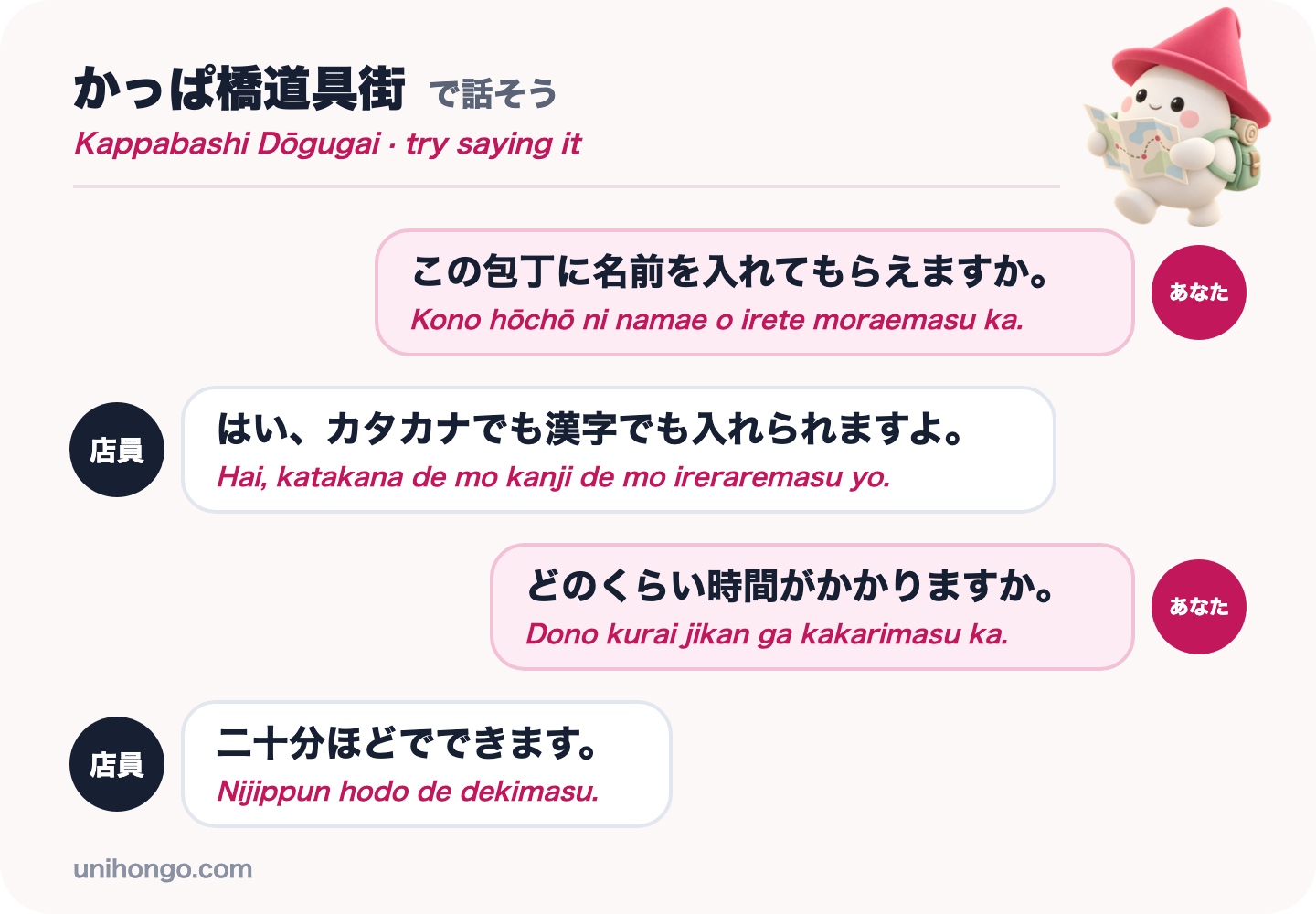
Name engraving is the moment when most visitors need to speak, because the shop needs to know how to write your name and you need to know when to come back. Listen for katakana and kanji in the reply, and for a number of minutes with hodo, about.
Practise the four lines aloud until you can say them without reading, then rehearse with a partner who answers back. In Unihongo, choose the Shopping topic and ask your AI Sensei to play the knife-shop owner, then try the Japanese Cuisine topic to talk about what you like to cook.
| Japanese | Romaji | Meaning |
|---|---|---|
| この包丁に名前を入れてもらえますか。 | Kono hōchō ni namae o irete moraemasu ka. | Could you engrave my name on this knife? |
| はい、カタカナでも漢字でも入れられますよ。 | Hai, katakana de mo kanji de mo ireraremasu yo. | Yes, we can do it in katakana or in kanji. |
| どのくらい時間がかかりますか。 | Dono kurai jikan ga kakarimasu ka. | How long does it take? |
| 二十分ほどでできます。 | Nijippun hodo de dekimasu. | It will be ready in about twenty minutes. |
Official information
The Kappabashi Dougugai Promotion Association runs the street's official website, with a shop search, access details and a downloadable map. Individual shops set their own hours and holidays, so check the shops you most want to visit before you go.