

Why Gion is Kyoto at its most traditional
Gion takes its name from Yasaka Jinja, which was called Gion-sha until the late nineteenth century. Teahouses opened along the road to the shrine to serve its visitors, and by the Edo period the area had become one of the most famous hanamachi, flower towns, in Japan: districts where geiko and maiko live, train and perform. Gion Kōbu, the part around Hanamikōji, is the largest of Kyoto's five hanamachi.
What you see as you walk is a townscape of machiya, narrow wooden houses with latticed fronts, bamboo blinds, lanterns and nameplates of the geiko who belong to each house. Behind those doors are ochaya, where guests are entertained, and okiya, the houses where maiko live during their training. It is a working community, not a museum, and that is exactly why it feels special.
For a learner, Gion is also a lesson in polite Japanese. Restaurants here use careful, soft speech, many signs are written with a courteous touch, and the difference between a public street and a private lane is marked in two or three kanji you will want to recognise.
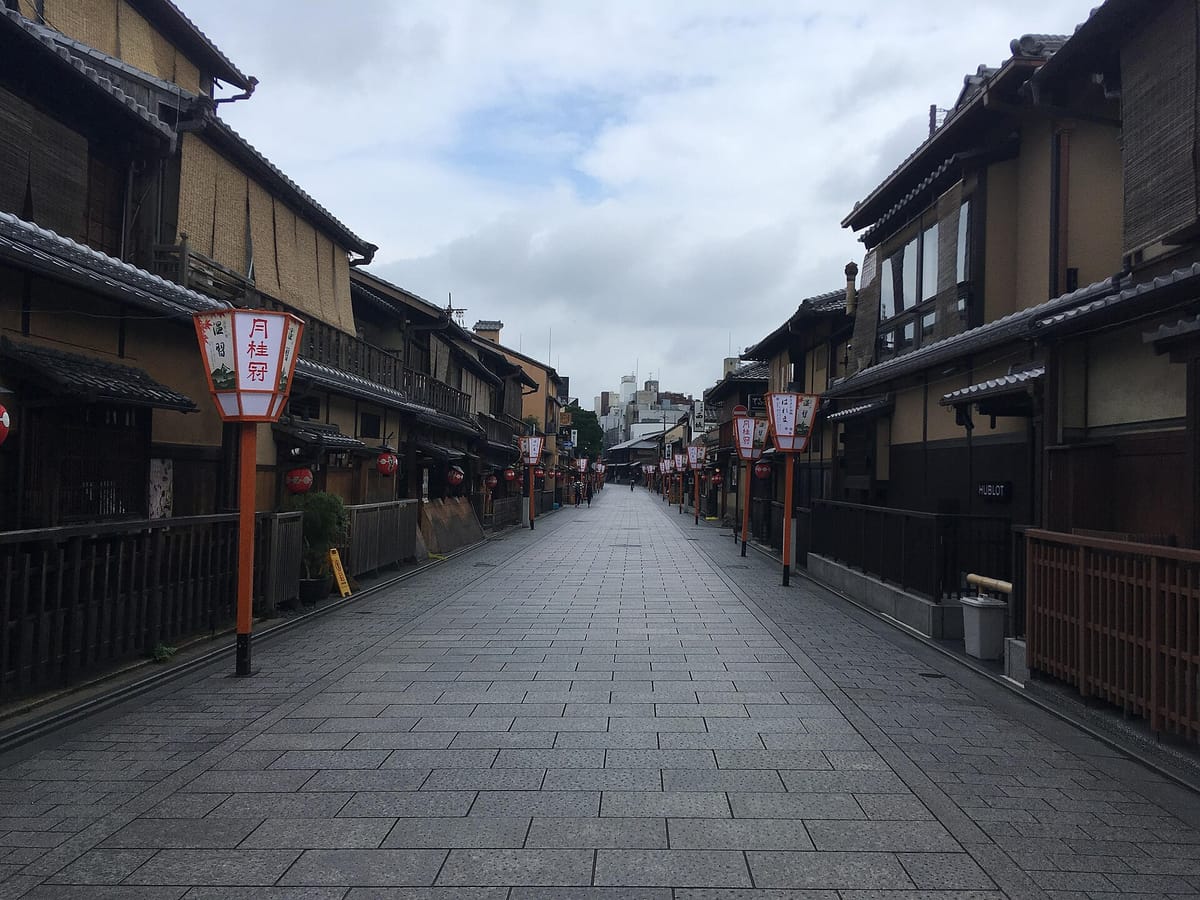
Getting there: Gion-Shijō, Kawaramachi and the Gion bus stop
Keihan Gion-Shijō Station is under the east end of the Shijō bridge over the Kamo River. Come up to street level and walk east along Shijō-dōri, past the Minamiza kabuki theatre, and in five minutes you reach Hanamikōji; keep going to the end of the street and you face the tower gate of Yasaka Jinja. Hankyū Kyoto-Kawaramachi Station is on the west side of the river, a few minutes' walk from Gion across the bridge.
From Kyoto Station, city buses 206 and 100 stop at Gion, right in front of Yasaka Jinja. Gion is also within walking distance of Kiyomizu-dera, up through Ninenzaka and Sannenzaka, and of Pontochō across the river, so many visitors walk in rather than ride.
| Japanese | Romaji | Meaning |
|---|---|---|
| 祇園四条駅はどの出口が近いですか。 | Gion-Shijō-eki wa dono deguchi ga chikai desu ka. | Which exit of Gion-Shijō Station is closest? |
| 花見小路はこの先ですか。 | Hanamikōji wa kono saki desu ka. | Is Hanamikōji further along here? |
| 八坂神社まで歩いて何分ですか。 | Yasaka Jinja made aruite nanpun desu ka. | How many minutes on foot to Yasaka Jinja? |
| 白川の方へはどう行けばいいですか。 | Shirakawa no hō e wa dō ikeba ii desu ka. | How do I get to the Shirakawa area? |
| このバスは祇園に止まりますか。 | Kono basu wa Gion ni tomarimasu ka. | Does this bus stop at Gion? |
A walk through Gion: Yasaka Jinja to Shirakawa
Start at Yasaka Jinja. Climb the steps through the vermilion west gate, visit the main hall, and look up at the dance stage hung with hundreds of paper lanterns, each bearing the name of a local business that sponsors it. Behind the shrine lies Maruyama Park, famous for its great weeping cherry.
Walk back down Shijō-dōri and turn left into Hanamikōji. The northern section, above Shijō-dōri, is full of small restaurants; the southern section is the classic view, with the Gion Corner theatre near its far end and Kennin-ji, Kyoto's oldest Zen temple, where the street ends. Then cross Shijō-dōri again to the north side for the Shirakawa canal, lined with willows and restaurants, the small Tatsumi Daimyōjin shrine and the Tatsumi bridge.
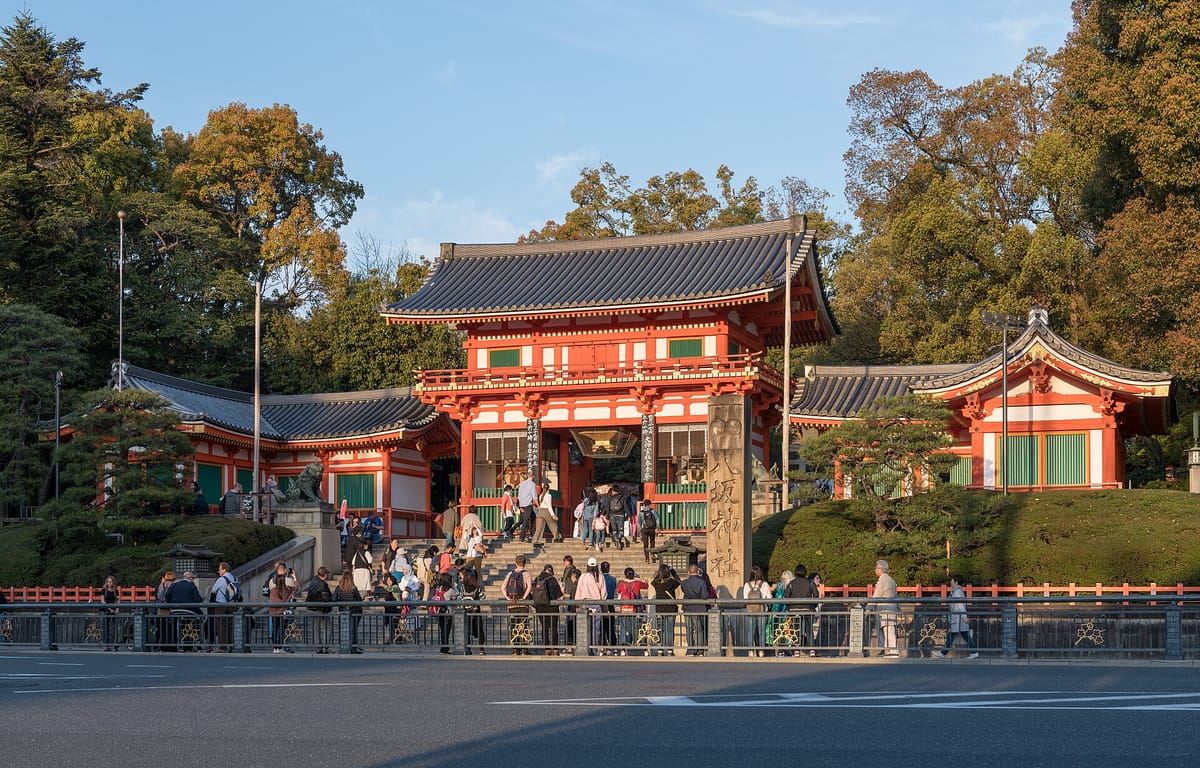
- Yasaka Jinja: the shrine at the east end of Shijō-dōri, free and open at all hours.
- Maruyama Park: the park behind the shrine with the famous weeping cherry.
- Hanamikōji: the main public street of teahouses and restaurants.
- Gion Corner: a theatre offering short shows of traditional arts, including dance by maiko.
- Kennin-ji: the Zen temple at the south end of Hanamikōji.
- Shirakawa and Shinbashi-dōri: the canal, the willows, the Tatsumi bridge and some of Kyoto's best-preserved streets.
- Minamiza: the kabuki theatre at the river end of Shijō-dōri.
Read the signs: private lanes and no photography
The most important signs in Gion are not place names. The narrow lanes that branch off Hanamikōji are private roads, 私道, owned by the residents, and since April 2024 many of them carry signs closing them to visitors, some with barriers. Signs also ban photography on private roads, 撮影禁止, and have warned of a fine since 2019. The public main street remains open to everyone.
Learn to spot the pattern: a place name, then 私道, then a word ending in 禁止, forbidden. If you see that combination at the mouth of a lane, stay on the main street. The table also covers the words you will see on the doors of the teahouses.
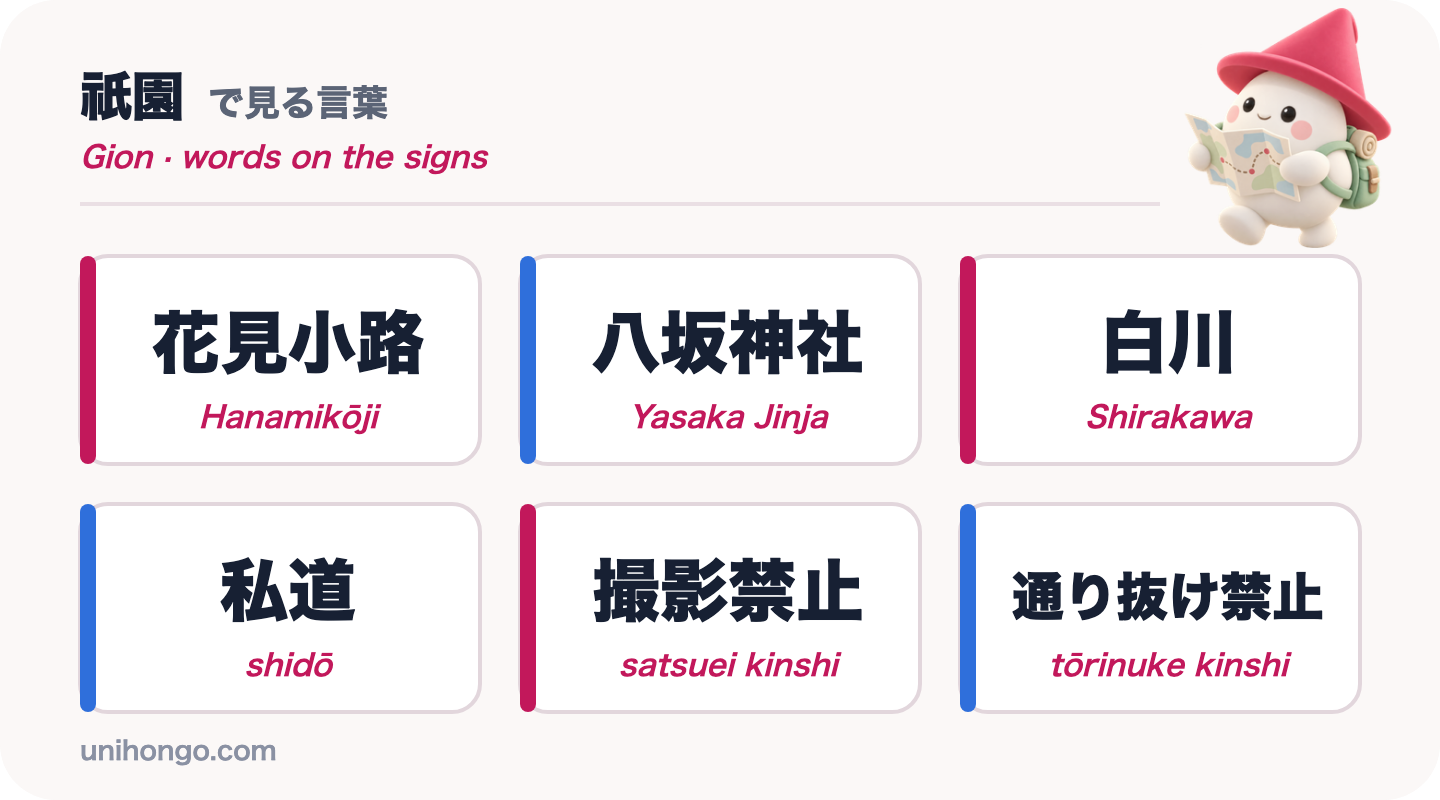
| Word | Reading | Meaning |
|---|---|---|
| 花見小路 | Hanamikōji | The main public street of Gion |
| 八坂神社 | Yasaka Jinja | The shrine at the east end of Shijō-dōri |
| 白川 | Shirakawa | The willow-lined canal north of Shijō-dōri |
| 私道 | shidō | Private road, owned by residents |
| 撮影禁止 | satsuei kinshi | No photography |
| 通り抜け禁止 | tōrinuke kinshi | No through passage |
| お茶屋 | ochaya | Teahouse where guests are entertained |
| 一見さんお断り | ichigen-san okotowari | No first-time customers without an introduction |
| 芸妓 | geiko | Kyoto word for a geisha |
| 舞妓 | maiko | Apprentice geiko |
Japanese for dinner in Gion
Most visitors meet Gion through a meal. Restaurants range from small counters serving obanzai, Kyoto home cooking, to formal kaiseki, and many of the best are small and fully booked in the evening, so it pays to reserve, even if only by asking in person earlier in the day. Staff speak softly and formally; answering in polite Japanese, however simple, fits the mood.
At the table, the phrases you need are about the set menu, seats, and any food you cannot eat, which is far easier to mention when booking than once the courses start arriving.
| Japanese | Romaji | Meaning |
|---|---|---|
| 今夜、二人で予約できますか。 | Kon'ya, futari de yoyaku dekimasu ka. | Can I book for two people tonight? |
| カウンター席は空いていますか。 | Kauntā-seki wa aite imasu ka. | Are there counter seats free? |
| おすすめのコースはどれですか。 | Osusume no kōsu wa dore desu ka. | Which set course do you recommend? |
| 食べられないものがあるんですが、大丈夫ですか。 | Taberarenai mono ga aru n desu ga, daijōbu desu ka. | There is something I cannot eat. Is that all right? |
| お会計をお願いします。 | O-kaikei o onegai shimasu. | The bill, please. |
| ごちそうさまでした。とてもおいしかったです。 | Gochisōsama deshita. Totemo oishikatta desu. | Thank you for the meal. It was delicious. |
Etiquette around geiko, maiko and residents
Most of Gion's problems with visitors come from a small number of habits, all easy to avoid.
- Do not stop, block, touch or follow geiko or maiko, and never photograph them at close range. If you see one, step aside and let her pass.
- Stay out of lanes marked 私道 or 通り抜け禁止, even if they look empty.
- Do not photograph on private roads, lean on house fronts or sit on doorsteps.
- Keep your voice down in the evening, especially in residential side streets and along Shirakawa.
- Eat and drink inside shops or restaurants rather than while walking.
- If you want to see maiko perform, book a show at Gion Corner, a seasonal dance performance, or a dinner arranged through a travel agency.
Practise the restaurant before you go
Walking into a small Gion restaurant without a reservation is common, and so is being turned away politely. Practise the four lines below until you can say them without reading. Listen for mōshiwake arimasen, I am very sorry, which signals a no, and deshitara, if it is, which introduces an alternative.
Then practise with someone who answers back. In Unihongo, try the Reserve a Restaurant by Phone mission, or choose the Restaurant topic and ask your AI Sensei to play the owner of a small Gion restaurant. Say the lines once aloud before you go, and your evening starts with a sentence rather than a gesture.
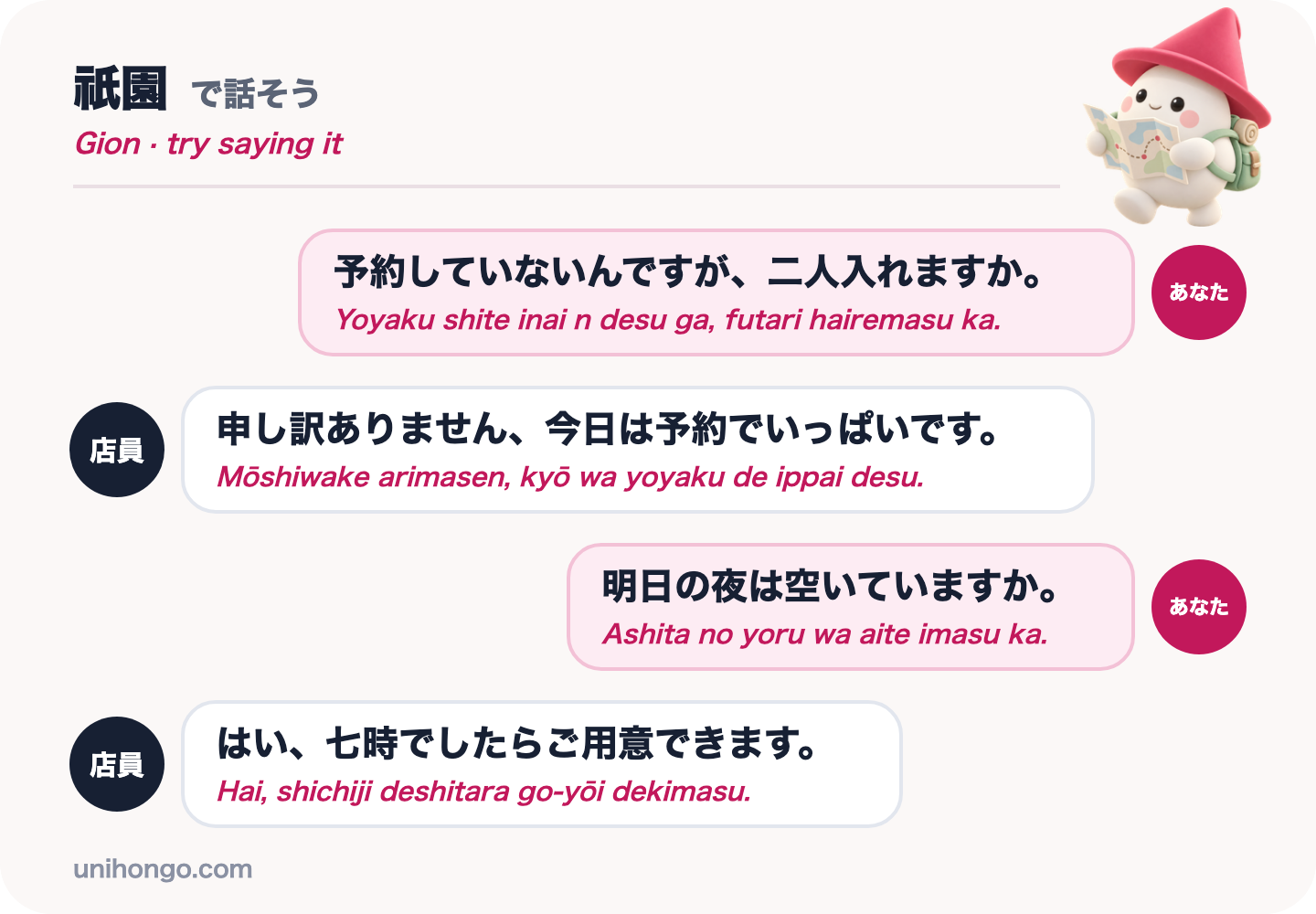
| Japanese | Romaji | Meaning |
|---|---|---|
| 予約していないんですが、二人入れますか。 | Yoyaku shite inai n desu ga, futari hairemasu ka. | We have no reservation. Is there room for two? |
| 申し訳ありません、今日は予約でいっぱいです。 | Mōshiwake arimasen, kyō wa yoyaku de ippai desu. | I am very sorry, we are fully booked today. |
| 明日の夜は空いていますか。 | Ashita no yoru wa aite imasu ka. | Do you have space tomorrow evening? |
| はい、七時でしたらご用意できます。 | Hai, shichiji deshitara go-yōi dekimasu. | Yes, we can have a table ready at seven. |
Official information
Yasaka Jinja publishes its festival calendar, including the Gion Matsuri in July, on its English website. Kyoto City's official travel guide covers Gion, seasonal dance performances and advice on visitor manners.