
What goes on top, and how to say yes or no
The balls themselves are plain batter, octopus and a few bits of ginger and green onion. The flavour comes from what is brushed and scattered on top at the last moment, and the seller will ask before doing it.
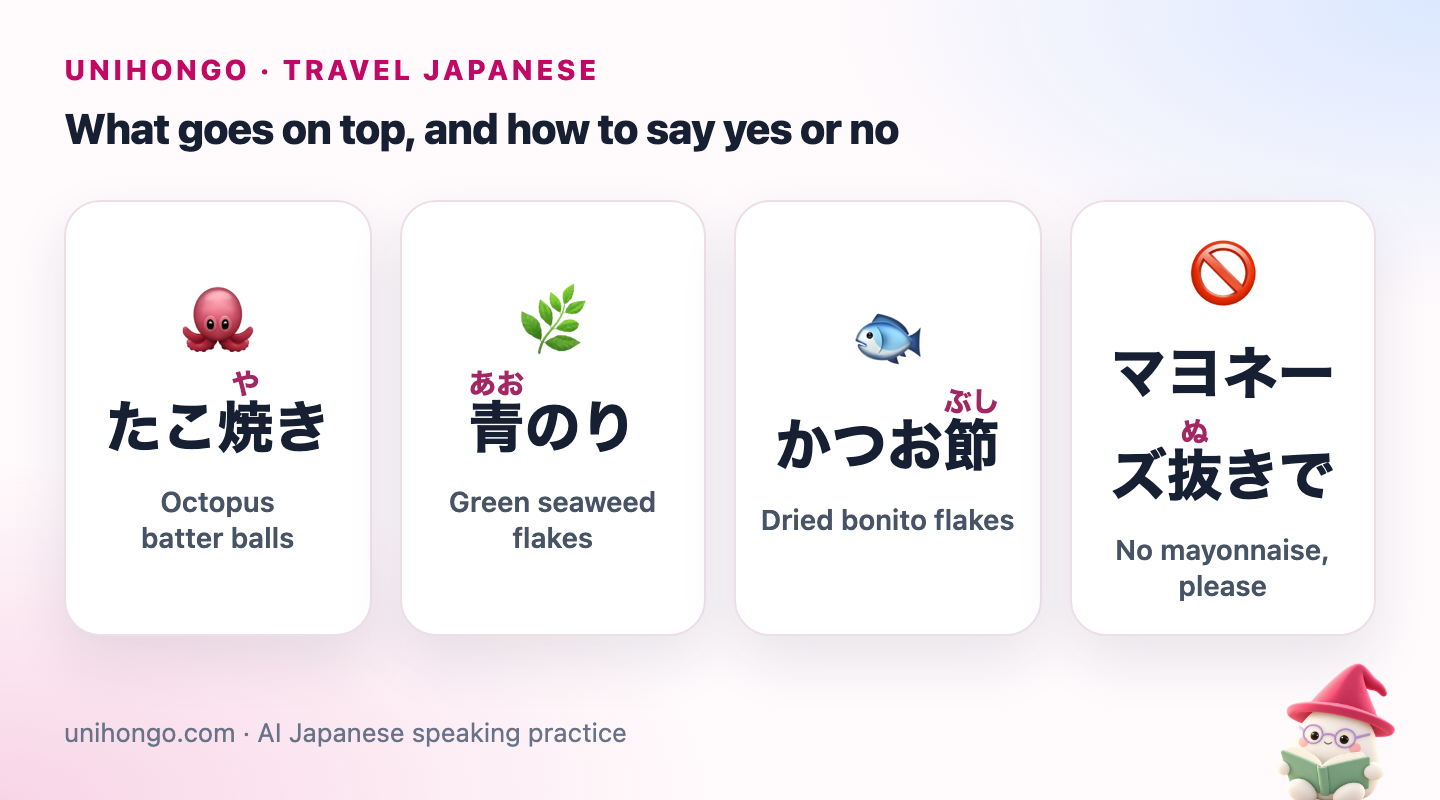
| Japanese | Romaji | Meaning |
|---|---|---|
| たこ焼き | Takoyaki | Octopus batter balls |
| 青のり | Aonori | Green seaweed flakes |
| かつお節 | Katsuobushi | Dried bonito flakes |
| マヨネーズ抜きで | Mayonēzu nuki de | No mayonnaise, please |
| ソース | Sōsu | Sweet brown sauce |
| マヨネーズ | Mayonēzu | Mayonnaise |
Sōsu on a Japanese menu does not mean sauce in general. It means this thick, sweet, Worcestershire-style sauce, the same family used on okonomiyaki and tonkatsu.
The stall exchange in order
There is rarely a queue system or a ticket. You step up, say a number, answer the topping question, pay and wait. The whole thing takes four lines.
| Japanese | Romaji | Meaning |
|---|---|---|
| いらっしゃいませ。何個にしますか。 | Irasshaimase. Nanko ni shimasu ka. | Staff: Welcome. How many would you like? |
| 6個ください。 | Rokko kudasai. | You: Six, please. |
| 全部かけて大丈夫ですか。 | Zenbu kakete daijōbu desu ka. | Staff: Is it all right to put everything on? |
| はい、お願いします。 | Hai, onegai shimasu. | You: Yes, please. |
| マヨネーズ抜きでお願いします。 | Mayonēzu nuki de onegai shimasu. | You: Without mayonnaise, please. |
| 熱いので気をつけてください。 | Atsui node ki o tsukete kudasai. | Staff: It is hot, so please be careful. |
| ありがとうございます。 | Arigatō gozaimasu. | You: Thank you. |
Take the warning seriously. Takoyaki straight off the plate, yakitate (焼きたて), is crisp outside and close to liquid inside. Open the first one with your pick and let the steam out before you bite.
Counting with ko: six, eight, ten
Small round things are counted with ko (個). Stall signs list the pack sizes with this counter, and the sizes differ from stall to stall. Six, eight and ten all double the consonant, so they are worth practising aloud.
| Japanese | Romaji | Meaning |
|---|---|---|
| 6個 | Rokko | Six pieces |
| 8個 | Hakko | Eight pieces |
| 10個 | Jukko | Ten pieces |
| 6個入り | Rokko-iri | Pack of six |
| たこ焼きを8個ください。 | Takoyaki o hakko kudasai. | Eight takoyaki, please. |
Konamon: Osaka's flour family
Osaka people call these foods konamon (粉もん), flour things, and the city takes pride in them. Takoyaki is one member. Here are others you will see on the same street.
| Japanese | Romaji | Meaning |
|---|---|---|
| 粉もん | Konamon | Flour-based foods |
| お好み焼き | Okonomiyaki | Savoury cabbage pancake |
| いか焼き | Ikayaki | Pressed squid pancake |
| 串カツ | Kushikatsu | Deep-fried skewers |
In Osaka, ikayaki usually means squid pressed flat in a chewy batter on a hot plate, not the whole grilled squid sold at festivals elsewhere. Kushikatsu is not a flour dish in the strict sense, but it belongs to the same snack culture: skewers of meat and vegetables in breadcrumbs, dipped in thin sauce. Shops with a shared sauce pot post the rule nidozuke kinshi (二度漬け禁止), no dipping twice. An existing post on this blog covers okonomiyaki restaurants in detail.
Tabearuki manners: eat by the stall
Tabearuki (食べ歩き) is the pleasure of going from stall to stall trying things. It does not have to mean chewing while you walk. Many busy streets ask you to stop and eat near the stall, and bins are scarce, so the stall that sold the food is usually the place to return the tray.
| Japanese | Romaji | Meaning |
|---|---|---|
| ここで食べてもいいですか。 | Koko de tabete mo ii desu ka. | May I eat here? |
| ごみはどこに捨てればいいですか。 | Gomi wa doko ni sutereba ii desu ka. | Where should I throw this away? |
| お箸をもらえますか。 | Ohashi o moraemasu ka. | Could I have chopsticks? |
Osaka dialect you will hear at the stall
Sellers in Osaka often speak Kansai dialect. The three words below are dialect, marked as such; the fourth row is the standard question you should use yourself.
| Japanese | Romaji | Meaning |
|---|---|---|
| おおきに | Ōkini | Thank you, in Kansai dialect |
| めっちゃおいしい | Meccha oishii | Really tasty, casual and from Kansai |
| なんぼ | Nanbo | How much, in Kansai dialect |
| いくらですか。 | Ikura desu ka. | How much is it? Standard and polite |
Ōkini is what the seller says to you. Meccha, very, has spread across Japan as casual speech among younger people, so you can use it with friends, but not in formal situations. Nanbo is the dialect form of ikura. A visitor who answers in clear standard Japanese sounds perfectly natural; copying dialect is not expected.