
The words that start the evening
Drinks are ordered first in Japan, before food, and the first round is expected to arrive fast so that everyone can raise a glass together. That is why so many tables open with the same line: toriaezu nama (とりあえず生). Toriaezu means for now, and nama (生), literally raw or fresh, is short for nama bīru, draft beer. It says: beer first, we will think about the rest later.
Beer is no longer the only opener. Highballs and lemon sours are just as common, and nobody minds if you start with tea. What matters is that everyone has something in hand for the kanpai (乾杯), the toast.
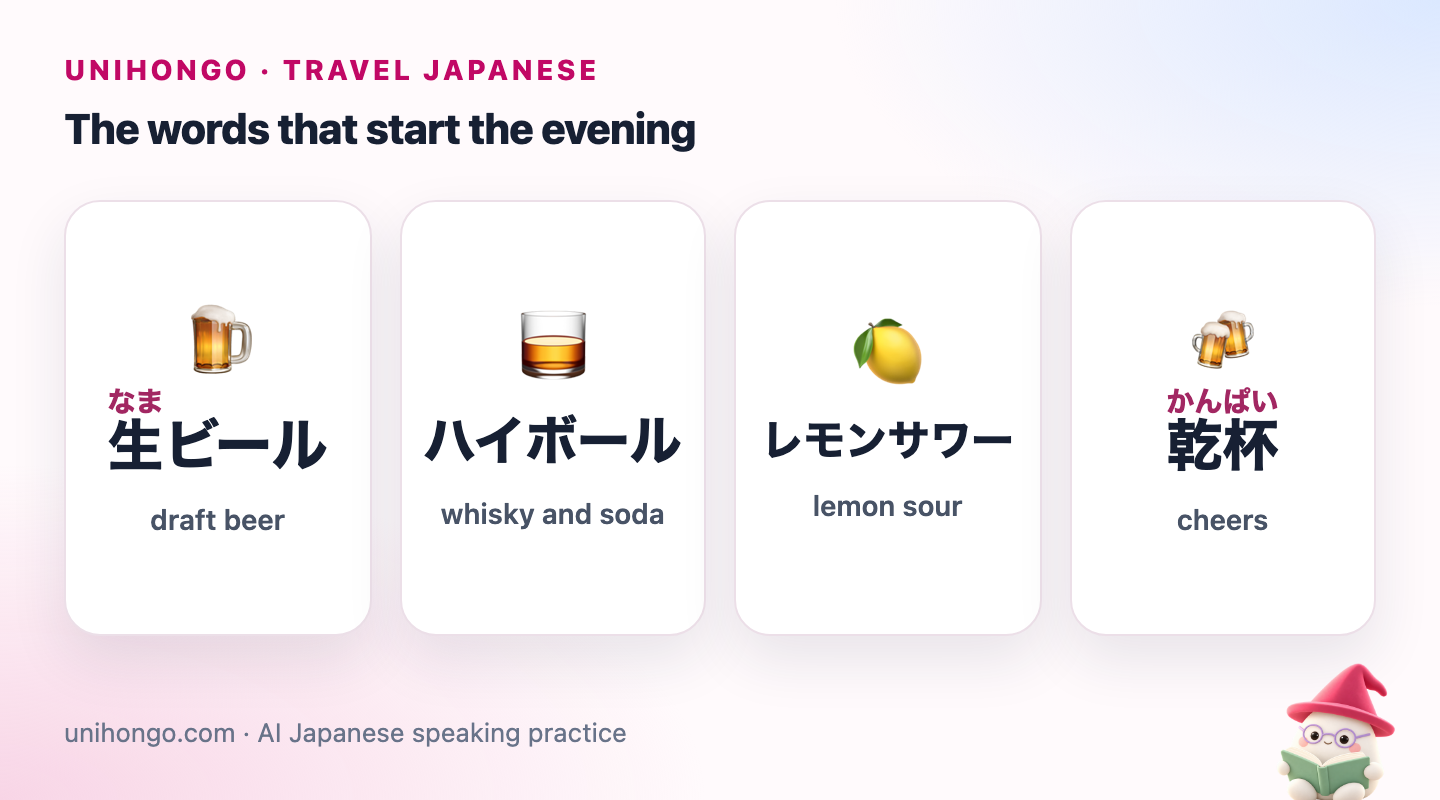
| Japanese | Romaji | Meaning |
|---|---|---|
| 生ビール | nama bīru | draft beer |
| ハイボール | haibōru | whisky and soda |
| レモンサワー | remon sawā | lemon sour |
| 乾杯 | kanpai | cheers |
| とりあえず生 | toriaezu nama | a draft beer to start |
Beer: nama, jokki and bin
Draft beer comes in a handled mug called a jokki (ジョッキ). The default size is chū jokki (中ジョッキ), a medium mug, often shortened to chūnama (中生). Dai (大) is large, and a gurasu (グラス) is a small glass for people who want only a little. Bottled beer is bin bīru (瓶ビール). A bottle arrives with small glasses and is meant to be shared: you pour for the people around you, and they pour for you.
| Japanese | Romaji | Meaning |
|---|---|---|
| 中ジョッキ | chū jokki | medium mug of draft beer |
| 瓶ビール | bin bīru | bottled beer |
| グラスビール | gurasu bīru | small glass of beer |
| 生を二つお願いします。 | Nama o futatsu onegai shimasu. | Two draft beers, please. |
| 瓶ビールを一本とグラスを三つください。 | Bin bīru o ippon to gurasu o mittsu kudasai. | One bottle of beer and three glasses, please. |
Highball, sour and chūhai
These are the long drinks that fill most of the page. A haibōru in Japan means whisky and soda unless the menu says otherwise. A sawā is shōchū, a clear distilled spirit, topped with soda and flavoured with fruit; remon sawā is the standard. Chūhai (酎ハイ) blends the words shōchū and highball, and in practice a chūhai and a sour are close relatives, with the name depending on the shop.
Ūronhai (ウーロンハイ) is shōchū with oolong tea: brown, flat and not sweet, popular with people who want something light with food. If a drink tastes too strong or too weak, two words adjust the next one.
| Japanese | Romaji | Meaning |
|---|---|---|
| 酎ハイ | chūhai | shōchū and soda with a flavour |
| ウーロンハイ | ūronhai | shōchū with oolong tea |
| 緑茶ハイ | ryokuchahai | shōchū with green tea |
| 濃いめ | koime | on the strong side |
| 薄め | usume | on the weak side |
| レモンサワーを薄めでお願いします。 | Remon sawā o usume de onegai shimasu. | A lemon sour, on the weak side, please. |
Umeshu and the ways to take it
Umeshu (梅酒) is a sweet liqueur made by steeping ume, Japanese plums, in alcohol and sugar. Order it and the staff will ask how you want it, because the same drink comes several ways. The suffix wari (割り) means cut with, diluted with.
| Japanese | Romaji | Meaning |
|---|---|---|
| 梅酒 | umeshu | plum liqueur |
| ロック | rokku | on the rocks |
| ソーダ割り | sōda-wari | mixed with soda |
| 水割り | mizuwari | mixed with water |
| お湯割り | oyuwari | mixed with hot water |
| 飲み方はどうなさいますか。 | Nomikata wa dō nasaimasu ka. | How would you like it served? |
| 梅酒をソーダ割りでお願いします。 | Umeshu o sōda-wari de onegai shimasu. | Umeshu with soda, please. |
The same words work for shōchū and whisky. Mizuwari is a classic way to take whisky in Japan, and oyuwari is a winter habit with shōchū.
The exchange: from sitting down to kanpai
Staff come for the drinks order almost as soon as you sit. Give the drink, the number, and onegai shimasu.
| Japanese | Romaji | Meaning |
|---|---|---|
| お飲み物はお決まりですか。 | O-nomimono wa o-kimari desu ka. | Have you decided on drinks? |
| とりあえず生を二つお願いします。 | Toriaezu nama o futatsu onegai shimasu. | Two draft beers to start, please. |
| 生一つとレモンサワー一つお願いします。 | Nama hitotsu to remon sawā hitotsu onegai shimasu. | One draft beer and one lemon sour, please. |
| こちら、お通しです。 | Kochira, otōshi desu. | Here is your appetiser. |
| 乾杯! | Kanpai! | Cheers! |
Otōshi (お通し) needs a word of explanation. It is a small dish that arrives with the first drink without being ordered, and at most izakaya it is charged to each person as a kind of table charge. It is normal practice, not a trick.
For the toast, wait until every glass has arrived, lift yours, say kanpai and touch glasses lightly. Drinking before the toast is the one real mistake at this stage.
Another round, and the last one
Okawari (おかわり) means another serving of the same thing, so a raised empty glass and okawari onegai shimasu is a complete order. On a nomihōdai (飲み放題) plan, unlimited drinks for a fixed time, shops usually bring the next drink only when your glass is empty and announce last orders near the end.
| Japanese | Romaji | Meaning |
|---|---|---|
| 同じものをもう一つお願いします。 | Onaji mono o mō hitotsu onegai shimasu. | One more of the same, please. |
| ハイボールのおかわりをください。 | Haibōru no okawari o kudasai. | Another highball, please. |
| お水をください。 | O-mizu o kudasai. | Water, please. |
| ラストオーダーです。 | Rasuto ōdā desu. | It is time for last orders. |
Soft drinks, and saying you do not drink
Not drinking alcohol is easy in Japan as long as you say so early and order something. Menus have a sofuto dorinku (ソフトドリンク) section, and oolong tea, ūroncha (ウーロン茶), is the default choice: it looks at home on the table and goes with the food. Non'arukōru (ノンアルコール), often shortened to non'aru, covers alcohol-free beer and cocktails.
| Japanese | Romaji | Meaning |
|---|---|---|
| ソフトドリンク | sofuto dorinku | soft drinks |
| ノンアルコールビール | non'arukōru bīru | alcohol-free beer |
| ウーロン茶をお願いします。 | Ūroncha o onegai shimasu. | Oolong tea, please. |
| お酒は飲めないんです。 | O-sake wa nomenai n desu. | I can't drink alcohol. |
| 今日は車なので、ノンアルコールでお願いします。 | Kyō wa kuruma na no de, non'arukōru de onegai shimasu. | I am driving today, so alcohol-free, please. |
Nomenai n desu, I can't drink, is the gentle formula: it states a fact and invites no argument. Nomimasen, I don't drink, is also correct but sounds more like a principle. Driving is accepted as a reason everywhere, because the rules on drinking and driving are strict. The legal drinking age in Japan is twenty.