

Why Fushimi Inari is worth the climb
Fushimi Inari Taisha is the head shrine, the sōhonsha, of Inari, one of the most widely worshipped deities in Japan and the one people pray to for good harvests and for a business that does well, shōbai hanjō. The shrine's history on this mountain goes back to the early eighth century, and today it heads a network of Inari shrines found everywhere from office rooftops to village fields. Whenever you see a small red shrine guarded by two stone foxes elsewhere in Japan, you are looking at a branch of this one.
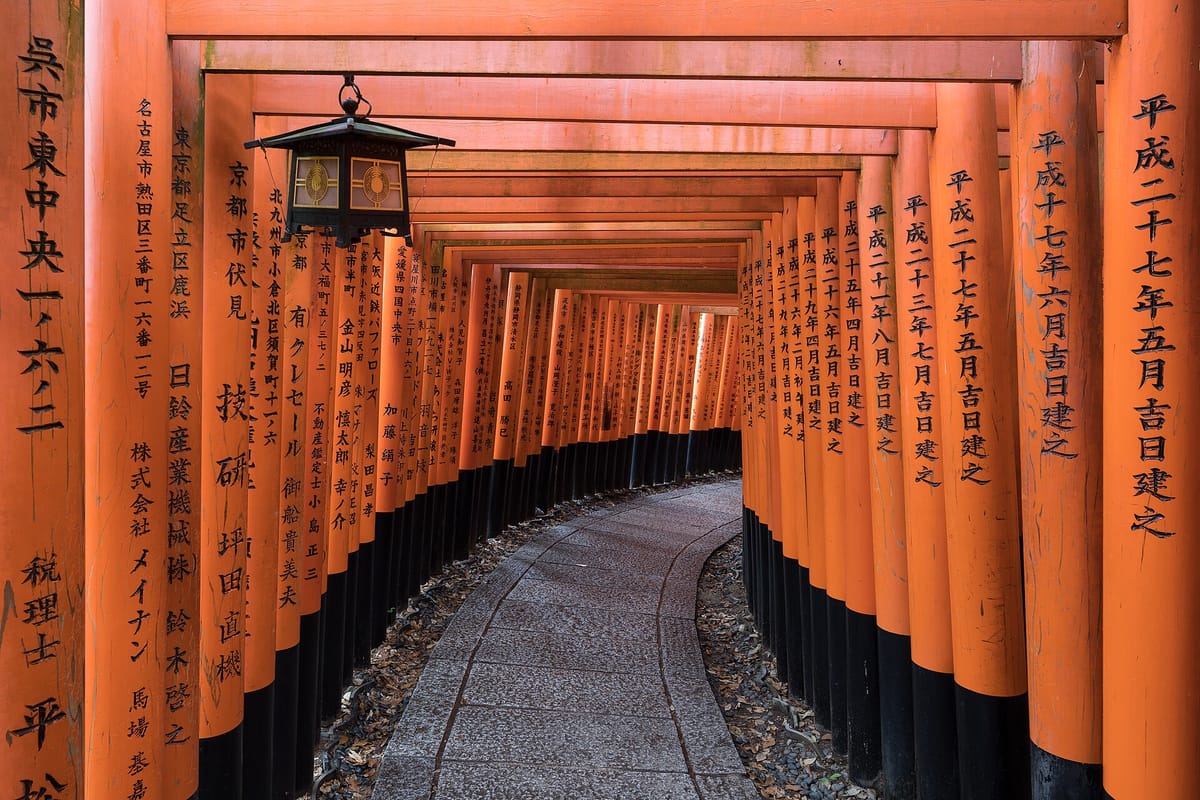
What draws visitors is the mountain behind the main hall. Inariyama, Mount Inari, rises to a little over two hundred metres, and its paths are lined with thousands of torii, the vermilion gates you walk through rather than past. The famous double row near the bottom is called the senbon torii, and the gates keep going almost all the way up, broken by small shrines, stone foxes, tea houses and graveyard-like clusters of miniature gates left as offerings.
For a Japanese learner, it is also one of the best reading classrooms in Kyoto. The signs are short, repeated and full of the same few kanji: 稲荷, 鳥居, 社, 山. By the time you come down you will be able to read the name of the place and most of the signposts without looking anything up.
Getting there: Inari Station and Fushimi-Inari Station
Two stations serve the shrine. JR Inari Station, Inari-eki, on the JR Nara Line, is the easiest: it is a few minutes from Kyoto Station, and the great torii at the shrine entrance stands just across the road from the exit. Since the March 2026 timetable change every Nara Line train stops there, rapid trains included, so you can take the first train that comes.
Keihan Fushimi-Inari Station, on the Keihan Main Line, is the better choice if you are coming from Gion or central Kyoto along the river. From there it is a short walk east along the shopping street, sandō, lined with stalls selling inarizushi, grilled snacks and fox-shaped crackers. The two station names are written differently, 稲荷 for JR and 伏見稲荷 for Keihan, which is worth knowing when you read a route planner or ask a station attendant.
| Japanese | Romaji | Meaning |
|---|---|---|
| 稲荷駅に行きたいんですが、この電車は止まりますか。 | Inari-eki ni ikitai n desu ga, kono densha wa tomarimasu ka. | I want to go to Inari Station. Does this train stop there? |
| 奈良線は何番線ですか。 | Nara-sen wa nanbansen desu ka. | Which platform is the Nara Line on? |
| 伏見稲荷大社はどちらですか。 | Fushimi Inari Taisha wa dochira desu ka. | Which way is Fushimi Inari Taisha? |
| ここから歩いて何分くらいですか。 | Koko kara aruite nanpun kurai desu ka. | About how many minutes on foot from here? |
| 帰りは京阪の駅から乗れますか。 | Kaeri wa Keihan no eki kara noremasu ka. | Can I take the Keihan train back? |
From the Rōmon gate to Yotsutsuji: what you will see
The visit follows one long line uphill. After the big torii at the road you climb to the Rōmon, the two-storey tower gate, and then reach the honden, the main hall, where most people make their first prayer. Behind it the path narrows into the senbon torii, which splits into two parallel rows for a few minutes before joining again at the Okusha Hōhaisho, the inner shrine's place of worship.
Beyond the Okusha the crowds thin with every flight of steps. The path climbs past small ponds and shrines to Yotsutsuji, the four-way crossroads about halfway up, where a tea house and a clearing look out over the south of Kyoto. From here the summit loop runs round the top of the mountain through Ichinomine, the highest peak, and back to Yotsutsuji. You can walk it in either direction.
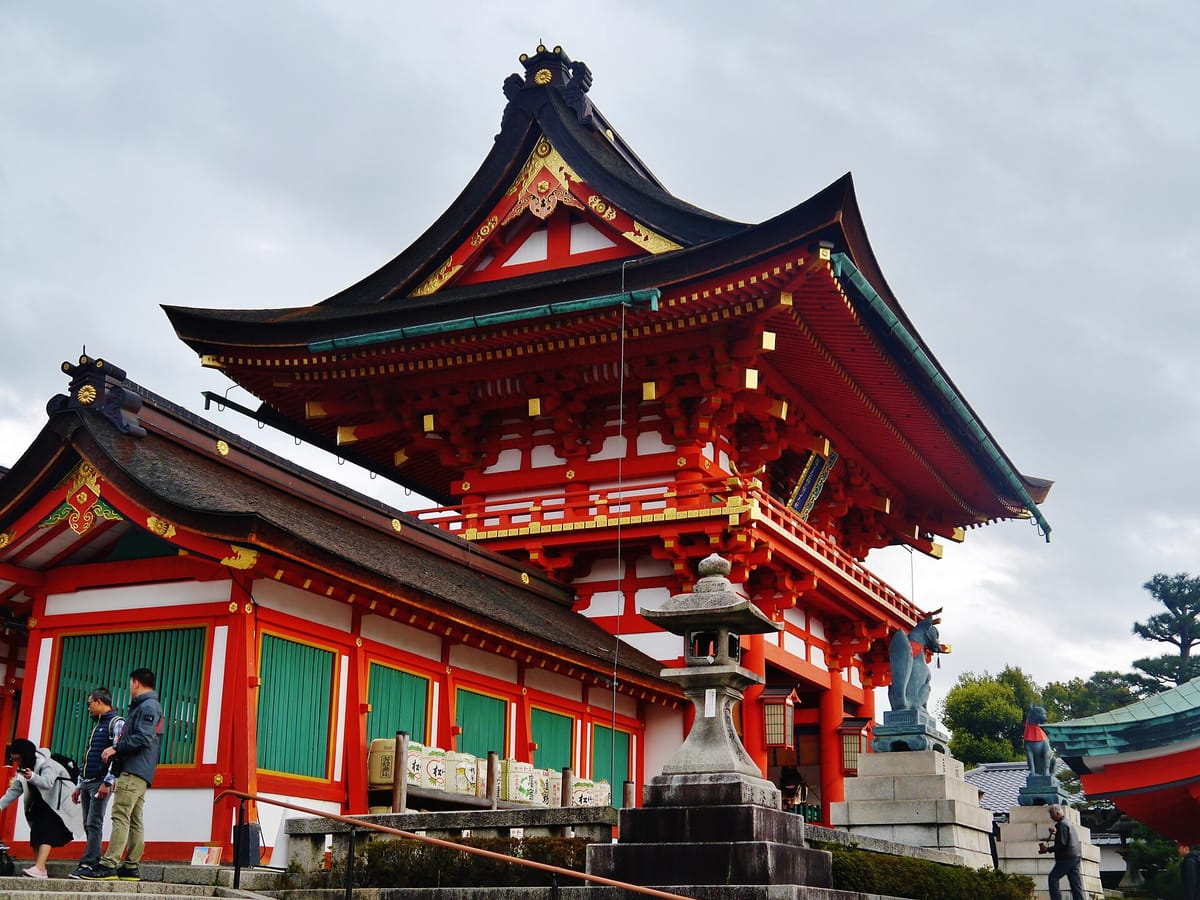
- Rōmon: the tower gate at the top of the entrance steps, the first photo stop.
- Honden: the main hall, where you pray before starting the climb.
- Senbon torii: the famous double row of gates just behind the main hall.
- Okusha Hōhaisho: the inner shrine; many visitors turn back here.
- Omokaru-ishi: a pair of stone lanterns at the Okusha where you lift the stone on top and compare its weight with what you expected.
- Yotsutsuji: the crossroads with the city view, roughly halfway to the top.
- Ichinomine: the summit shrine, quiet and wooded rather than a viewpoint.
Foxes, torii and the words on the signs
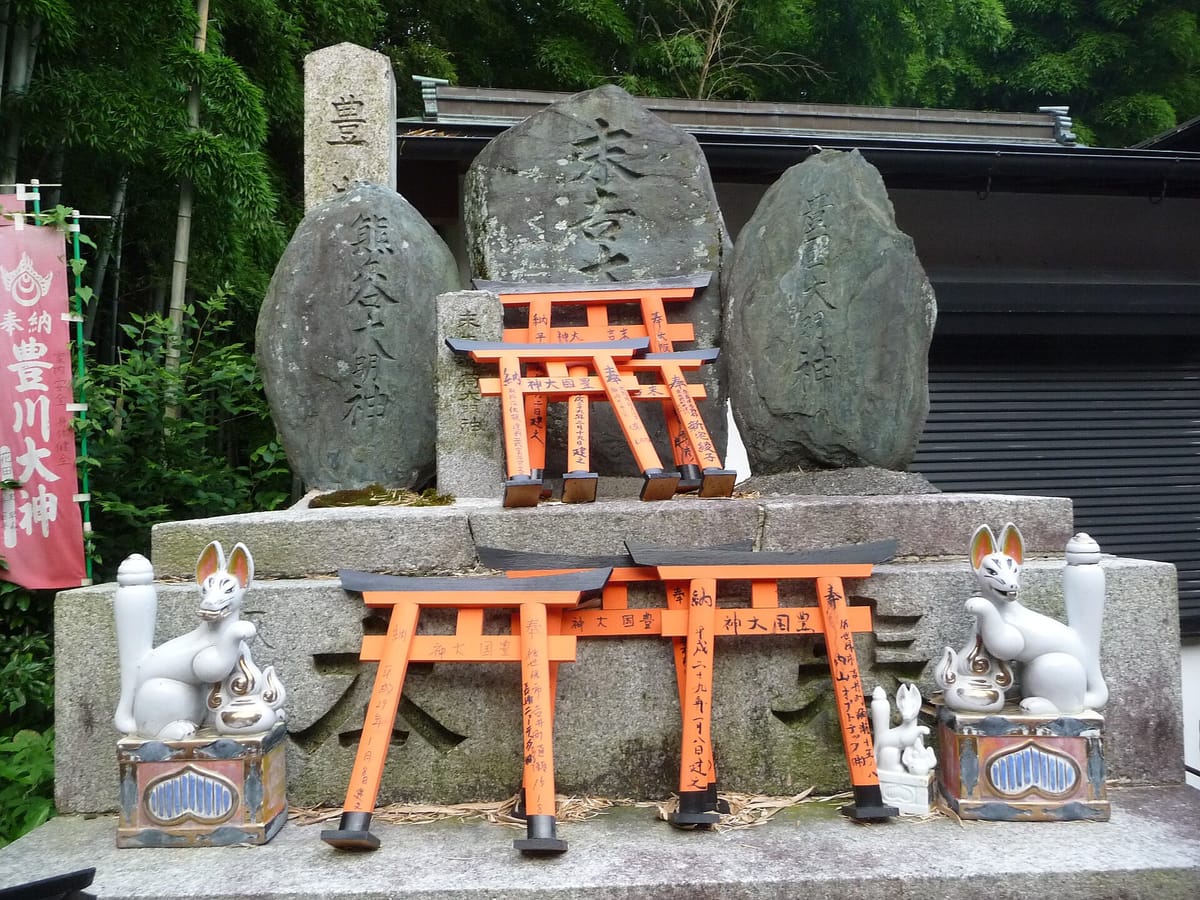
Look at the stone foxes as you climb. They come in pairs, and each usually holds something in its mouth: a key, a round jewel, a scroll or ears of rice. Foxes are the messengers of Inari rather than the deity itself, which is why you will hear them called o-tsukai, messengers. At the Okusha you can buy fox-faced ema, wooden prayer boards, and draw your own expression on them.
The gates themselves tell a story if you read them on the way down. The large characters on the back of each torii give the donor, often a company, and the date it was offered, 奉納, hōnō. The smaller signposts use a short, repeating set of words, and the table below covers nearly all of them.
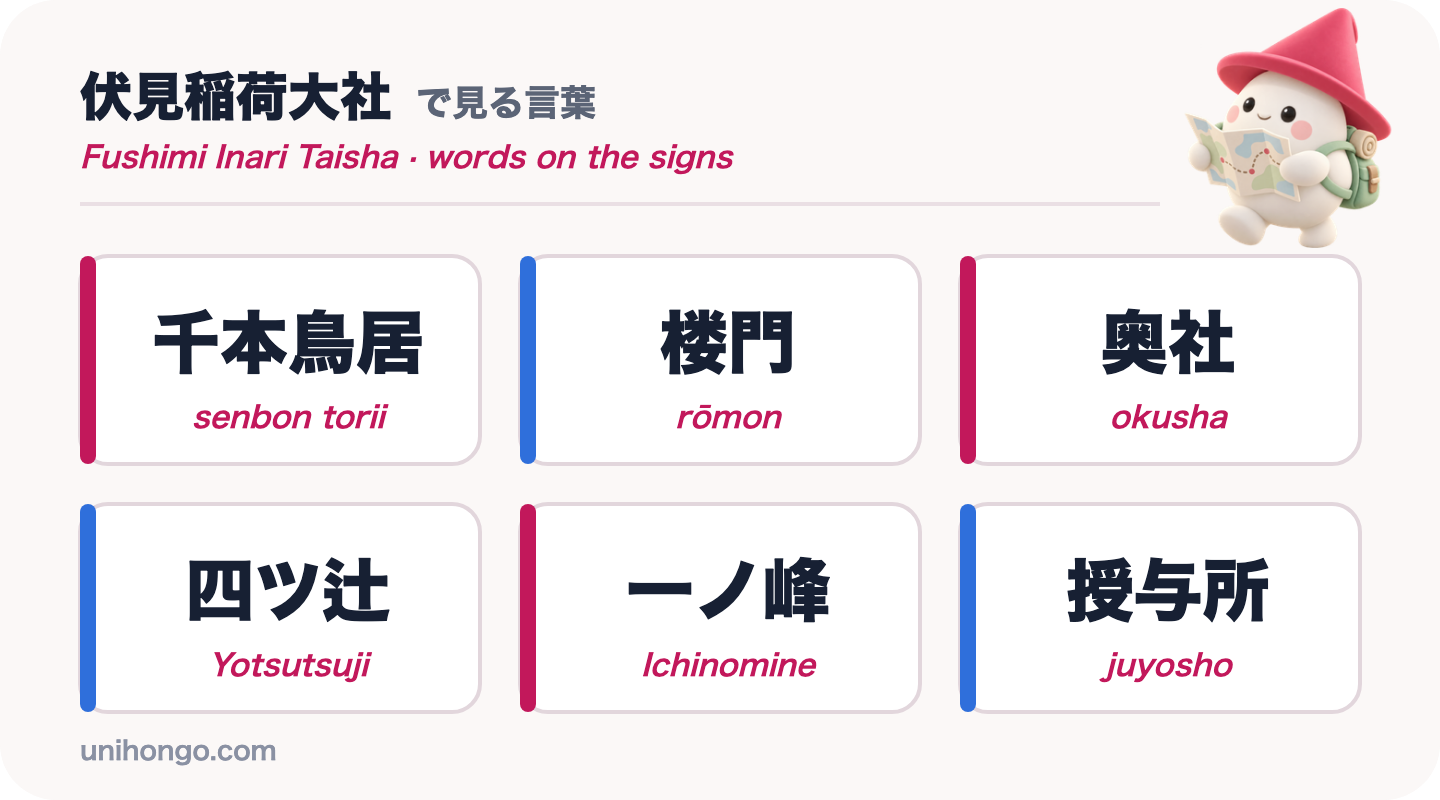
| Word | Reading | Meaning |
|---|---|---|
| 千本鳥居 | senbon torii | The famous rows of torii, literally a thousand gates |
| 楼門 | rōmon | Two-storey tower gate at the entrance |
| 本殿 | honden | Main hall |
| 奥社 | okusha | Inner shrine behind the main hall |
| 四ツ辻 | Yotsutsuji | The four-way crossroads halfway up |
| 一ノ峰 | Ichinomine | The highest peak and its shrine |
| 授与所 | juyosho | Office where charms and fortunes are sold |
| 奉納 | hōnō | Offered, written on donated gates |
| お稲荷さん | o-inari-san | Friendly name for Inari and its shrines |
Japanese at the shrine office: omamori, omikuji and goshuin
The juyosho, the counter where charms are handed out, is staffed by shrine attendants who are used to visitors pointing, but a short polite sentence goes a long way. Charms are omamori, fortunes are omikuji, and the calligraphy stamp that collectors gather in a special book is the goshuin. Fushimi Inari is known for charms linked to business and prosperity, and for small votive torii that you can buy, write a wish on and leave on the mountain.
Shrines avoid the language of shopping: you are said to receive, itadaku, a charm rather than buy it. You do not have to copy this, but using itadakemasu ka instead of kaemasu ka sounds respectful and staff will notice.
| Japanese | Romaji | Meaning |
|---|---|---|
| このお守りをいただけますか。 | Kono o-mamori o itadakemasu ka. | May I have this charm? |
| 商売繁盛のお守りはどれですか。 | Shōbai hanjō no o-mamori wa dore desu ka. | Which charm is for business prosperity? |
| おみくじを引いてもいいですか。 | Omikuji o hiite mo ii desu ka. | May I draw a fortune? |
| 御朱印をお願いできますか。 | Goshuin o onegai dekimasu ka. | Could I ask for a goshuin? |
| 英語のおみくじはありますか。 | Eigo no omikuji wa arimasu ka. | Do you have fortunes in English? |
| このキツネの絵馬をください。 | Kono kitsune no ema o kudasai. | This fox ema, please. |
Etiquette and timing on the mountain
Fushimi Inari is an active place of worship as well as a hiking trail, and a few habits keep you on good terms with the people who come to pray.
- Bow once as you pass under the first large torii, and walk to the side of the path rather than the centre, which is traditionally left for the deity.
- At the main hall, rinse your hands at the temizuya, then bow twice, clap twice, pray and bow once more.
- Do not hang on, lean on or climb the torii for photos, and do not block the path in the narrow double row; step to the side.
- Take your rubbish with you: there are almost no bins on the mountain.
- Start early. The lower gates are busiest from late morning, and the upper trail is dark and steep after sunset.
- Bring water and good shoes. The loop is mostly stone steps, and the tea houses on the way are small.
Practise the visit before you go
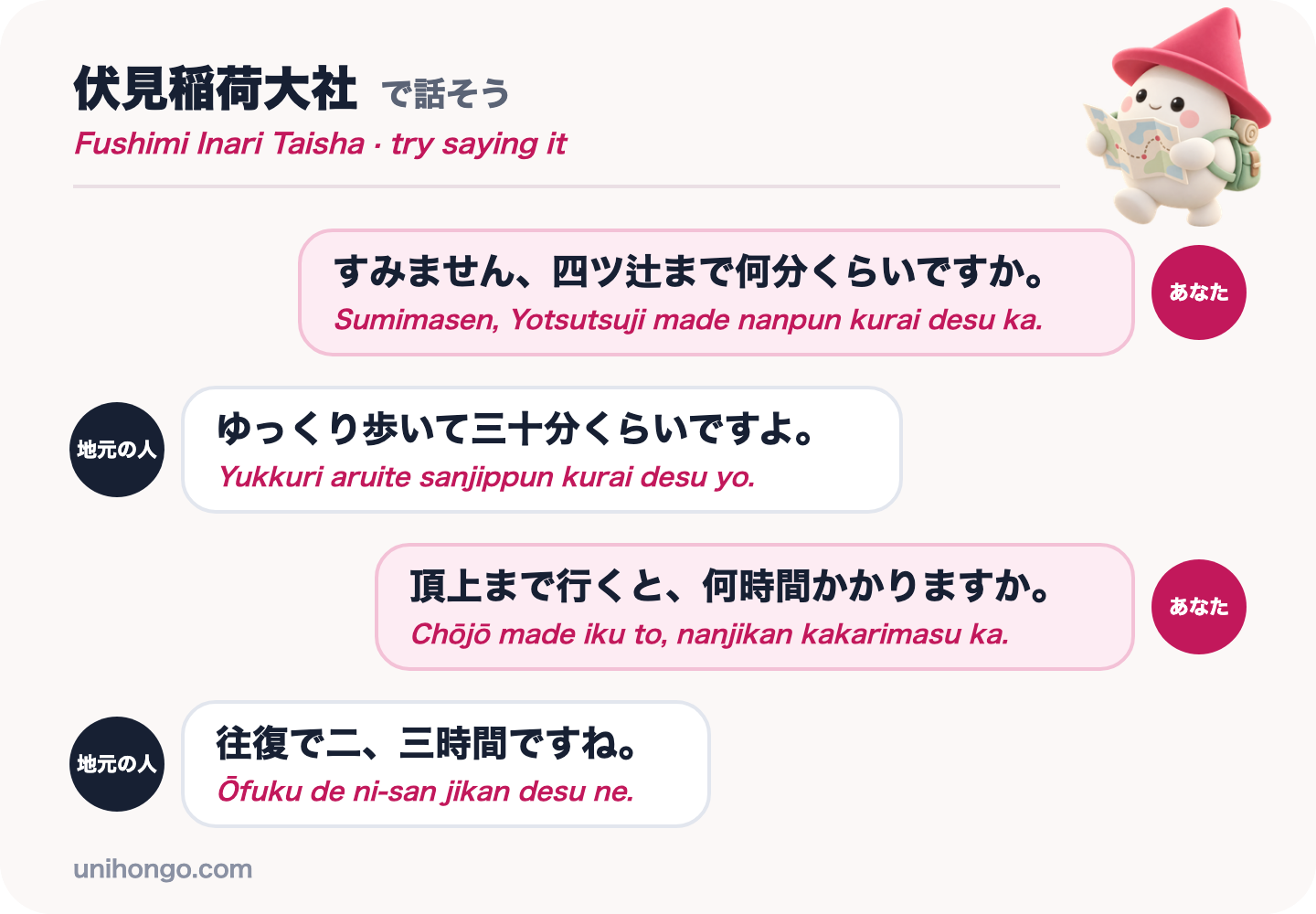
The one conversation you are likely to have on the mountain is about distance. Locals walking their daily loop are usually happy to answer, and the answer comes in minutes or hours with kurai, about, attached. Practise the four lines below until you can say them without reading, and listen for the numbers in the reply.
Then practise with a partner who answers back. In Unihongo, choose the Sightseeing topic and ask your AI Sensei to play a local on Mount Inari, or choose Shrine Visit to rehearse the prayer and the charm counter. Speaking the lines once before you arrive is what makes them come out on the day.
| Japanese | Romaji | Meaning |
|---|---|---|
| すみません、四ツ辻まで何分くらいですか。 | Sumimasen, Yotsutsuji made nanpun kurai desu ka. | Excuse me, about how many minutes to Yotsutsuji? |
| ゆっくり歩いて三十分くらいですよ。 | Yukkuri aruite sanjippun kurai desu yo. | About thirty minutes at an easy pace. |
| 頂上まで行くと、何時間かかりますか。 | Chōjō made iku to, nanjikan kakarimasu ka. | If I go to the top, how many hours does it take? |
| 往復で二、三時間ですね。 | Ōfuku de ni-san jikan desu ne. | Two or three hours there and back. |
Official information
Opening hours of the shrine office, festival dates and any path closures after heavy rain are published by the shrine itself. Check before you go, especially around New Year and the Inari festival season in spring.