

Why Hakone is Tokyo's favourite escape
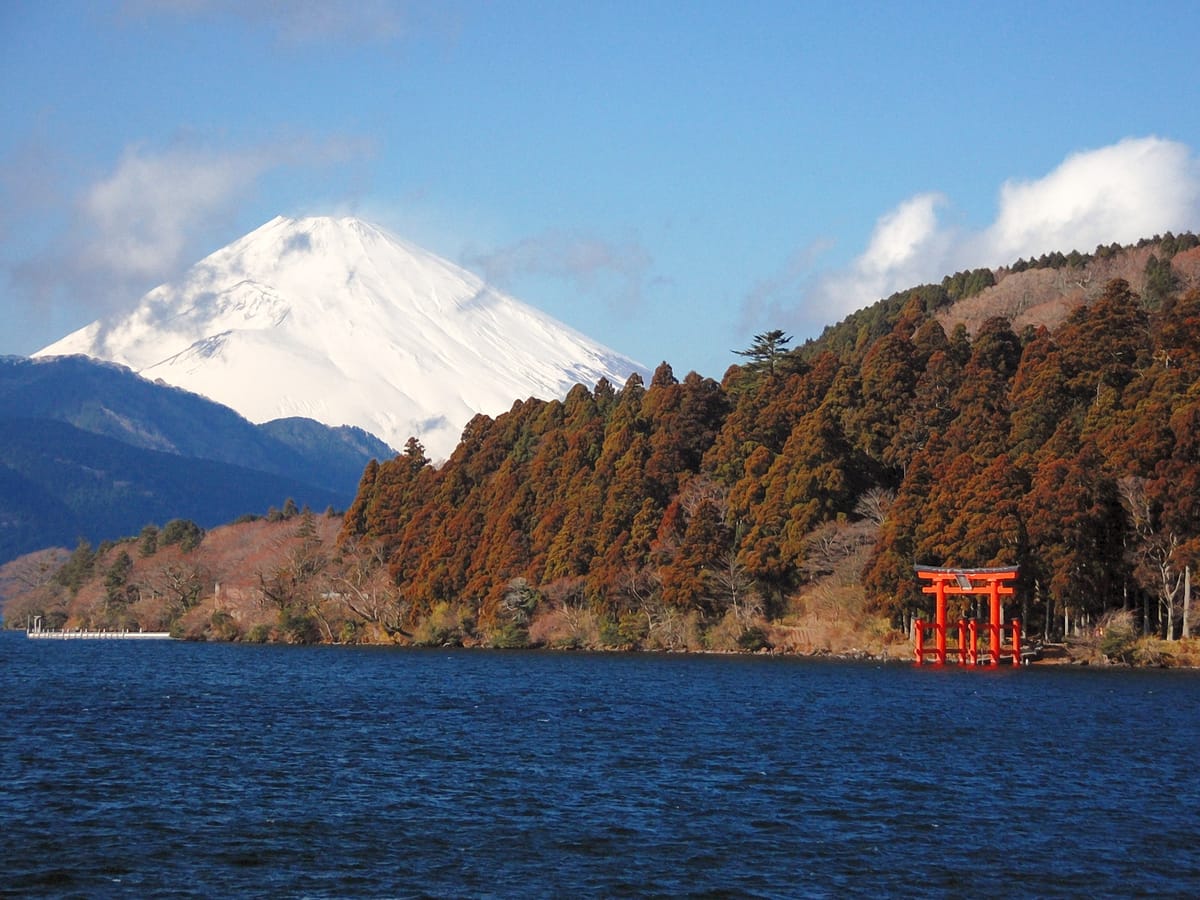
Hakone packs a remarkable range into a small area. There are more than a dozen hot spring districts, each with its own ryokan and day-trip baths, an active volcanic valley where the ground steams, a caldera lake with Mount Fuji behind it, and museums, from the Hakone Open-Air Museum with its sculptures on the hillside to galleries of Japanese and Western art. On a clear day the combination of Fuji, the lake and the red torii of Hakone Shrine is one of Japan's classic views.
History runs through it too. The Tōkaidō, the great road between Edo and Kyoto, climbed over the Hakone pass, and the shogunate kept a checkpoint on the shore of Lake Ashi to control who passed. A stretch of the old stone-paved road and an avenue of old cedars survive near the lake.
For a Japanese learner, Hakone is a day of small transactions: tickets, transfers, egg shops and onsen counters. Each one is short, predictable and repeated, which makes it the ideal place to try out practical phrases.
Getting there: Odakyu to Hakone-Yumoto and the Hakone loop
The gateway is Hakone-Yumoto Station, Hakone-Yumoto-eki. From Shinjuku, the Odakyu Romancecar limited express runs straight there in about ninety minutes, with reserved seats and a supplement; ordinary Odakyu trains go to Odawara, where you change. With a JR pass, the Tōkaidō Shinkansen reaches Odawara quickly from Tokyo or Shinagawa. Odakyu sells the Hakone Freepass, covering the local trains, cable car, ropeway, the Hakone Sightseeing Cruise boats and most buses, with or without the round trip from Shinjuku.
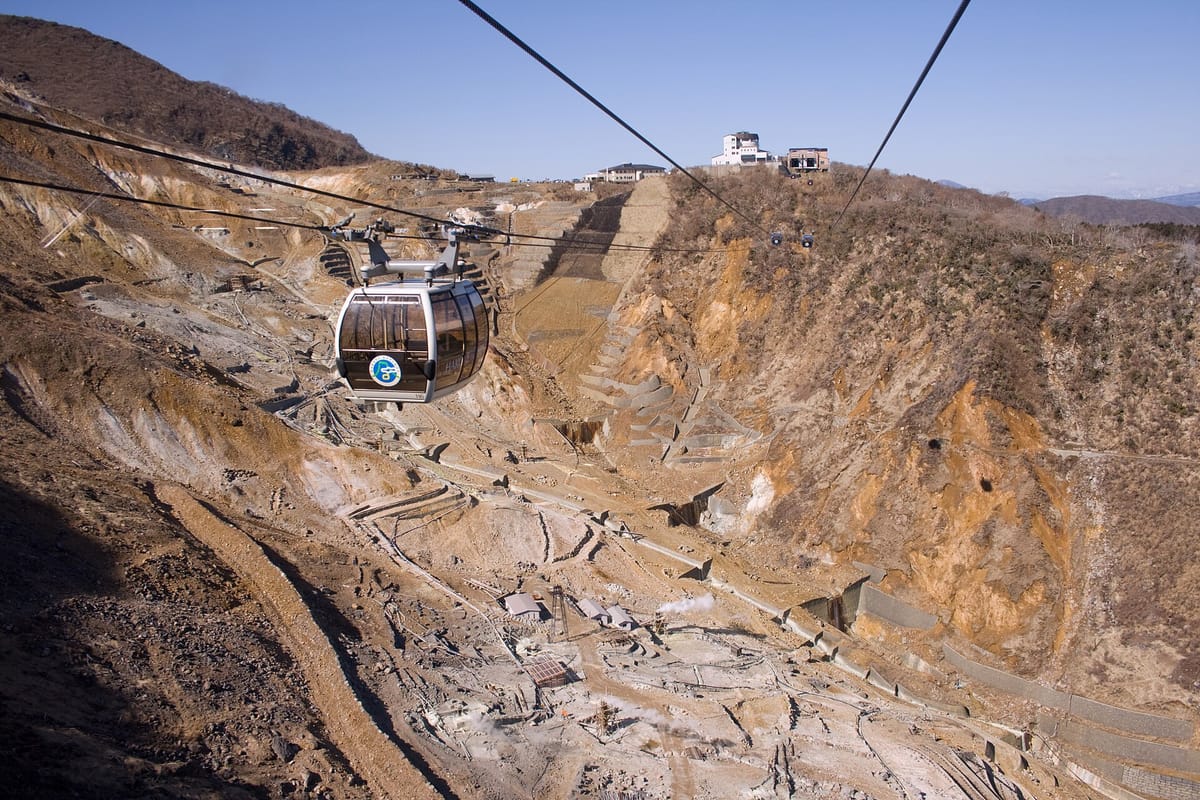
The classic loop runs anticlockwise. The Hakone Tozan Railway climbs from Hakone-Yumoto to Gōra, reversing direction at switchbacks on the steep slope. At Gōra you change to the cable car up to Sōunzan, then to the Hakone Ropeway, which floats over Ōwakudani and down to Tōgendai on Lake Ashi. Sightseeing boats cross the lake to Moto-Hakone and Hakone-machi, and a bus takes you back down to Hakone-Yumoto. Sections of the ropeway are occasionally replaced by buses for maintenance or volcanic activity, so check the day's service information.
| Japanese | Romaji | Meaning |
|---|---|---|
| 箱根湯本までロマンスカーの特急券をください。 | Hakone-Yumoto made Romansukā no tokkyūken o kudasai. | A Romancecar ticket to Hakone-Yumoto, please. |
| フリーパスはどこで買えますか。 | Furīpasu wa doko de kaemasu ka. | Where can I buy the Freepass? |
| 強羅行きの電車はどのホームですか。 | Gōra-yuki no densha wa dono hōmu desu ka. | Which platform is the train to Gōra? |
| 今日はロープウェイが動いていますか。 | Kyō wa rōpuwei ga ugoite imasu ka. | Is the ropeway running today? |
| 元箱根へ行く船はどこから出ますか。 | Moto-Hakone e iku fune wa doko kara demasu ka. | Where does the boat to Moto-Hakone leave from? |
| 箱根湯本に戻るバスはどれですか。 | Hakone-Yumoto ni modoru basu wa dore desu ka. | Which bus goes back to Hakone-Yumoto? |
Ōwakudani, Lake Ashi and Hakone Shrine: what you will see
Ōwakudani, the great boiling valley, is the crater area left by Mount Hakone's last major eruption around 3,000 years ago. From the ropeway you look straight down on bare yellow slopes, steam vents and pipes carrying hot spring water, and the smell of sulphur reaches you before the station does. On clear days Mount Fuji appears behind the ridge. Signs warn visitors with asthma, heart or breathing conditions to take care because of the volcanic gas.
Lake Ashi, Ashinoko, fills part of the old caldera. The Hakone Sightseeing Cruise runs boats built to look like pirate ships between Tōgendai at the north end and Moto-Hakone and Hakone-machi in the south. From Moto-Hakone, a short walk along the shore brings you to Hakone Shrine, whose red Heiwa no Torii stands in the water, and up stone steps through old cedars to the main hall.
Near Hakone-machi, the reconstructed Hakone Sekisho checkpoint shows how travellers on the Tōkaidō were inspected, and the cedar avenue of the old road runs between the two lakeside villages.
- Hakone Tozan Railway: the mountain train with switchbacks, lined with hydrangeas in early summer.
- Hakone Open-Air Museum: sculptures on open lawns near Chōkoku-no-Mori Station.
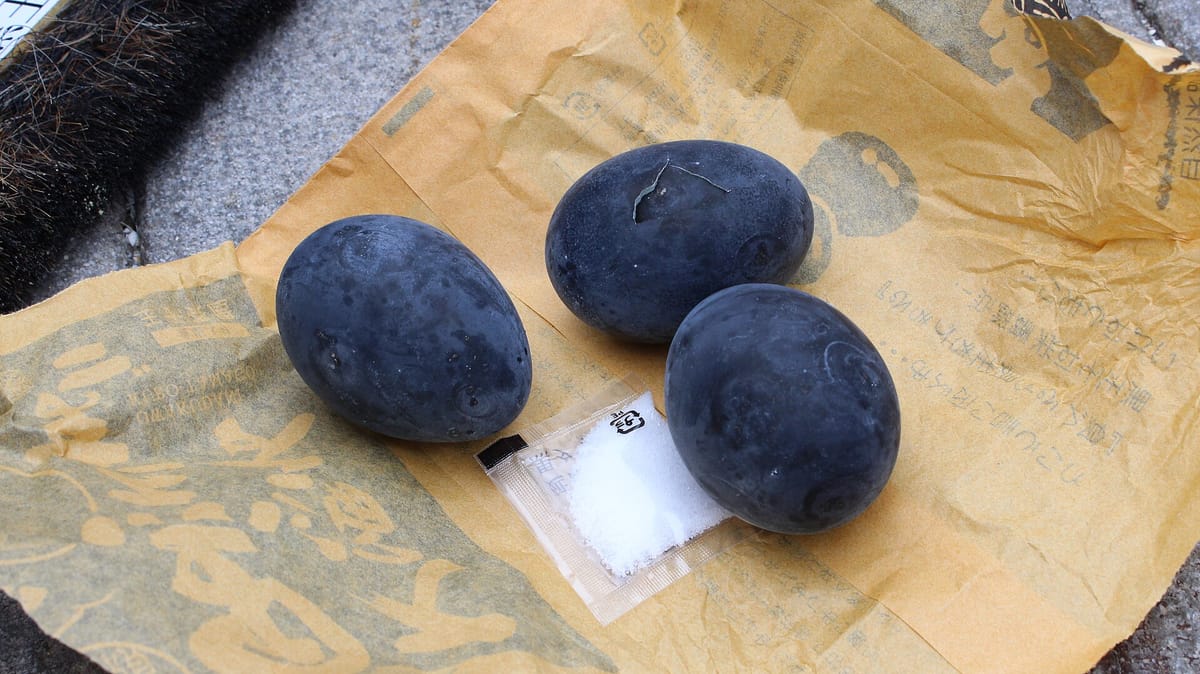
- Ōwakudani: the steaming volcanic valley and its black eggs.
- Lake Ashi cruise: pirate-ship-style boats between Tōgendai and Moto-Hakone.
- Hakone Shrine: the torii in the lake and the main hall among cedars.
- Hakone Sekisho: the reconstructed Edo-period checkpoint on the old Tōkaidō.
- Hakone-Yumoto: the hot spring town at the foot of the mountains, with day-trip baths and souvenir shops.
Station names and onsen words on the signs
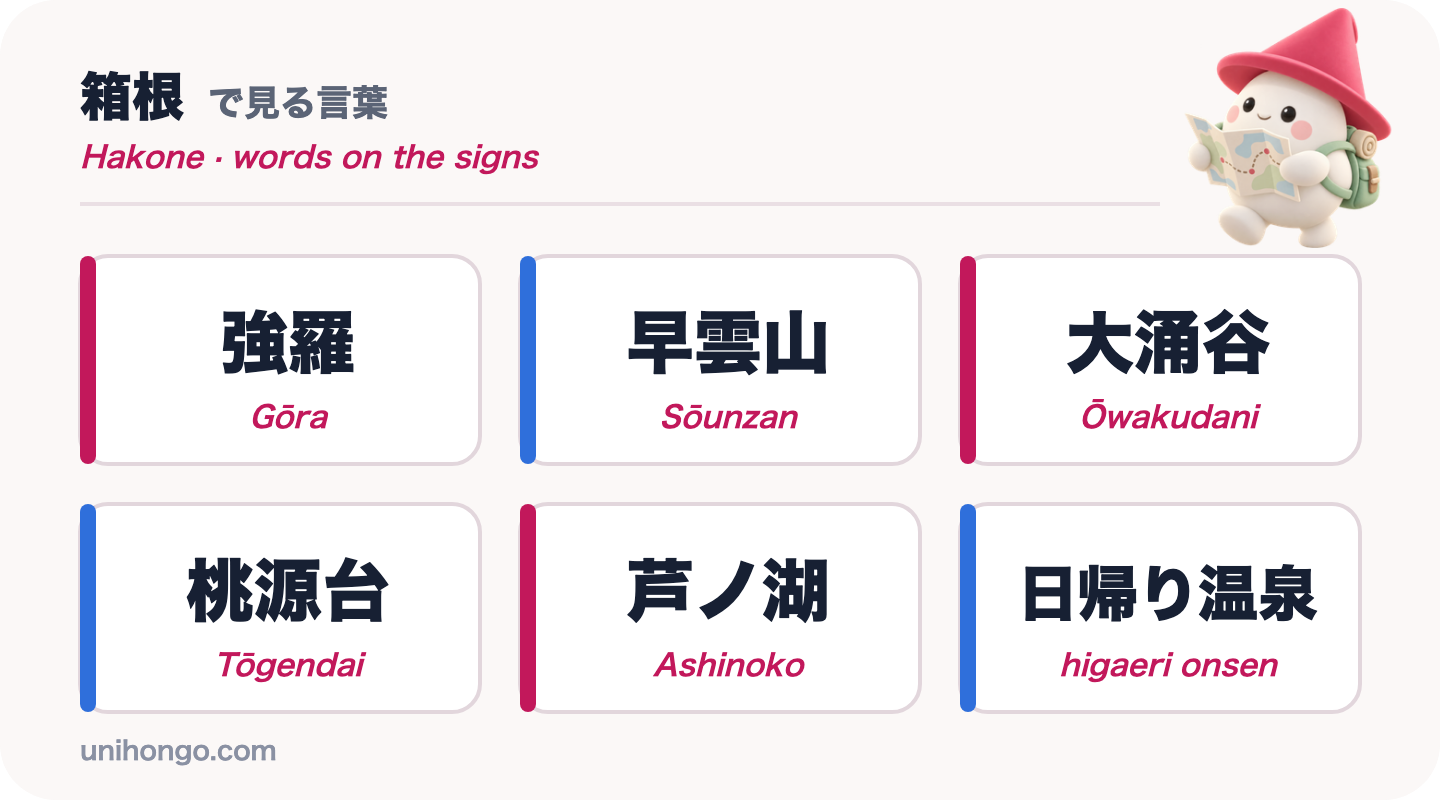
Hakone's place names are hard to read even for Japanese visitors, because they use unusual readings: 強羅 is Gōra, and 芦ノ湖 is Ashinoko. Learn the five stops of the loop and you can follow every transfer sign. At the baths, the key signs are the ones that separate men and women, and the ones that tell you whether a bath is open to non-staying guests.
The table below lists the words you need for the loop and the onsen.
| Word | Reading | Meaning |
|---|---|---|
| 箱根湯本 | Hakone-Yumoto | The gateway station and hot spring town |
| 強羅 | Gōra | Where the mountain train meets the cable car |
| 早雲山 | Sōunzan | Where the cable car meets the ropeway |
| 大涌谷 | Ōwakudani | The volcanic valley |
| 桃源台 | Tōgendai | Ropeway terminus and boat pier on Lake Ashi |
| 芦ノ湖 | Ashinoko | Lake Ashi |
| 元箱根 | Moto-Hakone | Lakeside village near Hakone Shrine |
| 日帰り温泉 | higaeri onsen | Hot spring open to day visitors |
| 男湯 | otoko-yu | Men's bath |
| 女湯 | onna-yu | Women's bath |
| 露天風呂 | rotenburo | Outdoor bath |
| 貸切風呂 | kashikiri-buro | Private bath you can reserve |
Japanese for a day at the onsen
Many ryokan and hotels in Hakone open their baths to day visitors, and Hakone-Yumoto has large day-trip bathhouses. The routine is simple: pay at the counter, rent or bring a towel, leave your shoes in a locker, undress in the changing room, wash thoroughly at the showers, and only then get into the bath. Swimsuits are not worn, the small towel stays out of the water, and long hair is tied up.
The phrases below cover the counter and the changing room. When staff explain the way, listen for kochira, this way, and o-kutsu, your shoes.
| Japanese | Romaji | Meaning |
|---|---|---|
| 日帰り入浴はできますか。 | Higaeri nyūyoku wa dekimasu ka. | Can day visitors bathe here? |
| タオルは借りられますか。 | Taoru wa kariraremasu ka. | Can I rent a towel? |
| 露天風呂はどちらですか。 | Rotenburo wa dochira desu ka. | Which way is the outdoor bath? |
| 貸切風呂は予約できますか。 | Kashikiri-buro wa yoyaku dekimasu ka. | Can I book the private bath? |
| タトゥーがあるんですが、入れますか。 | Tatū ga aru n desu ga, hairemasu ka. | I have a tattoo. Can I go in? |
| ロッカーの鍵はどこで返しますか。 | Rokkā no kagi wa doko de kaeshimasu ka. | Where do I return the locker key? |
| 黒たまごを一袋ください。 | Kuro-tamago o hitofukuro kudasai. | One bag of black eggs, please. |
Onsen etiquette, weather and timing
Hakone is busy at weekends and in the autumn colour season, and mountain weather changes fast. A few habits make the day go smoothly.
- Wash and rinse fully before you enter the bath, keep your towel out of the water and do not swim or splash.
- Photography is not allowed in the changing rooms or baths.
- Start the loop early: queues for the ropeway and boats build from late morning, especially at weekends.
- Check volcanic and weather information before heading to Ōwakudani; access can be restricted at short notice.
- Use a luggage delivery or storage service at Hakone-Yumoto rather than carrying suitcases on the crowded mountain train.
- Mount Fuji is most often visible on cold, clear mornings from late autumn to early spring; in summer it is frequently hidden.
Practise the loop before you go
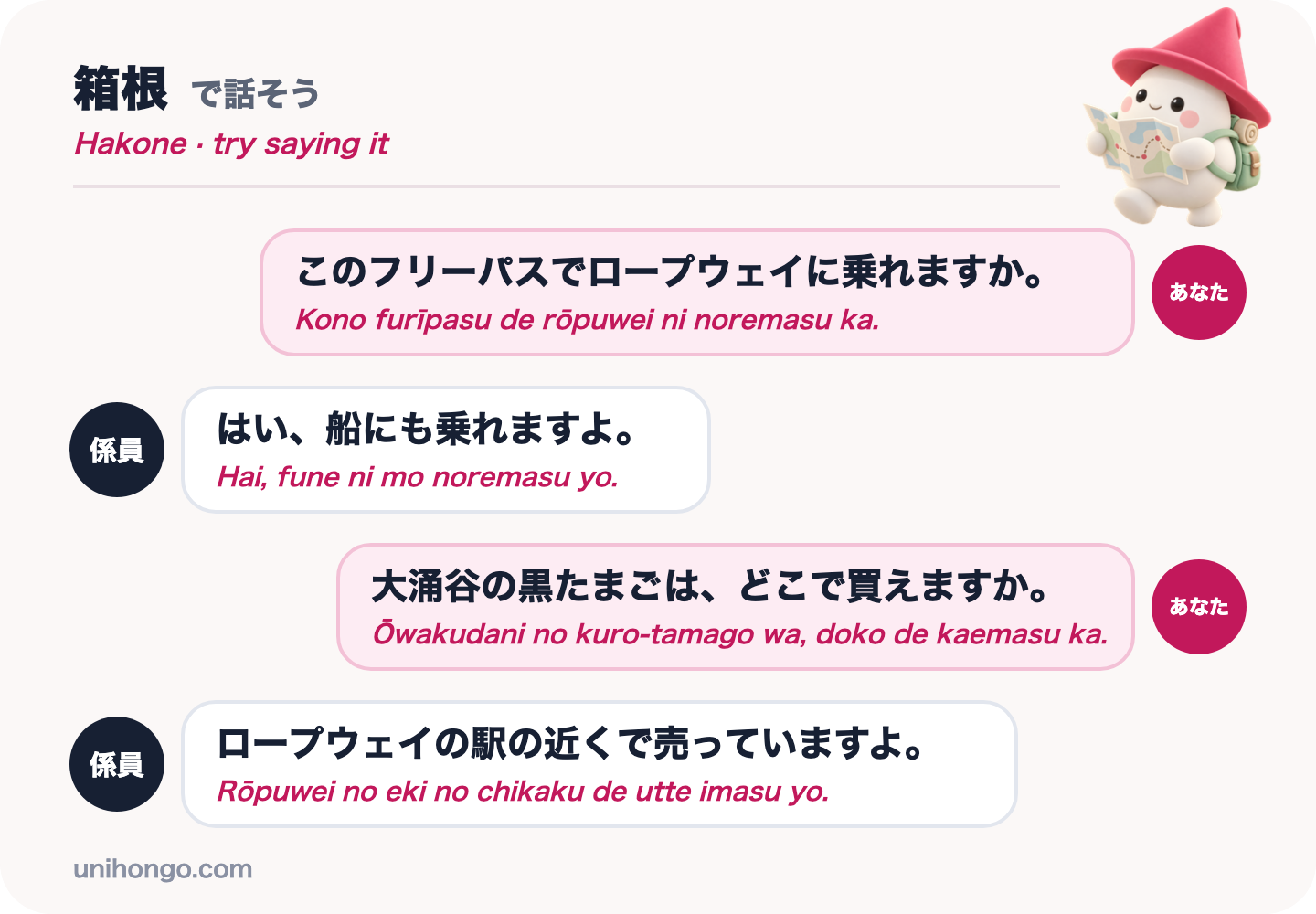
At Hakone-Yumoto, the most useful thing to confirm is what your pass covers, and at Ōwakudani, everyone wants the eggs. The four lines below cover both, and the pattern de noremasu ka, can I ride with, works for any ticket or pass in Japan. Practise them until you can say them without hesitation.
Then practise with a partner who answers. In Unihongo, choose the Train Tickets topic and ask your AI Sensei to play the ticket office at Hakone-Yumoto, or choose the Onsen topic to rehearse the bath counter and the rules. One spoken run-through makes the real day much more relaxed.
| Japanese | Romaji | Meaning |
|---|---|---|
| このフリーパスでロープウェイに乗れますか。 | Kono furīpasu de rōpuwei ni noremasu ka. | Can I ride the ropeway with this Freepass? |
| はい、船にも乗れますよ。 | Hai, fune ni mo noremasu yo. | Yes, and you can ride the boats too. |
| 大涌谷の黒たまごは、どこで買えますか。 | Ōwakudani no kuro-tamago wa, doko de kaemasu ka. | Where can I buy Ōwakudani's black eggs? |
| ロープウェイの駅の近くで売っていますよ。 | Rōpuwei no eki no chikaku de utte imasu yo. | They sell them near the ropeway station. |
Official information
Service status for the ropeway, boats and mountain train, current Freepass coverage and fares, and access to Ōwakudani are published by the Odakyu Hakone group. The Hakone town tourism association lists onsen, ryokan and events.