

Why Fukuoka's yatai are worth an evening
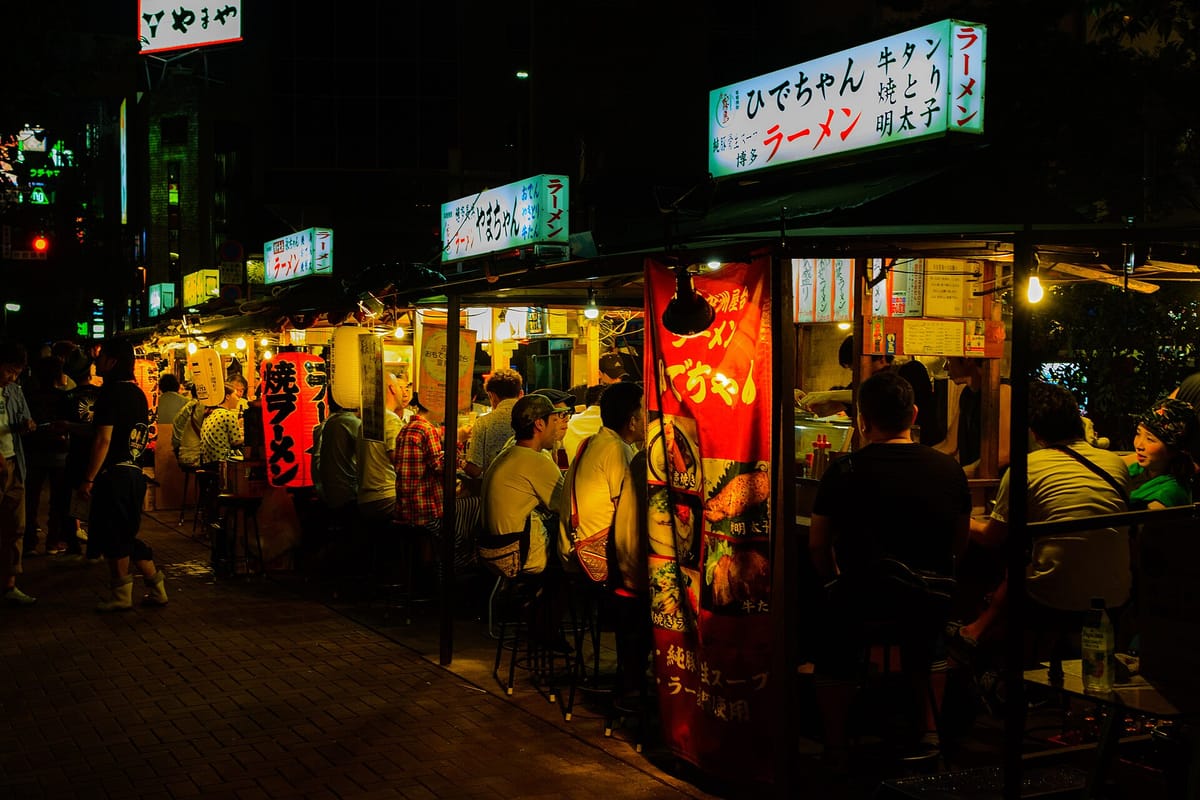
A yatai, 屋台, is a mobile stall: a wooden counter on wheels with a roof, a noren curtain and a kitchen squeezed into the middle. In Fukuoka they are wheeled out to fixed spots every evening, fitted with benches and plastic sheeting, and packed away again before dawn. Food stalls used to be common across Japan, but most cities have regulated them out of existence. Fukuoka instead wrote rules to keep them, and today it has by far the largest number in the country, around a hundred stalls.
What makes them special is the size. A yatai seats seven to ten people shoulder to shoulder around the cook, so every order is a short conversation and strangers end up talking across the counter. It is the opposite of a ticket machine restaurant: you have to ask, listen and answer, which makes it one of the best places in Japan to use your Japanese for real.
For a learner, the vocabulary is pleasantly small. Lanterns and curtains repeat the same words, ラーメン, おでん, 焼き鳥, 屋台, and the stall owner, often addressed as taishō, boss, uses the same handful of questions all night. By your second stall you will recognise the pattern.
Getting there: Nakasu, Tenjin and Nagahama
The biggest cluster is in Nakasu, the island between the Naka and Hakata rivers, where around twenty stalls line the riverside walk on the Tenjin side. The nearest subway stations are Nakasu-Kawabata on the Kūkō Line, one stop from Tenjin and two from Hakata, and Kushida Jinja-mae on the Nanakuma Line. From either one it is a short walk to the river.
Tenjin's stalls stand on the pavements near the big department stores and the Watanabe-dōri and Shōwa-dōri avenues, a few minutes from Tenjin Station on the Kūkō Line or Nishitetsu Fukuoka (Tenjin) Station. Nagahama's handful of stalls are near the Nagahama fish market, the neighbourhood where Nagahama ramen and the kaedama habit began; the closest subway station is Akasaka.
Stalls start setting up in the early evening and fill quickly at weekends. There are no reservations: you walk along, look for a gap on the bench and ask.
| Japanese | Romaji | Meaning |
|---|---|---|
| 中洲の屋台はどちらですか。 | Nakasu no yatai wa dochira desu ka. | Which way are the Nakasu food stalls? |
| 中洲川端駅は何番出口が近いですか。 | Nakasu-Kawabata-eki wa nanban deguchi ga chikai desu ka. | Which exit of Nakasu-Kawabata Station is closest? |
| このあたりに屋台はありますか。 | Kono atari ni yatai wa arimasu ka. | Are there any food stalls around here? |
| 今日は屋台が出ていますか。 | Kyō wa yatai ga dete imasu ka. | Are the stalls out today? |
| ここから歩いて何分くらいですか。 | Koko kara aruite nanpun kurai desu ka. | About how many minutes on foot from here? |
What to eat at a yatai
Every stall has its own speciality, and the menu is usually written on a board or on the curtain. Ramen stalls are the classic, but many yatai are more like tiny izakaya, and a growing number serve French, Italian or fusion dishes, or cocktails. Raw food is not served, under city rules, so there is no sashimi.
Order a drink first; it signals that you are staying for a while and gives the cook time to take your food order. Then choose one or two dishes, eat, and decide whether to stay or move on to another stall.
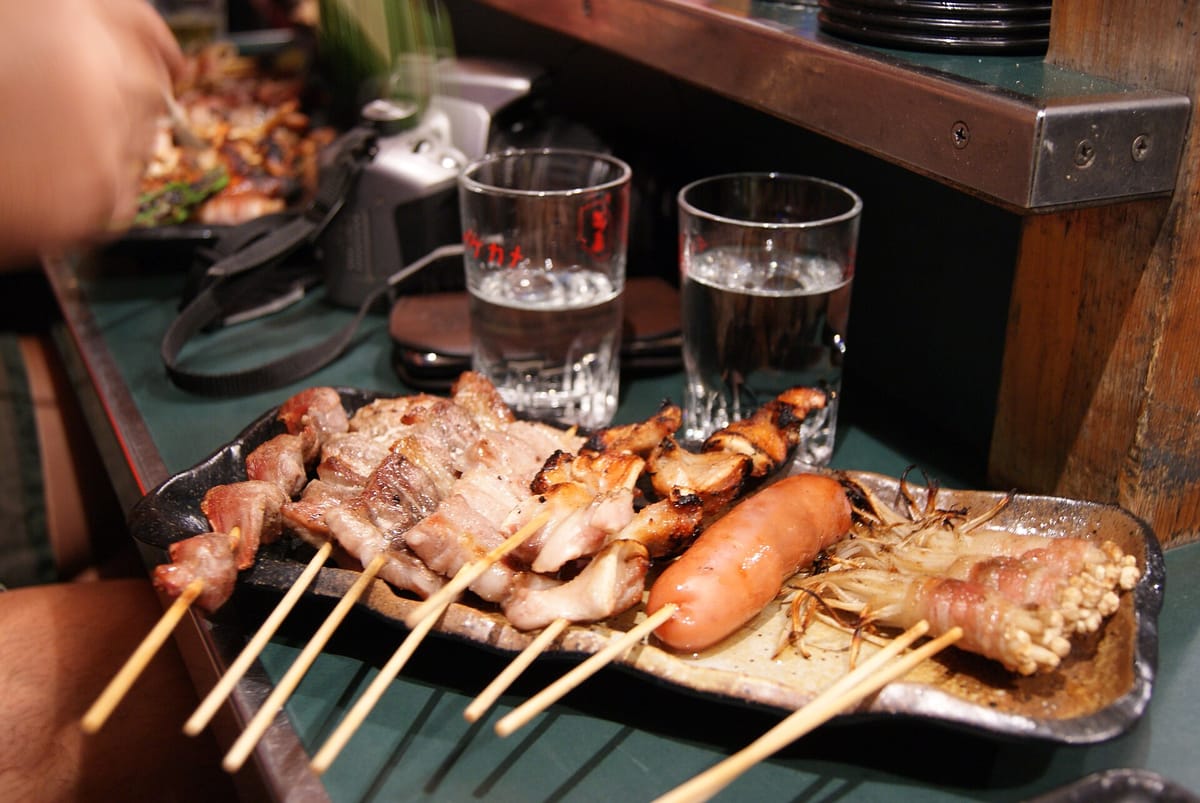
- Hakata rāmen: thin, straight noodles in a creamy pork-bone tonkotsu soup, the dish Fukuoka is famous for.
- Kaedama: a refill of noodles for the soup left in your bowl, ordered near the end.
- Oden: fishcakes, daikon, eggs and other ingredients simmered in a light broth; point at the pot and choose.
- Yakitori: grilled skewers, which in Fukuoka often include pork belly, butabara, as well as chicken.
- Mentaiko: spicy cod roe, a Fukuoka speciality, served grilled or in an omelette at some stalls.
- Gyōza: small pan-fried dumplings, a popular side with beer.
Words on the lanterns and menus
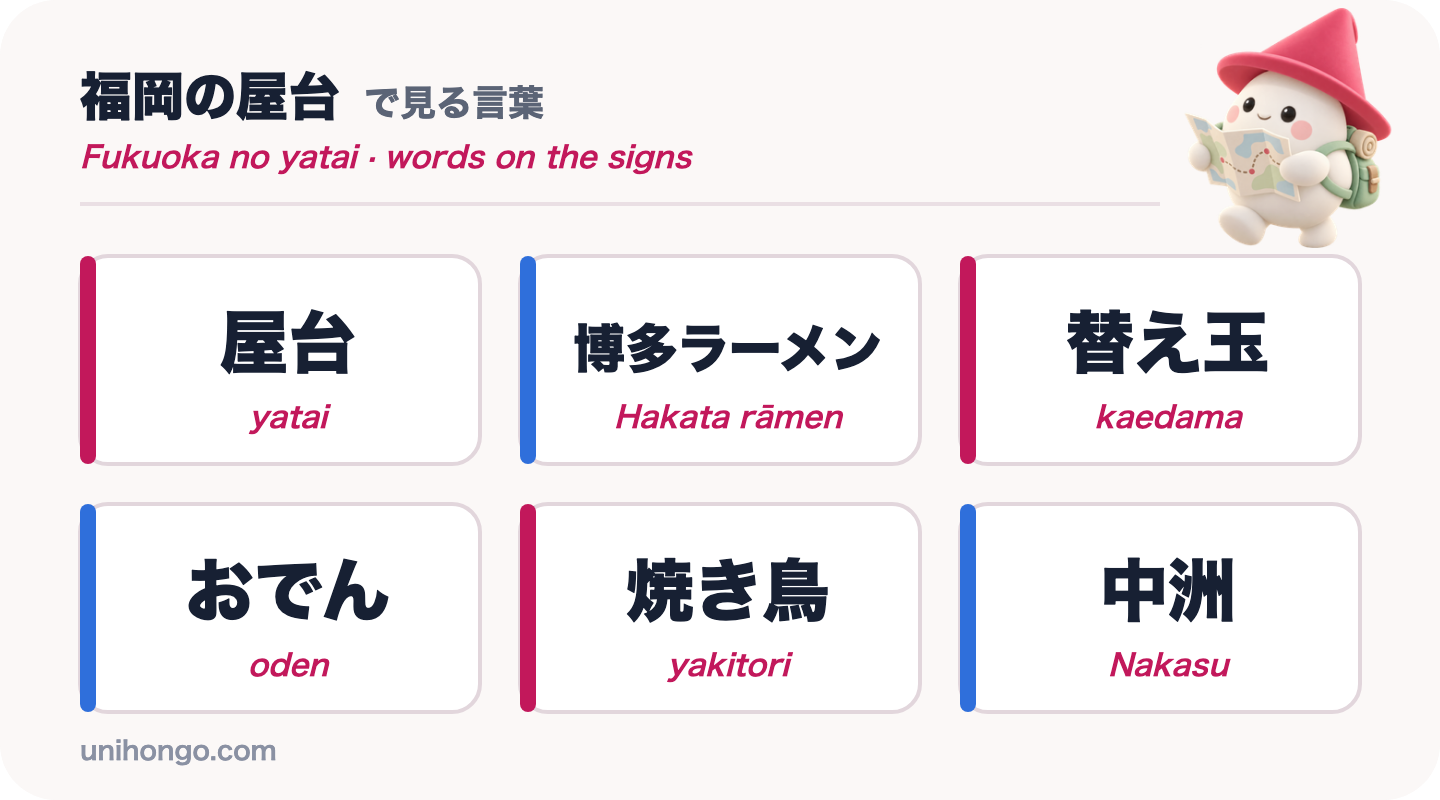
Yatai signs are handwritten and informal, but the same words appear again and again. Menus mix kanji, hiragana and katakana, so it is a good place to practise all three at once. If a stall has an English menu, it will often be on request: ask eigo no menyū wa arimasu ka.
| Word | Reading | Meaning |
|---|---|---|
| 屋台 | yatai | Food stall |
| 博多ラーメン | Hakata rāmen | Fukuoka's thin-noodle pork-bone ramen |
| 替え玉 | kaedama | Extra noodles for the soup left in your bowl |
| おでん | oden | Ingredients simmered in broth |
| 焼き鳥 | yakitori | Grilled skewers |
| 中洲 | Nakasu | The river island with the largest cluster of stalls |
| 明太子 | mentaiko | Spicy cod roe |
| お品書き | oshinagaki | Menu, often written on a board |
| 本日休業 | honjitsu kyūgyō | Closed today |
Japanese for sitting down and ordering
The whole evening fits into a few sentences. Ask if there is room, order a drink and food, choose your noodle firmness, and ask for the bill. Ramen stalls in Fukuoka usually ask how firm you want your noodles, men no katasa, and the answers run from barikata, very firm, and katamen, firm, to futsū, regular, and yawa, soft. Barikata is the local favourite.
Stall owners speak quickly and may use a little Hakata dialect, but they are used to visitors. If you miss something, mō ichido onegai shimasu, once more please, is always welcome.
| Japanese | Romaji | Meaning |
|---|---|---|
| 二人ですが、座れますか。 | Futari desu ga, suwaremasu ka. | There are two of us. Can we sit down? |
| どうぞ、詰めて座ってください。 | Dōzo, tsumete suwatte kudasai. | Go ahead, squeeze in and sit down. |
| ラーメンとビールをお願いします。 | Rāmen to bīru o onegai shimasu. | Ramen and a beer, please. |
| 麺の硬さはどうしますか。 | Men no katasa wa dō shimasu ka. | How firm would you like your noodles? |
| バリカタでお願いします。 | Barikata de onegai shimasu. | Very firm, please. |
| 替え玉をお願いします。 | Kaedama o onegai shimasu. | An extra portion of noodles, please. |
| おすすめは何ですか。 | Osusume wa nan desu ka. | What do you recommend? |
| お会計をお願いします。 | O-kaikei o onegai shimasu. | The bill, please. |
Yatai etiquette and practical tips
Fukuoka's official tourist guide publishes a short list of manners for yatai visitors, and regulars follow them without thinking. They are mostly about space and turnover: a stall has very few seats and a short night.
- Order at least one item per person; do not sit at the counter without ordering.
- Keep your luggage elsewhere. Leave suitcases in a coin locker or at your hotel, as there is nowhere to put them.
- Leave room for others: sit close, keep bags on your lap and let newcomers squeeze in.
- Eat, pay and move on. Hopping between two or three stalls is normal and polite; staying for hours is not.
- There are no toilets at the stalls, so use one before you go, for example at a station or convenience store.
- Bring cash in small notes and coins. Some stalls take cards or mobile payment, but many do not.
- Check the weather. Stalls stay shut in heavy rain and strong wind, and many close one day a week.
- Chat if the moment is right, but do not push; not everyone at the counter wants a conversation.
Practise your first yatai order
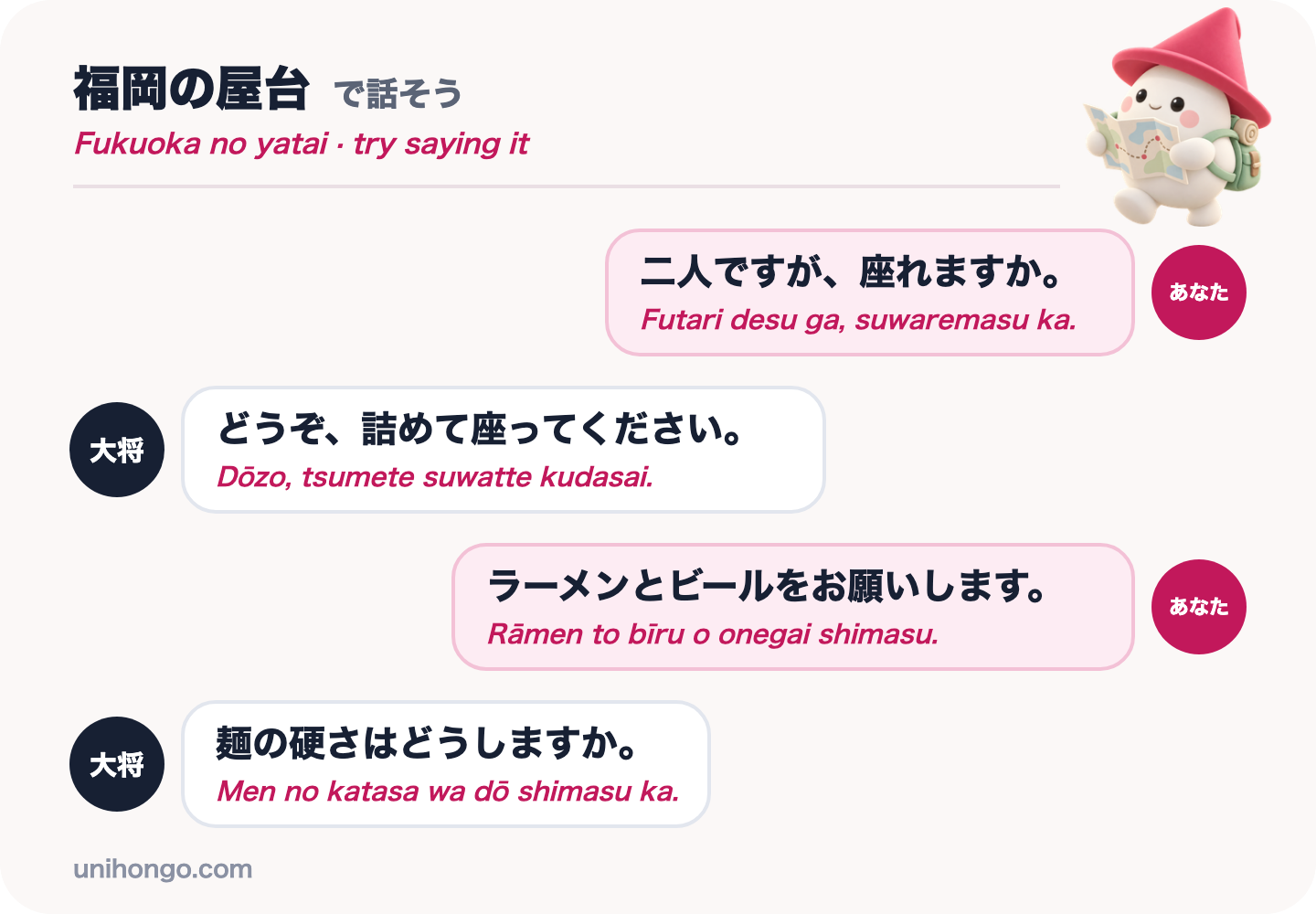
The moment that matters is the first one: standing at the curtain, asking if there is room. After that the owner guides the conversation. Practise the four lines below until you can say them without reading, then add your answer to the last question, barikata de onegai shimasu or futsū de onegai shimasu.
Then rehearse with a partner who answers back. In Unihongo, choose the Izakaya topic and ask your AI Sensei to play a yatai owner in Nakasu who asks about noodle firmness and suggests a dish, or try the First Round at an Izakaya mission for the drink order. Hearing the questions at natural speed before you go is what makes them easy on the night.
| Japanese | Romaji | Meaning |
|---|---|---|
| 二人ですが、座れますか。 | Futari desu ga, suwaremasu ka. | There are two of us. Can we sit down? |
| どうぞ、詰めて座ってください。 | Dōzo, tsumete suwatte kudasai. | Go ahead, squeeze in and sit down. |
| ラーメンとビールをお願いします。 | Rāmen to bīru o onegai shimasu. | Ramen and a beer, please. |
| 麺の硬さはどうしますか。 | Men no katasa wa dō shimasu ka. | How firm would you like your noodles? |
Official information
Fukuoka City's official tourist guide publishes yatai manners, area maps and features on individual stalls. Opening days vary stall by stall and depend on the weather, so check on the day.