

Why Kokusai-dōri is the place to start in Naha
Before the war, the road that became Kokusai-dōri was a new prefectural road through farmland and marsh on the edge of Naha. After the Battle of Okinawa in 1945 destroyed the city, people rebuilt around it, and in 1948 a cinema called the Ernie Pyle International Theatre opened on the road. The street took its name from the cinema, and its rapid recovery, together with a length of almost exactly a mile, gave it the nickname kiseki no ichi mairu, the Miracle Mile.
Today the street is mostly for visitors: souvenir shops, steak houses, awamori bars and hotels, several branches of the same shop within a few hundred metres. For daily life, locals head into the covered shopping streets that branch off the middle of the street, which lead to the Makishi Public Market, known as the kitchen of Okinawa.
It is an easy place to use Japanese. Shop staff are relaxed and talkative, prices are written clearly, and the vocabulary of food and souvenirs is simple and repetitive. It is also where you will first notice Okinawa's own words, on shop signs, menus and in greetings.
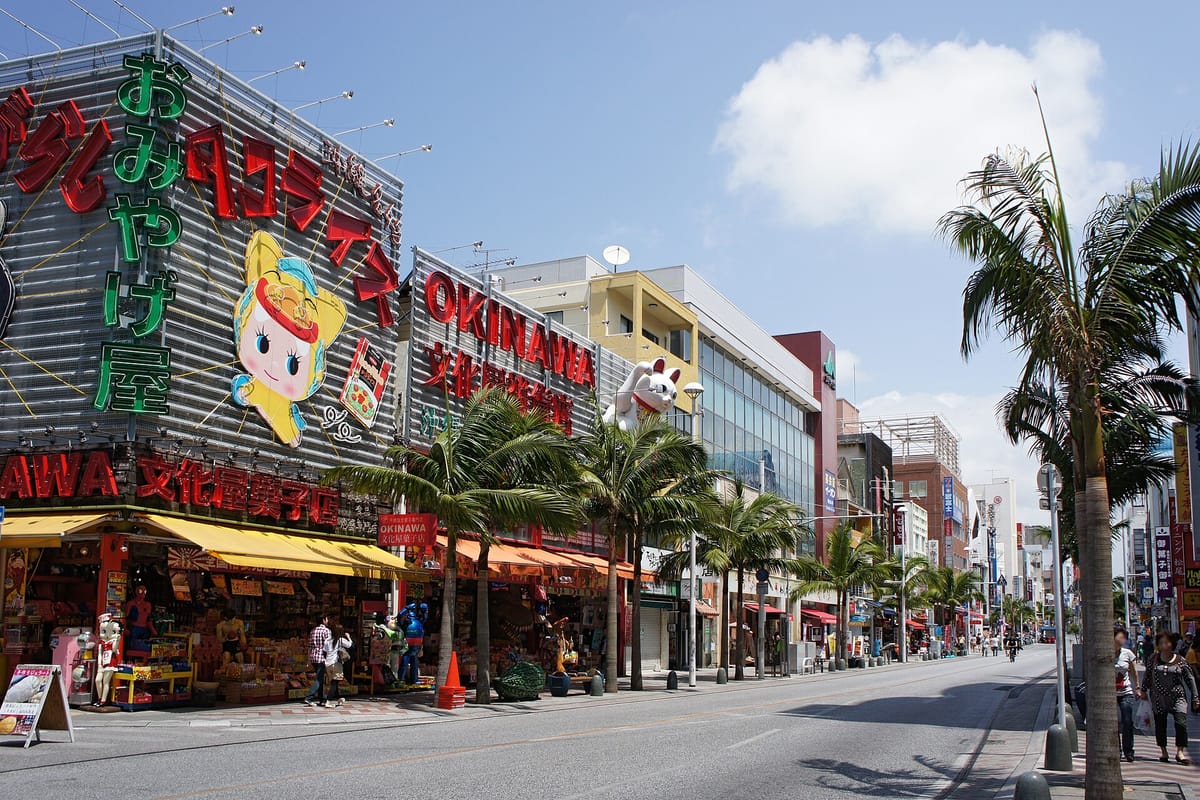
Getting there: Yui Rail to Kenchō-mae or Makishi
The Yui Rail monorail runs from Naha Airport through the city centre. Kokusai-dōri runs between two of its stations: Kenchō-mae, by the prefectural office at the western end, and Makishi, near the eastern end. Miebashi Station, in between, is officially the nearest to the Makishi Public Market, a short walk down Okiei-dōri towards Kokusai-dōri. Many buses also run along the street, but traffic is heavy and on Sunday afternoons they take other roads.
The most useful landmark is Tenbusu Naha, a cultural centre near the middle of the street, which houses the Naha City tourist information office. The entrances to the Heiwa-dōri and Ichiba Hondōri arcades are close by, around the Mutsumibashi crossing.
| Japanese | Romaji | Meaning |
|---|---|---|
| 国際通りに行きたいんですが、どの駅で降りればいいですか。 | Kokusai-dōri ni ikitai n desu ga, dono eki de orireba ii desu ka. | I want to go to Kokusai-dōri. Which station should I get off at? |
| 牧志公設市場はどちらですか。 | Makishi Kōsetsu Ichiba wa dochira desu ka. | Which way is the Makishi Public Market? |
| 平和通りの入口はどこですか。 | Heiwa-dōri no iriguchi wa doko desu ka. | Where is the entrance to Heiwa-dōri? |
| 観光案内所はありますか。 | Kankō annaijo wa arimasu ka. | Is there a tourist information office? |
| ここから牧志駅まで歩けますか。 | Koko kara Makishi-eki made arukemasu ka. | Can I walk from here to Makishi Station? |
The main street, the arcades and the market
Walk the main street once end to end, then turn off into the arcades. Heiwa-dōri and Ichiba Hondōri are covered shopping streets full of small shops selling clothes, snacks, dried goods and local sweets. The market sits about 150 metres in along Ichiba Hondōri. Its old building closed in 2019, the market traded in a temporary building nearby during the rebuild, and the new three-storey market opened on its original site in March 2023.
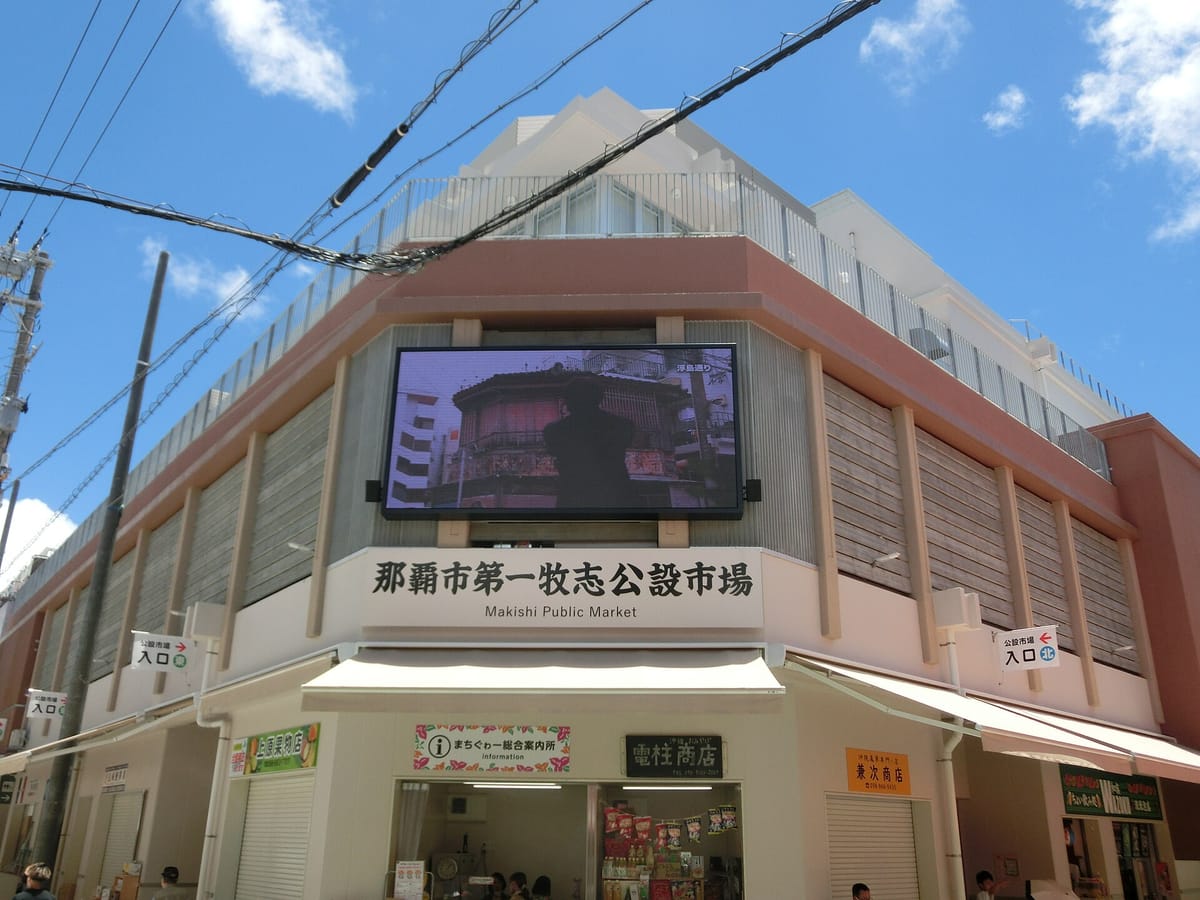
- Kokusai-dōri: the main street, souvenirs, restaurants and bars along about 1.6 kilometres.
- Heiwa-dōri: a covered shopping street off the middle of Kokusai-dōri, busier with locals.
- Ichiba Hondōri: the arcade that leads to the Makishi Public Market.
- First Makishi Public Market: fish, meat and produce on the ground floor, small restaurants upstairs.
- Tsuboya Yachimun-dōri: a stone-paved street of pottery workshops and shops a short walk away; yachimun is the Okinawan word for pottery.
- Tenbusu Naha: a cultural centre on the main street with the city tourist information office.
Words on the signs around Kokusai-dōri
Most of the signs you will read here are shop names, street names and menu items. Two food words appear everywhere: Okinawa soba, a wheat noodle soup that is not made with buckwheat, and awamori, the local rice spirit. On menus you will also see champurū, a stir-fry, most famously with bitter gourd, gōyā.
Okinawan words are mixed into signs freely, often written in katakana or hiragana: mensōre for welcome, chanpurū for mixed, yachimun for pottery. They are part of the fun of reading Naha's streets.
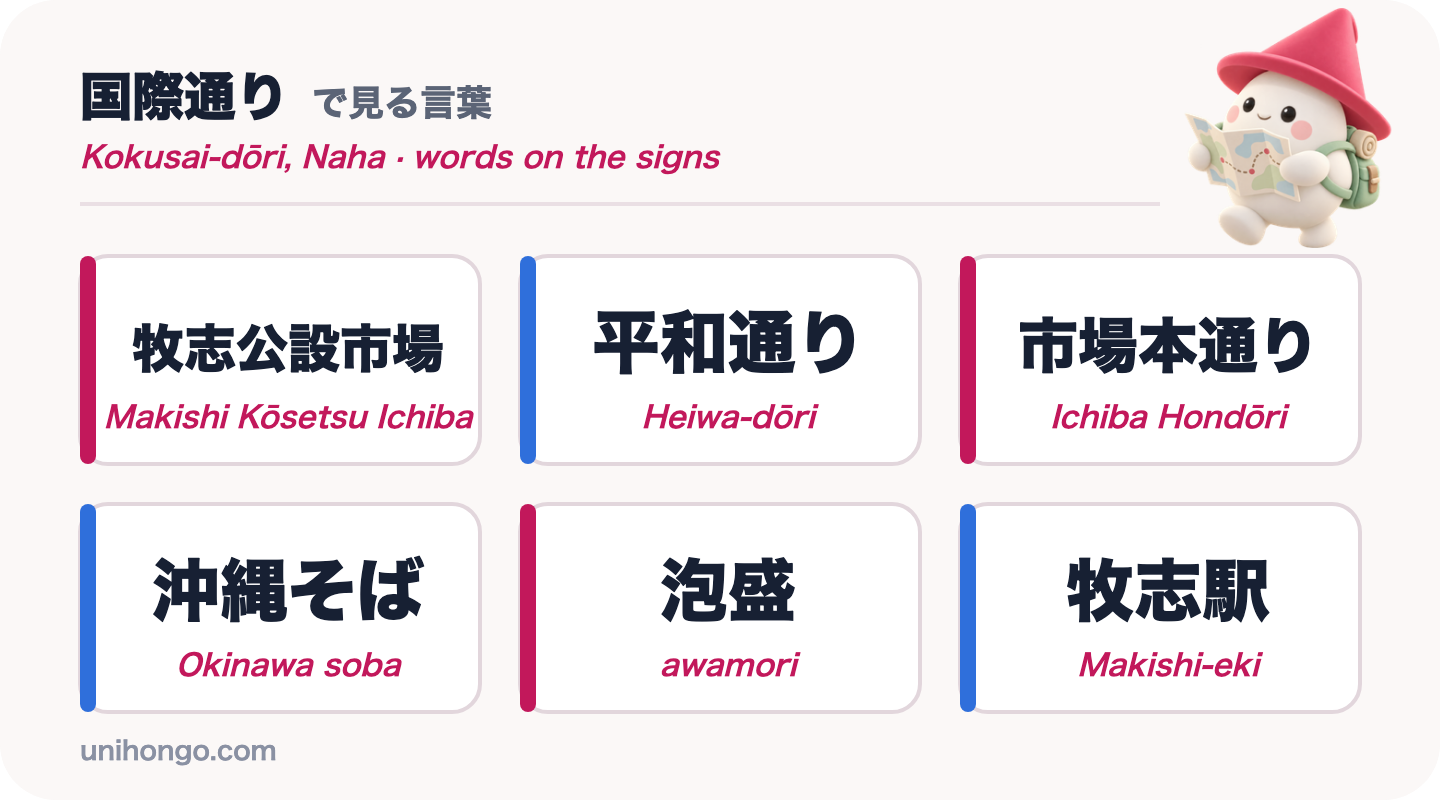
| Word | Reading | Meaning |
|---|---|---|
| 牧志公設市場 | Makishi Kōsetsu Ichiba | Makishi Public Market |
| 平和通り | Heiwa-dōri | Heiwa-dōri covered shopping street |
| 市場本通り | Ichiba Hondōri | The arcade leading to the market |
| 沖縄そば | Okinawa soba | Okinawan wheat noodle soup |
| 泡盛 | awamori | Okinawan rice spirit |
| 牧志駅 | Makishi-eki | Makishi Station on the Yui Rail |
| 県庁前駅 | Kenchō-mae-eki | Kenchō-mae Station, at the western end |
| 持ち上げ | mochiage | The market's system of cooking food you buy downstairs |
| ゴーヤーチャンプルー | gōyā champurū | Stir-fry with bitter gourd, tofu and egg |
Japanese for the market: buy downstairs, eat upstairs
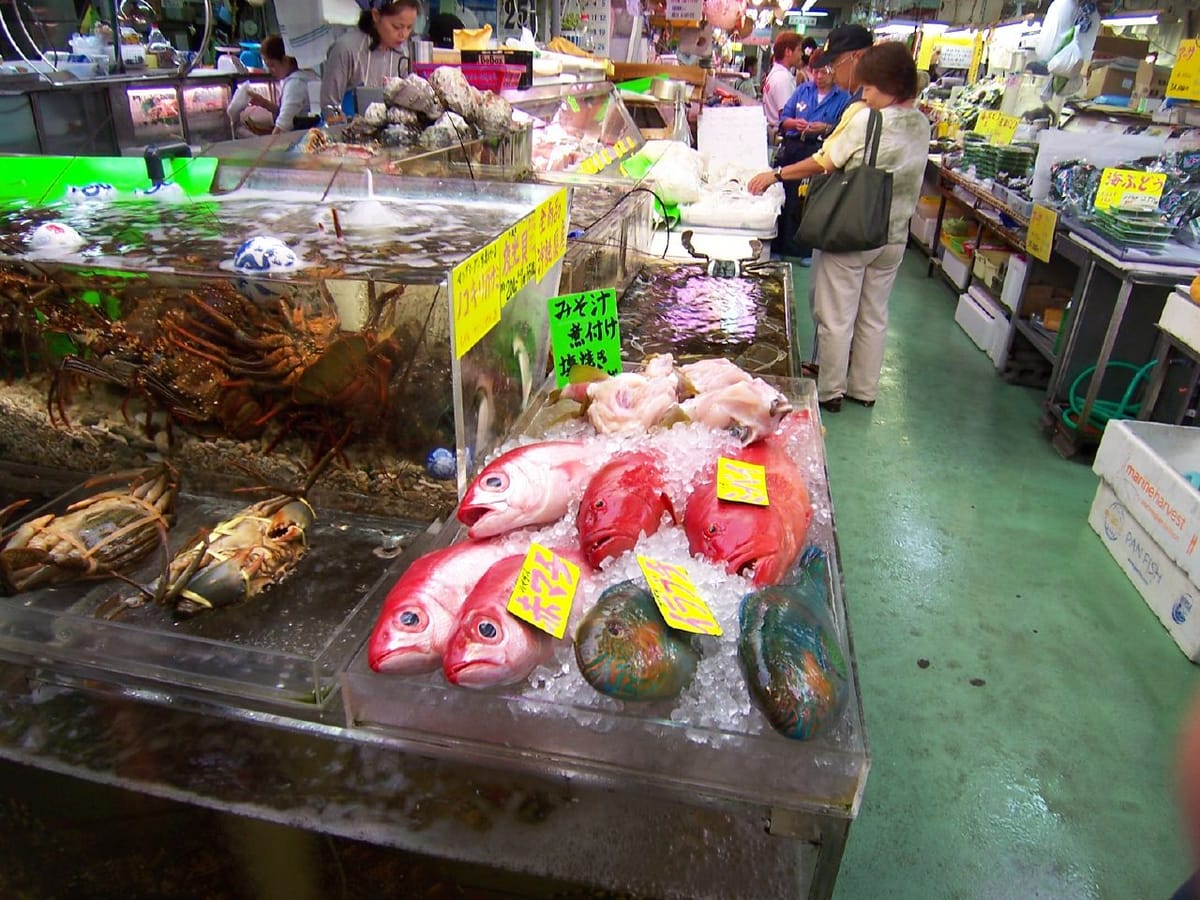
The fun of the market is mochiage, literally carrying up. You choose fish or other seafood at a stall on the ground floor, pay the stall, and ask for it to be prepared at one of the restaurants upstairs, which charge a small cooking fee per person or per dish. Stallholders will suggest how to cook it: sashimi, deep-fried, grilled, or in miso soup.
Okinawan fish look nothing like the fish in mainland markets: bright blue parrotfish, called irabuchā, red snappers and spiny lobsters. Ask what a fish is called and how it is usually eaten; stallholders enjoy explaining.
| Japanese | Romaji | Meaning |
|---|---|---|
| この魚は何ですか。 | Kono sakana wa nan desu ka. | What is this fish? |
| どうやって食べるのがおすすめですか。 | Dō yatte taberu no ga osusume desu ka. | How do you recommend eating it? |
| 二人分ください。 | Futari-bun kudasai. | Enough for two, please. |
| 全部でいくらですか。 | Zenbu de ikura desu ka. | How much is it altogether? |
| 調理代は別ですか。 | Chōridai wa betsu desu ka. | Is the cooking fee separate? |
| 沖縄そばを一つください。 | Okinawa soba o hitotsu kudasai. | One Okinawa soba, please. |
| 泡盛を水割りでお願いします。 | Awamori o mizuwari de onegai shimasu. | Awamori with water, please. |
Okinawan greetings, shopping manners and tips
Everyone on Kokusai-dōri speaks standard Japanese, and many staff speak some English, but a few Uchināguchi greetings are used all the time and go down well. Uchināguchi is the traditional language of central and southern Okinawa Island; it is related to Japanese but not a dialect of it, and fluent speakers today are mostly older people.
| Japanese | Romaji | Meaning |
|---|---|---|
| めんそーれ | Mensōre | Welcome (Uchināguchi; standard Japanese: irasshaimase) |
| はいさい | Haisai | Hello, said by men (Uchināguchi; women say haitai; standard Japanese: konnichiwa) |
| にふぇーでーびる | Nifē dēbiru | Thank you (Uchināguchi; standard Japanese: arigatō gozaimasu) |
- Prices in shops are fixed and bargaining is not normal; ask for a discount only if a sign offers one for buying several.
- Many shops sell the same souvenirs, so compare before you buy, and check the label if you want goods made in Okinawa.
- Ask before photographing stalls and their owners in the market.
- On Sunday afternoons the street becomes a pedestrian zone, which is the most relaxed time to walk it.
- Carry a small amount of cash for market stalls and older shops, though most shops on the main street take cards.
- Pack awamori and other liquids in checked luggage if you are flying on.
Practise the market conversation before you go
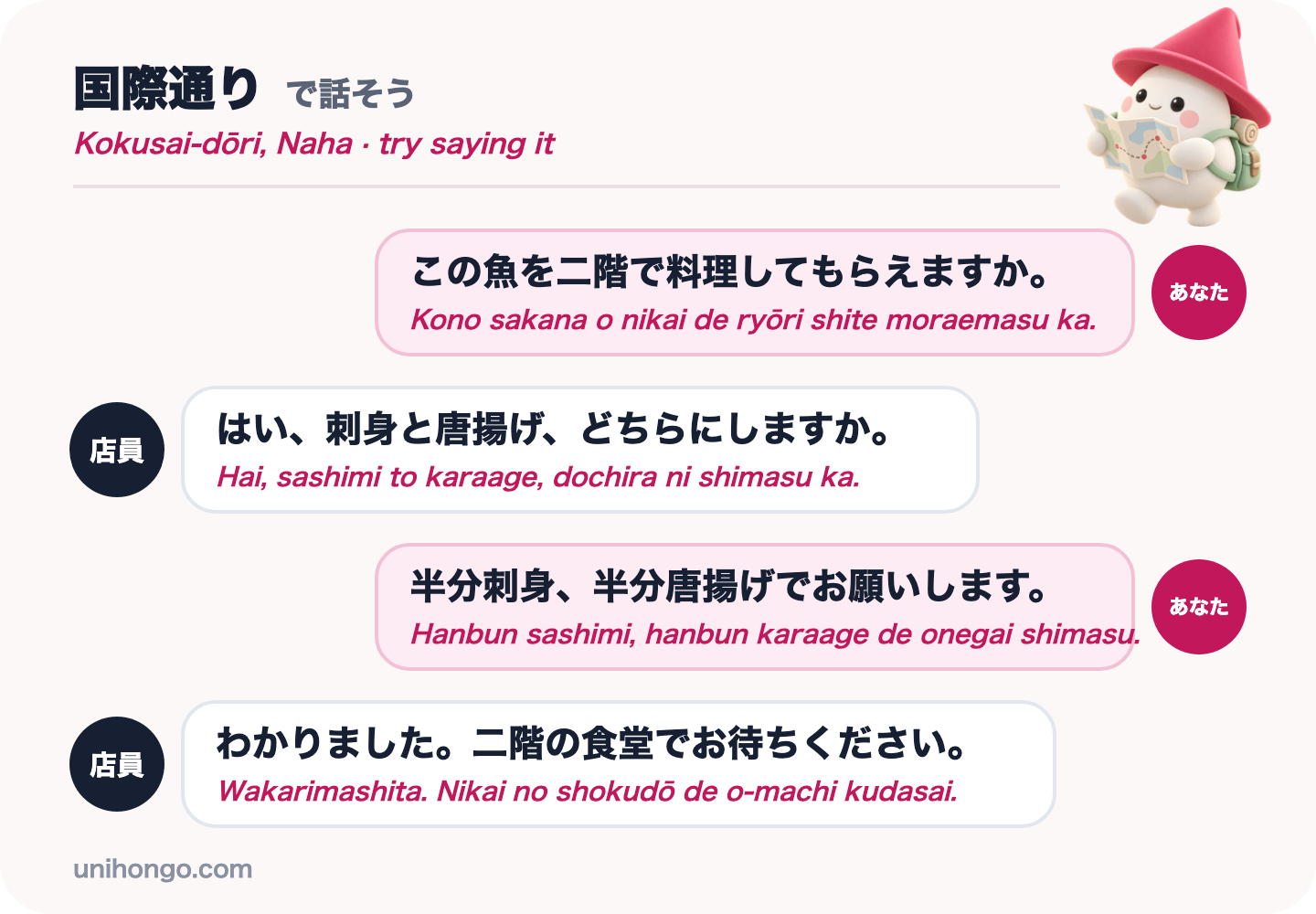
The one conversation almost everyone has at the market is the mochiage request. Practise the four lines below until you can say them without reading. Listen for dochira ni shimasu ka, which will you have, in the reply, and for the words for how the fish is cooked: sashimi, raw slices, and karaage, deep-fried.
Then practise with someone who answers back. In Unihongo, choose the Shopping topic and ask your AI Sensei to play a fish seller, or pick the Japanese Cuisine topic to talk about Okinawan dishes. Saying the lines once before you arrive is what makes them come out at the stall.
| Japanese | Romaji | Meaning |
|---|---|---|
| この魚を二階で料理してもらえますか。 | Kono sakana o nikai de ryōri shite moraemasu ka. | Could this fish be cooked upstairs? |
| はい、刺身と唐揚げ、どちらにしますか。 | Hai, sashimi to karaage, dochira ni shimasu ka. | Yes. Sashimi or deep-fried, which would you like? |
| 半分刺身、半分唐揚げでお願いします。 | Hanbun sashimi, hanbun karaage de onegai shimasu. | Half sashimi and half deep-fried, please. |
| わかりました。二階の食堂でお待ちください。 | Wakarimashita. Nikai no shokudō de o-machi kudasai. | Certainly. Please wait at the restaurant upstairs. |
Official information
The Naha City Tourism Association lists shops, events and the tourist information office on Kokusai-dōri, and the shopping street federation posts events such as festivals and the Sunday pedestrian zone. Check them for current details before your visit.