
The honest answer in two parts
Ask what desu means and you will usually be told it means is. That answer works for gakusei desu, which means I am a student, and it collapses for takai desu, which does not mean it is expensive is. The reason is that Japanese has two kinds of words that describe things. Nouns and na-adjectives need a linking word to become a sentence, and desu is that linking word. I-adjectives are already complete predicates on their own, so nothing needs linking.
So desu has two jobs depending on what sits in front of it. Job one is the polite copula: it joins a subject to a noun or na-adjective and supplies the tense and the politeness. Job two is a politeness marker with no meaning of its own, attached to an i-adjective that could have stood alone. Both jobs share the same spelling, which is why the word feels slippery until you separate them.
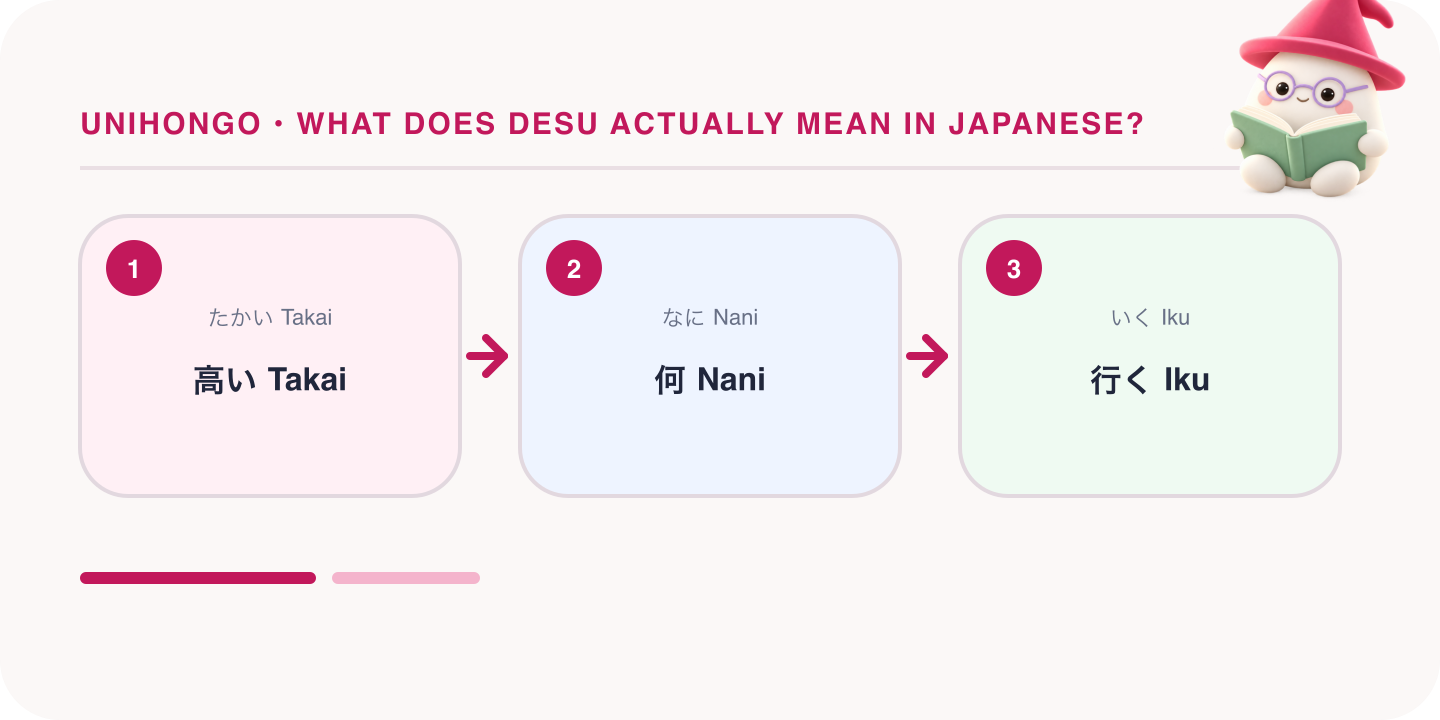
What comes before desu, and whether it means anything
| What comes before | Example | Does desu carry meaning? | Plain equivalent |
|---|---|---|---|
| Noun | 学生です Gakusei desu | Yes, it is the copula is or am | 学生だ Gakusei da |
| Na-adjective | 静かです Shizuka desu | Yes, it links the quality to the subject | 静かだ Shizuka da |
| I-adjective | 高いです Takai desu | No, politeness only | 高い Takai |
| Phrase with a particle | 三時からです San-ji kara desu | Yes, it stands in for a full predicate | 三時から San-ji kara |
| Question word | 何ですか Nan desu ka | Yes, copula plus the question marker ka | 何 Nani |
| Polite verb | 行きます Ikimasu | Not used; masu already carries politeness | 行く Iku |
The last row is worth reading twice. Desu never stacks on top of a masu verb, because masu is already the polite ending for verbs. Ikimasu desu is not a softer way of saying ikimasu; it is simply broken Japanese, and it is one of the few mistakes that marks a learner instantly.
Desu after a noun: the real copula
This is the use that matches the English word is most closely. The pattern is A wa B desu, where B is a noun that identifies or classifies A. It also works with a bare noun when the topic is obvious from context, which is why you can answer a question with two words. Notice that Japanese does not change the form for I, you, or she; one copula covers them all.
The pattern is broader than English is. Watashi wa kōhī desu is a normal thing to say in a cafe, and it means I will have the coffee rather than I am coffee. Desu is standing in for whatever verb the situation makes obvious, which is a habit of Japanese worth noticing early.
| Japanese | Romaji | Meaning |
|---|---|---|
| 私は学生です。 | Watashi wa gakusei desu. | I am a student. |
| 田中です。よろしくお願いします。 | Tanaka desu. Yoroshiku onegai shimasu. | I am Tanaka. Pleased to meet you. |
| これは私の傘です。 | Kore wa watashi no kasa desu. | This is my umbrella. |
| 会議は三時からです。 | Kaigi wa san-ji kara desu. | The meeting is from three o'clock. |
| 私はコーヒーです。 | Watashi wa kōhī desu. | I will have the coffee. |
| はい、そうです。 | Hai, sō desu. | Yes, that is right. |
Desu after a na-adjective works the same way
Na-adjectives such as shizuka, benri, and genki behave like nouns grammatically. They need desu to become a sentence, and they take the same negative and past forms as nouns. The na itself only appears when the adjective sits directly in front of a noun, as in shizuka na heya, a quiet room. At the end of a sentence the na disappears and desu does the work.
| Japanese | Romaji | Meaning |
|---|---|---|
| この部屋は静かです。 | Kono heya wa shizuka desu. | This room is quiet. |
| 静かな部屋ですね。 | Shizuka na heya desu ne. | It is a quiet room, isn't it. |
| 駅が近くて便利です。 | Eki ga chikakute benri desu. | The station is close, so it is convenient. |
| お元気ですか。 | O-genki desu ka. | How are you? |
| 昨日は暇でした。 | Kinō wa hima deshita. | I was free yesterday. |
Desu after an i-adjective adds nothing but politeness
Takai on its own is a complete sentence meaning it is expensive. The i ending already contains the being. Adding desu does not repeat that meaning, and it does not make the sentence more grammatical; it makes it more polite. This is why the plain and polite versions of the same i-adjective sentence differ by exactly one word and nothing else.
The proof is in the past tense. Because desu is not carrying the meaning, it cannot carry the tense either. The adjective itself changes: takai becomes takakatta, and desu simply follows along unchanged. Learners who assume desu is the verb produce takai deshita, which sounds to a Japanese ear roughly like saying was expensive was.
| Japanese | Romaji | Meaning |
|---|---|---|
| この本は高いです。 | Kono hon wa takai desu. | This book is expensive. |
| この本は高い。 | Kono hon wa takai. | This book is expensive. (plain) |
| 今日は忙しかったです。 | Kyō wa isogashikatta desu. | I was busy today. |
| 高くないです。 | Takakunai desu. | It is not expensive. |
| 高くありません。 | Takaku arimasen. | It is not expensive. (more formal) |
| 高くなかったです。 | Takakunakatta desu. | It was not expensive. |
| ちょっと難しいですね。 | Chotto muzukashii desu ne. | It is a little difficult, isn't it. |
Takakunai desu and takaku arimasen mean the same thing. The first is what you will hear in ordinary polite conversation; the second is a shade more formal and appears more in writing and announcements. Both are safe with a colleague or a shop assistant.
The forms of desu you will actually use
| Japanese | Romaji | Meaning |
|---|---|---|
| 私は担当ではありません。 | Watashi wa tantō dewa arimasen. | I am not the person in charge. |
| 昨日は休みでした。 | Kinō wa yasumi deshita. | Yesterday was a day off. |
| 明日は雨でしょう。 | Ashita wa ame deshō. | It will probably rain tomorrow. |
| たぶん来ないでしょう。 | Tabun konai deshō. | They probably will not come. |
| それは大変でしたね。 | Sore wa taihen deshita ne. | That must have been hard. |
| Meaning | Polite | Plain | Example with a noun |
|---|---|---|---|
| Present affirmative | です desu | だ da | 学生です Gakusei desu |
| Present negative | じゃありません ja arimasen | じゃない ja nai | 学生じゃありません Gakusei ja arimasen |
| Present negative, formal | ではありません dewa arimasen | ではない dewa nai | 担当ではありません Tantō dewa arimasen |
| Past affirmative | でした deshita | だった datta | 学生でした Gakusei deshita |
| Past negative | じゃありませんでした ja arimasen deshita | じゃなかった ja nakatta | 学生じゃありませんでした Gakusei ja arimasen deshita |
| Probably, I expect | でしょう deshō | だろう darō | 雨でしょう Ame deshō |
Dewa arimasen is the written and formal version of ja arimasen; ja is simply the spoken contraction of dewa. In an announcement or a report you will see dewa, and in speech you will almost always hear ja. Neither is more correct, so choose by setting.
Deshō is the form that surprises people, because it is not a tense. It softens a statement into a prediction or an invitation to agree, which makes it useful when you do not want to sound certain. Said with rising intonation it asks for confirmation rather than stating anything.
Da, and why people drop it
Da is the plain copula, the casual twin of desu. You use it with close friends, with family, and in your own head. What surprises learners is how often it is left out entirely. In casual speech a bare noun can end a sentence with no copula at all, and among women in particular the copula is frequently dropped where a man might say da. Ashita wa yasumi is completely natural.
The key point is that dropping desu or da does not change the information. Ashita wa yasumi desu and ashita wa yasumi carry the same fact; they carry different social distance. If you are unsure of the relationship, keep desu, because sounding slightly too polite costs nothing while sounding too familiar can land badly. The polite versus casual guide on this blog goes further into where the line sits.
| Japanese | Romaji | Meaning |
|---|---|---|
| 明日は休みです。 | Ashita wa yasumi desu. | Tomorrow is a day off. (polite) |
| 明日は休みだ。 | Ashita wa yasumi da. | Tomorrow is a day off. (plain) |
| 明日は休み。 | Ashita wa yasumi. | Tomorrow is off. (casual, copula dropped) |
| 彼は先生だ。 | Kare wa sensei da. | He is a teacher. (plain) |
| 私は田中じゃない。 | Watashi wa Tanaka ja nai. | I am not Tanaka. (plain) |
| 昨日は暇だった。 | Kinō wa hima datta. | I was free yesterday. (plain) |
Desu ka and asking questions
Adding ka after desu turns a statement into a polite question, and no word order changes. Gakusei desu becomes gakusei desu ka. In writing you will often see a full stop rather than a question mark, because ka already marks the question. In speech, keep the intonation gentle and slightly rising; a hard falling desu ka can sound like an interrogation.
In casual speech ka is usually dropped and intonation does the work instead. Gakusei is a question if your voice rises at the end. Learners who have only drilled desu ka often sound stiff with friends, and learners who have only drilled casual questions sound blunt at work, so practise both shapes on the same content.
| Japanese | Romaji | Meaning |
|---|---|---|
| お名前は何ですか。 | O-namae wa nan desu ka. | What is your name? |
| 今、何時ですか。 | Ima, nan-ji desu ka. | What time is it now? |
| これでいいですか。 | Kore de ii desu ka. | Is this all right? |
| 学生ですか。 | Gakusei desu ka. | Are you a student? |
| 学生? | Gakusei? | You're a student? (casual) |
| いいえ、違います。会社員です。 | Iie, chigaimasu. Kaishain desu. | No, I'm not. I'm an office worker. |
N desu, the explaining ending
You will hear n desu, written んです, constantly, and it is not a random extra n. It attaches to a plain form and frames what you are saying as an explanation of the situation in front of you. Okuremasu simply reports that you will be late; okureru n desu explains why something is happening, as an answer or a reason. After a noun or na-adjective it appears as nan desu, as in hajimete nan desu.
Used as a question, dō shita n desu ka asks what is going on with warmth rather than demanding facts. Overused, n desu makes every sentence sound like a justification, so add it when there is genuinely something to account for. The nominalisation guide covering koto and no goes into how this ending is built, since the n is a contraction of the nominaliser no.
| Japanese | Romaji | Meaning |
|---|---|---|
| すみません、電車が遅れているんです。 | Sumimasen, densha ga okurete iru n desu. | Sorry, the train is delayed. |
| 頭が痛いんです。 | Atama ga itai n desu. | The thing is, I have a headache. |
| どうしたんですか。 | Dō shita n desu ka. | What's the matter? |
| 実は、初めてなんです。 | Jitsu wa, hajimete nan desu. | Actually, it is my first time. |
| 明日は行けないんです。 | Ashita wa ikenai n desu. | I am afraid I cannot go tomorrow. |
The anime desu habit is a joke, not a rule
Somewhere between subtitles and internet culture, desu became a punchline: a word you can staple to the end of anything for comic effect. In Japanese fiction, a character who attaches desu to verbs and to sentences that do not take it is being written as odd, overly formal, or childlike, and that is the point. It is a costume, in the same way a catchphrase is.
In real conversation the effect is different and less fun. Attaching desu everywhere marks you as someone who learned the word without learning its grammar, and it can make an otherwise correct sentence hard to parse. The good news is that the fix is small. Use desu after nouns, na-adjectives, and i-adjectives; use masu on verbs; and never put the two together.
- Correct: kaerimasu. Not: kaeru desu, and not kaerimasu desu.
- Correct: takai desu. Not: takai da, which mixes politeness levels.
- Correct: takakatta desu. Not: takai deshita.
- Correct: shizuka desu. Not: shizuka na desu at the end of a sentence.
- Correct: kirei ja arimasen. Not: kirei kunai, which treats a na-adjective as an i-adjective.
A five-minute drill that fixes this for good
The mistakes above are not knowledge problems; they are speed problems. You know that takai deshita is wrong and still say it, because under time pressure your mouth reaches for the word it has said most often. The cure is a small number of sentences said aloud many times, with the register switched deliberately so both versions become available.
| Japanese | Romaji | Meaning |
|---|---|---|
| これは水です。 | Kore wa mizu desu. | This is water. |
| これは水じゃありません。 | Kore wa mizu ja arimasen. | This is not water. |
| これは水でした。 | Kore wa mizu deshita. | This was water. |
| この部屋は静かじゃありませんでした。 | Kono heya wa shizuka ja arimasen deshita. | This room was not quiet. |
| 今日は寒くなかったです。 | Kyō wa samukunakatta desu. | It was not cold today. |
| それは便利でしょう。 | Sore wa benri deshō. | That would be convenient, wouldn't it. |
- Pick three nouns, three na-adjectives, and three i-adjectives from your own life.
- Say each one in four forms: present, negative, past, past negative, out loud.
- Repeat the i-adjective set slowly, checking that deshita never appears.
- Say every sentence twice, polite then plain, so you feel the register change without the meaning changing.
- Finish with five questions using desu ka, then the same five casually with rising intonation only.