

The core idea: ga points and says this one
Imagine the sentence kimashita, came, with a blank in front of it: someone came, but who? Ga fills the blank. In a question the blank is held by a question word, dare ga kimashita ka, and in the answer by a name, Tanaka-san ga kimashita. The finger points at Tanaka and picks him out from everyone else who might have come.
The pattern is a noun or question word, then ga, then the rest. Volunteering uses the same pointing. If a manager asks who will phone the client, watashi ga yarimasu says I am the one who will do it. The scene is an office where a cake has appeared on a desk and colleagues are asking about it politely.
| Japanese | Romaji | Meaning |
|---|---|---|
| 誰が来ましたか。 | Dare ga kimashita ka. | Who came? |
| 田中さんが来ました。 | Tanaka-san ga kimashita. | Mr Tanaka came. |
| どれが田中さんの傘ですか。 | Dore ga Tanaka-san no kasa desu ka. | Which one is Mr Tanaka's umbrella? |
| これが私のです。 | Kore ga watashi no desu. | This one is mine. |
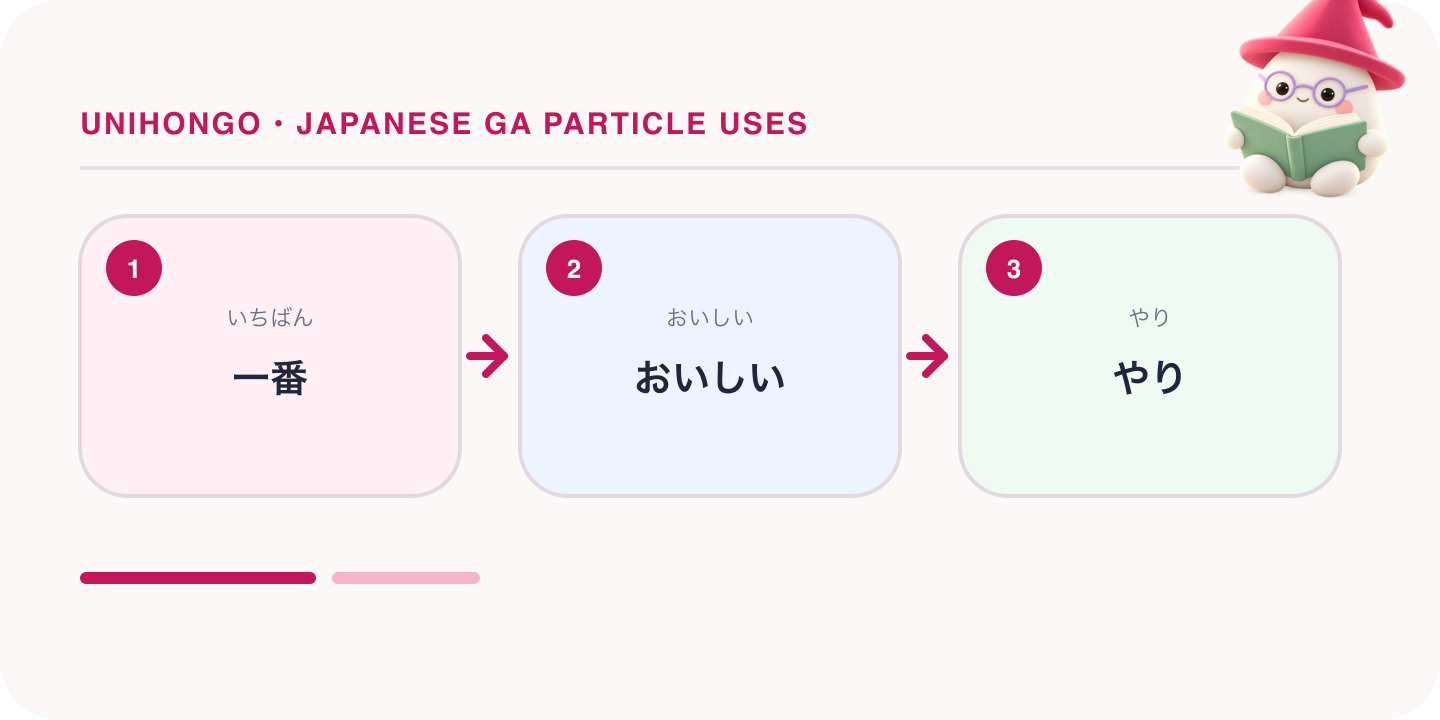
| 何が一番おいしいですか。 | Nani ga ichiban oishii desu ka. | What's the tastiest thing? |
| 私がやります。 | Watashi ga yarimasu. | I'll do it. |
Existence: ga aru and ga iru
When you tell someone that a thing exists, you are pointing it out for the first time, so it takes ga. Asoko ni konbini ga arimasu, there is a convenience store over there. Aru is for things and plants, iru for people and animals. The place comes first with ni, then the new thing with ga.
The same verbs express having. Japanese does not say I have time; it says jikan ga arimasu, literally time exists. Brothers, sisters and pets use iru. Once something has been introduced, it stops being new, and later sentences about it switch to wa.
| Japanese | Romaji | Meaning |
|---|---|---|
| あそこにコンビニがあります。 | Asoko ni konbini ga arimasu. | There's a convenience store over there. |
| 庭に猫がいます。 | Niwa ni neko ga imasu. | There's a cat in the garden. |
| 明日、試験があります。 | Ashita, shiken ga arimasu. | I have an exam tomorrow. |
| 兄が二人います。 | Ani ga futari imasu. | I have two older brothers. |
| 質問がありますか。 | Shitsumon ga arimasu ka. | Do you have any questions? |
What you notice: ame ga futte iru, oto ga suru
When you report something you have just noticed, the whole event is news, and its subject takes ga. You look out of the window and say ame ga futte imasu, it's raining. The bus comes round the corner and you say basu ga kimashita. You are pointing at the world for your listener.
Sensations use ga with suru. Oto ga suru is literally a sound does, and the same frame takes nioi, smell, aji, taste, and koe, voice. Mieru and kikoeru, to be visible and to be audible, take ga for a reason you can now predict: the sea is not something you act on, it is what presents itself. Feelings in the body follow the pattern too. Atama ga itai desu is literally the head is painful. Two people are viewing a flat near the coast with an agent.
| Japanese | Romaji | Meaning |
|---|---|---|
| あ、雨が降っています。 | A, ame ga futte imasu. | Oh, it's raining. |
| 変な音がしますね。 | Hen na oto ga shimasu ne. | There's a strange noise, isn't there? |
| いいにおいがします。 | Ii nioi ga shimasu. | Something smells good. |
| 窓から海が見えます。 | Mado kara umi ga miemasu. | You can see the sea from the window. |
| 隣の部屋から声が聞こえます。 | Tonari no heya kara koe ga kikoemasu. | I can hear voices from the next room. |
| 頭が痛いです。 | Atama ga itai desu. | I have a headache. |
How it is built: six patterns with ga
Ga follows a noun or a question word directly. It never combines with wa or mo; those particles replace it. The table collects the basic frames and the two clause patterns explained in the second half.
| Pattern | Reading | How it is formed |
|---|---|---|
| 誰が来る | dare ga kuru | Question word, ga, verb |
| 猫がいる | neko ga iru | Noun, ga, iru or aru: existence |
| 音がする | oto ga suru | Sensation noun, ga, suru |
| 海が見える | umi ga mieru | Noun, ga, mieru or kikoeru |
| 母が作った料理 | haha ga tsukutta ryōri | Subject with ga inside a clause describing a noun |
| 母の作った料理 | haha no tsukutta ryōri | The same clause with ga changed to no |
Beyond the basics: ga inside subordinate clauses
A sentence often contains a smaller sentence: when my mother came, if it rains, after the children go to sleep. Inside that smaller part, the subject takes ga. Haha ga kita toki, watashi wa nete imashita, when my mother came, I was asleep.
The reason lies in how far each particle reaches. Wa sets a topic for the whole sentence, right to the final verb. If you said haha wa kita toki, the listener would expect your mother to be the subject of the main verb too, and would hear when she came, she was asleep. Ga stays local. It points out who does the action in its own clause and stops there. This holds firmly for clauses with toki, tara, ba, to, mae ni and te kara. Clauses with kara, node and kedo are more independent, and you will sometimes hear wa inside them.
| Japanese | Romaji | Meaning |
|---|---|---|
| 母が来たとき、私は寝ていました。 | Haha ga kita toki, watashi wa nete imashita. | When my mother came, I was asleep. |
| 雨が降ったら、試合は中止です。 | Ame ga futtara, shiai wa chūshi desu. | If it rains, the match is off. |
| 子供が寝てから、映画を見ます。 | Kodomo ga nete kara, eiga o mimasu. | After the children go to sleep, I'll watch a film. |
| 友達が来るので、部屋を掃除します。 | Tomodachi ga kuru node, heya o sōji shimasu. | A friend is coming, so I'm cleaning my room. |
Relative clauses and the switch from ga to no
Japanese describes a noun by placing a clause in front of it: haha ga tsukutta ryōri, the food my mother made. The subject of that clause takes ga, for the reason just given. In this position, and only here, ga may change to no: haha no tsukutta ryōri. The meaning is the same. No sounds slightly softer, and it is frequent in writing and in short descriptions such as se no takai hito, a tall person.
There is a limit, and it follows from what no normally does. No joins one noun to the next, so the listener tries that reading first. In watashi no hon o katta mise, watashi no hon is heard as my book, and the phrase means the shop where someone bought my book. To say the shop where I bought a book, keep ga: watashi ga hon o katta mise. Use no when the verb or adjective comes straight after the subject.
| Japanese | Romaji | Meaning |
|---|---|---|
| 母が作った料理が一番好きです。 | Haha ga tsukutta ryōri ga ichiban suki desu. | I like the food my mother makes best. |
| 母の作った料理が一番好きです。 | Haha no tsukutta ryōri ga ichiban suki desu. | I like the food my mother makes best. |
| 友達が撮った写真を見ました。 | Tomodachi ga totta shashin o mimashita. | I looked at the photos my friend took. |
| 雨の降る日は家にいます。 | Ame no furu hi wa ie ni imasu. | On rainy days I stay at home. |
| 背の高い人は誰ですか。 | Se no takai hito wa dare desu ka. | Who is the tall person? |
Minimal pairs: ga beside its neighbours wa and o
In each pair only the particle changes.
| Sentence | Reading | What it says |
|---|---|---|
| 田中さんが来ました。 | Tanaka-san ga kimashita. | Tanaka is the one who came, or: look, Tanaka has arrived |
| 田中さんは来ました。 | Tanaka-san wa kimashita. | Tanaka came, with a hint that someone else did not |
| これがいいです。 | Kore ga ii desu. | This is the one I want |
| これはいいです。 | Kore wa ii desu. | This one is fine, and often: I don't need this one |
| 海が見える。 | Umi ga mieru. | The sea is in view: it presents itself |
| 海を見る。 | Umi o miru. | Look at the sea: a deliberate act |
The second pair matters in shops. Kore ga ii desu chooses an item; kore wa ii desu is a common way to decline one. A full comparison of wa and ga has its own post. Ga also marks the thing liked, understood or possible with suki, wakaru, dekiru and hoshii. Neko ga suki desu is literally cats are likeable, so the cat is the subject of a state, and another post takes those predicates one by one. The ga that joins two sentences and means but is a different word.
Spoken reality: dropping ga, and when you cannot
In casual talk ga is often dropped when it only marks a plain subject in a short remark: onaka suita, jikan nai, basu kita. It stays when it carries the pointing meaning, because that meaning lives in the particle. Watashi iku and watashi ga iku are not the same: the second says I am the one. Inside relative clauses ga is usually kept as well.
You may notice that some speakers, especially older ones and trained announcers, pronounce ga in the middle of a phrase with a soft nasal sound, close to nga. Many younger speakers use a plain g. Both are standard, and you do not need to copy the nasal version.
| Japanese | Romaji | Meaning |
|---|---|---|
| お腹すいた。 | Onaka suita. | I'm hungry. |
| 時間ないよ。 | Jikan nai yo. | There's no time. |
| バス来たよ。 | Basu kita yo. | The bus is here. |
| 私が行くよ。 | Watashi ga iku yo. | I'll go. (Literally: I am the one who goes.) |
Common mistakes with ga and their causes
Dare wa kimashita ka is wrong. Learners meet wa first and treat it as the default subject marker. A question word is unknown by definition and cannot be a topic: dare ga kimashita ka.
Watashi wa tsukutta kēki desu is wrong for it's the cake I made. Watashi wa is learned as a fixed chunk, so it follows learners into relative clauses. Inside the clause the subject takes ga: watashi ga tsukutta kēki desu.
Fujisan o miemasu is wrong. English says I can see Mount Fuji, with I as subject and the mountain as object. Mieru means to be visible, so the mountain is the subject: Fujisan ga miemasu.
Tsukue no ue ni hon wa arimasu, said to tell someone for the first time that a book is there, is not ungrammatical but sends the wrong message. It sounds like a book is there, but something else is not. To introduce the book, use ga: hon ga arimasu.
Watashi no hon o katta mise is wrong if you mean the shop where I bought a book. It over-applies the switch to no. With an object in the clause, keep ga: watashi ga hon o katta mise.