
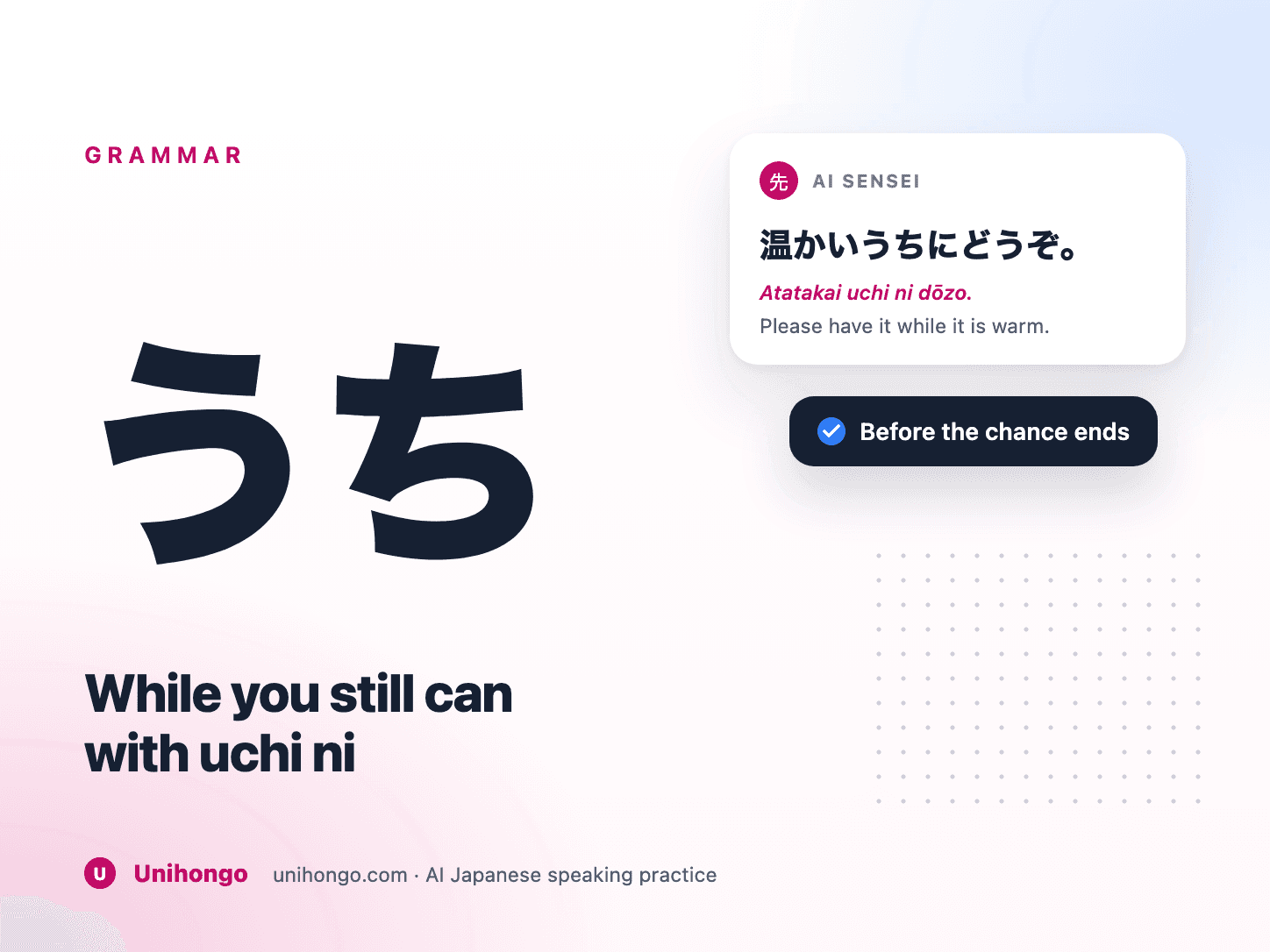
A window that will close
Uchi means inside, and uchi ni places an action inside a stretch of time while a condition holds: while it is warm, while you are young, while nobody is watching. The unspoken message is that once the condition ends, the chance ends too.
That is why uchi ni so often goes with advice, encouragement and plans. It gives a reason to act now.
| Word type | Pattern | Meaning |
|---|---|---|
| I-adjective | Adjective + uchi ni | While it is still warm |
| Na-adjective | Adjective + na uchi ni | While you are still healthy |
| Noun | Noun + no uchi ni | While you are still a student |
| Negative verb | Nai form + uchi ni | Before something happens |
| Ongoing verb | Te iru + uchi ni | While doing, or as you kept doing |
While it still lasts
With adjectives and nouns, uchi ni means while a state still holds. The main clause is usually something you intend or recommend doing before that state changes.
| Japanese | Romaji | Meaning |
|---|---|---|
| 温かいうちにどうぞ。 | Atatakai uchi ni dōzo. | Please have it while it is warm. |
| 若いうちに、いろいろな国に行きたいです。 | Wakai uchi ni, iroiro na kuni ni ikitai desu. | I want to visit lots of countries while I am young. |
| 元気なうちに、富士山に登りたいです。 | Genki na uchi ni, Fujisan ni noboritai desu. | I want to climb Mount Fuji while I am still fit. |
| 学生のうちに、留学したほうがいいですよ。 | Gakusei no uchi ni, ryūgaku shita hō ga ii desu yo. | You should study abroad while you are still a student. |
| 午前中のうちに、終わらせます。 | Gozen-chū no uchi ni, owarasemasu. | I will finish it within the morning. |
Nai uchi ni: before something happens
With a negative verb, uchi ni means while something has not yet happened, which English says as before. It is used above all for things you want to avoid or get ahead of: forgetting, getting dark, rain starting, prices going up.
It sounds more urgent than mae ni, because it focuses on the time that is left.
| Japanese | Romaji | Meaning |
|---|---|---|
| 暗くならないうちに、帰りましょう。 | Kuraku naranai uchi ni, kaerimashō. | Let us go home before it gets dark. |
| 忘れないうちに、メモしておきます。 | Wasurenai uchi ni, memo shite okimasu. | I will note it down before I forget. |
| 雨が降らないうちに、洗濯物を入れてください。 | Ame ga furanai uchi ni, sentakumono o irete kudasai. | Please bring the laundry in before it rains. |
| 冷めないうちに、食べてください。 | Samenai uchi ni, tabete kudasai. | Please eat before it gets cold. |
Te iru uchi ni: while doing, and before I knew it
With te iru, uchi ni has two uses. The first is simply while an action continues, when the main clause is something you deliberately do during it.
The second is more interesting: as you kept doing something, a change happened gradually, often without you noticing. The main clause here is usually a change with naru or a result you did not plan.
| Japanese | Romaji | Meaning |
|---|---|---|
| 覚えているうちに、書いておきます。 | Oboete iru uchi ni, kaite okimasu. | I will write it down while I still remember. |
| 本を読んでいるうちに、眠くなりました。 | Hon o yonde iru uchi ni, nemuku narimashita. | I got sleepy while I was reading. |
| 毎日話しているうちに、仲良くなりました。 | Mainichi hanashite iru uchi ni, naka yoku narimashita. | We became close as we talked every day. |
| 聞いているうちに、だんだんわかるようになりました。 | Kiite iru uchi ni, dandan wakaru yō ni narimashita. | As I kept listening, I gradually started to understand. |
Set phrases you will hear
A few uchi ni expressions are fixed enough to learn as single units. They appear constantly in conversation, advertising and advice.
| Japanese | Romaji | Meaning |
|---|---|---|
| 今のうちに | ima no uchi ni | While you can, now before it is too late |
| 知らないうちに | shiranai uchi ni | Before I knew it, without realising |
| 明るいうちに | akarui uchi ni | While it is still light |
| その日のうちに | sono hi no uchi ni | Within the same day |
| 今のうちに休んでおいてください。 | Ima no uchi ni yasunde oite kudasai. | Rest now while you can. |
| 知らないうちに、三時間も経っていました。 | Shiranai uchi ni, sanjikan mo tatte imashita. | Before I knew it, three hours had passed. |
Uchi ni or mae ni?
Both can translate as before, and many sentences accept either. Mae ni states the order of two events neutrally. Uchi ni focuses on the time window and adds urgency or a sense of opportunity: do it now, while you still can.
There are also places where only one works. Mae ni takes a positive dictionary form, as in neru mae ni. With action verbs, uchi ni takes nai or te iru, so neru uchi ni is not used. State verbs such as iru and aru are the exception: Nihon ni iru uchi ni, while I am in Japan, is natural. And for periods of life and chances that will not return, uchi ni is the natural choice.
| Japanese | Romaji | Meaning |
|---|---|---|
| 日本に来る前に、日本語を勉強しました。 | Nihon ni kuru mae ni, Nihongo o benkyō shimashita. | I studied Japanese before coming to Japan. |
| 日本にいるうちに、日本語をたくさん話したいです。 | Nihon ni iru uchi ni, Nihongo o takusan hanashitai desu. | I want to speak lots of Japanese while I am in Japan. |
- Neutral order of events: mae ni.
- Before something unwelcome happens: nai uchi ni, or mae ni.
- While a good condition lasts: uchi ni.
- A change that happened gradually: te iru uchi ni.
- Before going to bed: neru mae ni, never neru uchi ni.
The second sentence carries the feeling that the chance will end when you leave. That feeling is what uchi ni adds.