

Give the particle a conversational job
An isolated sentence does not always reveal why a speaker chose a particle. Add a question or a preceding statement so the intended job becomes clearer. If someone asks who arrived, an identifying answer has a different purpose from a sentence that begins a comment about a person already under discussion. Tell Mocchi which part of the exchange you want to practice before asking it to judge a blank.
Keep the first lesson narrow. Japanese は and が have several important uses, and a long list can make the starting contrast harder to see. Learn one decision well enough to explain it, then broaden the practice with another context rather than memorizing an apparently universal translation.
Compare identifying an arrival with reporting about a person
In response to だれが来ましたか, 'Who came?', 田中さんが来ました identifies the person who came. A separate statement such as 田中さんは昨日来ました presents information about Tanaka in a context where that person is the topic. These are teaching examples for different conversational purposes, not proof that swapping a particle always creates an ungrammatical sentence.
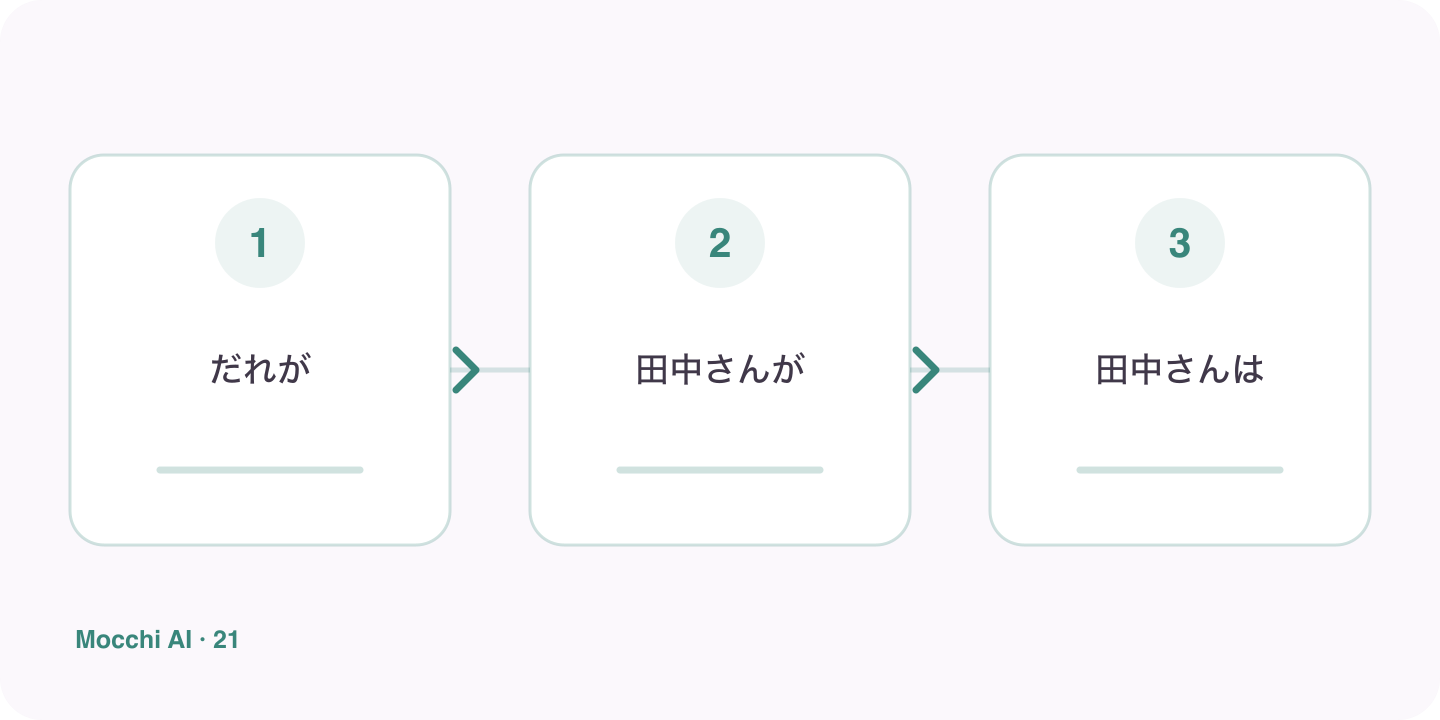
| Japanese | Romaji | Meaning |
|---|---|---|
| だれが来ましたか。 | Dare ga kimashita ka. | Who came? |
| 田中さんが来ました。 | Tanaka-san ga kimashita. | Tanaka came. |
| 田中さんは昨日来ました。 | Tanaka-san wa kinō kimashita. | Tanaka came yesterday. |
Explain the information before naming the rule
Say what the listener needs to know in ordinary language. Are you identifying a person, contrasting possibilities, or making a comment about a topic? Then connect that purpose to the example. This approach gives Mocchi something concrete to respond to and helps you notice when an answer sounds plausible only because you memorized a phrase such as 'subject marker' without understanding the exchange.
Change the question to test the explanation
After a correct answer, change the question or the preceding sentence while keeping some words familiar. Ask how the new context changes what the answer should do. If the tutor gives a different particle, request an explanation of the intended meaning rather than assuming that the first example was wrong. Context-sensitive practice is useful precisely because the same noun can serve different roles in different exchanges.
Keep a specific note for later review
Record the kind of context that caused difficulty, such as identifying the person in an answer to a who-question. At your next visit, ask for a fresh exchange of that type and attempt it before rereading the explanation. Once the distinction is stable, add another use. A personal review target should be small enough to practice and precise enough that a later correct answer means more than a lucky choice between two familiar symbols.