

Mo as also: the core meaning
At its simplest, mo adds a new item to something already said. If someone says they are from Osaka and you are too, you say watashi mo desu. The mo attaches to the word that is being added, not to the verb, and this is worth noticing early because English puts also near the verb. Ringo mo tabemashita means I ate an apple as well as something else; if you wanted to say you also ate the apple, rather than only looking at it, Japanese would use a different structure.
Mo always points back at something. Even when the earlier item is not spoken, it is understood: kyō mo atsui desu ne, it's hot today too, implies yesterday was hot. That is why mo appears so often in small talk, where it links today to yesterday, this shop to the last one, your experience to the listener's.
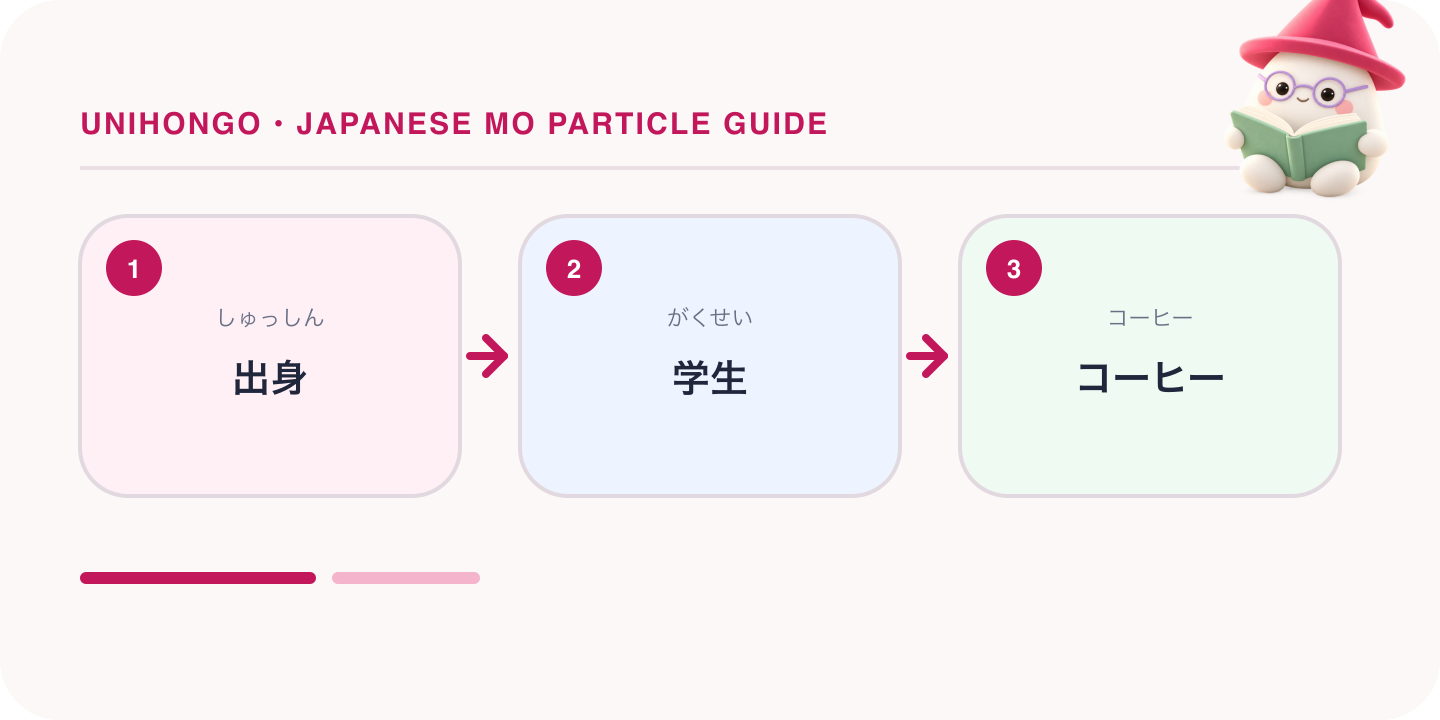
| Japanese | Romaji | Meaning |
|---|---|---|
| 私も大阪出身です。 | Watashi mo Ōsaka shusshin desu. | I'm from Osaka too. |
| 田中さんも学生です。 | Tanaka-san mo gakusei desu. | Tanaka is a student as well. |
| コーヒーも飲みました。 | Kōhī mo nomimashita. | I drank coffee as well. |
| 今日も暑いですね。 | Kyō mo atsui desu ne. | It's hot again today, isn't it? |
| この店もおいしいですよ。 | Kono mise mo oishii desu yo. | This place is good too. |
| それも知りませんでした。 | Sore mo shirimasen deshita. | I didn't know that either. |
Which particles mo replaces and which it joins
Mo takes the place of the three particles that mark the basic roles in a sentence: wa for the topic, ga for the subject and o for the object. So Tanaka-san wa becomes Tanaka-san mo, neko ga becomes neko mo, and pan o becomes pan mo. Never stack them: wa mo, ga mo and o mo do not exist in modern Japanese.
Every other particle stays and mo follows it. Ni mo, de mo, e mo, to mo, kara mo and made mo are all common, because those particles carry information about place, time, direction or partner that mo cannot express. Tōkyō ni mo ikimashita means I went to Tokyo too, and Tōkyō de mo means in Tokyo too. Getting this pair of rules right removes most mo errors at once.
| Japanese | Romaji | Meaning |
|---|---|---|
| 妹も来ます。 | Imōto mo kimasu. | My younger sister is coming too. |
| パンも買いました。 | Pan mo kaimashita. | I bought bread as well. |
| 東京にも行きました。 | Tōkyō ni mo ikimashita. | I went to Tokyo too. |
| 家でも勉強します。 | Ie de mo benkyō shimasu. | I study at home as well. |
| 友達とも話しました。 | Tomodachi to mo hanashimashita. | I talked with my friend too. |
| 先生からもメールが来ました。 | Sensei kara mo mēru ga kimashita. | An email came from the teacher as well. |
Both and neither: noun mo noun mo
When mo follows two or more nouns in a row, the group means both or all of them: tomodachi mo kazoku mo kimashita, both my friends and my family came. With a negative verb, the same structure means neither: sakana mo niku mo tabemasen, I eat neither fish nor meat. Japanese has no separate word for neither; the negative verb does the work.
This pattern extends to more than two items, and to adjectives as well as nouns. Yasukute mo takakute mo kaimasu, I'll buy it whether it is cheap or expensive, uses the te form plus mo twice. Compared with to, which simply lists items, mo mo adds a feeling of emphasis, as if to say even this one and even that one.
| Japanese | Romaji | Meaning |
|---|---|---|
| 友達も家族も来ました。 | Tomodachi mo kazoku mo kimashita. | Both my friends and my family came. |
| 魚も肉も食べません。 | Sakana mo niku mo tabemasen. | I eat neither fish nor meat. |
| 英語も日本語も話せます。 | Eigo mo Nihongo mo hanasemasu. | I can speak both English and Japanese. |
| 時間もお金もありません。 | Jikan mo okane mo arimasen. | I have neither time nor money. |
| 兄も姉も東京に住んでいます。 | Ani mo ane mo Tōkyō ni sunde imasu. | Both my older brother and my older sister live in Tokyo. |
Mo with question words: dare mo, nani mo, doko mo, itsu mo
Attach mo to a question word and the word stops asking a question. With a negative verb, dare mo means nobody, nani mo means nothing, doko mo means nowhere and dō mo, in the set phrase dō mo, means in no way. The verb must be negative: dare mo imasen, there is nobody here; nani mo tabemasen deshita, I ate nothing. English speakers often try to make the noun negative instead, but Japanese keeps the question word plain and negates the verb.
Itsu mo is the exception, because it means always and takes a positive verb: itsu mo kono densha ni norimasu, I always take this train. With a negative verb it means never, itsu mo is fine but zenzen is often used instead. For positive anyone and anything, use dare demo and nan demo, or dare mo ga with a positive verb in the sense of everyone.
| Japanese | Romaji | Meaning |
|---|---|---|
| 教室に誰もいません。 | Kyōshitsu ni dare mo imasen. | There's nobody in the classroom. |
| 朝は何も食べませんでした。 | Asa wa nani mo tabemasen deshita. | I didn't eat anything this morning. |
| 週末はどこも行きませんでした。 | Shūmatsu wa doko mo ikimasen deshita. | I didn't go anywhere at the weekend. |
| いつもこの電車に乗ります。 | Itsu mo kono densha ni norimasu. | I always take this train. |
| 誰でも参加できます。 | Dare demo sanka dekimasu. | Anyone can take part. |
| 何でも食べます。 | Nan demo tabemasu. | I eat anything. |
Mo with numbers: san-kai mo and surprise
When mo follows a number and counter, it tells the listener that the speaker finds the amount large. San-kai mo ikimashita means I went three whole times, as many as three times. The number itself does not change; the attitude does. This is the mirror image of shika with a negative verb, which says the amount is small: san-kai shika ikimasen deshita, I only went three times.
The pattern works with any counter and with amounts of time and money: ni-jikan mo matta, I waited a full two hours; ichi-man-en mo shita, it cost a whole ten thousand yen. With a negative verb, a number plus mo means not even one: ichi-do mo itta koto ga nai, I have never once been. This not even use is very common with ichi, one, and with the counter for people: hitori mo kimasen deshita, not a single person came.
| Japanese | Romaji | Meaning |
|---|---|---|
| 去年、日本に三回も行きました。 | Kyonen, Nihon ni san-kai mo ikimashita. | I went to Japan three whole times last year. |
| 二時間も待ちました。 | Ni-jikan mo machimashita. | I waited a full two hours. |
| ラーメンを三杯も食べました。 | Rāmen o san-bai mo tabemashita. | I ate three whole bowls of ramen. |
| 一度も行ったことがありません。 | Ichi-do mo itta koto ga arimasen. | I've never once been there. |
| 一人も来ませんでした。 | Hitori mo kimasen deshita. | Not a single person came. |
| 百人も来ました。 | Hyaku-nin mo kimashita. | As many as a hundred people came. |
Te mo: even if and permission
Attach mo to the te form of a verb or adjective and you get even if or even though. Ame ga futte mo ikimasu means I'll go even if it rains. Takakute mo kaimasu means I'll buy it even if it is expensive. Nouns and na adjectives use de mo: gakusei de mo haremasu, even students can enter. The clause before te mo is a condition that does not stop the main action.
The same structure gives the permission pattern te mo ii desu, literally even if you do it, it is fine: tabete mo ii desu ka, may I eat this? The question form asks permission; the statement gives it. It also builds the concessive question forms: nan-ji ni kite mo ii desu, you can come at any time, with a question word plus te mo.
| Japanese | Romaji | Meaning |
|---|---|---|
| 雨が降っても行きます。 | Ame ga futte mo ikimasu. | I'll go even if it rains. |
| 高くても買います。 | Takakute mo kaimasu. | I'll buy it even if it's expensive. |
| ここで写真を撮ってもいいですか。 | Koko de shashin o totte mo ii desu ka. | May I take photos here? |
| 何時に来てもいいです。 | Nan-ji ni kite mo ii desu. | You can come at any time. |
| 何回読んでもわかりません。 | Nan-kai yonde mo wakarimasen. | No matter how many times I read it, I don't understand. |
Summary table of mo patterns
The table collects the patterns from this guide in one place, with a typical example for each.
| Pattern | Reading | Meaning and example |
|---|---|---|
| 名詞も | meishi mo | Also, too: watashi mo, me too |
| 名詞も名詞も | meishi mo meishi mo | Both: eigo mo Nihongo mo, both English and Japanese |
| 名詞も名詞も+否定 | meishi mo meishi mo plus negative | Neither: jikan mo okane mo nai, neither time nor money |
| 誰も+否定 | dare mo plus negative | Nobody: dare mo inai, there's nobody |
| 何も+否定 | nani mo plus negative | Nothing: nani mo shiranai, I know nothing |
| どこも+否定 | doko mo plus negative | Nowhere: doko mo ikanai, I'm not going anywhere |
| いつも | itsu mo | Always: itsu mo genki, always cheerful |
| 誰でも | dare demo | Anyone: dare demo dekiru, anyone can do it |
| 数+も | kazu plus mo | As many as: san-kai mo, three whole times |
| 一+助数詞+も+否定 | ichi plus counter plus mo plus negative | Not even one: ichi-do mo nai, never once |
| て形+も | te-kei plus mo | Even if: futte mo, even if it rains |
| て形+もいい | te-kei plus mo ii | Permission: tabete mo ii, you may eat |
Common mistakes with mo
The first mistake is stacking: watashi wa mo, ringo o mo. Mo replaces wa, ga and o, so drop them. The second is the reverse, dropping a particle that should stay: Tōkyō mo ikimashita is understandable but Tōkyō ni mo ikimashita is correct. The third is using a positive verb after dare mo or nani mo: dare mo kimashita is wrong for everybody came; use minna kimashita or dare mo ga kimashita.
Learners also confuse mo with to when listing. Ringo to banana o kaimashita is a plain list; ringo mo banana mo kaimashita adds emphasis, both of them. Finally, watch the position of mo in a reply. If someone asks whether you like sushi and you want to say you like sashimi as well, it is sashimi mo suki desu, with mo after the new item, never after suki.
- Say watashi mo, never watashi wa mo or watashi ga mo
- Keep ni, de, to and kara before mo: ni mo, de mo, to mo, kara mo
- Use a negative verb after dare mo, nani mo and doko mo
- Use itsu mo with a positive verb for always
- Put mo on the item being added, not on the verb or adjective
If you want the wider picture of how mo fits with wa, ga and the other particles, the overview guide to Japanese particles covers each one briefly; this article is the deep dive on mo alone.