

The core meaning
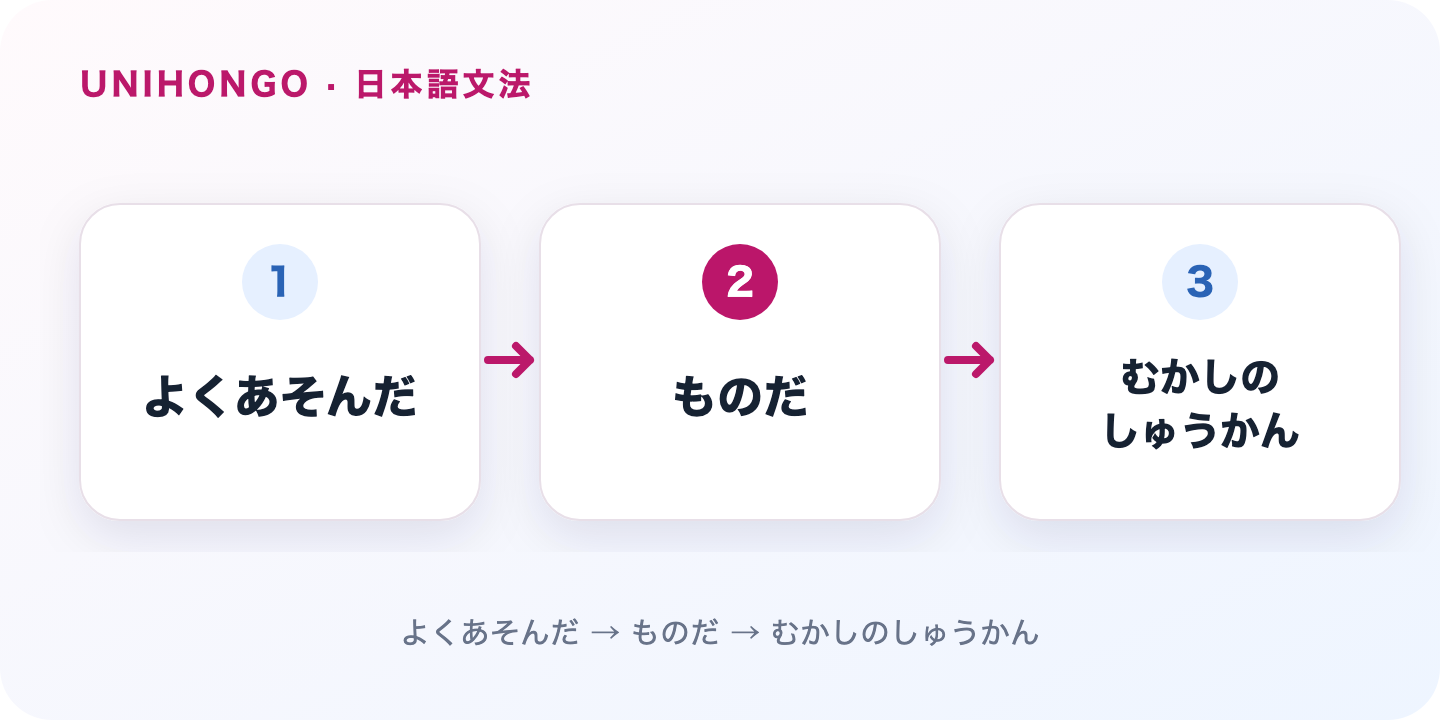
子どもはよく転ぶものだ gives a general observation: children often fall. 昔は川で遊んだものだ recalls something the speaker used to do. 時間がたつのは早いものだ expresses a feeling of wonder. These three uses look similar on the surface, so context and the form before ものだ tell you which one is intended.
| Japanese | Romaji | Meaning |
|---|---|---|
| 子どもはよく転ぶものです。 | Kodomo wa yoku korobu mono desu. | Children do fall often. |
| 昔はこの公園でよく遊んだものです。 | Mukashi wa kono kōen de yoku asonda mono desu. | I used to play in this park a lot. |
How to form it
A plain nonpast verb or adjective often supports a general statement: 人は変わるものだ. Plain past + ものだ commonly recalls a repeated habit: よく遊んだものだ. An adjective or exclamatory observation can carry strong feeling: 早いものだ. Nouns and な adjectives need the appropriate attributive form, such as 静かなものだ.
| Use | Japanese form | Meaning |
|---|---|---|
| General | 人は変わるものだ | People do change |
| Past habit | よく遊んだものだ | I used to play often |
| Feeling | 早いものだ | How fast it is |
Natural examples
Read each sentence for the relationship between the first idea and the second. The English translation gives a natural meaning, while the Japanese wording shows exactly where the pattern attaches.
| Japanese | Romaji | Meaning |
|---|---|---|
| 時間がたつのは早いものですね。 | Jikan ga tatsu no wa hayai mono desu ne. | How quickly time passes. |
| 人は経験から学ぶものだ。 | Hito wa keiken kara manabu mono da. | People learn from experience. |
Compare the nearby pattern
よく川で遊びました simply reports past frequency. よく川で遊んだものです makes it a warm recollection. 人は変わります is a plain assertion; 人は変わるものだ presents it as a broader lesson. The form adds stance, not a new physical event.
| Japanese | Romaji | Meaning |
|---|---|---|
| 昔、この公園で遊びました。 | Mukashi, kono kōen de asobimashita. | I played in this park in the past. |
| 昔、この公園でよく遊んだものです。 | Mukashi, kono kōen de yoku asonda mono desu. | I used to play in this park often. |
The two examples may describe similar situations, but they lead the listener to different conclusions. Choose the form that matches the claim you really intend to make.
Common mistake to avoid
Do not automatically translate past + ものだ as 'should have.' In この公園で遊んだものだ, it usually means 'I used to play here.' Conversely, general nonpast ものだ can sound like a norm or tendency. Identify time clues before deciding the meaning.
- Nonpast often expresses a general truth
- Past + ものだ often recalls a repeated habit
- It can also intensify a feeling
- Context determines the reading
Try it yourself
Write three short sentences: a general observation, a repeated childhood habit, and a feeling of surprise about time. Use ものだ in each, then explain which clue changes the meaning.
Say your sentence once slowly while looking at the Japanese pattern. Then say it again without reading. If your second clause changes from a possibility to a fact, or from advice to a requirement, revise it so the grammar still matches your meaning.