

Where nakya and nakucha come from
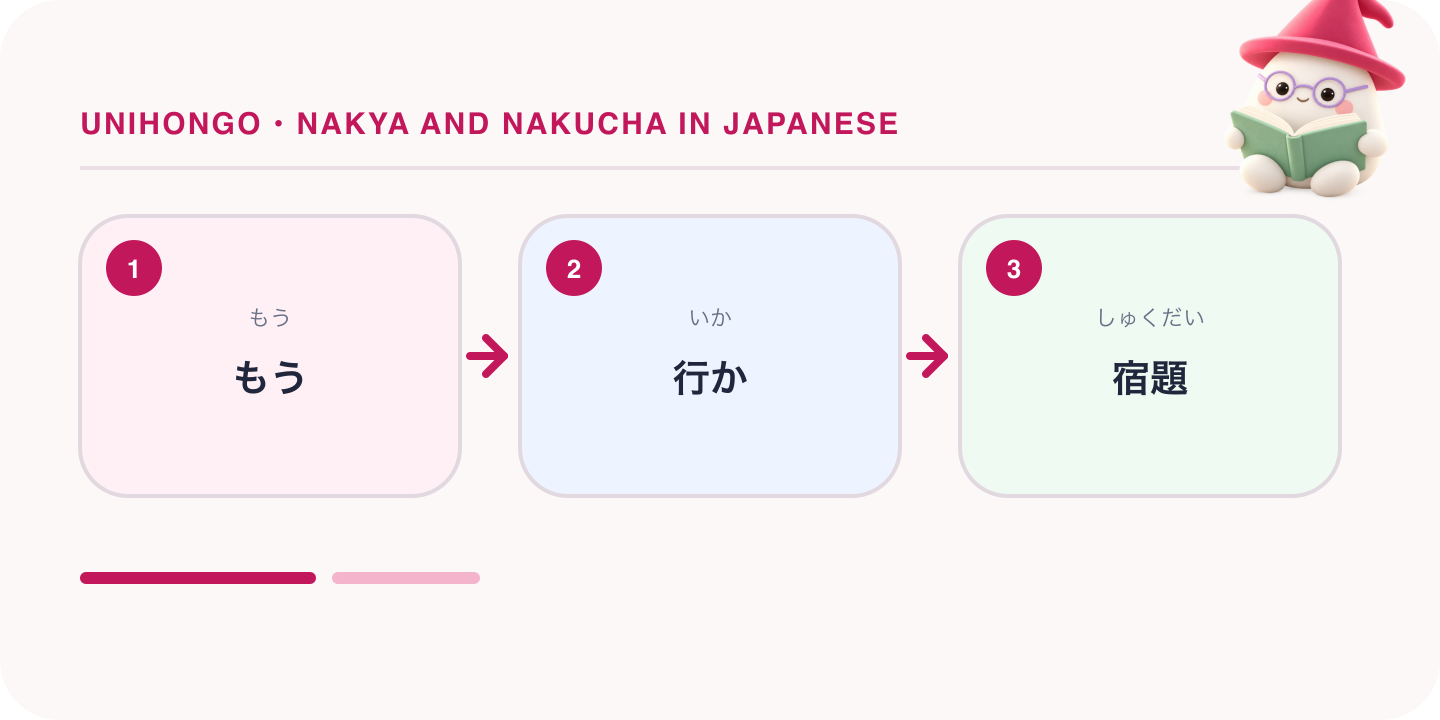
Every casual obligation form starts from the plain negative of the verb. Take iku, to go: the negative is ikanai. The formal obligation pattern replaces the final i with kereba, giving ikanakereba, and adds naranai, ikenai or ikemasen: ikanakereba narimasen. Spoken Japanese compresses nakereba into nakya. That is the whole story of ikanakya.
Nakucha comes from a second formal pattern, nakute wa, which is the te form of the negative plus the topic particle wa. Ikanakute wa ikenai contracts to ikanakucha ikenai, and the cha sound is exactly what happens to te wa in fast speech. The same contraction gives shicha dame from shite wa dame.
The third form is the simplest. Nai to is the plain negative plus the conditional to: ikanai to ikenai, if I do not go, it will not do. Nothing contracts here, which is why nai to is the easiest to build on the spot with any verb, including irregular ones like shinai to and konai to.
| Japanese | Romaji | Meaning |
|---|---|---|
| もう行かなきゃ。 | Mō ikanakya. | I have to go now. |
| 宿題やらなくちゃ。 | Shukudai yaranakucha. | I have to do my homework. |
| 明日早く起きないと。 | Ashita hayaku okinai to. | I have to get up early tomorrow. |
| これ、今日中に出さなきゃいけないんだ。 | Kore, kyōjū ni dasanakya ikenai n da. | I have to hand this in by the end of today. |
| 薬、飲まなくちゃだめだよ。 | Kusuri, nomanakucha dame da yo. | You have to take your medicine. |
| ちゃんと連絡しないといけないよ。 | Chanto renraku shinai to ikenai yo. | You have to get in touch properly. |
Why the ending disappears
The most common way to hear these forms is with nothing after them. Ikanakya, full stop. Learners feel the sentence is broken, but to a native ear it is complete: the listener supplies naranai or ikenai without thinking, so saying it adds only length and a bossy edge.
Trailing forms are especially natural when you are talking about your own obligations. Sorosoro kaeranai to, I should be getting home, is what people say while glancing at their watch. Adding ikenai to that makes it feel like you are stating a rule rather than a feeling. Dropping the ending keeps it light, and it invites the listener to respond: sō da ne, mō konna jikan da, yes, look at the time.
| Japanese | Romaji | Meaning |
|---|---|---|
| そろそろ帰らないと。 | Sorosoro kaeranai to. | I should be getting home soon. |
| あ、電話しなきゃ。 | A, denwa shinakya. | Oh, I need to make a call. |
| これ、返さなくちゃ。 | Kore, kaesanakucha. | I have to return this. |
| もう出なきゃ? | Mō denakya? | Do we have to leave already? |
| ご飯作らなきゃなあ。 | Gohan tsukuranakya nā. | I suppose I have to make dinner. |
| 急がないと、間に合わないよ。 | Isoganai to, maniawanai yo. | If we don't hurry, we won't make it. |
Ikenai, dame and naranai: the ending changes the tone
When the ending is spoken, the choice of word matters. Naranai is the textbook ending and the most formal; in speech it belongs to announcements, instructions and writing. Ikenai is the everyday ending and the one to use when you do finish the sentence in conversation. Dame is the most personal: it says that the alternative is no good, and it often carries a note of scolding or self-scolding.
Compare three ways of telling a friend to take medicine. Nomanakereba naranai sounds like a doctor's leaflet. Nomanakya ikenai yo sounds like a friend reminding you. Nomanakya dame da yo sounds like a worried parent.
In polite speech, ikenai becomes ikemasen and dame becomes dame desu. Naranai becomes narimasen. You cannot attach masu forms to the contracted stems nakya and nakucha, so once you are speaking politely you need the full stem: ikanakereba narimasen, ikanakute wa ikemasen or ikanai to ikemasen. The last of these is the shortest polite obligation available and worth learning as your default in the office.
| Japanese | Romaji | Meaning |
|---|---|---|
| 会議は九時に始めなければなりません。 | Kaigi wa kuji ni hajimenakereba narimasen. | The meeting must start at nine. |
| 明日までに送らないといけません。 | Ashita made ni okuranai to ikemasen. | I have to send it by tomorrow. |
| ここは靴を脱がなくちゃいけないよ。 | Koko wa kutsu o nuganakucha ikenai yo. | You have to take your shoes off here. |
| ちゃんと寝なきゃだめだよ。 | Chanto nenakya dame da yo. | You have to get proper sleep. |
| それは言わなきゃならないことだった。 | Sore wa iwanakya naranai koto datta. | That was something that had to be said. |
| 予約しないとだめですか。 | Yoyaku shinai to dame desu ka. | Do I have to make a reservation? |
Register: who you can say nakya to
Nakya, nakucha and the trailing nai to are casual by nature. They are right with friends, family, partners, classmates and colleagues you joke with. They are wrong with a client, a customer, a teacher you barely know, or anyone you would address with desu and masu. The rule of thumb is simple: if your other verbs in the conversation end in masu, your obligations should end in ikemasen or narimasen.
There is a middle ground. With a friendly manager during small talk, you might say kaeranai to desu ne, adding desu to the trailing form. This is common in relaxed office speech and lets you stay polite while sounding natural. Do not say ikanakya desu, which sounds like a child trying to be polite.
Within casual speech, the forms stack with sentence-ending particles: nakya ne asks for agreement, nakya na is a private mutter, nakya yo reminds someone else, and nakya nā shows reluctance.
| Japanese | Romaji | Meaning |
|---|---|---|
| 今日は早く帰らないとですね。 | Kyō wa hayaku kaeranai to desu ne. | I need to head home early today, don't I. |
| 先に確認しなきゃね。 | Saki ni kakunin shinakya ne. | We should check first, right? |
| そろそろ準備しなくちゃな。 | Sorosoro junbi shinakucha na. | I'd better start getting ready. |
| もっと勉強しなきゃなあ。 | Motto benkyō shinakya nā. | I really should study more. |
| 部長には報告しなければなりません。 | Buchō ni wa hōkoku shinakereba narimasen. | I must report to the department head. |
| 先に食べちゃだめだよ。 | Saki ni tabecha dame da yo. | You mustn't eat first. |
How these forms look in texts and chat
Messaging is where the trailing forms dominate. A text saying ikanakya is complete, and it is often followed by a sticker rather than a verb ending.
Shinakya as a bare reply to a question means I have to: are you going to the party? Shigoto shinakya, I have to work. A common apology in chat is gomen, mō nenakya, sorry, I have to sleep now, which closes a late-night conversation without anyone feeling brushed off.
- ikanakya: I have to go, the standard sign-off when leaving a chat
- yaranakucha: I have to do it, often about chores or homework
- nenai to: I need to sleep, the late-night goodbye
- shigoto shinakya: I have to work, a reason for declining
- kikanakya: I have to ask, before checking with someone else
- ganbaranakya: I have to do my best, a cheerful self-encouragement
Notice how each of these can be a whole message. In writing there is no intonation, so if you want the message to sound gentle rather than abrupt, add ne or a softening emoji rather than the verb ending.
The spoken forms side by side
The table below takes one verb per row and shows the casual contraction, so you can see the pattern across verb groups. The Reading column gives the romaji; the last column notes anything worth knowing about the form.
| Casual form | Reading | Meaning and notes |
|---|---|---|
| 行かなきゃ | ikanakya | have to go; from ikanakereba |
| 行かなくちゃ | ikanakucha | have to go; from ikanakute wa |
| 行かないと | ikanai to | have to go; also a plain condition |
| しなきゃ | shinakya | have to do; irregular suru |
| 来なくちゃ | konakucha | have to come; irregular kuru, read konakucha |
| 食べなきゃ | tabenakya | have to eat; ru verb |
| 書かないと | kakanai to | have to write; u verb |
| 待たなきゃ | matanakya | have to wait; tsu becomes ta |
| 買わなくちゃ | kawanakucha | have to buy; u becomes wa |
| 帰らないと | kaeranai to | have to go home; ru ending u verb |
| 言わなきゃならない | iwanakya naranai | must say; the formal ending kept in speech |
| 寝なくちゃだめ | nenakucha dame | must sleep; dame adds a scolding note |
The irregular verbs are the usual trap. Kuru gives konai, so the forms are konakya, konakucha and konai to, never kinakya. Suru gives shinai, so shinakya, shinakucha and shinai to.
Answering and negotiating with obligation
When a friend says ikanakya, the natural replies are mō? already?, sō ka, I see, or ganbatte, good luck. When someone asks whether they must do something, answer with the same form or with permission: ikanakya dame? Uun, ikanakute mo ii yo, no, you don't have to go.
Negotiation with obligation is common at work and among friends. Kyō ja nakya dame? asks whether it really has to be today. Zenbu yaranakya ikenai no? asks whether all of it really has to be done. The question forms are useful because they let you push back without refusing outright, which is the polite way to disagree in Japanese.
| Japanese | Romaji | Meaning |
|---|---|---|
| 今日じゃなきゃだめ? | Kyō ja nakya dame? | Does it have to be today? |
| 全部やらなきゃいけないの? | Zenbu yaranakya ikenai no? | Do I have to do all of it? |
| ううん、行かなくてもいいよ。 | Uun, ikanakute mo ii yo. | No, you don't have to go. |
| 明日までですね、わかりました。 | Ashita made desu ne, wakarimashita. | By tomorrow, right, understood. |
| じゃあ、私も帰らなきゃ。 | Jā, watashi mo kaeranakya. | Well then, I have to go home too. |
| それは自分でやらないとね。 | Sore wa jibun de yaranai to ne. | That's something you have to do yourself. |
Mistakes learners make with nakya and nakucha
The first mistake is using the contractions in polite speech. Ikanakya ikemasen mixes a casual stem with a polite ending; it is understood, but it sounds uneven. Either go fully casual, ikanakya, or fully polite, ikanakereba narimasen or ikanai to ikemasen.
The second is building the contraction from the wrong stem, producing iku nakya or ikimasen nakya. The contraction always attaches to the plain negative with the final i removed: ikana plus kya, tabena plus kya, shina plus kya.
The third mistake is overusing dame. It is tempting because it is short and easy, but dame da yo after every obligation makes you sound like you are lecturing everyone. Use ikenai for neutral obligations and save dame for when something really is not acceptable, or when you are being deliberately warm and bossy with a close friend.
Finally, a bare ikanakya can sound cryptic to a stranger on the phone or in a message to someone who does not know your plans. Adding a short reason fixes it: ikanakya, kaigi ga aru kara.
| Japanese | Romaji | Meaning |
|---|---|---|
| 行かなければなりません。 | Ikanakereba narimasen. | I must go. (polite, correct) |
| 行かなきゃ。 | Ikanakya. | I have to go. (casual, correct) |
| 行かなきゃ、会議があるから。 | Ikanakya, kaigi ga aru kara. | I have to go, I've got a meeting. |
| 食べなきゃいけないよ。 | Tabenakya ikenai yo. | You have to eat. (neutral reminder) |
| すぐ返事しないといけないんです。 | Sugu henji shinai to ikenai n desu. | I have to reply straight away. (polite explanation) |