

One-way and mutual: the idea behind ni and to
The clearest way to think about this pair is direction. Ni is an arrow: it points an action at a target, and the target does not have to do anything. To is a bracket: it puts two parties together, and both take part in the action. Some verbs can only be one-way, some only mutual, and the most useful ones can be either.
A quick test helps. Turn the sentence around and see whether it is still true. If Tanaka-san to kekkon shita is true, then Tanaka-san also married you, so to fits. If you tell Tanaka-san some news, Tanaka-san did not tell you the news back, so ni fits. When both directions are true at once, as with talking or meeting, Japanese lets you choose the particle that matches what you want to stress.
| Japanese | Romaji | Meaning |
|---|---|---|
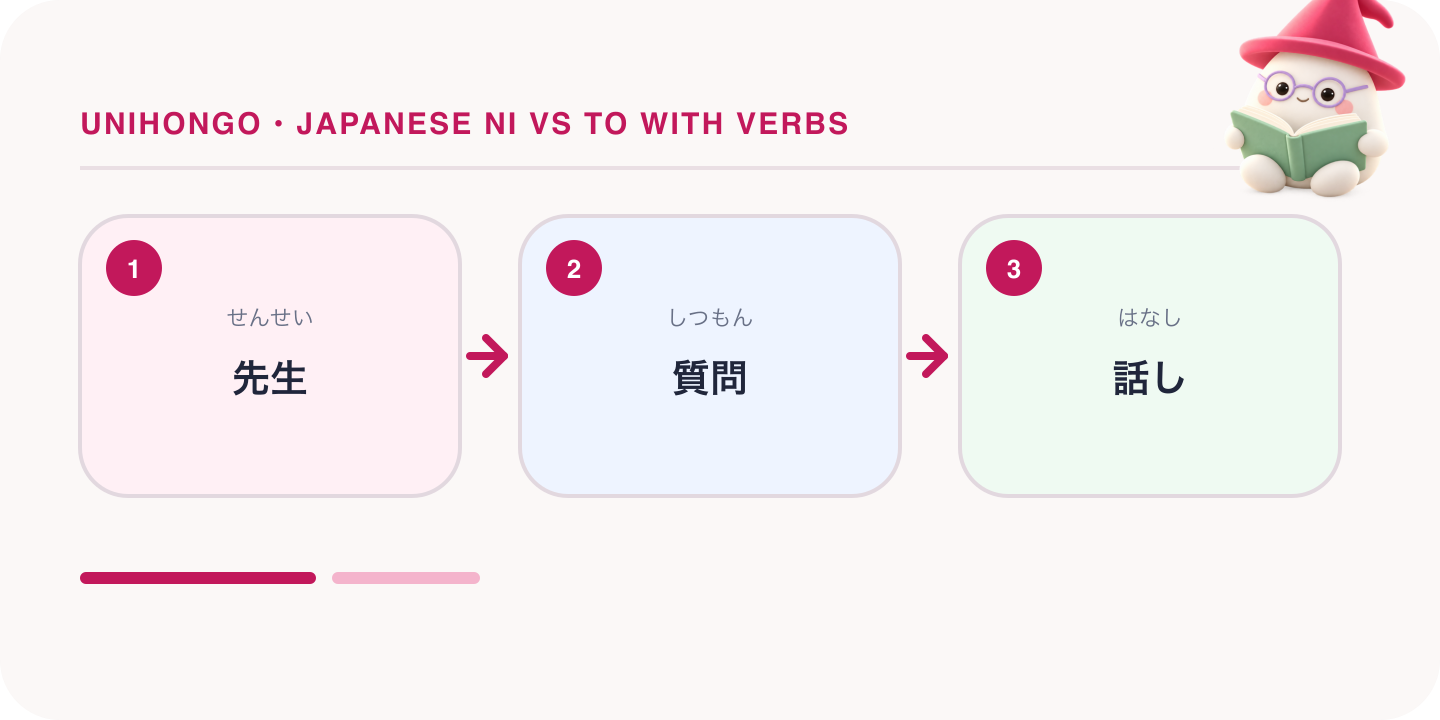
| 先生に質問しました。 | Sensei ni shitsumon shimashita. | I asked the teacher a question. |
| 先生と話しました。 | Sensei to hanashimashita. | I talked with the teacher. |
| 妹にメールを送りました。 | Imōto ni mēru o okurimashita. | I sent my younger sister an email. |
| 妹と買い物に行きました。 | Imōto to kaimono ni ikimashita. | I went shopping with my younger sister. |
| 同僚と協力します。 | Dōryō to kyōryoku shimasu. | I'll cooperate with my colleagues. |
Au: meeting someone with ni or to
Au, to meet, is the verb that puzzles learners first, because both particles are common and correct. Hito ni au is the default. It treats the other person as the point you are heading for, which is why it pairs naturally with going somewhere: eki de tomodachi ni au, meet a friend at the station. It is also the only choice when meeting is one-sided, as in running into someone by chance, or seeing a doctor or a client.
Hito to au stresses that the two of you are meeting each other, usually by arrangement and with some time spent together. Kanojo to au sounds like a planned meeting between two willing parties; kanojo ni au is more neutral. The related verb deau, to come across, prefers to for people who meet by chance and become friends or partners, and ni for a thing or idea you happened upon.
| Japanese | Romaji | Meaning |
|---|---|---|
| 駅で友達に会います。 | Eki de tomodachi ni aimasu. | I'll meet a friend at the station. |
| 週末に彼女と会います。 | Shūmatsu ni kanojo to aimasu. | I'm meeting my girlfriend at the weekend. |
| 昨日、偶然先生に会いました。 | Kinō, gūzen sensei ni aimashita. | I ran into my teacher yesterday. |
| 医者に会って相談しました。 | Isha ni atte sōdan shimashita. | I saw a doctor and asked for advice. |
| 大学で妻と出会いました。 | Daigaku de tsuma to deaimashita. | I met my wife at university. |
Hanasu and sōdan suru: telling versus talking together
Hanasu covers both to tell and to talk, and the particle decides which. Tomodachi ni hanasu is to tell a friend something; the friend listens. It often takes a content object with o or a quoted clause with to: sono koto o tomodachi ni hanashita, I told my friend about that. Tomodachi to hanasu is to have a conversation; both people speak. The quoting to, I said that, is a different word, so one sentence can hold both: tomodachi ni ikanai to hanashita, I told my friend I would not go.
Sōdan suru, to consult, follows the same split. Sensei ni sōdan suru means you bring your problem to the teacher and the teacher advises you, the usual situation. Tomodachi to sōdan suru means you and your friend put your heads together over a shared problem. Iu, to say, setsumei suru, to explain, and oshieru, to tell or teach, are ni verbs, because the action is directed. Shaberu, to chat, leans towards to, because it describes an exchange.
| Japanese | Romaji | Meaning |
|---|---|---|
| そのことは母に話しました。 | Sono koto wa haha ni hanashimashita. | I told my mother about that. |
| 昼休みに母と話しました。 | Hiruyasumi ni haha to hanashimashita. | I talked with my mother during the lunch break. |
| 進路について先生に相談しました。 | Shinro ni tsuite sensei ni sōdan shimashita. | I consulted my teacher about my future path. |
| 旅行の予定を友達と相談しています。 | Ryokō no yotei o tomodachi to sōdan shite imasu. | I'm discussing travel plans with a friend. |
| 理由を部長に説明しました。 | Riyū o buchō ni setsumei shimashita. | I explained the reason to the department head. |
Kekkon suru, niru and chigau: always symmetrical
Some relationships are the same from both sides. If A marries B, B marries A. If A resembles B, B resembles A. If A differs from B, B differs from A. Japanese marks all of these with to. Kekkon suru is the clearest case: Tanaka-san to kekkon shimashita is the only normal way to say I married Tanaka.
Niru, to resemble, uses to when the comparison is between equals: chichi to nite iru, I look like my father. Ni is also heard, chichi ni nite iru, and here the father is treated as the model that the child is measured against. Both are accepted; ni is a little more common in casual talk about family resemblance. Chigau, to differ, and onaji, the same, both pair with to, as do tsukiau, to go out with, kenka suru, to quarrel, and wakareru, to split up.
| Japanese | Romaji | Meaning |
|---|---|---|
| 来年、高校の同級生と結婚します。 | Rainen, kōkō no dōkyūsei to kekkon shimasu. | Next year I'm marrying a classmate from high school. |
| 兄と性格がよく似ています。 | Ani to seikaku ga yoku nite imasu. | My personality is a lot like my older brother's. |
| 娘は母親に似ています。 | Musume wa hahaoya ni nite imasu. | The daughter takes after her mother. |
| 日本の習慣と少し違います。 | Nihon no shūkan to sukoshi chigaimasu. | It's a little different from Japanese custom. |
| 彼と同じ意見です。 | Kare to onaji iken desu. | I have the same opinion as him. |
| 大学の時から彼女と付き合っています。 | Daigaku no toki kara kanojo to tsukiatte imasu. | I've been going out with her since university. |
To issho ni and ni tsuite
To issho ni, together with, is the everyday way to say you did something in someone's company. The to already means with, and issho ni adds the picture of two people side by side doing the same thing. It is more common than bare to for going, eating, living and playing, and it lets you drop the partner when it is obvious: issho ni tabemasen ka, shall we eat together? Bare to is preferred with the mutual verbs above; to issho ni kekkon suru is odd, because marrying is already mutual.
Ni tsuite means about, concerning, and marks the topic of a verb of communication or thought: hanasu, kangaeru, kaku, shiraberu, kiku. Before a noun it needs no: Nihon no bunka ni tsuite no repōto, a report about Japanese culture. Both particles often appear in one sentence: tomodachi to shigoto ni tsuite hanashita, I talked with a friend about work.
| Japanese | Romaji | Meaning |
|---|---|---|
| 家族と一緒に京都へ行きました。 | Kazoku to issho ni Kyōto e ikimashita. | I went to Kyoto together with my family. |
| 一緒に昼ご飯を食べませんか。 | Issho ni hirugohan o tabemasen ka. | Shall we have lunch together? |
| 日本の歴史について話しました。 | Nihon no rekishi ni tsuite hanashimashita. | We talked about Japanese history. |
| 環境問題についてのレポートを書きます。 | Kankyō mondai ni tsuite no repōto o kakimasu. | I'll write a report about environmental problems. |
| 友達と仕事について相談しました。 | Tomodachi to shigoto ni tsuite sōdan shimashita. | I talked over my job with a friend. |
Summary table: which particle each verb takes
The table gathers the verbs from this guide, with the standard particle, the possible alternative, and the change in meaning when both work.
| Verb | Reading | Particle and meaning |
|---|---|---|
| 会う | au | Ni to meet, see someone; to to meet up together |
| 出会う | deau | To to meet by chance and get to know; ni for things and ideas |
| 話す | hanasu | Ni to tell someone; to to talk with someone |
| 相談する | sōdan suru | Ni to ask someone for advice; to to discuss together |
| 言う | iu | Ni only: to say to someone |
| 説明する | setsumei suru | Ni only: to explain to someone |
| 結婚する | kekkon suru | To only: to marry someone |
| 似ている | nite iru | To or ni: to resemble; ni treats the other as the model |
| 違う | chigau | To only: to differ from |
| 同じ | onaji | To only: the same as |
| 付き合う | tsukiau | To only: to go out with, keep company with |
| けんかする | kenka suru | To only: to quarrel with |
Two rules cover most of the table. If the other person could be replaced by a place or a thing without changing the grammar, the verb takes ni. If the sentence remains true when you swap the two people around, the verb takes to.
Ni, to, e and de: keeping the neighbours apart
Because ni also marks destinations, learners sometimes swap it for e with these verbs. E marks a direction of movement and cannot mark a person you meet or talk to: tomodachi e au is wrong. De marks the place where an action happens, so it combines with any of these verbs without competing: kafe de tomodachi to hanasu, talk with a friend at a café. Most speakers say eki de tomodachi ni au, because the meeting happens at the station rather than the station being a destination.
- Ni: the person an action is aimed at (au, hanasu as tell, iu, sōdan suru, setsumei suru)
- To: the person who shares the action (kekkon suru, tsukiau, hanasu as talk, chigau, onaji)
- E: a direction of movement, never a person you meet or tell
- De: the place where the meeting or conversation happens
- Quoting to: marks what was said and sits right before iu, hanasu or omou
Common mistakes and how to fix them
The most frequent error is o with au: tomodachi o aimashita. English has a direct object after meet, but Japanese never does; use ni for a neutral meeting or to for a planned meet-up. The second is ni with kekkon suru, which sounds like an arranged marriage from a period drama; use to. The third is bare to where ni tsuite is needed: kaisha to hanashita means you talked with the company, not about it.
Politeness also interacts with the choice. With people above you, one-way verbs keep their ni: buchō ni sōdan suru, buchō ni hōkoku suru. Turning them into to versions does not make them more polite; it changes the meaning to a joint discussion, which can sound presumptuous.
| Japanese | Romaji | Meaning |
|---|---|---|
| 友達に会いました。 | Tomodachi ni aimashita. | I met a friend. (not tomodachi o) |
| 田中さんと結婚しました。 | Tanaka-san to kekkon shimashita. | I married Tanaka. (not Tanaka-san ni) |
| 会社について話しました。 | Kaisha ni tsuite hanashimashita. | I talked about the company. (not kaisha to) |
| 部長に相談してから決めます。 | Buchō ni sōdan shite kara kimemasu. | I'll decide after consulting the department head. |