
Two families and how to sort a new word
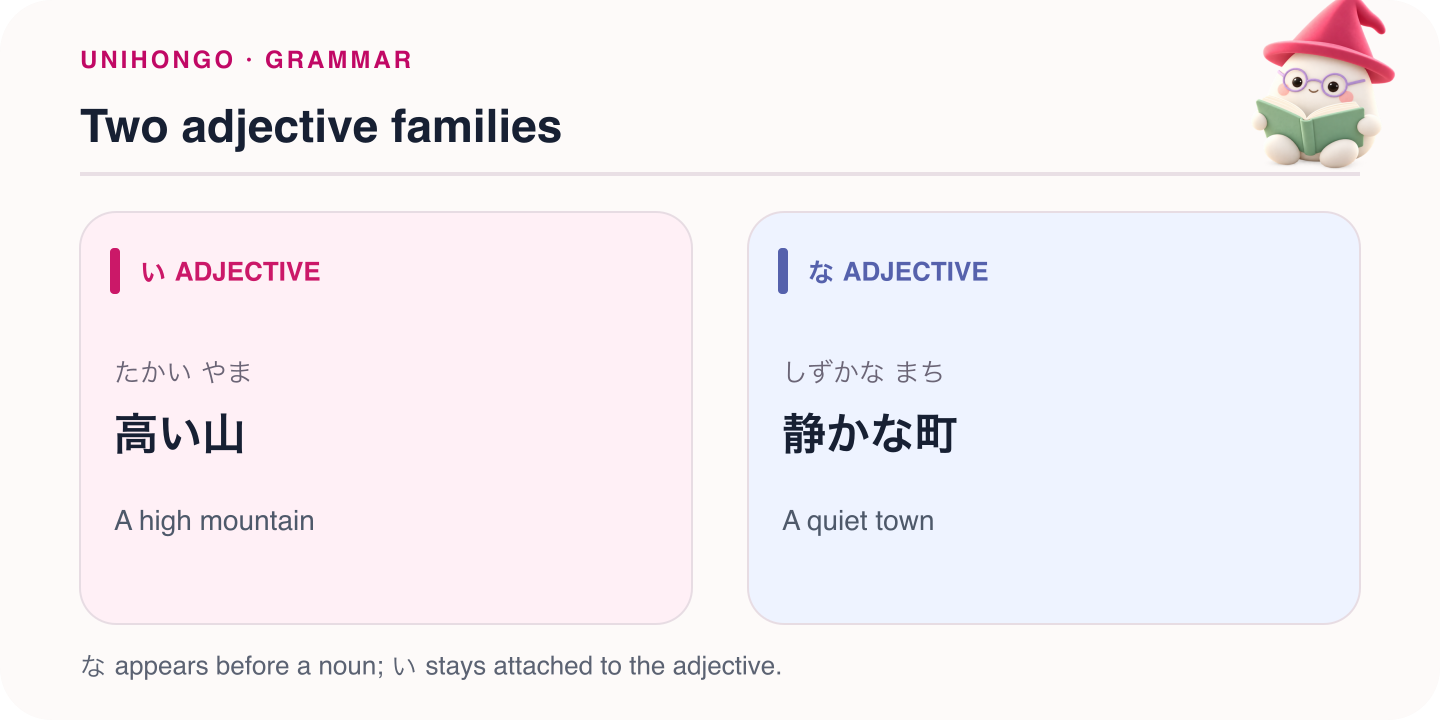
Every Japanese adjective belongs to one of two groups. The i-adjectives end in the sound i in their dictionary form and behave like small verbs: the ending itself carries tense and negation. The na-adjectives behave like nouns and borrow their endings from desu, taking na only when they sit directly in front of a noun. Sorting a new word correctly is the single most useful habit, because every other pattern in this guide branches from it.
The sorting rule is nearly mechanical: if the plain form ends in i, treat it as an i-adjective. The exceptions are few enough to memorise, since kirei, yūmei, kirai, and teinei end in i but take na. Borrowed words such as hansamu are na-adjectives too. When you meet a new adjective, say it once in front of a noun so the na either appears or does not.
| Japanese | Romaji | Meaning |
|---|---|---|
| 高い店です。 | Takai mise desu. | It is an expensive shop. |
| 静かな店です。 | Shizuka na mise desu. | It is a quiet shop. |
| きれいな部屋ですね。 | Kirei na heya desu ne. | This is a lovely room, isn't it. |
| 有名な人です。 | Yūmei na hito desu. | He is a famous person. |
The four forms side by side
| Form | 高い takai (expensive) | 静か shizuka (quiet) |
|---|---|---|
| Present positive | 高いです takai desu | 静かです shizuka desu |
| Present negative | 高くないです takaku nai desu | 静かじゃないです shizuka ja nai desu |
| Past positive | 高かったです takakatta desu | 静かでした shizuka deshita |
| Past negative | 高くなかったです takaku nakatta desu | 静かじゃなかったです shizuka ja nakatta desu |
| Before a noun | 高い店 takai mise | 静かな店 shizuka na mise |
Read the columns as two machines. On the left the word itself changes and desu never moves; on the right the word never changes and everything happens after it. Once that picture is clear you can conjugate an adjective you have never seen, because its ending tells you which machine to use.
Making i-adjectives negative and past
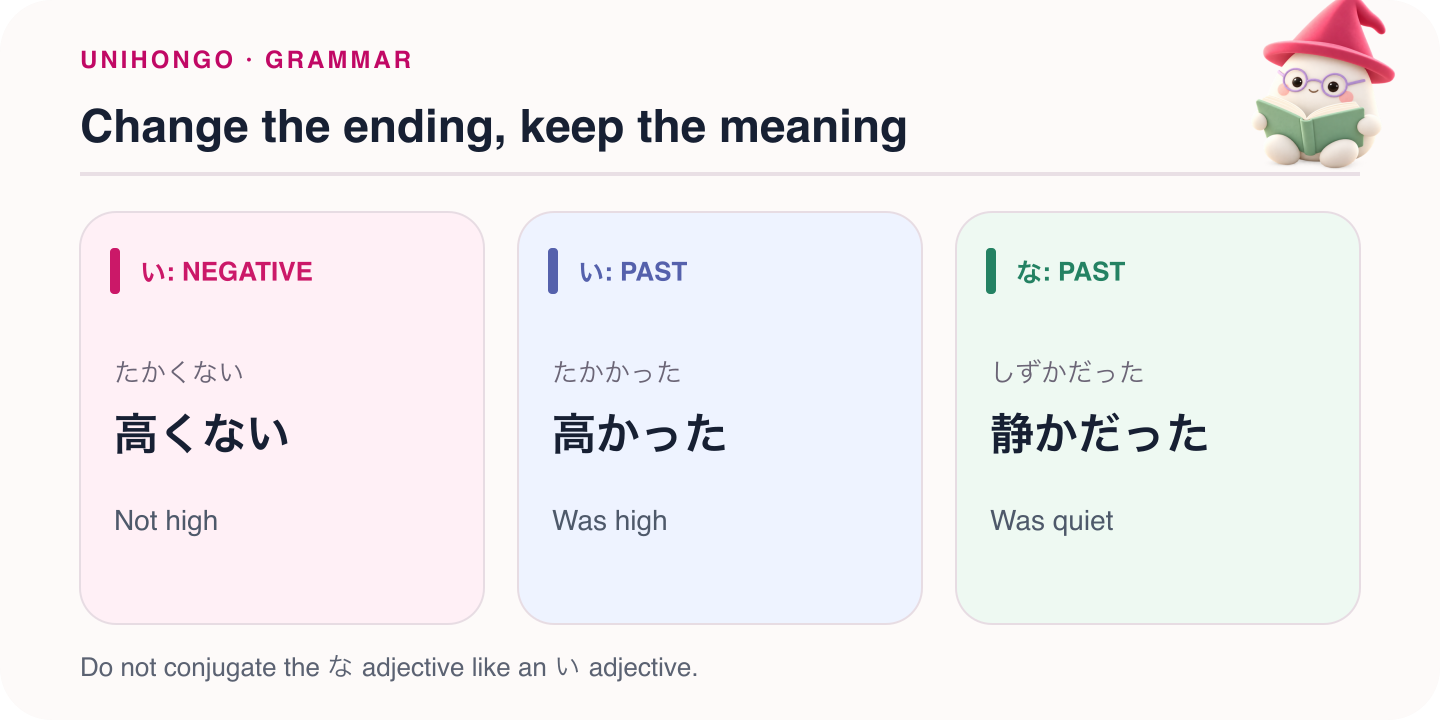
Drop the final i and add the ending. Takai becomes taka plus ku nai for the negative and taka plus katta for the past. The two combine into takaku nakatta for the past negative. Keep desu on the end in polite speech and leave it off with friends. The one mistake to avoid is takai deshita, which sounds clearly wrong to a Japanese ear because the past is already available inside the adjective.
In formal settings you will hear takaku arimasen and takaku arimasen deshita instead. Recognise them, but use takaku nai desu when speaking. A useful reply habit is to give the negative and then the reason: samuku nai desu, kōto ga arimasu kara.
| Japanese | Romaji | Meaning |
|---|---|---|
| この本は面白いです。 | Kono hon wa omoshiroi desu. | This book is interesting. |
| この本は面白くないです。 | Kono hon wa omoshiroku nai desu. | This book is not interesting. |
| 昨日は寒かったです。 | Kinō wa samukatta desu. | It was cold yesterday. |
| 昨日は寒くなかったです。 | Kinō wa samuku nakatta desu. | It was not cold yesterday. |
| 試験は難しくありませんでした。 | Shiken wa muzukashiku arimasen deshita. | The exam was not difficult. |
Making na-adjectives negative and past
A na-adjective never changes; the ending after it does. Shizuka desu becomes shizuka ja nai desu, shizuka deshita, and shizuka ja nakatta desu. The written and more formal equivalent replaces ja with de wa, giving shizuka de wa arimasen. Since nouns take exactly the same endings, learning this set once also teaches you gakusei ja nai desu and ame deshita.
The classic error is treating a na-adjective as if it had an i ending, producing shizukaku nai. If you reach for ku, check whether the word takes na before a noun. The other frequent slip is keeping na at the end of a sentence: say benri desu, not benri na desu.
| Japanese | Romaji | Meaning |
|---|---|---|
| この駅は便利です。 | Kono eki wa benri desu. | This station is convenient. |
| この駅は便利じゃないです。 | Kono eki wa benri ja nai desu. | This station is not convenient. |
| 先週は暇でした。 | Senshū wa hima deshita. | I was free last week. |
| 先週は暇じゃなかったです。 | Senshū wa hima ja nakatta desu. | I was not free last week. |
| 彼は親切ではありません。 | Kare wa shinsetsu de wa arimasen. | He is not kind. |
Ii and kakkoii change their stem
Ii is the one truly irregular adjective. It conjugates from its older form yoi, so the negative is yoku nai desu and the past is yokatta desu, never iikatta. Yokatta desu on its own is one of the most useful sentences in the language, meaning that was good or I am glad to hear it. Any compound built on ii inherits the same behaviour: kakkoii becomes kakkoyokatta, and kimochi ii becomes kimochi yokatta.
| Japanese | Romaji | Meaning |
|---|---|---|
| 天気がいいです。 | Tenki ga ii desu. | The weather is good. |
| 天気がよくないです。 | Tenki ga yoku nai desu. | The weather is not good. |
| 昨日の映画はよかったです。 | Kinō no eiga wa yokatta desu. | Yesterday's film was good. |
| 元気になってよかったですね。 | Genki ni natte yokatta desu ne. | I am glad you are better. |
| そのシャツ、かっこよかったですよ。 | Sono shatsu, kakkoyokatta desu yo. | That shirt looked great. |
Joining two descriptions with kute and de
To put two adjectives in one sentence, connect them rather than repeating desu. An i-adjective drops i and adds kute: yasui plus oishii gives yasukute oishii desu. A na-adjective simply adds de: shizuka de kirei desu. Ii again becomes yokute. You can mix the families freely as long as each word uses its own connector, as in hiroku te benri na heya.
Use this whenever a reply feels too short. Asked how a restaurant was, yasukatta desu answers, but yasukute oishikatta desu sounds like an opinion. The joined descriptions should point the same way; if one is positive and one negative, use ga or kedo instead, as in yasui desu ga, semai desu.
| Japanese | Romaji | Meaning |
|---|---|---|
| 安くておいしいです。 | Yasukute oishii desu. | It is cheap and tasty. |
| 静かできれいな町です。 | Shizuka de kirei na machi desu. | It is a quiet, pretty town. |
| 広くて明るい部屋でした。 | Hirokute akarui heya deshita. | It was a spacious, bright room. |
| 安いですが、狭いです。 | Yasui desu ga, semai desu. | It is cheap, but cramped. |
| 天気がよくて楽しかったです。 | Tenki ga yokute tanoshikatta desu. | The weather was good and it was fun. |
Turning adjectives into adverbs
To describe how an action is done, an i-adjective changes i to ku and a na-adjective adds ni. Hayai becomes hayaku, and jōzu becomes jōzu ni. The same forms combine with naru to describe change, giving ōkiku narimashita for it has grown and genki ni narimashita for I have recovered. This one pattern turns your whole adjective list into a set of usable adverbs.
Some of these matter more as requests than as descriptions. Shizuka ni shite kudasai asks a room for quiet, and mō sukoshi ōkiku onegaishimasu asks someone to speak up. Being able to produce those two on the spot is worth more in a real conversation than another ten adjectives you can only recognise on a page.
| Japanese | Romaji | Meaning |
|---|---|---|
| 早く起きました。 | Hayaku okimashita. | I got up early. |
| 上手に話しますね。 | Jōzu ni hanashimasu ne. | You speak well. |
| 静かにしてください。 | Shizuka ni shite kudasai. | Please be quiet. |
| もう少し大きくお願いします。 | Mō sukoshi ōkiku onegaishimasu. | A little louder, please. |
| 日本語が上手になりました。 | Nihongo ga jōzu ni narimashita. | My Japanese has got better. |
Comparing with yori, hō, and ichiban
Japanese adjectives do not change shape to compare. You add words instead. A yori B means B more than A, and no hō ga marks the side you prefer. To ask a question, offer both options with to and finish with dochira ga: kōhī to kōcha to, dochira ga suki desu ka. A natural answer keeps the structure: kōhī no hō ga suki desu.
For the top of a group, use ichiban, meaning number one. Name the group with no naka de and then say what wins: Nihon ryōri no naka de sushi ga ichiban suki desu. Have three ready answers about food, cities, and seasons before you need them.
| Japanese | Romaji | Meaning |
|---|---|---|
| 電車のほうが速いです。 | Densha no hō ga hayai desu. | The train is faster. |
| 東京は大阪より大きいです。 | Tōkyō wa Ōsaka yori ōkii desu. | Tokyo is bigger than Osaka. |
| コーヒーと紅茶と、どちらが好きですか? | Kōhī to kōcha to, dochira ga suki desu ka? | Which do you prefer, coffee or tea? |
| コーヒーのほうが好きです。 | Kōhī no hō ga suki desu. | I prefer coffee. |
| 日本料理の中で寿司がいちばん好きです。 | Nihon ryōri no naka de sushi ga ichiban suki desu. | Of all Japanese food, I like sushi best. |
Sugiru, sou, and rashii
Add sugiru to the stem to say that something goes past the acceptable point. An i-adjective drops i, giving takasugiru, and a na-adjective attaches directly, giving shizukasugiru. Verbs use the same ending on their masu stem, so tabesugimashita means I ate too much. Remember that this is a complaint, not an intensifier: takasugimasu means the price is unreasonable, while totemo takai desu simply means very expensive.
| Japanese | Romaji | Meaning |
|---|---|---|
| ちょっと高すぎます。 | Chotto takasugimasu. | It is a little too expensive. |
| この部屋は狭すぎますね。 | Kono heya wa semasugimasu ne. | This room is too small, isn't it. |
| 昨日は食べすぎました。 | Kinō wa tabesugimashita. | I ate too much yesterday. |
| この漢字は難しすぎます。 | Kono kanji wa muzukashisugimasu. | This kanji is too difficult. |
| おいしそうですね。 | Oishisō desu ne. | That looks delicious. |
| 元気そうですね。 | Genki sō desu ne. | You look well. |
| この本はよさそうです。 | Kono hon wa yosasō desu. | This book looks good. |
| 明日は寒いらしいです。 | Ashita wa samui rashii desu. | Apparently it will be cold tomorrow. |
| あの店は有名らしいです。 | Ano mise wa yūmei rashii desu. | That shop is apparently famous. |
Sou attaches to an adjective stem to report what something looks like from the outside. Oishisō desu means it looks delicious, said before you taste it, and genki sō desu ne means you look well. Ii becomes yosasō desu, and nai becomes nasasō desu. Do not use sou for something you can see plainly: a red bag is akai, not akasō.
Rashii reports information you picked up elsewhere, so ashita wa samui rashii desu means apparently it will be cold tomorrow. It attaches to the plain form of an i-adjective and directly to a na-adjective. Both endings let you soften an opinion instead of stating everything as fact.
Twenty adjectives that carry beginner conversation
| Theme | Adjective | Opposite |
|---|---|---|
| Size | 大きい ōkii (big) | 小さい chiisai (small) |
| Price | 高い takai (expensive) | 安い yasui (cheap) |
| Age of things | 新しい atarashii (new) | 古い furui (old) |
| Weather | 暑い atsui (hot) | 寒い samui (cold) |
| Food | おいしい oishii (tasty) | まずい mazui (bad-tasting) |
| Experience | 楽しい tanoshii (fun) | つまらない tsumaranai (boring) |
| Difficulty | 難しい muzukashii (difficult) | 簡単な kantan na (easy) |
| Schedule | 忙しい isogashii (busy) | 暇な hima na (free) |
| Distance | 近い chikai (near) | 遠い tōi (far) |
| Sound | 静かな shizuka na (quiet) | うるさい urusai (noisy) |
Two pairs need care. Atsui and samui describe the air, while atsui and tsumetai describe what you touch, so cold water is tsumetai rather than samui. Mazui is blunt, and in company most speakers soften it to amari suki ja nai desu. Kantan, hima, and shizuka take na while their opposites do not, which makes these rows good practice for switching machines mid-sentence.
Drills that make the endings automatic
- Run one adjective through all four forms out loud before you look at the answer key.
- Pair every i-adjective drill with a na-adjective drill so your mouth learns to switch.
- Describe three objects near you each morning using kute or de to join two ideas.
- Answer dō deshita ka about yesterday in the past tense until takakatta comes without thought.
- Collect the exceptions on one card: ii, kirei, yūmei, kirai, and any new word that surprises you.