

Possession: watashi no hon
Noun A no noun B means B belongs to A: watashi no hon, my book; Tanaka-san no kuruma, Tanaka's car. Japanese has no separate possessive pronouns: my, your and his are watashi no, anata no, kare no. The chain can grow as long as you need, and it always reads from the outside in: chichi no kaisha no tomodachi is a friend from my father's company.
When the owned thing is obvious, the noun after no drops out and no becomes a pronoun meaning one or mine: kono kasa wa watashi no desu, this umbrella is mine. You will use this constantly at shop counters and lost property desks.
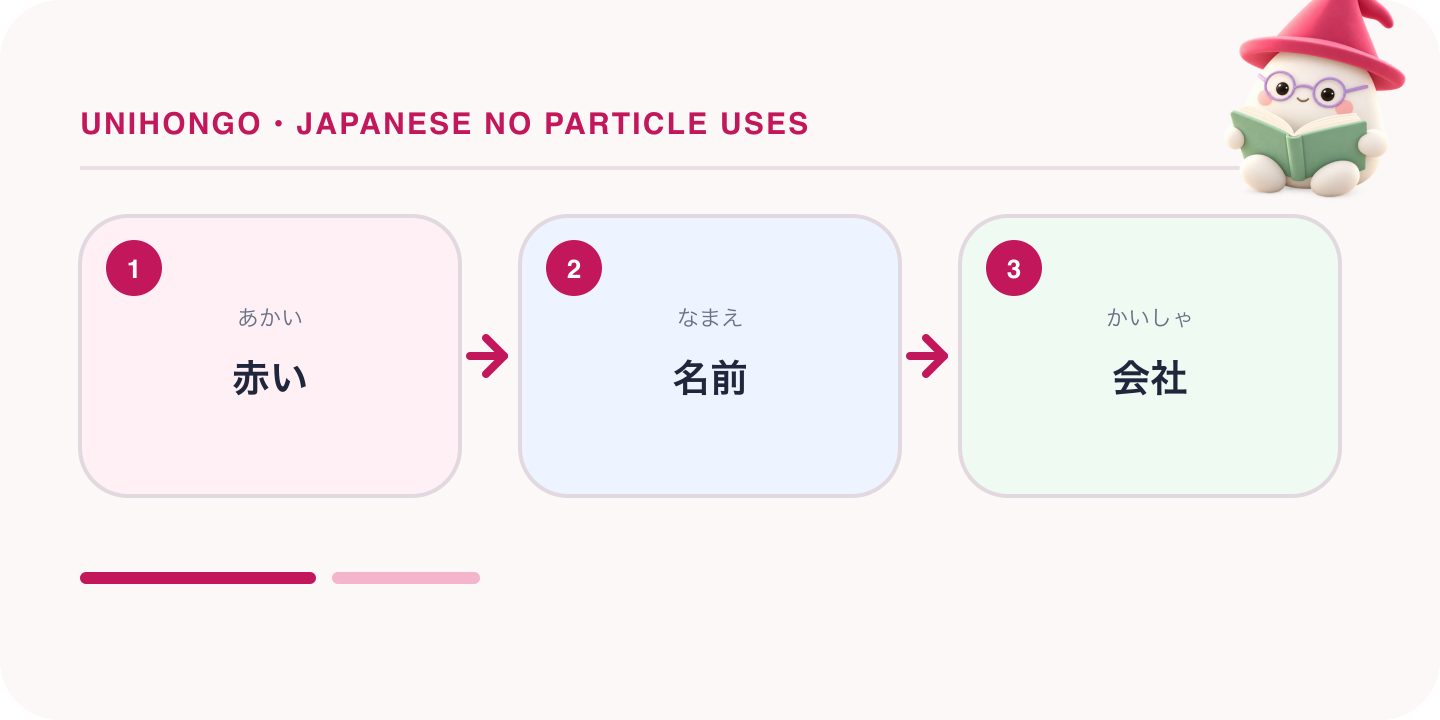
| Japanese | Romaji | Meaning |
|---|---|---|
| これは私の本です。 | Kore wa watashi no hon desu. | This is my book. |
| 田中さんの車は赤いです。 | Tanaka-san no kuruma wa akai desu. | Tanaka's car is red. |
| 母の名前は花子です。 | Haha no namae wa Hanako desu. | My mother's name is Hanako. |
| この傘は私のです。 | Kono kasa wa watashi no desu. | This umbrella is mine. |
| 父の会社の友達に会いました。 | Chichi no kaisha no tomodachi ni aimashita. | I met a friend from my father's company. |
Description and apposition: nihongo no sensei, tomodachi no Tanaka-san
The second use looks like possession but is not. Nihongo no sensei is a teacher of Japanese, not a teacher owned by the Japanese language. Here the first noun describes what kind of thing the second noun is: rekishi no hon, a history book; kaigi no shiryō, the documents for the meeting; asa no densha, the morning train. English handles this with compound nouns or with of, for and from; Japanese uses no for all of them.
Origin, position and material belong here too: Kyōto no okashi, sweets from Kyoto; tsukue no ue, on the desk; ki no tēburu, a wooden table. Position words like ue, mae, naka and tonari always come second, after the reference noun.
A third relationship is apposition, where both nouns name the same person or thing: tomodachi no Tanaka-san is Tanaka, who is my friend, and shachō no Yamamoto is Yamamoto, the president. The label comes first and the name second, the reverse of English, and this is how every Japanese introduction works: kochira wa dōryō no Satō-san desu, this is my colleague Sato.
| Japanese | Romaji | Meaning |
|---|---|---|
| 山田さんは日本語の先生です。 | Yamada-san wa Nihongo no sensei desu. | Yamada is a Japanese teacher. |
| 歴史の本を読んでいます。 | Rekishi no hon o yonde imasu. | I'm reading a history book. |
| 京都のお菓子を買いました。 | Kyōto no okashi o kaimashita. | I bought sweets from Kyoto. |
| 鍵は机の上にあります。 | Kagi wa tsukue no ue ni arimasu. | The keys are on the desk. |
| 駅の前で待っています。 | Eki no mae de matte imasu. | I'm waiting in front of the station. |
| 木のテーブルが欲しいです。 | Ki no tēburu ga hoshii desu. | I want a wooden table. |
| こちらは友達の田中さんです。 | Kochira wa tomodachi no Tanaka-san desu. | This is my friend Tanaka. |
| 同僚の佐藤さんを紹介します。 | Dōryō no Satō-san o shōkai shimasu. | Let me introduce my colleague Sato. |
| 妹の美咲は大学生です。 | Imōto no Misaki wa daigakusei desu. | My younger sister Misaki is a university student. |
The nominaliser: turning a verb into a noun
Particles like ga, o and wa attach to nouns, so if you want to say swimming is fun or I like reading, the verb needs to become a noun first. No does that job: oyogu no wa tanoshii desu, swimming is fun; hon o yomu no ga suki desu, I like reading books. The verb stays in the plain form and no follows it, taking whatever particle the sentence needs.
Koto does the same job and the two overlap heavily. No feels closer and more concrete, koto more abstract or formal. With verbs of perception, only no works: kare ga hashitte iru no o mimashita, I saw him running. Before desu at the end of a sentence, only koto works: shumi wa ryokō suru koto desu, my hobby is travelling. Elsewhere both are fine, and no is what you will hear in conversation.
| Japanese | Romaji | Meaning |
|---|---|---|
| 泳ぐのは楽しいです。 | Oyogu no wa tanoshii desu. | Swimming is fun. |
| 本を読むのが好きです。 | Hon o yomu no ga suki desu. | I like reading books. |
| 朝早く起きるのは大変です。 | Asa hayaku okiru no wa taihen desu. | Getting up early is hard. |
| 彼が走っているのを見ました。 | Kare ga hashitte iru no o mimashita. | I saw him running. |
| 約束を忘れたのはすみません。 | Yakusoku o wasureta no wa sumimasen. | I'm sorry I forgot our appointment. |
The question no and the explaining no
At the end of a casual sentence, no does two related things. With rising intonation it asks a question that expects an explanation: dō shita no, what happened? doko ni iku no, where are you off to? It is softer than ka and is the normal casual question form for both men and women. Nouns and na adjectives take na before it: gakusei na no, are you a student?
With falling intonation, the same no gives an explanation: ashita shiken ga aru no, it's that I have an exam tomorrow. This statement use sounds feminine or childlike in many settings, so adult male speakers usually say n da instead. In polite speech both become n desu ka and n desu: dō shita n desu ka, what happened? Chotto tsukareta n desu, it's just that I'm a bit tired.
| Japanese | Romaji | Meaning |
|---|---|---|
| どうしたの? | Dō shita no? | What's the matter? |
| どこに行くの? | Doko ni iku no? | Where are you going? |
| 学生なの? | Gakusei na no? | Are you a student? |
| 明日試験があるの。 | Ashita shiken ga aru no. | It's that I have an exam tomorrow. |
| どうしたんですか。 | Dō shita n desu ka. | What happened? |
| ちょっと疲れたんです。 | Chotto tsukareta n desu. | It's just that I'm a bit tired. |
No replacing ga inside relative clauses
A relative clause is a short sentence that describes a noun: watashi ga kaita tegami, the letter I wrote. Inside that clause, the subject marker ga can change to no with no change in meaning: watashi no kaita tegami. The same works for haha ga tsukutta ryōri and haha no tsukutta ryōri, the food my mother made, or se ga takai hito and se no takai hito, a tall person.
The swap is only allowed inside a modifying clause; in a main sentence, watashi no kakimashita is wrong. It works best when the clause is short, and ga is preferred once an object sits between subject and verb. You do not need to produce the no version, but you need to recognise it, because it explains sentences like se no takai hito that otherwise look like possession.
| Japanese | Romaji | Meaning |
|---|---|---|
| 私が書いた手紙です。 | Watashi ga kaita tegami desu. | It's the letter I wrote. |
| 私の書いた手紙です。 | Watashi no kaita tegami desu. | It's the letter I wrote. |
| 母の作った料理が一番おいしいです。 | Haha no tsukutta ryōri ga ichiban oishii desu. | The food my mother makes is the best. |
| 背の高い人が先生です。 | Se no takai hito ga sensei desu. | The tall person is the teacher. |
| 値段の安い店を探しています。 | Nedan no yasui mise o sagashite imasu. | I'm looking for a shop with low prices. |
No de and no ni: because and although
Two connectors are built on no. No de means because, and gives a reason in a slightly softer, more objective way than kara: ame na no de, uchi ni imasu, because it's raining, I'm staying home. No ni means although, and marks a result that goes against what you would expect: takai no ni, kaimashita, I bought it even though it was expensive. Both attach to the plain form; nouns and na adjectives take na before them, exactly as with the question no.
No ni at the end of a sentence expresses disappointment: renshū shita no ni, and yet I practised. Because it carries this emotional colour, no ni is not used for polite requests; use kedo or ga instead. The kara and made guide covers kara as a reason in detail.
| Japanese | Romaji | Meaning |
|---|---|---|
| 雨なので、家にいます。 | Ame na no de, uchi ni imasu. | Because it's raining, I'm staying home. |
| 時間がないので、急ぎましょう。 | Jikan ga nai no de, isogimashō. | Since there's no time, let's hurry. |
| 高いのに、買いました。 | Takai no ni, kaimashita. | I bought it even though it was expensive. |
| 練習したのに、負けました。 | Renshū shita no ni, makemashita. | I practised, and yet I lost. |
| 静かなのに、眠れません。 | Shizuka na no ni, nemuremasen. | Even though it's quiet, I can't sleep. |
Summary table of no patterns
The table brings the uses together with one example of each, so you can check quickly which pattern a sentence follows.
| Pattern | Reading | Use and example |
|---|---|---|
| 私の本 | watashi no hon | Possession: my book |
| 日本語の先生 | Nihongo no sensei | Description: a Japanese teacher |
| 京都のお菓子 | Kyōto no okashi | Origin: sweets from Kyoto |
| 机の上 | tsukue no ue | Position: on the desk |
| 木のテーブル | ki no tēburu | Material: a wooden table |
| 友達の田中さん | tomodachi no Tanaka-san | Apposition: my friend Tanaka |
| 私のです | watashi no desu | Pronoun: it's mine |
| 泳ぐのが好き | oyogu no ga suki | Nominaliser: I like swimming |
| どうしたの? | dō shita no? | Casual question: what's wrong? |
| 試験があるの | shiken ga aru no | Explanation: it's that I have an exam |
| 私の書いた手紙 | watashi no kaita tegami | No for ga in a relative clause |
| 雨なので | ame na no de | Reason: because it's raining |
| 高いのに | takai no ni | Concession: even though it's expensive |
Common mistakes with no
The most frequent error is putting no after a na adjective: shizuka no machi should be shizuka na machi. The second is reversing position phrases: ue no tsukue means the desk above, not on the desk. The third is no between an i adjective and a noun: takai no hon is wrong, takai hon is right.
Learners also forget the na before sentence-final no, no de and no ni after nouns: gakusei no de should be gakusei na no de. And a relative clause needs the verb straight before the noun, kinō katta hon, with no no in between.
- Na adjectives take na, not no: shizuka na machi, kirei na hana
- I adjectives take nothing: takai hon, never takai no hon
- Position words come second: tsukue no ue, eki no mae
- Add na before sentence-final no, no de and no ni after nouns and na adjectives
- Use no, not koto, after verbs of seeing and hearing
- Never swap ga for no in a main sentence, only inside a modifying clause
If you want to see how no fits beside wa, ga, o and the other basic particles, the overview guide to Japanese particles gives each one a short section; this article is the full treatment of no on its own.