

The principle: drop only what the listener can put back
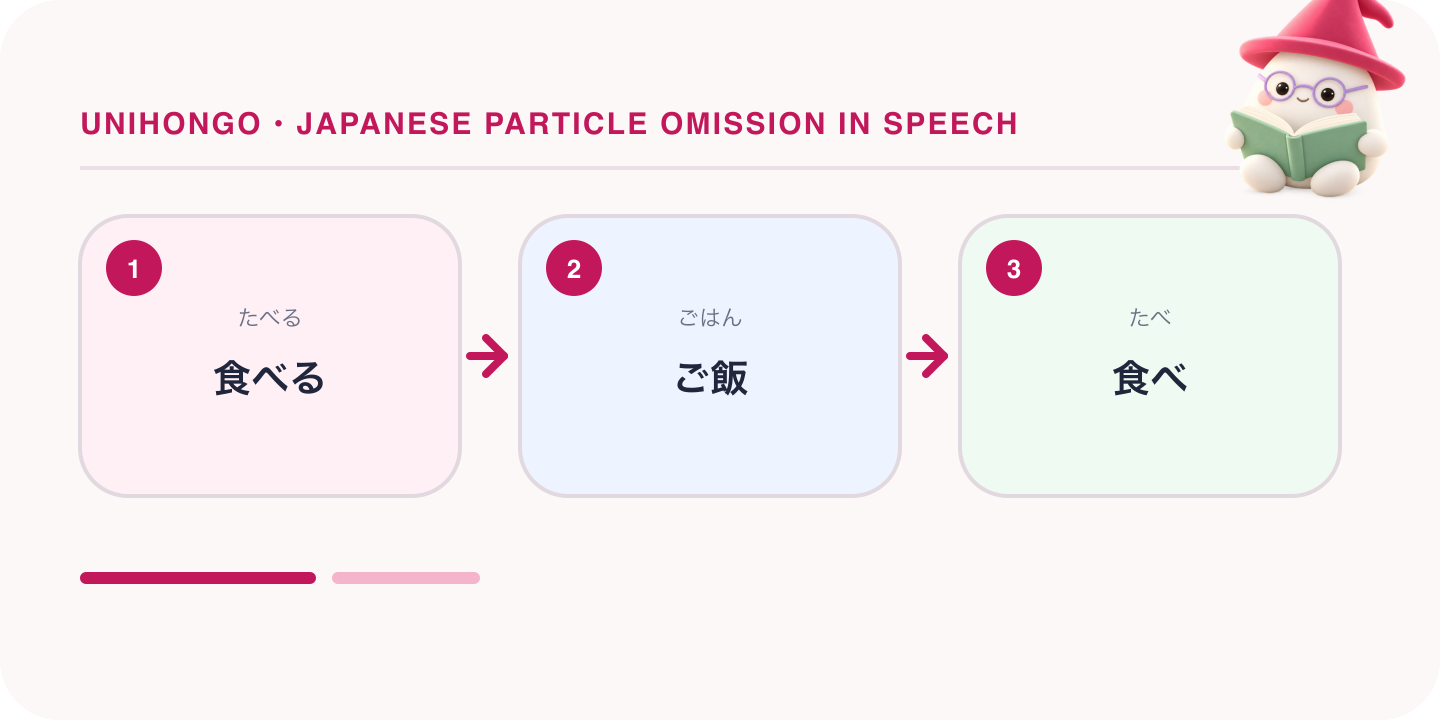
Compare two sentences a flatmate might say while holding out a bag of crisps: kore o taberu? and kore, taberu? Both offer you some. In the second, o has gone and nothing is lost: kore is a thing, taberu needs a thing to eat, and there is only one way to connect them. The road has a single turning, so the sign can come down. Literally, the casual version is just: this, eat?
Now take Tanaka-san to itta, I went with Tanaka-san, and remove to. Tanaka-san itta means Tanaka-san went. The listener restored a particle, as listeners always do, but the most natural one to restore was ga or wa, and the meaning changed. That junction needed its sign. Everything in this article follows from one test: if the particle were gone, would the listener put the same one back?
| Japanese | Romaji | Meaning |
|---|---|---|
| これを食べる? | Kore o taberu? | Are you going to eat this? |
| これ、食べる? | Kore, taberu? | Want some of this? |
| ご飯、食べた? | Gohan, tabeta? | Have you eaten? |
| テレビ、見てもいい? | Terebi, mite mo ii? | Is it okay if I watch TV? |
| 田中さんと行った。 | Tanaka-san to itta. | I went with Tanaka-san. |
The easy ones: wa, o and the pause that replaces them
Topic wa and object o are the two particles dropped most often. Wa goes when the topic is obvious, often something visible or just mentioned: kono kēki, oishii ne. O goes when the noun sits directly before its verb: kōhī nomu? In both cases the particle is commonly replaced by a very short pause, a beat in which the noun is held up before the rest follows. In messages between friends that beat is often written as a comma or a space.
One kind of wa does not drop. Contrastive wa, as in niku wa taberu kedo, sakana wa tabenai, I eat meat but not fish, carries the contrast itself, and removing it flattens the sentence. O is sturdier than it looks too: when the object is far from the verb, or stressed, speakers keep it. Scene: two friends at a café on a Sunday.
| Japanese | Romaji | Meaning |
|---|---|---|
| このケーキ、おいしいね。 | Kono kēki, oishii ne. | This cake's good, isn't it? |
| コーヒー、飲む? | Kōhī, nomu? | Want a coffee? |
| 写真、撮ってもいい? | Shashin, totte mo ii? | Can I take a photo? |
| 昨日の映画、どうだった? | Kinō no eiga, dō datta? | How was the film yesterday? |
| 肉は食べるけど、魚は食べない。 | Niku wa taberu kedo, sakana wa tabenai. | I eat meat, but I don't eat fish. |
How it works: every common particle sorted
The table sorts the particles a learner meets in the first year by how readily they drop in casual conversation.
| Particle | Reading | Drops in casual speech? | Why |
|---|---|---|---|
| は | wa | Yes, often | The topic is visible or already known |
| を | o | Yes, often | The verb predicts its object |
| が | ga | Sometimes | Fine for a plain subject, not for singling out |
| に、へ | ni, e for a destination | Yes, with iku, kuru and kaeru | A movement verb implies a destination |
| に | ni for time or recipient | Rarely | The verb does not predict it |
| で | de | No | Place and means cannot be guessed |
| と | to | No | Without it the partner becomes the subject |
| から | kara | No | Only kara says from |
| まで | made | No | Only made says until |
| の | no | No, but it can shorten to n | Two bare nouns do not link themselves |
The right-hand column is the whole rule. Particles that mark roles the verb hands out anyway, subject, object and the destination of a movement, are the ones that go. Particles that add a setting, a partner, a start or an end are extra information, and extra information has to be said. Usage at the edges varies between speakers and regions, so treat sometimes and rarely as honest labels, not as hard limits.
Ga: when it drops and when it cannot
Ga drops in short sentences that simply report what is happening, above all with feelings, the body and the weather: onaka suita, I'm hungry, literally: stomach has emptied; jikan nai, there's no time; ame futte kita, it has started raining. It also drops before suki, hoshii and wakaru in quick exchanges: sushi suki?
Ga cannot drop when it is doing its second job, singling one thing out. If someone asks dare ga iku, who is going, the answer watashi ga iku means I am the one. That ga is the point of the sentence. For the same reason ga usually stays after question words, as in nani ga ii, which one would be good? Scene: two colleagues who are close friends, leaving the office.
| Japanese | Romaji | Meaning |
|---|---|---|
| お腹すいた。 | Onaka suita. | I'm hungry. |
| 雨、降ってきた。 | Ame, futte kita. | It's started raining. |
| 時間ないから、急ごう。 | Jikan nai kara, isogō. | There's no time, so let's hurry. |
| 誰が行くの? | Dare ga iku no? | Who's going? |
| 私が行く。 | Watashi ga iku. | I'll be the one to go. |
Minimal pairs: what the missing particle does
Each pair is the same sentence with and without one particle.
| Sentence | Reading | What it says |
|---|---|---|
| これ、食べる? | Kore, taberu? | A neutral offer: want this? |
| これを食べる? | Kore o taberu? | Weight on this: is this the one you will eat? |
| 田中さん、来たよ。 | Tanaka-san, kita yo. | Tanaka-san is here: light, plain news |
| 田中さんが来たよ。 | Tanaka-san ga kita yo. | A little more weight on who it is that came |
| 田中さんと行った。 | Tanaka-san to itta. | I went with Tanaka-san |
| 田中さん、行った。 | Tanaka-san, itta. | Tanaka-san went: a different meaning |
In the first two pairs the particle adds weight, and leaving it out gives the lighter sentence. That is why speaking with every particle in a relaxed chat can sound slightly insistent or bookish. In the last pair the particle carries the meaning itself, and leaving it out produces a different sentence. The skill is knowing which kind of pair you are in.
Beyond the basics: destinations, and the particles that stay
With iku, kuru and kaeru, the destination particle ni or e is dropped freely: konbini iku, literally: convenience store, go. The verb means movement towards somewhere, so a place noun before it can only be the destination. Other uses of ni hold on. Time and recipient ni are kept by most speakers most of the time: shichi-ji ni au, tomodachi ni ageta.
De, to, kara and made stay, even in the fastest speech. Uchi de taberu, eat at home, cannot become uchi taberu: the listener has no confident way to repair it. No stays as well, though it often shortens to n, as in boku n chi, my place. That is a contraction, not an omission, because the link is still audible. Scene: messages between friends arranging an evening.
| Japanese | Romaji | Meaning |
|---|---|---|
| コンビニ行くけど、何かいる? | Konbini iku kedo, nanika iru? | I'm going to the convenience store. Need anything? |
| 今日、どこ行く? | Kyō, doko iku? | Where shall we go today? |
| 駅で七時に会おう。 | Eki de shichi-ji ni aō. | Let's meet at the station at seven. |
| 六時まで仕事だから、遅れるかも。 | Roku-ji made shigoto da kara, okureru ka mo. | I've got work until six, so I might be late. |
| ミキと一緒に行くね。 | Miki to issho ni iku ne. | I'll come with Miki. |
| うちから近いよ。 | Uchi kara chikai yo. | It's close to my place. |
Natural versus sloppy: register, length and writing
Omission sounds natural when three things line up: plain form, a short sentence, and a listener you are close to. Change any one and it begins to sound off. With masu forms, light omission does occur, as in kōhī, nomimasu ka to a colleague, but a polite sentence stripped of several particles sounds as if the speaker could not be bothered. In long sentences, particles return even among friends, because the listener can no longer hold all the roles in their head.
Writing restores everything. A reader has no intonation, no pause and no chance to ask what you meant, so emails, reports, essays and news keep every particle. The exception is writing that imitates speech: chat messages, manga dialogue, social media posts. Formal speech behaves like writing. In an interview, a presentation or service talk, complete particles are part of the politeness, in the same way that a complete sentence is.
| Japanese | Romaji | Meaning |
|---|---|---|
| コーヒー、飲みますか。 | Kōhī, nomimasu ka. | Would you like a coffee? |
| 駅はどこですか。 | Eki wa doko desu ka. | Where is the station? |
| 資料を会議の前にお送りします。 | Shiryō o kaigi no mae ni ookuri shimasu. | I will send you the materials before the meeting. |
Neighbours: dropping the whole noun, and contractions
Particle omission is often confused with two other habits of spoken Japanese. The first is dropping the whole noun. Tabeta? with no subject and no object is complete, because Japanese leaves out anything already understood. This is far more common than particle omission, it happens in polite speech and in writing too, and it is safe for learners from the first week. If a noun and its particle are both obvious, dropping both is usually more natural than keeping the noun bare.
The second is contraction: te iru becoming teru, te shimau becoming chau, no becoming n. Contractions shorten a form without removing its function. Both habits travel with particle omission in casual talk, and the articles on casual speech describe when to switch into that style at all.
| Japanese | Romaji | Meaning |
|---|---|---|
| もう食べた? | Mō tabeta? | Have you eaten already? |
| 今、何してるの? | Ima, nani shiteru no? | What are you doing now? |
Common mistakes and the real risk for learners
Tomodachi itta, meant as I went with a friend, is wrong. Learners who hear particles vanish assume any of them can. To is not predictable from the verb, so the sentence now says the friend went. Keep it: tomodachi to itta.
Resutoran tabeta, meant as I ate at a restaurant, is wrong. It over-applies the pattern of konbini iku. Iku implies a destination; taberu does not imply a place. Say resutoran de tabeta.
Watashi iku, as the answer to dare ga iku, is wrong in effect: it removes the ga that singles you out, so the answer no longer matches the question. Say watashi ga iku.
Sumimasen, eki doko desu ka, said to a stranger, will be understood, but dropping wa inside a polite request to someone you do not know makes it sound abrupt. Learners do it because they have copied friends. Eki wa doko desu ka costs one syllable.
The larger risk is not any single sentence. Learners who drop particles from the start never build the reflex, and then cannot produce them when an email, an exam or an interview demands it. Omission is something fluent speakers do with particles they already own.