

What wake ni wa ikanai means
Wake means reason or circumstance, and iku here has the old sense of work out or go well. Wake ni wa ikanai therefore means something like the circumstances do not allow it. The speaker is not unable; they have a reason, usually social, moral or practical, that stops them.
Typical reasons are responsibility (I'm the organiser, so I can't very well leave early), consideration for others (my friend cooked for me, so I can't very well refuse), and common sense (it's an important exam, so I can't very well not study). The pattern often comes with a kara or node clause stating the reason, or the reason is obvious from context.
Because it expresses restraint and a sense of duty, wake ni wa ikanai is common when Japanese speakers explain why they are doing something reluctantly or turning something down politely.
| Japanese | Romaji | Meaning |
|---|---|---|
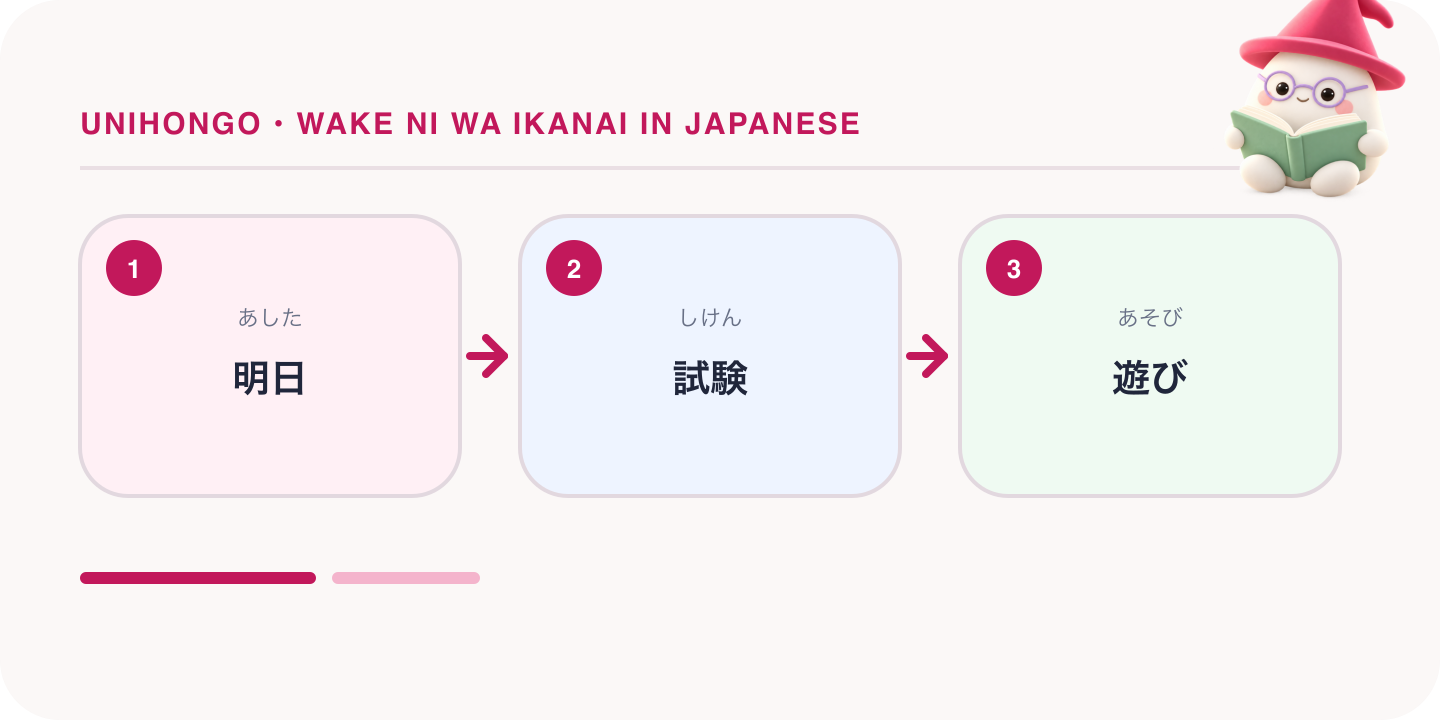
| 明日試験だから、遊びに行くわけにはいかない。 | Ashita shiken da kara, asobi ni iku wake ni wa ikanai. | I have an exam tomorrow, so I can't very well go out. |
| 車で来たので、お酒を飲むわけにはいきません。 | Kuruma de kita node, osake o nomu wake ni wa ikimasen. | I came by car, so I can't very well drink. |
| 約束したから、今さら断るわけにはいかない。 | Yakusoku shita kara, imasara kotowaru wake ni wa ikanai. | I promised, so I can't very well say no now. |
| 部長がいるのに、先に帰るわけにはいかない。 | Buchō ga iru noni, saki ni kaeru wake ni wa ikanai. | The department head is still here, so I can't very well leave first. |
| これは秘密なので、教えるわけにはいかないんです。 | Kore wa himitsu na node, oshieru wake ni wa ikanai n desu. | It's confidential, so I'm afraid I can't tell you. |
How to form wake ni wa ikanai
The pattern follows a verb in the dictionary form for can't very well, and in the nai form for have to. It is only used with verbs of deliberate action, because it is about choices the speaker could make.
The ending conjugates like iku: wake ni wa ikanai (plain), wake ni wa ikimasen (polite), wake ni wa ikanakatta (past, couldn't very well), and wake ni wa ikanai n desu (explanatory, often used to soften a refusal).
| Form | Pattern | Example | Meaning |
|---|---|---|---|
| Can't very well | Verb dictionary form + わけにはいかない | 休むわけにはいかない | I can't very well take time off |
| Have to | Verb nai form + わけにはいかない | 行かないわけにはいかない | I can't not go, I have to go |
| Polite | …わけにはいきません | 受け取るわけにはいきません | I'm afraid I can't accept this |
| Past | …わけにはいかなかった | 断るわけにはいかなかった | I couldn't very well refuse |
| Casual | …わけにいかない | 逃げるわけにいかない | I can't just run away |
| Fixed phrase | そういうわけには… | そういうわけにはいかないよ | That just won't do |
Nai wake ni wa ikanai: I have no choice but to
Put a negative verb in front and the meaning becomes an obligation: I can't not do this. Ikanai wake ni wa ikanai means I can't very well not go, which in natural English is I really have to go, or I'd better go.
The obligation comes from the situation or from other people's expectations, not from a rule. Compare nakereba naranai, which states a requirement (you must submit it by Friday), with shinai wake ni wa ikanai, which explains why the speaker feels they have no real choice (my boss asked me personally, so I can't not go).
This double negative often sounds a little reluctant. The speaker would rather not, but can see no acceptable way out.
| Japanese | Romaji | Meaning |
|---|---|---|
| 上司に誘われたから、行かないわけにはいかない。 | Jōshi ni sasowareta kara, ikanai wake ni wa ikanai. | My boss invited me, so I can't really not go. |
| 約束した以上、やらないわけにはいかない。 | Yakusoku shita ijō, yaranai wake ni wa ikanai. | Since I promised, I have to do it. |
| お世話になったので、お礼を言わないわけにはいきません。 | Osewa ni natta node, orei o iwanai wake ni wa ikimasen. | They helped me so much that I must thank them. |
| せっかく作ってくれたから、食べないわけにはいかない。 | Sekkaku tsukutte kureta kara, tabenai wake ni wa ikanai. | She went to the trouble of making it, so I have to eat it. |
| 明日は大事な会議なので、出ないわけにはいかない。 | Ashita wa daiji na kaigi na node, denai wake ni wa ikanai. | Tomorrow's meeting is important, so I have to attend. |
Shinai wake ni wa ikanai is close in meaning to sezaru o enai, a more formal and written pattern that also means have no choice but to. In everyday speech, shinai wake ni wa ikanai or shinakucha is far more common.
Wake ni wa ikanai vs wake ga nai
Wake ga nai means there's no way that, it can't be true. It expresses the speaker's strong conviction that something is impossible or untrue: kare ga uso o tsuku wake ga nai, there's no way he would lie. It follows any plain form, including adjectives and nouns with na or no.
Wake ni wa ikanai is about what the speaker can acceptably do. Wake ga nai is about what the speaker believes is possible or true. Swapping them changes the sentence from I shouldn't to impossible.
| Japanese | Romaji | Meaning |
|---|---|---|
| 彼がうそをつくわけがない。 | Kare ga uso o tsuku wake ga nai. | There's no way he would lie. |
| こんな簡単な問題を間違えるわけがない。 | Konna kantan na mondai o machigaeru wake ga nai. | There's no way I'd get such an easy question wrong. |
| ここで諦めるわけにはいかない。 | Koko de akirameru wake ni wa ikanai. | I can't give up now. |
| 一人で行けるわけがないでしょう。 | Hitori de ikeru wake ga nai deshō. | There's no way you can go alone. |
Wake ni wa ikanai vs wake de wa nai
Wake de wa nai means it's not that or it doesn't mean that. It partially denies an assumption: kirai na wake de wa nai, it's not that I dislike it. It is used to soften or correct an impression, not to express restraint.
Putting the three wake patterns side by side is the clearest way to keep them apart.
| Pattern | Core meaning | Example | Translation |
|---|---|---|---|
| わけにはいかない | Can't acceptably do | 今やめるわけにはいかない | I can't very well quit now |
| ないわけにはいかない | Have to, no real choice | 行かないわけにはいかない | I have to go |
| わけがない | No way, impossible | 彼が来るわけがない | There's no way he'll come |
| わけではない | It's not that | 嫌いなわけではない | It's not that I dislike it |
| わけだ | That's why, no wonder | 道理で寒いわけだ | No wonder it's cold |
JLPT questions often test exactly this set. Ask yourself whether the sentence is about acceptability (wake ni wa ikanai), impossibility (wake ga nai) or correcting an impression (wake de wa nai).
Wake ni wa ikanai vs dekinai, nakereba naranai and zaru o enai
Dekinai and the potential form are about ability: oyogenai, I can't swim. Wake ni wa ikanai is only about social or moral acceptability. If someone physically cannot do something, wake ni wa ikanai is wrong.
Nakereba naranai and nakute wa ikenai state an obligation, often from rules or necessity. Nai wake ni wa ikanai explains a personal sense of obligation arising from the situation. Zaru o enai, have no choice but to, is closer to nai wake ni wa ikanai but sounds more written and more resigned.
| Japanese | Romaji | Meaning |
|---|---|---|
| 足をけがしたので、走れない。 | Ashi o kega shita node, hashirenai. | I hurt my leg, so I can't run. (ability) |
| キャプテンだから、休むわけにはいかない。 | Kyaputen da kara, yasumu wake ni wa ikanai. | I'm the captain, so I can't very well skip it. |
| 金曜日までに提出しなければならない。 | Kin'yōbi made ni teishutsu shinakereba naranai. | It must be submitted by Friday. |
| 台風なので、中止せざるを得ない。 | Taifū na node, chūshi sezaru o enai. | Because of the typhoon, we have no choice but to cancel. |
Refusing politely with wake ni wa ikanai
In business and customer service, wake ni wa ikimasen is a polite way to decline without implying that the listener's request is unreasonable. It places the reason on rules or on the speaker's position: kisoku na node, o-uke suru wake ni wa ikimasen, I'm afraid I can't accept this because of our rules.
It is also common when refusing gifts, money or favours out of modesty. Konna ni takai mono, itadaku wake ni wa ikimasen, I couldn't possibly accept something so expensive, is a standard polite response, often followed by some back and forth before the gift is accepted.
| Japanese | Romaji | Meaning |
|---|---|---|
| こんな高価な物、いただくわけにはいきません。 | Konna kōka na mono, itadaku wake ni wa ikimasen. | I couldn't possibly accept something so expensive. |
| 規則ですので、例外を認めるわけにはいかないんです。 | Kisoku desu node, reigai o mitomeru wake ni wa ikanai n desu. | Those are the rules, so I'm afraid we can't make an exception. |
| お客様の個人情報をお伝えするわけにはいきません。 | Okyakusama no kojin jōhō o otsutae suru wake ni wa ikimasen. | I'm afraid we can't share customers' personal information. |
| そういうわけにはいかないよ。 | Sō iu wake ni wa ikanai yo. | That just won't do. |
Common mistakes with wake ni wa ikanai
- Using it for ability: oyogu wake ni wa ikanai does not mean I can't swim; use oyogenai.
- Using it for other people's restrictions without context: it describes the speaker's (or the subject's) own reasoning, so explain whose position it is.
- Mixing it up with wake ga nai: akirameru wake ga nai means there's no way I'd give up, not I can't very well give up.
- Using a potential or adjective before it: attach it to a plain verb (dictionary or nai form), not ikeru or takai.
- Forgetting the double negative logic: tabenai wake ni wa ikanai means I have to eat, not I can't eat.