
Four seemings, four sources of evidence
Before any conjugation, fix the map. If your evidence is what your eyes report right now, use sō attached to the verb stem or the adjective root. If your evidence is reasoning from circumstances, use yō desu in careful speech or mitai in relaxed speech. If your evidence is a person, a forecast or a notice, use the plain form plus sō desu. If you are reporting hearsay at a distance, or describing what is typical of a category, use rashii.
Japanese speakers care about this because taking responsibility for a claim is part of politeness. Saying kaigi wa chūshi desu asserts the cancellation as fact. Saying chūshi da sō desu credits it to whoever told you, and chūshi no yō desu says you worked it out from an empty meeting room. Choosing the right one protects you when the information turns out to be wrong.
How each pattern attaches
| Word type | Hearsay: plain form + sō desu | Looks: stem or root + sō | Yō desu | Mitai desu | Rashii desu |
|---|---|---|---|---|---|
| Verb: iku | 行くそうです iku sō desu | 行きそうです iki sō desu | 行くようです iku yō desu | 行くみたいです iku mitai desu | 行くらしいです iku rashii desu |
| I-adjective: samui | 寒いそうです samui sō desu | 寒そうです samusō desu | 寒いようです samui yō desu | 寒いみたいです samui mitai desu | 寒いらしいです samui rashii desu |
| Na-adjective: genki | 元気だそうです genki da sō desu | 元気そうです genki sō desu | 元気なようです genki na yō desu | 元気みたいです genki mitai desu | 元気らしいです genki rashii desu |
| Noun: gakusei | 学生だそうです gakusei da sō desu | Not used with plain nouns | 学生のようです gakusei no yō desu | 学生みたいです gakusei mitai desu | 学生らしいです gakusei rashii desu |
| Irregular ii | いいそうです ii sō desu | よさそうです yosasō desu | いいようです ii yō desu | いいみたいです ii mitai desu | いいらしいです ii rashii desu |
| Irregular nai | ないそうです nai sō desu | なさそうです nasasō desu | ないようです nai yō desu | ないみたいです nai mitai desu | ないらしいです nai rashii desu |
Read the table down the two sō columns first. The hearsay column keeps the word whole and adds da after a na-adjective or a noun. The appearance column cuts something off: the masu-stem of the verb, the final i of the adjective, the na of a na-adjective. That cut is the fastest way to tell which sō a speaker just used.
Note the third column too. Yō desu is the only one that needs na after a na-adjective and no after a noun, because yō is itself a noun meaning appearance or manner. Mitai and rashii attach straight to the bare word.
Sou desu for what somebody told you
Attach sō desu to any plain form, present or past, positive or negative, and you are quoting a source without naming one. Ashita wa yuki ga furu sō desu means the forecast says snow tomorrow. Because it is a report, this sō never changes shape: there is no sō na or sō ni for hearsay, and there is no past form sō deshita. The tense lives in the plain form before it.
If you want to name the source, add it at the front with ni yoru to, or add kara kikimashita afterwards. Tenki yohō ni yoru to, ashita wa ame da sō desu is the natural news register, while Tanaka-san kara kikimashita ga, kaigi wa chūshi da sō desu is what you say when the source is a person and you want that on the record. Learners often skip this step and state the news flatly, which quietly makes them responsible for information they never verified.
| Japanese | Romaji | Meaning |
|---|---|---|
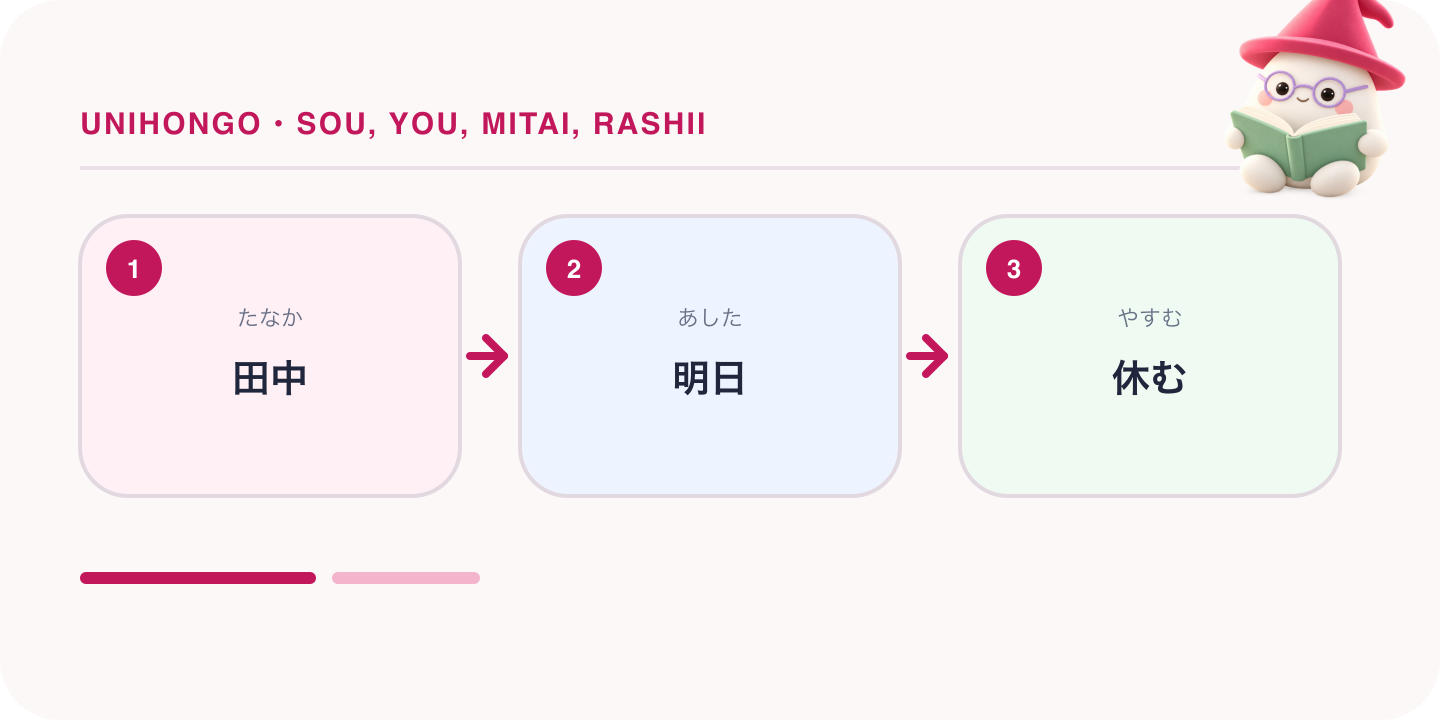
| 田中さんは明日休むそうです。 | Tanaka-san wa ashita yasumu sō desu. | I hear Tanaka is taking tomorrow off. |
| あの店は有名だそうです。 | Ano mise wa yūmei da sō desu. | They say that shop is famous. |
| 試験は難しかったそうです。 | Shiken wa muzukashikatta sō desu. | I hear the exam was difficult. |
| 彼は来ないそうです。 | Kare wa konai sō desu. | Apparently he is not coming. |
| 天気予報によると、明日は雨だそうです。 | Tenki yohō ni yoru to, ashita wa ame da sō desu. | According to the forecast, it will rain tomorrow. |
Sou for what you can see coming
This sō is a judgement made from appearance, so it attaches to the part of the word that carries meaning. For verbs, take the masu-stem: furimasu becomes furisō, ochimasu becomes ochisō, nakimasu becomes nakisō. For i-adjectives, drop the final i: oishii becomes oishisō, takai becomes takasō. For na-adjectives, drop the na: taihen becomes taihensō. Plain nouns cannot take it at all.
Two forms are irregular and must be memorised. Ii becomes yosasō, not iisō, and nai becomes nasasō. The same sa appears when a negative i-adjective is involved: omoshirokunai becomes omoshirokunasasō. Once formed, this sō behaves like a na-adjective, so it becomes oishisō na kēki before a noun and oishisō ni tabemasu before a verb.
| Japanese | Romaji | Meaning |
|---|---|---|
| 雨が降りそうです。 | Ame ga furisō desu. | It looks like it is going to rain. |
| このケーキはおいしそうです。 | Kono kēki wa oishisō desu. | This cake looks delicious. |
| 荷物が落ちそうですよ。 | Nimotsu ga ochisō desu yo. | Your luggage looks like it is about to fall. |
| この本はよさそうですね。 | Kono hon wa yosasō desu ne. | This book looks good. |
| 問題はなさそうです。 | Mondai wa nasasō desu. | There seems to be no problem. |
| おいしそうなパンですね。 | Oishisō na pan desu ne. | That is delicious-looking bread. |
| 子どもがおいしそうに食べています。 | Kodomo ga oishisō ni tabete imasu. | The child is eating as if it tastes good. |
For the negative of appearance sō with verbs, most speakers say furi sō ni nai for it does not look like it will rain, or furanasasō desu in casual speech. Both are heard; furi sō ni nai is the safer written form.
Telling the two sou apart in one breath
| Japanese | Romaji | Meaning |
|---|---|---|
| ケーキはおいしいそうです。 | Kēki wa oishii sō desu. | I hear the cake is delicious. |
| ケーキはおいしそうです。 | Kēki wa oishisō desu. | The cake looks delicious. |
| 電車が来るそうです。 | Densha ga kuru sō desu. | They announced that a train is coming. |
| 電車が来そうです。 | Densha ga kisō desu. | It looks like a train is about to arrive. |
| この仕事は大変だそうです。 | Kono shigoto wa taihen da sō desu. | I hear this job is hard. |
| この仕事は大変そうです。 | Kono shigoto wa taihensō desu. | This job looks hard. |
In each pair only the join changes. Hearsay keeps the full word and adds da where a na-adjective or noun needs it; appearance removes a piece. Say the pairs aloud back to back until your mouth stops adding an extra i to oishisō, which is the single most common slip.
You desu for a conclusion you reasoned out
Yō desu says that the evidence in front of you supports a conclusion you have drawn yourself. You see shoes in the entrance and lights on, so dare ka iru yō desu. It is the most formal of the four, so it is what you use in a report, in a meeting, or when speaking to a customer, and it also sounds appropriately careful when you are guessing about somebody else's situation.
Watch the joins. A verb or i-adjective attaches directly, a na-adjective takes na, and a noun takes no. Yō itself is a noun, which is why it behaves like a na-adjective afterwards: yō na hito, yō ni narimashita. That second form is a whole pattern of its own for saying you became able to do something.
| Japanese | Romaji | Meaning |
|---|---|---|
| 誰かいるようです。 | Dare ka iru yō desu. | It appears somebody is in. |
| 部長はまだ会議中のようです。 | Buchō wa mada kaigi-chū no yō desu. | The manager appears to still be in a meeting. |
| 風邪をひいたようです。 | Kaze o hiita yō desu. | It seems I have caught a cold. |
| この機械は壊れているようです。 | Kono kikai wa kowarete iru yō desu. | This machine appears to be broken. |
| 彼女は元気なようです。 | Kanojo wa genki na yō desu. | She seems to be well. |
| 日本語が話せるようになりました。 | Nihongo ga hanaseru yō ni narimashita. | I have become able to speak Japanese. |
Mitai, the casual twin of you
Mitai means the same thing as yō desu but belongs to relaxed speech among friends, family and familiar colleagues. It attaches with no joining word at all: iku mitai, samui mitai, genki mitai, gakusei mitai. Add desu to keep it polite enough for ordinary workplace chat, and drop desu entirely with friends.
Mitai also carries the plain likeness meaning that English covers with like. Kodomo mitai means childlike, and yume mitai means dreamlike. In that use it behaves as a na-adjective: kodomo mitai na hito, yume mitai ni kirei desu. The more formal equivalent of that likeness use is no yō ni.
| Japanese | Romaji | Meaning |
|---|---|---|
| 田中さん、今日は忙しいみたいです。 | Tanaka-san, kyō wa isogashii mitai desu. | Tanaka seems busy today. |
| 電車が遅れているみたいですね。 | Densha ga okurete iru mitai desu ne. | It looks like the trains are delayed. |
| あの人、先生みたい。 | Ano hito, sensei mitai. | That person seems to be a teacher. (casual) |
| 子どもみたいなことを言わないで。 | Kodomo mitai na koto o iwanaide. | Do not say childish things. (casual) |
| 夢みたいにきれいでした。 | Yume mitai ni kirei deshita. | It was beautiful, like a dream. |
A useful reply when someone offers a mitai guess is hontō desu ka or sō mitai desu ne, which agrees while keeping the same level of certainty. The polite-versus-casual guide on this blog covers the register scale in more detail.
Rashii for hearsay and for typicality
Rashii has two jobs. The first is hearsay at a distance: you heard it somewhere, you are fairly confident, and you are deliberately not taking responsibility. Ashita wa yasumi rashii desu is close to apparently tomorrow is a holiday. Compared with sō desu it sounds less like a direct quote and more like something in the air.
The second job appears when rashii follows a noun that names a category. Then it means typical of, and the sentence is a judgement about character. Otoko rashii means manly, sensei rashii means teacherly, and haru rashii hi means a properly spring-like day. Because rashii behaves as an i-adjective, its negative is rashiku nai, as in kare rashiku nai desu for that is unlike him.
| Japanese | Romaji | Meaning |
|---|---|---|
| 新しい店ができるらしいです。 | Atarashii mise ga dekiru rashii desu. | Apparently a new shop is opening. |
| 部長は今日来ないらしいですよ。 | Buchō wa kyō konai rashii desu yo. | Word is the manager is not coming today. |
| 今日は春らしい天気ですね。 | Kyō wa haru rashii tenki desu ne. | The weather is properly spring-like today. |
| それは彼らしくないですね。 | Sore wa kare rashiku nai desu ne. | That is unlike him. |
| 学生らしい服装で行きましょう。 | Gakusei rashii fukusō de ikimashō. | Let us go dressed as students should. |
The same situation said four ways
| Japanese | Romaji | Evidence | Nuance |
|---|---|---|---|
| 雨が降りそうです。 | Ame ga furisō desu. | The sky you are looking at | About to happen, judged by sight |
| 雨が降るようです。 | Ame ga furu yō desu. | Wet umbrellas in the entrance | A conclusion you reasoned out, formal |
| 雨が降るみたいです。 | Ame ga furu mitai desu. | The same reasoning, casual | Same meaning, relaxed register |
| 雨が降るそうです。 | Ame ga furu sō desu. | The forecast you read | A report you are relaying |
| 雨が降るらしいです。 | Ame ga furu rashii desu. | Something a colleague mentioned | Hearsay at a distance, less committed |
Five rows because the two sō patterns are genuinely separate. If a listener asks dōshite desu ka, each row has a different answer ready: sora ga kurai kara, kasa ga nurete iru kara, tenki yohō de mimashita, dareka ga itte imashita. Being able to justify the choice is the test that the pattern has been learned rather than memorised.
Choosing in real time
- Ask what your evidence is before you open your mouth: eyes, reasoning, a source, or a stereotype.
- Eyes on something in progress: use the stem plus sō, and remember yosasō and nasasō.
- Reasoning from circumstances: yō desu at work or with strangers, mitai desu with friends.
- A forecast, a notice, a colleague: plain form plus sō desu, with da after nouns and na-adjectives.
- Vague or distant hearsay, or a claim about what is typical: rashii.
- When you truly do not know, kamo shiremasen is the honest fallback and commits to nothing.
The mistakes to correct first
- Saying iisō instead of yosasō, and naisō instead of nasasō.
- Dropping the da in ame da sō desu, which turns hearsay into an ungrammatical mix.
- Adding na to yō after a noun: it is gakusei no yō desu, never gakusei na yō desu.
- Using appearance sō with a plain noun, as in sensei sō desu. Use mitai, rashii or no yō desu instead.
- Trying to conjugate hearsay sō desu into a past form. Put the past on the verb before it: ikimashita becomes itta sō desu.
- Choosing mitai in a formal report, where yō desu is expected.