
Three endings, three different questions
These patterns all sit on the te form, so they look like siblings, and learners treat them as interchangeable ways of saying something is done. They are not. Te iru answers whether a situation is currently running or currently true. Te aru answers whether somebody set this up on purpose. Te oku answers whether you are doing something now for the sake of later. Mixing them does not usually produce a broken sentence, which is the problem: it produces a sentence that means something you did not intend.
There are already guides on this blog for te iru on its own and for the te shimau, te oku, and te miru family, so this post does not repeat their basics. Here everything is arranged as a contrast, because in real conversation you are never choosing whether to use te iru; you are choosing between te iru and the other two, usually in under a second.
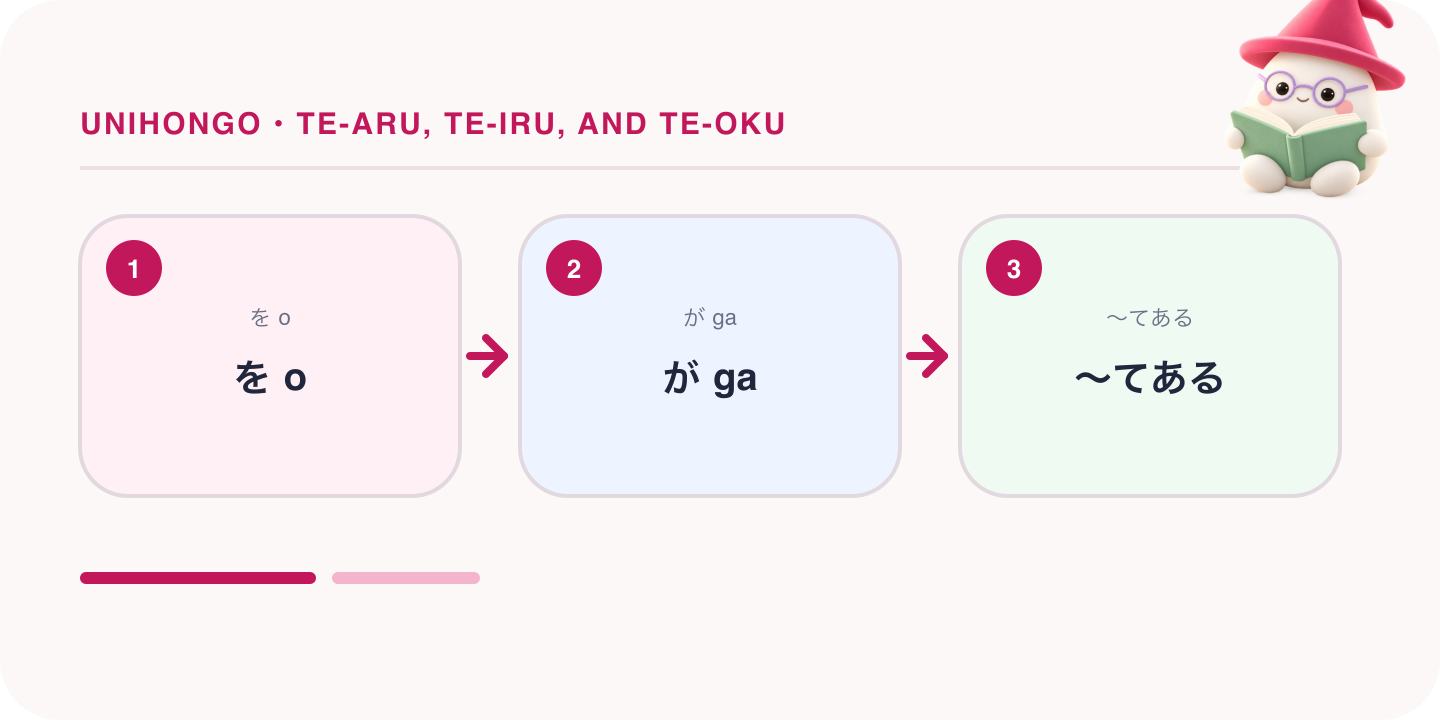
The three patterns side by side
| Pattern | Verb it takes | Particle on the thing | What it says |
|---|---|---|---|
| 〜ている (action) | An action verb with duration | を o | The action is running right now |
| 〜ている (state) | A change-of-state verb, usually intransitive | が ga | The change happened and the result is still true |
| 〜てある | A transitive verb only | が ga | Someone did it on purpose and left it that way |
| 〜ておく | Usually a transitive verb | を o | Do it now, in advance, and leave it done |
The middle two rows are where the trouble lives, because both end in a state and both put ga on the thing. The difference is whether a person is implied. Denki ga tsuite imasu is a neutral observation about a light that is on; denki ga tsukete arimasu says somebody switched it on, probably for a reason, and probably for you. Japanese speakers hear that implication clearly, and choosing te aru when you meant a neutral observation makes listeners look for an intention that does not exist.
Te iru does two jobs at once
Which of the two jobs te iru performs is decided by the verb, not by you. Verbs with duration such as taberu, yomu, hashiru, and matsu give an action in progress. Verbs that describe a change happening in an instant, such as aku, shimaru, kekkon suru, shiru, and kuru, give the resulting state instead, because there is no middle of the change to be inside.
That is why kite imasu means has come and is here, not is coming, and why shitte imasu means I know rather than I am knowing. This single distinction fixes a large share of intermediate mistakes, and it also explains why the negative of shitte imasu is shirimasen with no te iru at all.
| Japanese | Romaji | Meaning |
|---|---|---|
| ご飯を食べています。 | Gohan o tabete imasu. | I am eating. (action in progress) |
| 窓が開いています。 | Mado ga aite imasu. | The window is open. (resulting state) |
| 電気が消えています。 | Denki ga kiete imasu. | The light is off. |
| 田中さんはもう来ています。 | Tanaka-san wa mō kite imasu. | Tanaka is already here. |
| その店なら知っています。 | Sono mise nara shitte imasu. | I know that shop. |
| 姉は結婚しています。 | Ane wa kekkon shite imasu. | My older sister is married. |
| ずっと待っています。 | Zutto matte imasu. | I have been waiting the whole time. |
Te aru: a state somebody left on purpose
Te aru attaches to a transitive verb, the kind that needs a doer, and then removes the doer from the sentence entirely. What is left is the object, promoted to ga, described as sitting in the condition that the vanished person put it in. That combination is what gives te aru its distinctive flavour: it is not just a fact, it is evidence that somebody prepared something.
This is why te aru is everywhere in daily life without being taught much. Signs say kaite arimasu. A colleague says shiryō wa junbi shite arimasu. Someone points at the fridge and says naka ni irete arimasu. In all of them the useful information is that the job is done and you do not need to do it, and the person who did it is beside the point.
| Japanese | Romaji | Meaning |
|---|---|---|
| 窓が開けてあります。 | Mado ga akete arimasu. | The window has been opened and left open. |
| ここに名前が書いてあります。 | Koko ni namae ga kaite arimasu. | The name is written here. |
| 飲み物は冷蔵庫に入れてあります。 | Nomimono wa reizōko ni irete arimasu. | The drinks are in the fridge, ready. |
| 会議室は予約してあります。 | Kaigishitsu wa yoyaku shite arimasu. | The meeting room is booked. |
| 資料はもう印刷してあります。 | Shiryō wa mō insatsu shite arimasu. | The documents are already printed. |
| 椅子が並べてあります。 | Isu ga narabete arimasu. | The chairs have been set out in rows. |
| みんなにはもう伝えてあります。 | Minna ni wa mō tsutaete arimasu. | I have already told everyone. |
| 書いてあるとおりにしてください。 | Kaite aru tōri ni shite kudasai. | Please do it as written. |
Te oku: doing it now so that later is easier
Te oku keeps the doer and keeps the object on o, because it is still a report of an action. What it adds is purpose in time: I am doing this now with a later moment in mind, and I will leave the result standing. That forward look is why te oku appears constantly in plans, offers, and promises, and why it so often turns up with mae ni, made ni, and tsugi no.
It has a second, softer use that learners miss. Itte okimasu ga and kiite okimashita frame a remark as something being placed on the record for later, which makes a warning or a correction sound less blunt. In the same way, katazukete oku can mean simply leave it as it is when the point is that you are not going to change anything.
| Japanese | Romaji | Meaning |
|---|---|---|
| 窓を開けておきます。 | Mado o akete okimasu. | I will open the window in advance. |
| 会議の前に資料を読んでおきます。 | Kaigi no mae ni shiryō o yonde okimasu. | I will read the documents before the meeting. |
| 席を取っておきましょうか。 | Seki o totte okimashō ka? | Shall I save a seat for you? |
| この単語は覚えておいてください。 | Kono tango wa oboete oite kudasai. | Please learn this word in advance. |
| 先にメールしておきました。 | Saki ni mēru shite okimashita. | I emailed them ahead of time. |
| 一応、言っておきますね。 | Ichiō, itte okimasu ne. | Just so you know, let me say this now. |
| それはそのままにしておいてください。 | Sore wa sono mama ni shite oite kudasai. | Please leave that as it is. |
| 飲み物を買っておきましょう。 | Nomimono o katte okimashō. | Let us buy the drinks beforehand. |
The window, three ways
| Japanese | Romaji | Meaning |
|---|---|---|
| 窓を開けています。 | Mado o akete imasu. | I am opening the window right now. |
| 窓が開いています。 | Mado ga aite imasu. | The window is open. I am not saying who or why. |
| 窓が開けてあります。 | Mado ga akete arimasu. | Somebody opened the window on purpose and left it. |
| 窓を開けておきます。 | Mado o akete okimasu. | I will open the window now so the room airs out. |
| 窓を開けておきました。 | Mado o akete okimashita. | I opened the window in advance for you. |
Read the five lines in that order and the system becomes visible. The first is an action with an o object. The second drops the person completely and uses the intransitive verb aku. The third keeps the transitive verb akeru but still promotes the window to ga, which is the move nothing else in Japanese grammar prepares you for. The fourth and fifth put the person back and look forward.
Notice also that the last two sentences describe exactly the same physical situation as the third. Akete okimashita and akete arimasu can both be true at once; they simply choose whether to talk about your action or about the resulting state. In conversation you will often say the first and your listener will later describe it with the second.
The particle shift that surprises learners
The single most common te aru error is keeping o on the object out of habit. Mado o akete arimasu sounds wrong to most ears in a neutral description, because te aru is presenting a state, and Japanese states take ga. The fix is mechanical: when you switch from te oku to te aru, move the particle. Yoyaku o shite okimasu becomes yoyaku ga shite arimasu, or more naturally yoyaku wa shite arimasu with wa doing its usual topic work.
Two honest hedges belong here. First, wa very often replaces ga in these sentences, especially when the thing is already under discussion, and that is completely natural. Second, you will occasionally hear o kept with te aru when a speaker is reporting their own preparation and wants the action in focus. Use ga or wa as your default and you will never be wrong.
| Japanese | Romaji | Meaning |
|---|---|---|
| 予約はしてあります。 | Yoyaku wa shite arimasu. | The booking is done. |
| 予約をしておきます。 | Yoyaku o shite okimasu. | I will make the booking in advance. |
| お茶が入れてあります。 | Ocha ga irete arimasu. | Tea has been made for you. |
| お茶を入れておきます。 | Ocha o irete okimasu. | I will make tea beforehand. |
| エアコンがつけてあります。 | Eakon ga tsukete arimasu. | The air conditioning has been switched on for us. |
Transitive and intransitive pairs you need first
| It happens by itself | Someone does it | State with te iru | State with te aru |
|---|---|---|---|
| 開く aku | 開ける akeru | 開いている aite iru | 開けてある akete aru |
| 閉まる shimaru | 閉める shimeru | 閉まっている shimatte iru | 閉めてある shimete aru |
| つく tsuku | つける tsukeru | ついている tsuite iru | つけてある tsukete aru |
| 消える kieru | 消す kesu | 消えている kiete iru | 消してある keshite aru |
| 入る hairu | 入れる ireru | 入っている haitte iru | 入れてある irete aru |
| 並ぶ narabu | 並べる naraberu | 並んでいる narande iru | 並べてある narabete aru |
| 止まる tomaru | 止める tomeru | 止まっている tomatte iru | 止めてある tomete aru |
| 決まる kimaru | 決める kimeru | 決まっている kimatte iru | 決めてある kimete aru |
You cannot use te aru without transitive verbs, so this table is the entry fee. The left column takes te iru and reports a neutral fact; the right column takes te aru and adds a person behind the scenes. A separate guide works through the hairu and ireru pair in detail, and the same logic transfers to every row here.
One practical shortcut: if you know only the intransitive member of a pair, you can still describe any situation with te iru. That is why beginners survive without te aru for a long time, and also why their Japanese sounds oddly agentless when they describe a prepared room.
One situation described three ways
| Japanese | Romaji | Meaning |
|---|---|---|
| 今、晩ご飯を作っています。 | Ima, bangohan o tsukutte imasu. | I am cooking dinner right now. |
| 晩ご飯が作ってあります。 | Bangohan ga tsukutte arimasu. | Dinner has been cooked and is waiting. |
| 晩ご飯を作っておきます。 | Bangohan o tsukutte okimasu. | I will cook dinner in advance. |
| 部屋を掃除しています。 | Heya o sōji shite imasu. | I am cleaning the room. |
| 部屋は掃除してあります。 | Heya wa sōji shite arimasu. | The room has been cleaned for you. |
| 帰る前に部屋を掃除しておきます。 | Kaeru mae ni heya o sōji shite okimasu. | I will clean the room before I go home. |
| メールを書いています。 | Mēru o kaite imasu. | I am writing the email. |
| メールはもう書いてあります。 | Mēru wa mō kaite arimasu. | The email is already written and ready. |
| 今日中にメールを書いておきます。 | Kyōjū ni mēru o kaite okimasu. | I will get the email written today. |
Three situations, three patterns each, and the same verb throughout. This is the drill that makes the contrast permanent, because it forces the particle to move while the vocabulary stays still. Say each group of three as one breath and let the particle change be the thing you notice.
A useful reply to practise is the question that follows: mō shite arimasu ka. Answering hai, shite arimasu or mada desu, ima kara shite okimasu covers a large share of workplace exchanges about preparation.
Teru and toku in fast speech
In relaxed speech te iru loses its i and becomes teru, and te oku contracts to toku, with the voiced variants deru and doku after verbs whose te form is de. So aite imasu becomes aiteru, akete okimasu becomes aketokimasu and akete oita becomes aketoita, yonde okimasu becomes yondoku, and katte okimasu becomes kattoku. Te aru has no equivalent contraction, which is a small but useful clue when you are listening.
Treat these as listening targets first. If you only ever produce the full forms you will sound slightly formal among friends, which costs you nothing, but if you cannot decode aketoita you will lose whole sentences of casual Japanese. Once the polite forms are automatic, let the contractions in gradually.
| Japanese | Romaji | Meaning |
|---|---|---|
| 窓、開いてるよ。 | Mado, aiteru yo. | The window is open, you know. (casual) |
| ご飯、作っとくね。 | Gohan, tsukutoku ne. | I will get dinner made. (casual) |
| 資料、読んどいて。 | Shiryō, yondoite. | Read the documents beforehand. (casual request) |
| 飲み物、買っといたよ。 | Nomimono, kattoita yo. | I bought the drinks in advance. (casual) |
| 席、取っといたから。 | Seki, tottoita kara. | I saved you a seat. (casual) |
| 予約してあるから大丈夫。 | Yoyaku shite aru kara daijōbu. | It is booked, so we are fine. (casual, no contraction) |
Mistakes to stop making
- Do not put o on the object of te aru in a neutral description; use ga, or wa when the thing is already the topic.
- Do not use te aru with an intransitive verb; mado ga aite arimasu is not a sentence.
- Do not use te aru about something that just happened by itself, such as weather or a broken machine, because it implies a person and a purpose.
- Do not translate te iru as is doing every time; with instant-change verbs it means the result is still true.
- Do not say shitte imasen for I do not know; the negative is shirimasen.
- Do not use te oku for a result you are describing; switch to te aru once the preparation is finished.
- Do not mix contractions into polite speech; aketoita to a customer sounds careless rather than friendly.